
Contamination Analysis of Optical Telescope Assembly OTA April
Contamination Analysis of Optical Telescope Assembly (OTA) April 18 2006 Electronic, Mechanical Components and Materials Engineering Group, Institute of Aerospace Technology (IAT), JAXA Apr. 18. 2006
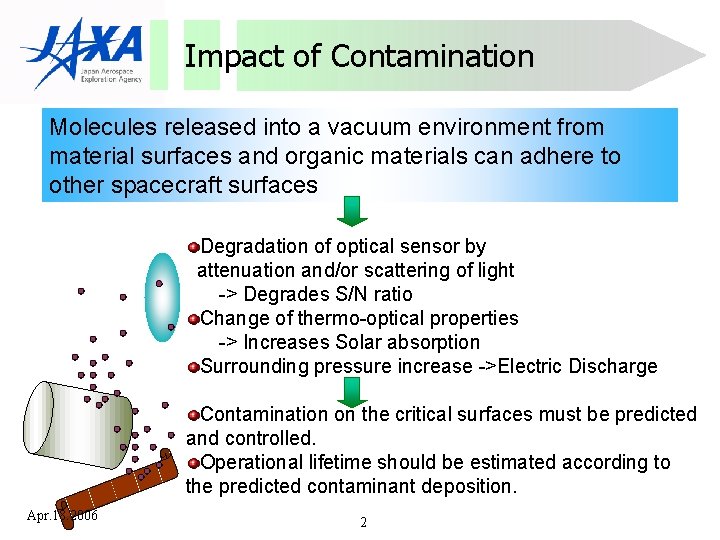
Impact of Contamination Molecules released into a vacuum environment from material surfaces and organic materials can adhere to other spacecraft surfaces Degradation of optical sensor by attenuation and/or scattering of light -> Degrades S/N ratio Change of thermo-optical properties -> Increases Solar absorption Surrounding pressure increase ->Electric Discharge Contamination on the critical surfaces must be predicted and controlled. Operational lifetime should be estimated according to the predicted contaminant deposition. Apr. 18. 2006 2
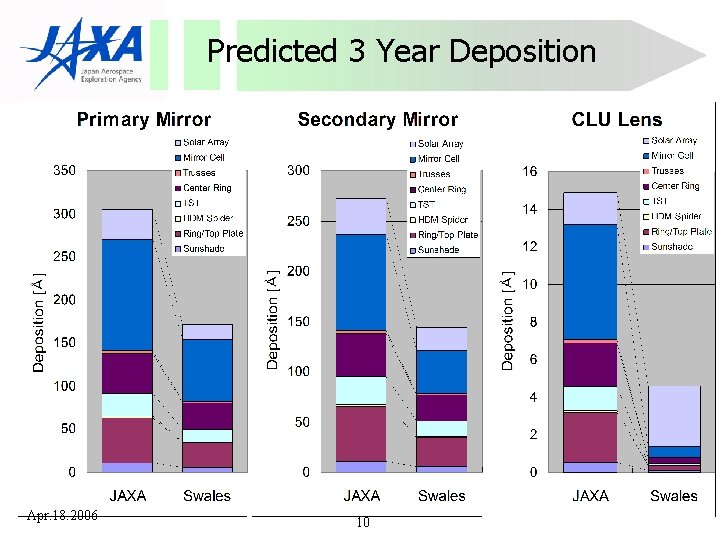
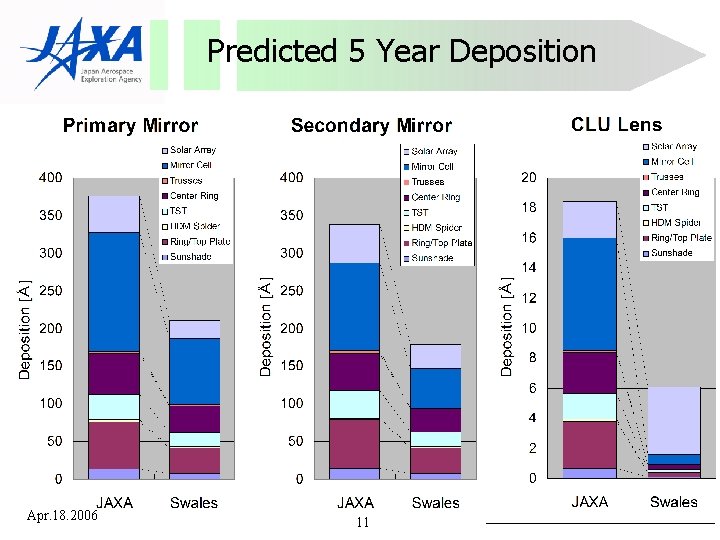
OTA Contamination Control Requirement Significant heat flux enter the Sun pointing OTA. Excessive absorbed solar energy introduces deformation of the mirror. Therefore, Solar Absorptance of critical surfaces must be controlled under a certain level. Contamination control during ground process Material Selection Cleanliness control Vacuum bakeout End of life contamination budget: 200~ 300Å Contaminant deposition to be predicted analytically. Target outgassing rates of OTA components were distributed according to the contamination budget. Additional vacuum bakeout of components were performed from the analysis results. Apr. 18. 2006 3
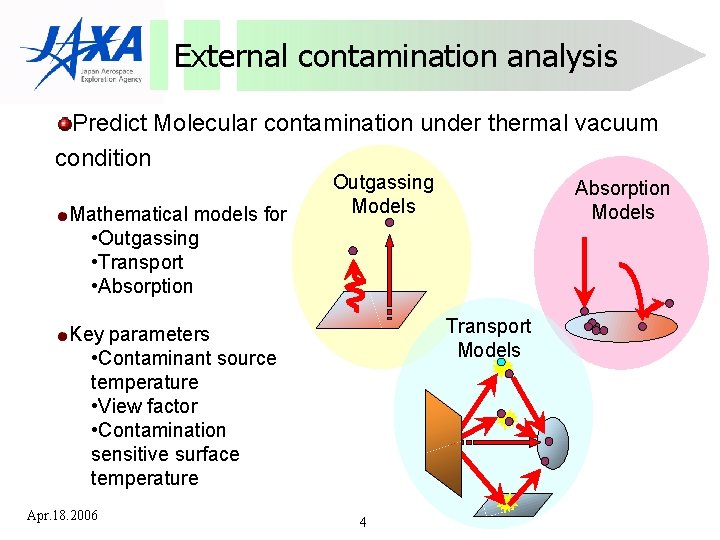
External contamination analysis Predict Molecular contamination under thermal vacuum condition Mathematical models for • Outgassing • Transport • Absorption Outgassing Models Transport Models Key parameters • Contaminant source temperature • View factor • Contamination sensitive surface temperature Apr. 18. 2006 Absorption Models 4
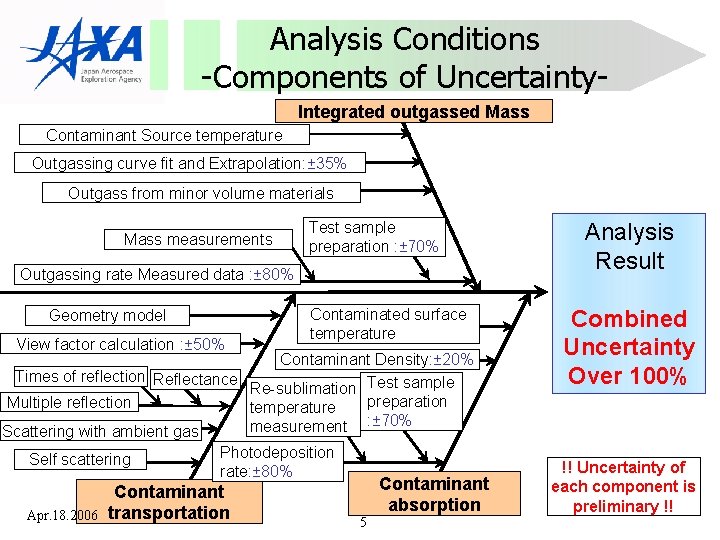
Analysis Conditions -Components of Uncertainty. Integrated outgassed Mass Contaminant Source temperature Outgassing curve fit and Extrapolation: ± 35% Outgass from minor volume materials Mass measurements Test sample preparation : ± 70% Outgassing rate Measured data : ± 80% Geometry model View factor calculation : ± 50% Contaminated surface temperature Contaminant Density: ± 20% Times of reflection Reflectance Re-sublimation Test sample preparation Multiple reflection temperature measurement : ± 70% Scattering with ambient gas Photodeposition Self scattering rate: ± 80% Apr. 18. 2006 Contaminant transportation 5 Contaminant absorption Analysis Result Combined Uncertainty Over 100% !! Uncertainty of each component is preliminary !!
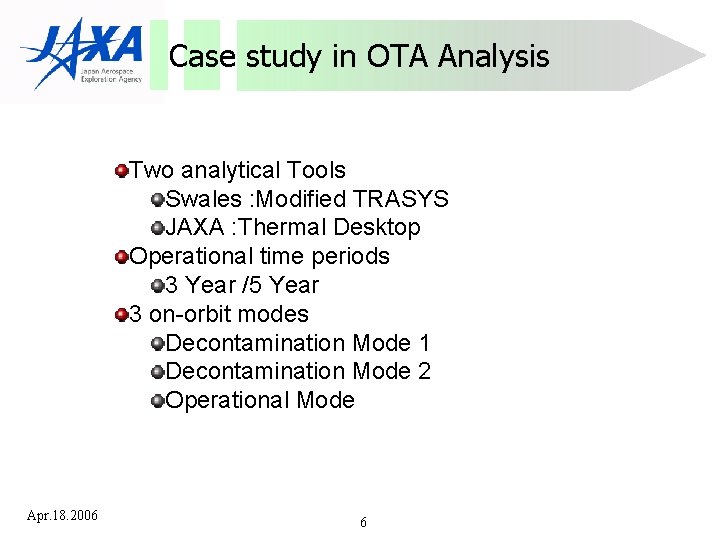
Case study in OTA Analysis Two analytical Tools Swales : Modified TRASYS JAXA : Thermal Desktop Operational time periods 3 Year /5 Year 3 on-orbit modes Decontamination Mode 1 Decontamination Mode 2 Operational Mode Apr. 18. 2006 6
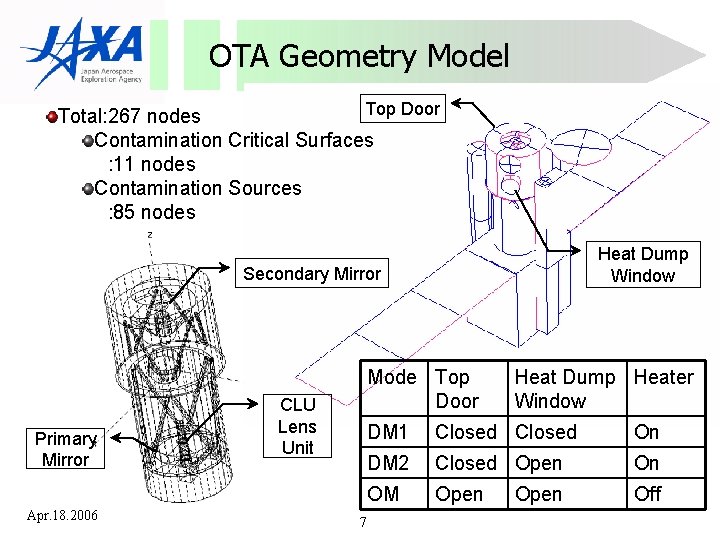
OTA Geometry Model Top Door Total: 267 nodes Contamination Critical Surfaces : 11 nodes Contamination Sources : 85 nodes Heat Dump Window Secondary Mirror Primary Mirror Apr. 18. 2006 Mode Top Door CLU Lens Unit 7 Heat Dump Heater Window DM 1 Closed On DM 2 Closed Open On OM Open Off Open
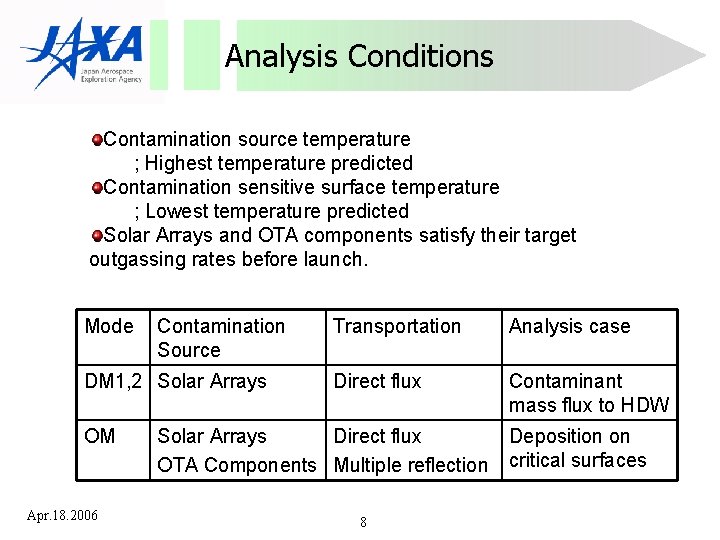
Analysis Conditions Contamination source temperature ; Highest temperature predicted Contamination sensitive surface temperature ; Lowest temperature predicted Solar Arrays and OTA components satisfy their target outgassing rates before launch. Mode Contamination Source DM 1, 2 Solar Arrays OM Apr. 18. 2006 Transportation Analysis case Direct flux Contaminant mass flux to HDW Solar Arrays Direct flux OTA Components Multiple reflection 8 Deposition on critical surfaces
![Analysis Results -Decontamination Mode. Predicted mass flux [g/cm 2/sec] Solar Array to HDW DM](http://slidetodoc.com/presentation_image/ae181c261b1f325ffece8a4c0e7faee7/image-9.jpg "Analysis Results -Decontamination Mode. Predicted mass flux [g/cm 2/sec] Solar Array to HDW DM")
Analysis Results -Decontamination Mode. Predicted mass flux [g/cm 2/sec] Solar Array to HDW DM 1 JAXA DM 2 Swales JAXA Swales 2. 27 E-12 6. 57 E-13 6. 0 E-13 -Operational Mode. Predicted Deposition [Å] JAXA 5 Year Swales JAXA Swales Primary Mirror 304. 4 171. 5 376 211. 2 Secondary Mirror 272. 8 8. 6 to 144 337. 9 10. 6 to 178. 9 18. 4 6. 1 CLU Lens Apr. 18. 2006 3 Year 14. 9 4. 6 9
Predicted 3 Year Deposition Apr. 18. 2006 10
Predicted 5 Year Deposition Apr. 18. 2006 11
Limit of analytical prediction The molecules contamination process is affected by many more factors. Crosslinking and Coloration induced by ultraviolet (UV) radiation Si. O 2 production by atomic oxygen (AO) and siloxane Erosion by AO Only a part of parameters are now considered in analysis. The parameters have synergy effect each other. Samples contaminated on-orbit are barely observed. Hard to establish correlation with true value Because. . True Value is NEVER available Apr. 18. 2006 12
Conclusion OTA is appropriately designed to perform required contamination control. Case studies with two analytical tools produced the results of wide variety. In some analytical cases, the predicted deposition exceeded the end of life contamination budget. Analysis results have significant uncertainty. The operational life estimation should be verified using data obtained on-orbit operation to reduce uncertainty. Apr. 18. 2006 13
- Slides: 13