
Containment Container Spatial Location and Containee Models SOCo
- Slides: 11
Containment, Container, Spatial Location and Containee Models SOCo. P 2012 Workshop Gary Berg-Cross Nov. 29 -30, 2012 U. S. Geological Survey National Center 12201 Sunrise Valley Dr. , Reston VA 1 SOCo. P 2012 Workshop
Originations of Topic • The idea of Container as a suitable design pattern (ODP) has been suggested by Werner Kuhn an discussed with Todd Pehle at the UCSB Vo. Camp – Todd & Gary Berg-Cross proposed following this up at this workshop • A general container pattern might serve as a foundation for discussing surface water etc. which might specialize it for useful purposes – A start is has been made by a series of exchanges between Gary, Werner and Torsten Hahmann (U of Toronto) along with input from Todd Pehle 2 SOCo. P 2012 Workshop
Strategy • Review and revise the “starter pattern” for container • Explore lightweight approach that might develop relevant vocabularies that can be modeled and formalized. – Leverage existing work such as Werner Kuhn of Contaiment, Torsten Hahmann’s on water containment and spatial relations – Hopefully this will interest enough people for 1 day’s worth of work on the topic and more if there is an interest. – Plan on following this work up and building on it in a subsequent workshop. 3 SOCo. P 2012 Workshop
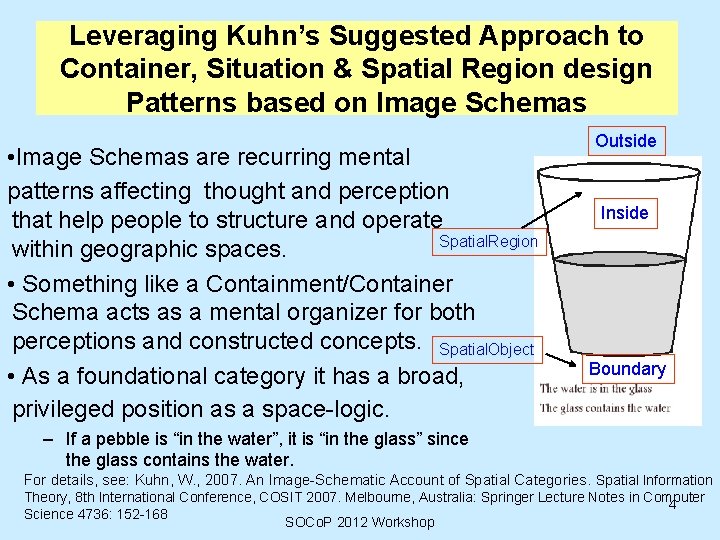
Leveraging Kuhn’s Suggested Approach to Container, Situation & Spatial Region design Patterns based on Image Schemas • Image Schemas are recurring mental patterns affecting thought and perception that help people to structure and operate Spatial. Region within geographic spaces. • Something like a Containment/Container Schema acts as a mental organizer for both perceptions and constructed concepts. Spatial. Object • As a foundational category it has a broad, privileged position as a space-logic. Outside Inside Boundary – If a pebble is “in the water”, it is “in the glass” since the glass contains the water. For details, see: Kuhn, W. , 2007. An Image-Schematic Account of Spatial Categories. Spatial Information Theory, 8 th International Conference, COSIT 2007. Melbourne, Australia: Springer Lecture Notes in Computer 4 Science 4736: 152 -168 SOCo. P 2012 Workshop
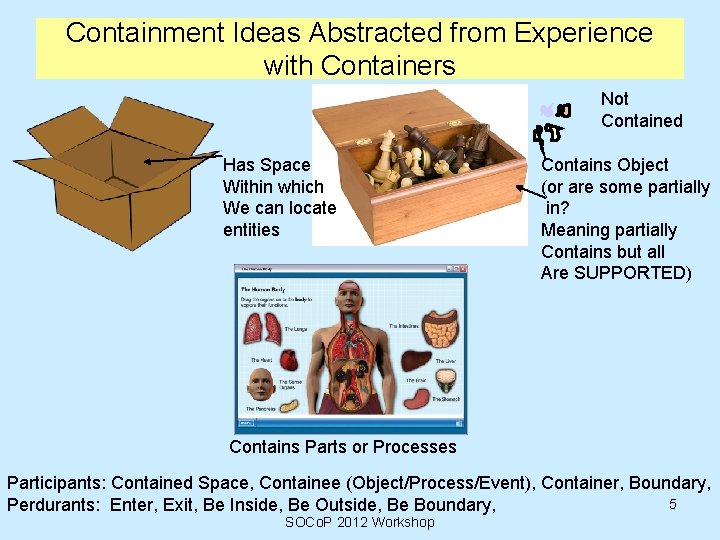
Containment Ideas Abstracted from Experience with Containers Not Contained Has Space Within which We can locate entities Contains Object (or are some partially in? Meaning partially Contains but all Are SUPPORTED) Contains Parts or Processes Participants: Contained Space, Containee (Object/Process/Event), Container, Boundary, 5 Perdurants: Enter, Exit, Be Inside, Be Outside, Be Boundary, SOCo. P 2012 Workshop
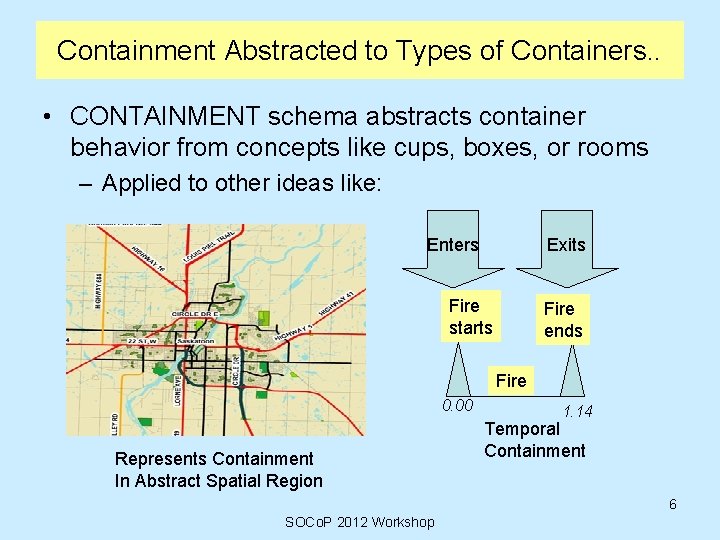
Containment Abstracted to Types of Containers. . • CONTAINMENT schema abstracts container behavior from concepts like cups, boxes, or rooms – Applied to other ideas like: Enters Exits Fire starts Fire ends Fire 0. 00 Represents Containment In Abstract Spatial Region 1. 14 Temporal Containment 6 SOCo. P 2012 Workshop
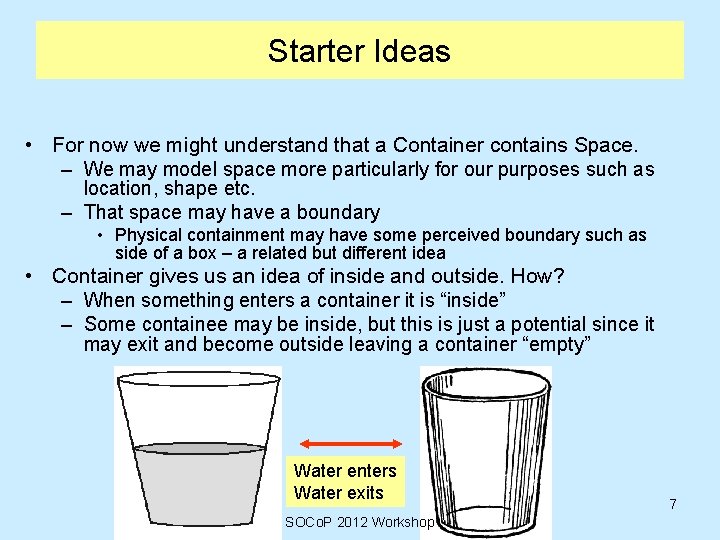
Starter Ideas • For now we might understand that a Container contains Space. – We may model space more particularly for our purposes such as location, shape etc. – That space may have a boundary • Physical containment may have some perceived boundary such as side of a box – a related but different idea • Container gives us an idea of inside and outside. How? – When something enters a container it is “inside” – Some containee may be inside, but this is just a potential since it may exit and become outside leaving a container “empty” Water enters Water exits SOCo. P 2012 Workshop 7
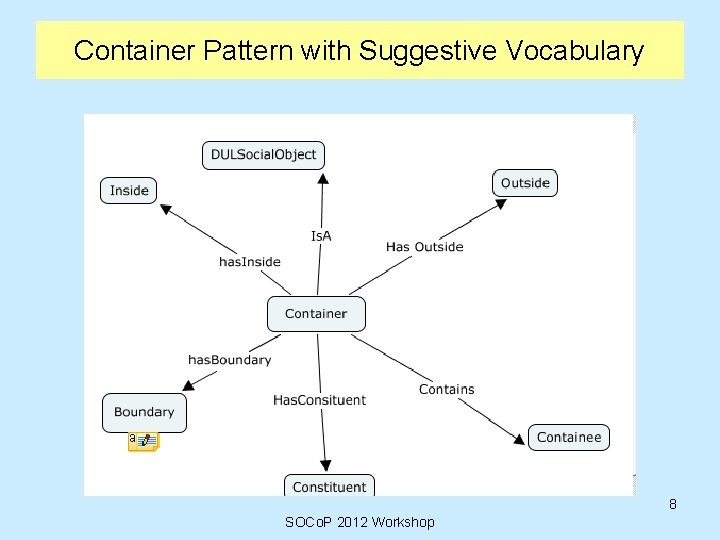
Container Pattern with Suggestive Vocabulary 8 SOCo. P 2012 Workshop
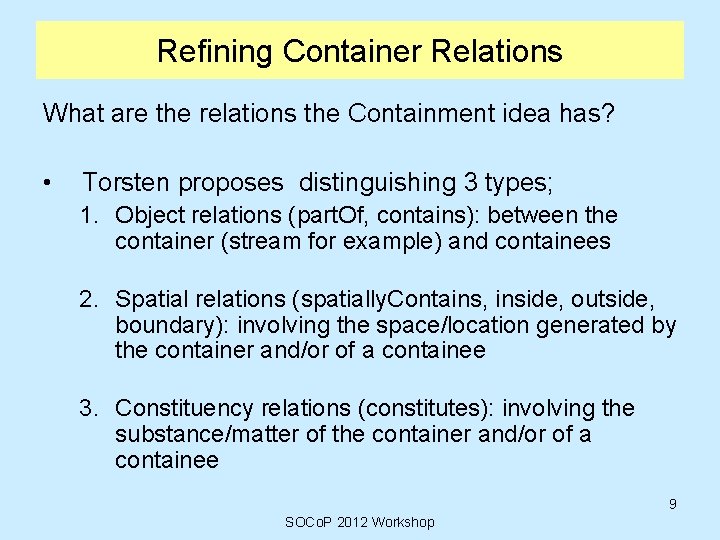
Refining Container Relations What are the relations the Containment idea has? • Torsten proposes distinguishing 3 types; 1. Object relations (part. Of, contains): between the container (stream for example) and containees 2. Spatial relations (spatially. Contains, inside, outside, boundary): involving the space/location generated by the container and/or of a containee 3. Constituency relations (constitutes): involving the substance/matter of the container and/or of a containee 9 SOCo. P 2012 Workshop
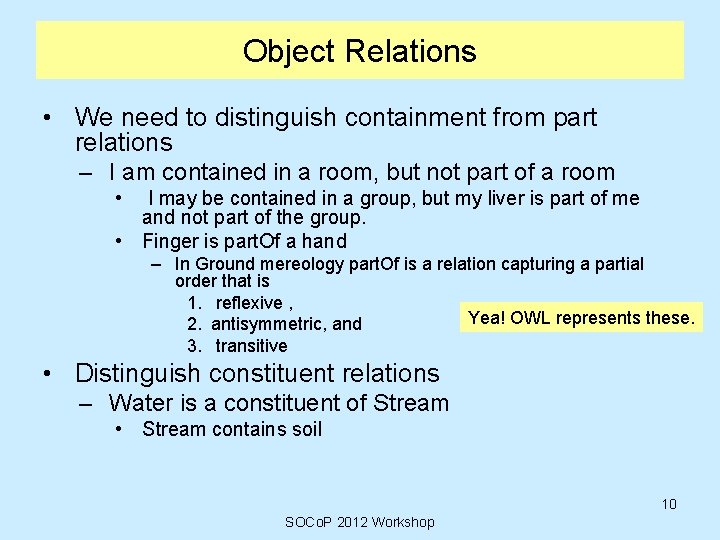
Object Relations • We need to distinguish containment from part relations – I am contained in a room, but not part of a room • I may be contained in a group, but my liver is part of me and not part of the group. • Finger is part. Of a hand – In Ground mereology part. Of is a relation capturing a partial order that is 1. reflexive , Yea! OWL represents these. 2. antisymmetric, and 3. transitive • Distinguish constituent relations – Water is a constituent of Stream • Stream contains soil 10 SOCo. P 2012 Workshop
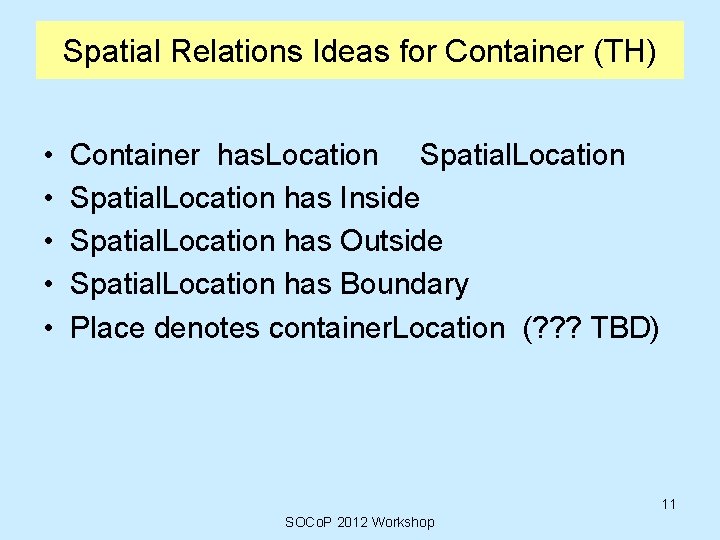
Spatial Relations Ideas for Container (TH) • • • Container has. Location Spatial. Location has Inside Spatial. Location has Outside Spatial. Location has Boundary Place denotes container. Location (? ? ? TBD) 11 SOCo. P 2012 Workshop