
Contact Mechanics Maria Persson Gulda Kathleen Di Santo











- Slides: 18
Contact Mechanics Maria Persson Gulda Kathleen Di. Santo
Outline ¡ ¡ ¡ ¡ What is Contact Mechanics? The two different kind of contacts. Boussinesq and Cerruti Potential Functions The specific case of an Applied Normal Force Hertz Equations- Derivation, Assumptions Rigid Sphere Contacting a Deformable Plate Deformable Sphere Contacting a Rigid Plate
What is Contact Mechanics? “[The theory of contact mechanics] is concerned with the stresses and deformation which arise when the surfaces of two solid bodies are brought into contact. ” Professor Johnsson
Two kinds of contact ¡ Conforming contacts l ¡ The two surfaces fit exactly or closely together without deformation Non-conforming contact l The surfaces, or one of the two surfaces, deforms when there is a contact area in between them.
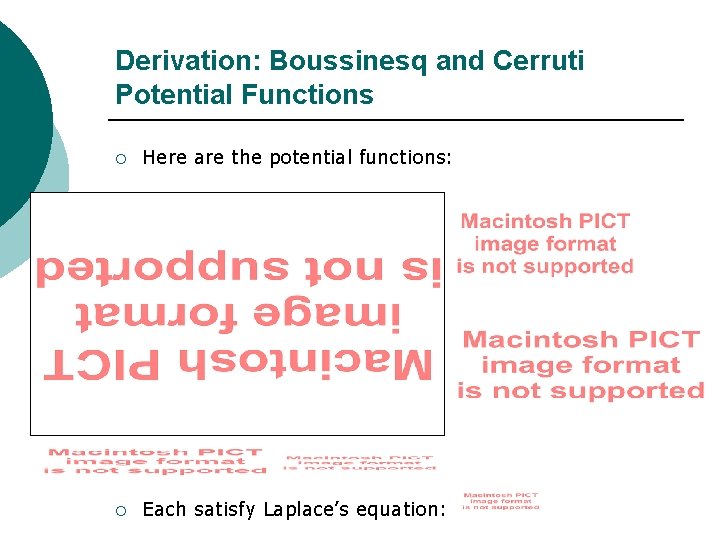
Derivation: Boussinesq and Cerruti Potential Functions ¡ Here are the potential functions: ¡ Each satisfy Laplace’s equation:
Special Case: Applied Pressure Only ¡ The potential functions are reduced as follows: ¡ Displacement equations: ¡ By Hooke’s Law, the stresses are:
Concentrated Normal Force on an Elastic Half Space ¡ The displacements are: ¡ The stresses in polar coordinates:
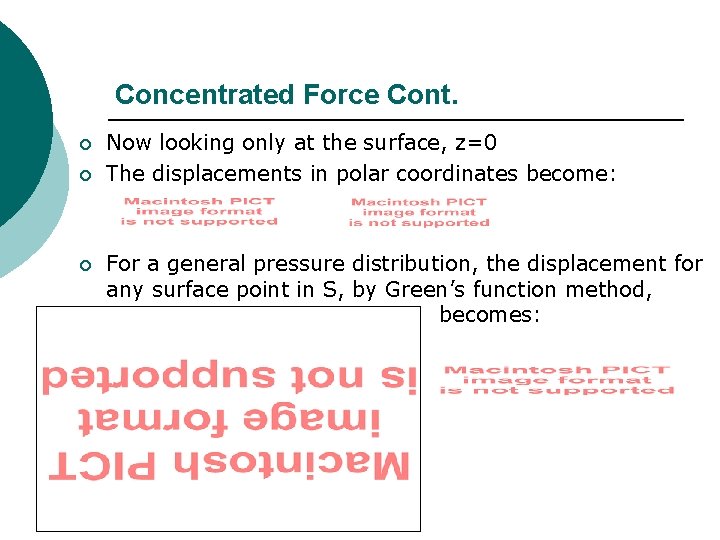
Concentrated Force Cont. ¡ ¡ ¡ Now looking only at the surface, z=0 The displacements in polar coordinates become: For a general pressure distribution, the displacement for any surface point in S, by Green’s function method, becomes:
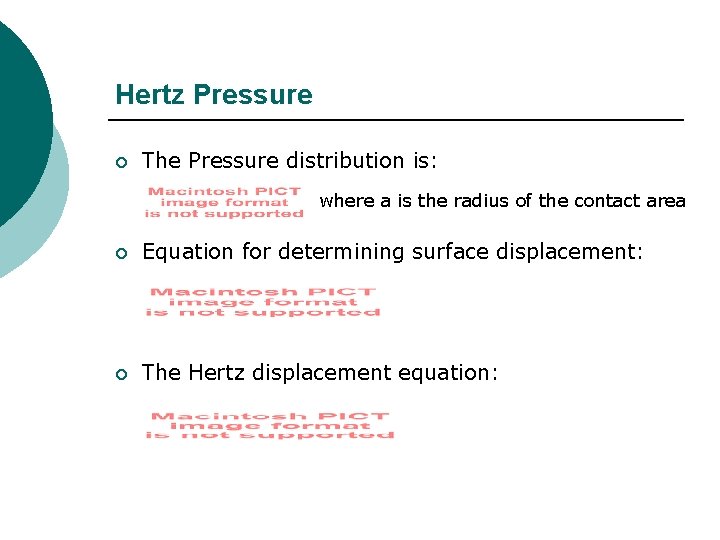
Hertz Pressure ¡ The Pressure distribution is: where a is the radius of the contact area ¡ Equation for determining surface displacement: ¡ The Hertz displacement equation:
Hertz Theory of Elastic Contact ¡ Assumptions: l The radii of curvature of the contacting bodies are large compared with the radius of the circle of contact. l The dimensions of each body are large compared to the radius of the circle of contact. l The contacting bodies are in frictionless contact. l The surfaces in contact are continuous and nonconforming.
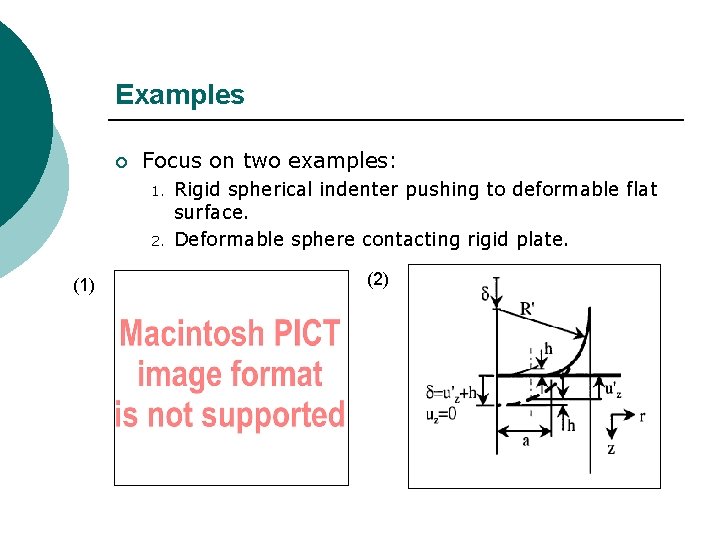
Examples ¡ Focus on two examples: 1. 2. (1) Rigid spherical indenter pushing to deformable flat surface. Deformable sphere contacting rigid plate. (2)
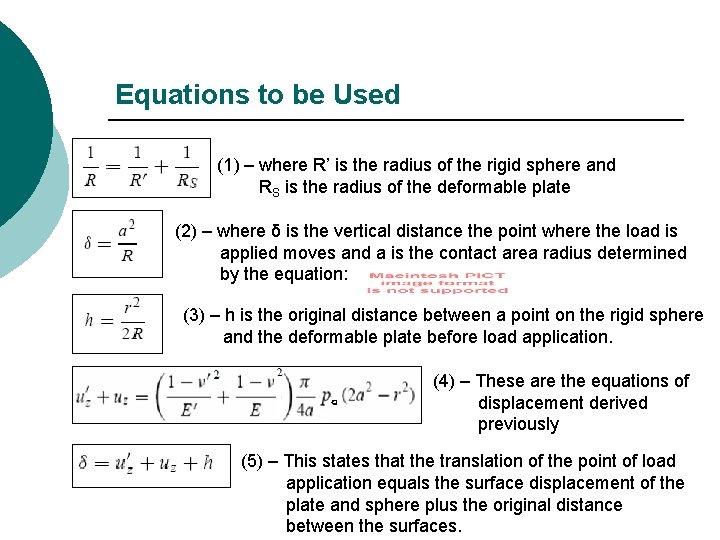
Equations to be Used (1) – where R’ is the radius of the rigid sphere and RS is the radius of the deformable plate (2) – where δ is the vertical distance the point where the load is applied moves and a is the contact area radius determined by the equation: (3) – h is the original distance between a point on the rigid sphere and the deformable plate before load application. (4) – These are the equations of displacement derived previously (5) – This states that the translation of the point of load application equals the surface displacement of the plate and sphere plus the original distance between the surfaces.
Rigid Sphere Contacting Deformable Flat Contact Radius: 11. 995 mm Surface with Abaqus Theoretical Abaqus Contact Radius: 11. 6 mm Error: 3%
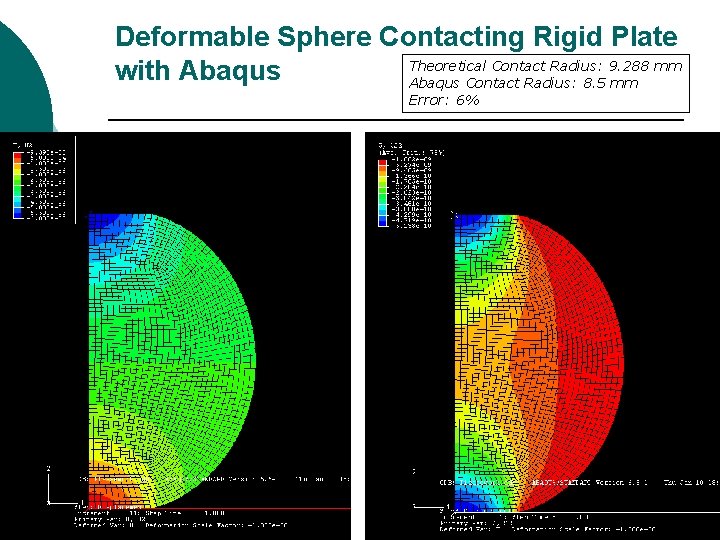
Deformable Sphere Contacting Rigid Plate Theoretical Contact Radius: 9. 288 mm with Abaqus Contact Radius: 8. 5 mm Error: 6%
Conclusion ¡ ¡ Contact problems in general are very complicated to model numerically and theoretically Other factors l l Friction - rough surfaces Blunt edges, sharp corners Sliding and rolling contact Dynamic impact
A Special Thank You To: Dr. Ashkan Vaziri ¡ Professor James Rice ¡
References ¡ ¡ ¡ Johnson, K. L. Contact Mechanics, Cambridge: Cambridge University Press; 1985 Fisher-Cripps, A. C. The Hertzian contact surface. J. Materials Science. 1999; 34: 129 -137 Kogut, L. , Etsion, I. Elastic-Plastic Contact Analysis of a Sphere and a Rigid Flat. J. of Applied Mechanics. 2002; 69: 657 -662 Johnson, K. L. , Greenwood, J. A. An Adhesion Map for the contact of elastic Spheres. J. of Colloid and Interface Science. 1997; 192: 326 -333 Barber, J. R. , Clavarella, M. Contact mechanics. Inter. J. of Solids and Structures. 2000; 37: 29 -43
Any Questions?