
Contact Information Design of a device to assist
- Slides: 1
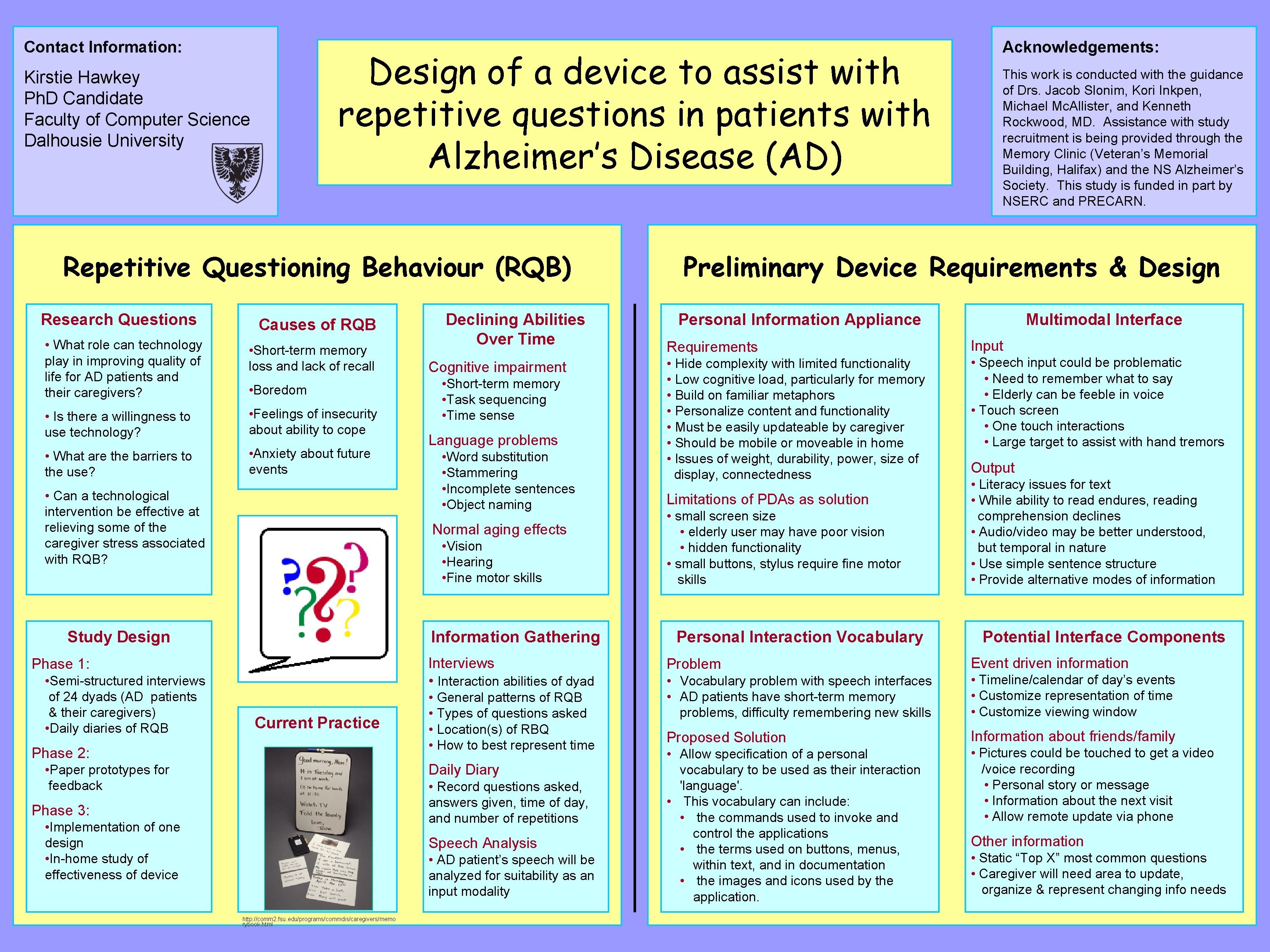
Contact Information: Design of a device to assist with repetitive questions in patients with Alzheimer’s Disease (AD) Kirstie Hawkey Ph. D Candidate Faculty of Computer Science Dalhousie University hawkey@cs. dal. ca Repetitive Questioning Behaviour (RQB) Research Questions Causes of RQB • What role can technology play in improving quality of life for AD patients and their caregivers? • Short-term memory loss and lack of recall • Is there a willingness to use technology? • Feelings of insecurity about ability to cope • What are the barriers to the use? • Anxiety about future events • Boredom • Can a technological intervention be effective at relieving some of the caregiver stress associated with RQB? Cognitive impairment • Short-term memory • Task sequencing • Time sense Language problems • Word substitution • Stammering • Incomplete sentences • Object naming Normal aging effects • Vision • Hearing • Fine motor skills Study Design Information Gathering Interviews • Interaction abilities of dyad Phase 1: • Semi-structured interviews of 24 dyads (AD patients & their caregivers) • Daily diaries of RQB Declining Abilities Over Time Current Practice Phase 2: • General patterns of RQB • Types of questions asked • Location(s) of RBQ • How to best represent time Daily Diary • Paper prototypes for feedback • Record questions asked, answers given, time of day, and number of repetitions Phase 3: • Implementation of one design • In-home study of effectiveness of device Speech Analysis • AD patient’s speech will be analyzed for suitability as an input modality http: //comm 2. fsu. edu/programs/commdis/caregivers/memo rybook. html Acknowledgements: This work is conducted with the guidance of Drs. Jacob Slonim, Kori Inkpen, Michael Mc. Allister, and Kenneth Rockwood, MD. Assistance with study recruitment is being provided through the Memory Clinic (Veteran’s Memorial Building, Halifax) and the NS Alzheimer’s Society. This study is funded in part by NSERC and PRECARN. Preliminary Device Requirements & Design Personal Information Appliance Multimodal Interface Requirements Input • Hide complexity with limited functionality • Low cognitive load, particularly for memory • Build on familiar metaphors • Personalize content and functionality • Must be easily updateable by caregiver • Should be mobile or moveable in home • Issues of weight, durability, power, size of display, connectedness • Speech input could be problematic • Need to remember what to say • Elderly can be feeble in voice • Touch screen • One touch interactions • Large target to assist with hand tremors Limitations of PDAs as solution • small screen size • elderly user may have poor vision • hidden functionality • small buttons, stylus require fine motor skills Personal Interaction Vocabulary Output • Literacy issues for text • While ability to read endures, reading comprehension declines • Audio/video may be better understood, but temporal in nature • Use simple sentence structure • Provide alternative modes of information Potential Interface Components Problem Event driven information • Vocabulary problem with speech interfaces • AD patients have short-term memory problems, difficulty remembering new skills • Timeline/calendar of day’s events • Customize representation of time • Customize viewing window Proposed Solution Information about friends/family • Allow specification of a personal vocabulary to be used as their interaction 'language'. • This vocabulary can include: • the commands used to invoke and control the applications • the terms used on buttons, menus, within text, and in documentation • the images and icons used by the application. • Pictures could be touched to get a video /voice recording • Personal story or message • Information about the next visit • Allow remote update via phone Other information • Static “Top X” most common questions • Caregiver will need area to update, organize & represent changing info needs