
CONTACT EDGE ROUGHNESS IN THE ETCHING OF HIGH

- Slides: 19
CONTACT EDGE ROUGHNESS IN THE ETCHING OF HIGH ASPECT RATIO CONTACTS IN Si. O 2* Shuo Huang, Chad Huard and Mark J. Kushner University of Michigan, Ann Arbor, MI 48109, USA shuoh@umich. edu, chuard@umich. edu, mjkush@umich. edu Seungbo Shim, Sangheon Lee, In-Cheol Song and Siqing Lu Samsung Electronics Co. , Republic of Korea seungb. shim@samsung. com, s 2009. lee@samsung. com, ic 13. song@samsung. com, siqing. lu@samsung. com The 44 th International Conference on Plasma Science, Atlantic City, New Jersey, USA 21 -25 May 2017 * Work supported by Samsung Electronics Co. , DOE Fusion Energy Science and National Science Foundation.
AGENDA · High aspect ratio contacts (HARCs) in Si. O 2 · Contact edge roughness (CER) · Monte Carlo feature profile model (MCFPM) · Reaction mechanism of Si. O 2 etching by Ar/C 4 F 8/O 2 · 3 D profile simulation of HARC etching in Si. O 2 · Single HARC: scalloped, convex and elliptic · Multiple HARCs: rectilinear and honeycomb · Concluding remarks ICOPS_2017_S. Huang University of Michigan Institute for Plasma Science & Engr.
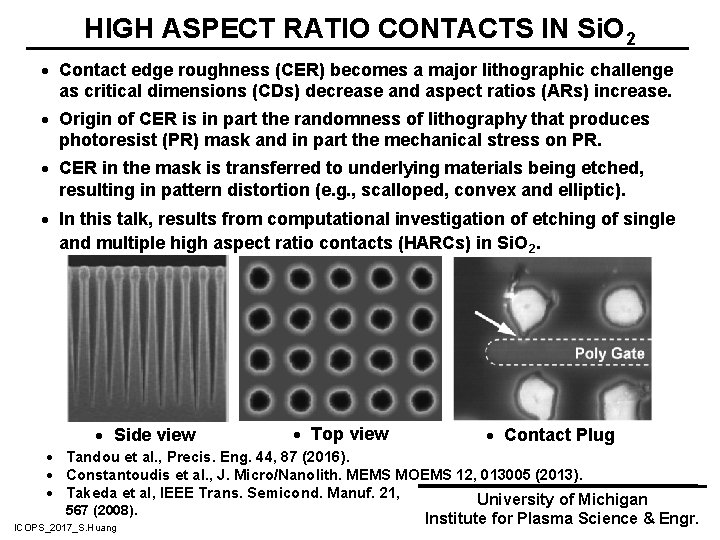
HIGH ASPECT RATIO CONTACTS IN Si. O 2 · Contact edge roughness (CER) becomes a major lithographic challenge as critical dimensions (CDs) decrease and aspect ratios (ARs) increase. · Origin of CER is in part the randomness of lithography that produces photoresist (PR) mask and in part the mechanical stress on PR. · CER in the mask is transferred to underlying materials being etched, resulting in pattern distortion (e. g. , scalloped, convex and elliptic). · In this talk, results from computational investigation of etching of single and multiple high aspect ratio contacts (HARCs) in Si. O 2. · Side view · Top view · Contact Plug · Tandou et al. , Precis. Eng. 44, 87 (2016). · Constantoudis et al. , J. Micro/Nanolith. MEMS MOEMS 12, 013005 (2013). · Takeda et al, IEEE Trans. Semicond. Manuf. 21, University of Michigan 567 (2008). ICOPS_2017_S. Huang Institute for Plasma Science & Engr.
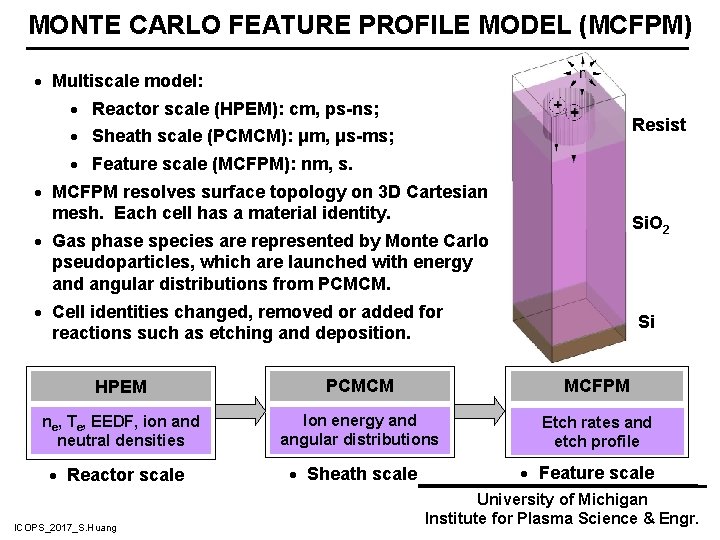
MONTE CARLO FEATURE PROFILE MODEL (MCFPM) · Multiscale model: · Reactor scale (HPEM): cm, ps-ns; · Sheath scale (PCMCM): μm, μs-ms; · Feature scale (MCFPM): nm, s. · MCFPM resolves surface topology on 3 D Cartesian mesh. Each cell has a material identity. · Gas phase species are represented by Monte Carlo pseudoparticles, which are launched with energy and angular distributions from PCMCM. · Cell identities changed, removed or added for reactions such as etching and deposition. Resist Si. O 2 Si HPEM PCMCM MCFPM ne, Te, EEDF, ion and neutral densities Ion energy and angular distributions Etch rates and etch profile · Reactor scale ICOPS_2017_S. Huang · Sheath scale · Feature scale University of Michigan Institute for Plasma Science & Engr.
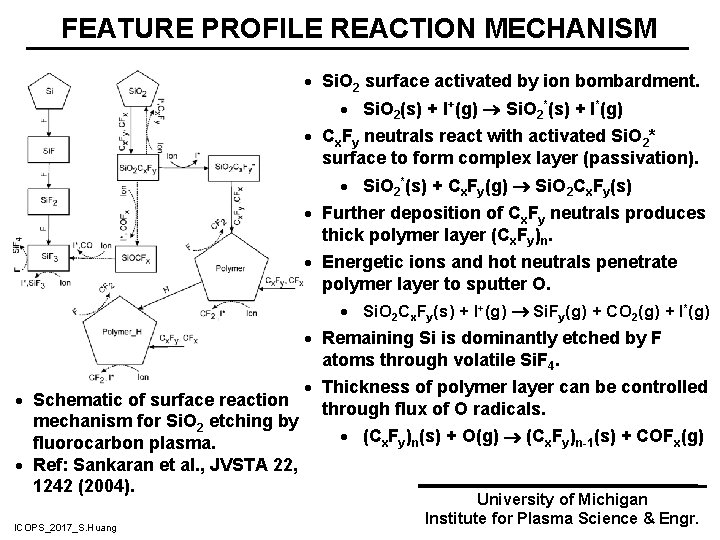
FEATURE PROFILE REACTION MECHANISM · Si. O 2 surface activated by ion bombardment. · Si. O 2(s) + I+(g) Si. O 2*(s) + I*(g) · Cx. Fy neutrals react with activated Si. O 2* surface to form complex layer (passivation). · Si. O 2*(s) + Cx. Fy(g) Si. O 2 Cx. Fy(s) · Further deposition of Cx. Fy neutrals produces thick polymer layer (Cx. Fy)n. · Energetic ions and hot neutrals penetrate polymer layer to sputter O. · Si. O 2 Cx. Fy(s) + I+(g) Si. Fy(g) + CO 2(g) + I*(g) · Remaining Si is dominantly etched by F atoms through volatile Si. F 4. · Thickness of polymer layer can be controlled · Schematic of surface reaction through flux of O radicals. mechanism for Si. O 2 etching by · (Cx. Fy)n(s) + O(g) (Cx. Fy)n-1(s) + COFx(g) fluorocarbon plasma. · Ref: Sankaran et al. , JVSTA 22, 1242 (2004). ICOPS_2017_S. Huang University of Michigan Institute for Plasma Science & Engr.
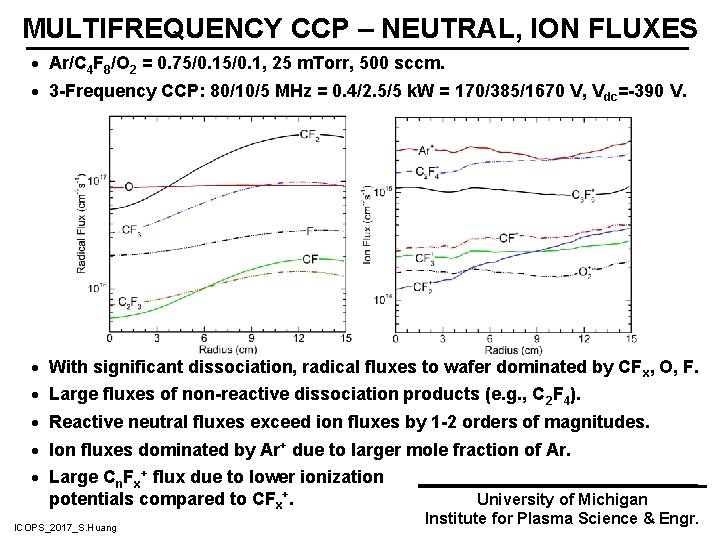
MULTIFREQUENCY CCP – NEUTRAL, ION FLUXES · Ar/C 4 F 8/O 2 = 0. 75/0. 1, 25 m. Torr, 500 sccm. · 3 -Frequency CCP: 80/10/5 MHz = 0. 4/2. 5/5 k. W = 170/385/1670 V, Vdc=-390 V. · · · With significant dissociation, radical fluxes to wafer dominated by CF x, O, F. Large fluxes of non-reactive dissociation products (e. g. , C 2 F 4). Reactive neutral fluxes exceed ion fluxes by 1 -2 orders of magnitudes. Ion fluxes dominated by Ar+ due to larger mole fraction of Ar. Large Cn. Fx+ flux due to lower ionization potentials compared to CFx+. ICOPS_2017_S. Huang University of Michigan Institute for Plasma Science & Engr.
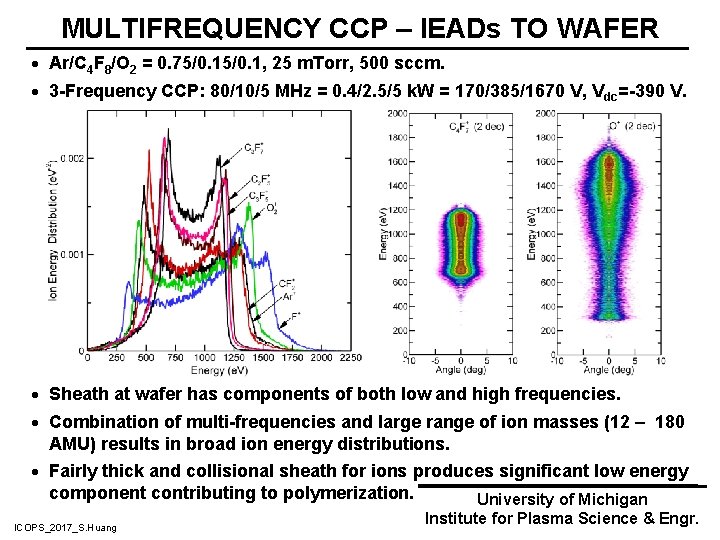
MULTIFREQUENCY CCP – IEADs TO WAFER · Ar/C 4 F 8/O 2 = 0. 75/0. 1, 25 m. Torr, 500 sccm. · 3 -Frequency CCP: 80/10/5 MHz = 0. 4/2. 5/5 k. W = 170/385/1670 V, Vdc=-390 V. · Sheath at wafer has components of both low and high frequencies. · Combination of multi-frequencies and large range of ion masses (12 – 180 AMU) results in broad ion energy distributions. · Fairly thick and collisional sheath for ions produces significant low energy component contributing to polymerization. University of Michigan ICOPS_2017_S. Huang Institute for Plasma Science & Engr.
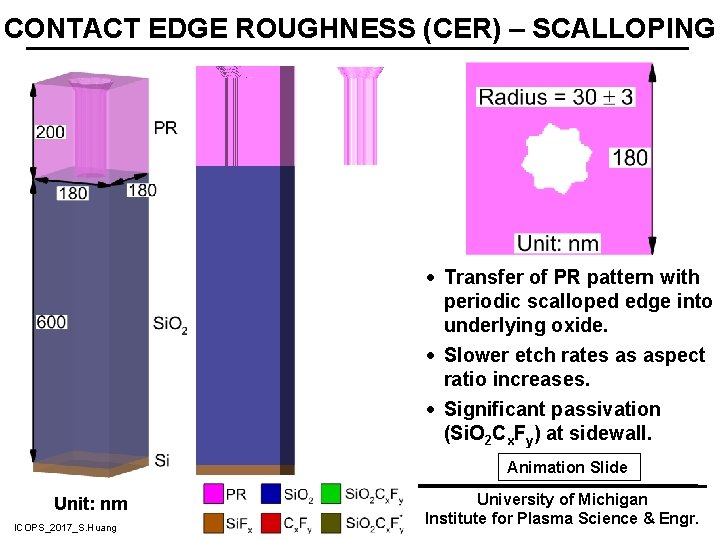
CONTACT EDGE ROUGHNESS (CER) – SCALLOPING · Transfer of PR pattern with periodic scalloped edge into underlying oxide. · Slower etch rates as aspect ratio increases. · Significant passivation (Si. O 2 Cx. Fy) at sidewall. Animation Slide Unit: nm ICOPS_2017_S. Huang University of Michigan Institute for Plasma Science & Engr.
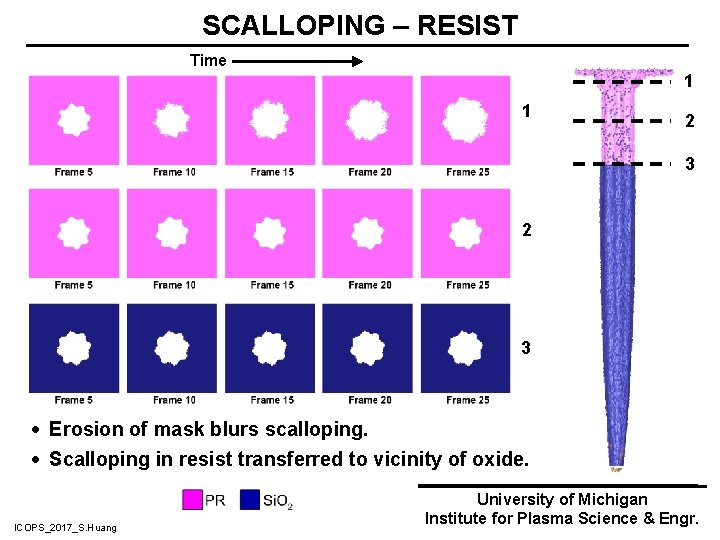
SCALLOPING – RESIST Time 1 1 2 3 · Erosion of mask blurs scalloping. · Scalloping in resist transferred to vicinity of oxide. ICOPS_2017_S. Huang University of Michigan Institute for Plasma Science & Engr.
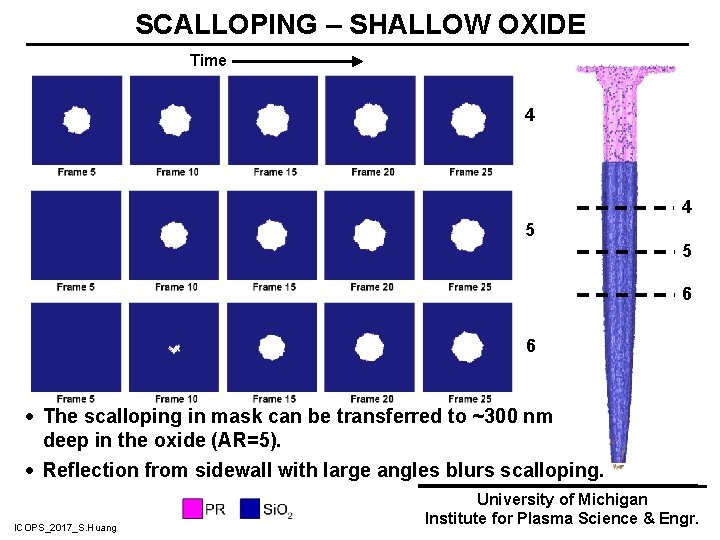
SCALLOPING – SHALLOW OXIDE Time 4 4 5 5 6 6 · The scalloping in mask can be transferred to ~300 nm deep in the oxide (AR=5). · Reflection from sidewall with large angles blurs scalloping. ICOPS_2017_S. Huang University of Michigan Institute for Plasma Science & Engr.
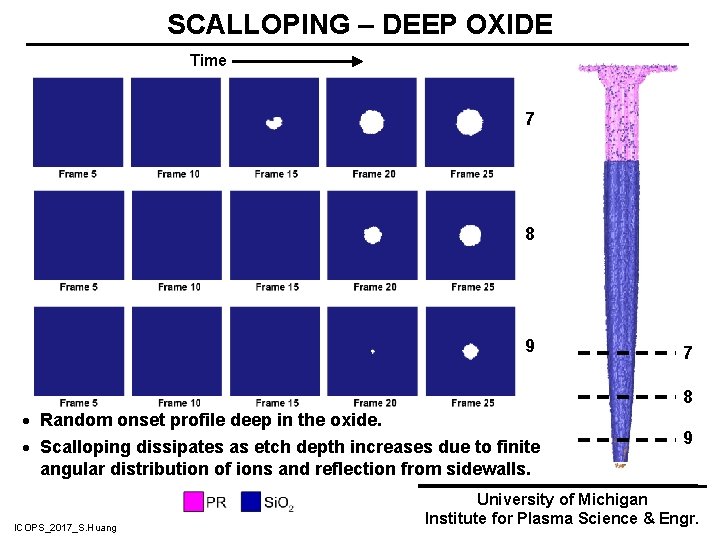
SCALLOPING – DEEP OXIDE Time 7 8 9 · Random onset profile deep in the oxide. · Scalloping dissipates as etch depth increases due to finite angular distribution of ions and reflection from sidewalls. ICOPS_2017_S. Huang 7 8 9 University of Michigan Institute for Plasma Science & Engr.
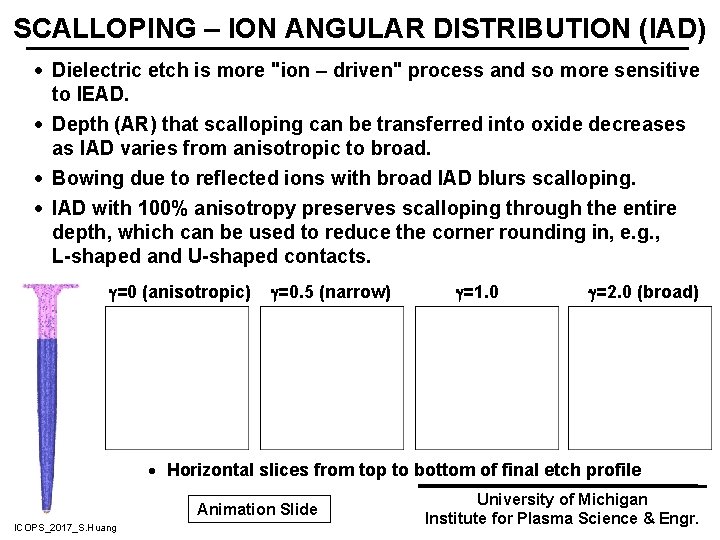
SCALLOPING – ION ANGULAR DISTRIBUTION (IAD) · Dielectric etch is more "ion – driven" process and so more sensitive to IEAD. · Depth (AR) that scalloping can be transferred into oxide decreases as IAD varies from anisotropic to broad. · Bowing due to reflected ions with broad IAD blurs scalloping. · IAD with 100% anisotropy preserves scalloping through the entire depth, which can be used to reduce the corner rounding in, e. g. , L-shaped and U-shaped contacts. =0 (anisotropic) =0. 5 (narrow) =1. 0 =2. 0 (broad) · Horizontal slices from top to bottom of final etch profile Animation Slide ICOPS_2017_S. Huang University of Michigan Institute for Plasma Science & Engr.
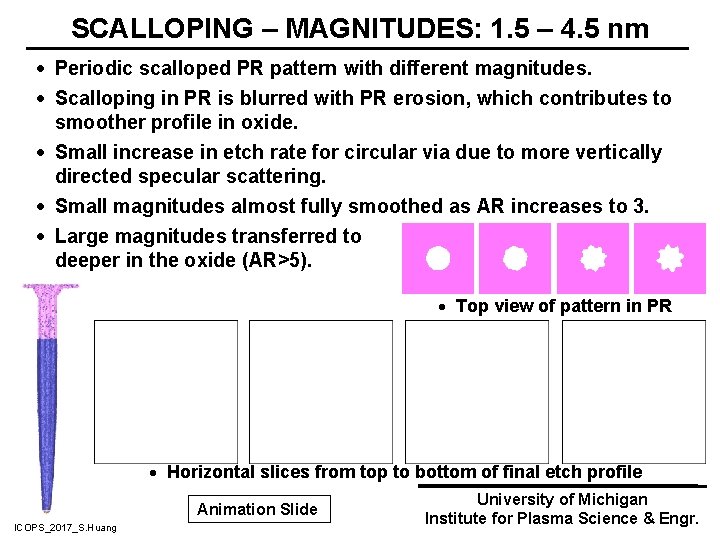
SCALLOPING – MAGNITUDES: 1. 5 – 4. 5 nm · Periodic scalloped PR pattern with different magnitudes. · Scalloping in PR is blurred with PR erosion, which contributes to smoother profile in oxide. · Small increase in etch rate for circular via due to more vertically directed specular scattering. · Small magnitudes almost fully smoothed as AR increases to 3. · Large magnitudes transferred to deeper in the oxide (AR>5). · Top view of pattern in PR · Horizontal slices from top to bottom of final etch profile Animation Slide ICOPS_2017_S. Huang University of Michigan Institute for Plasma Science & Engr.
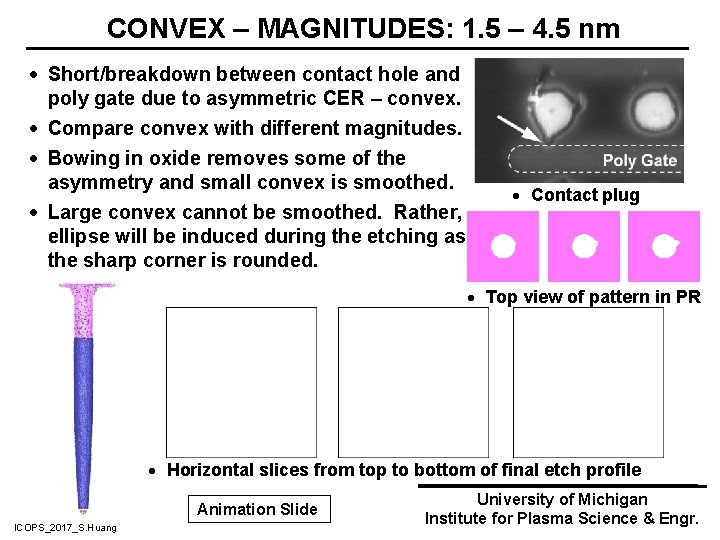
CONVEX – MAGNITUDES: 1. 5 – 4. 5 nm · Short/breakdown between contact hole and poly gate due to asymmetric CER – convex. · Compare convex with different magnitudes. · Bowing in oxide removes some of the asymmetry and small convex is smoothed. · Large convex cannot be smoothed. Rather, ellipse will be induced during the etching as the sharp corner is rounded. · Contact plug · Top view of pattern in PR · Horizontal slices from top to bottom of final etch profile Animation Slide ICOPS_2017_S. Huang University of Michigan Institute for Plasma Science & Engr.
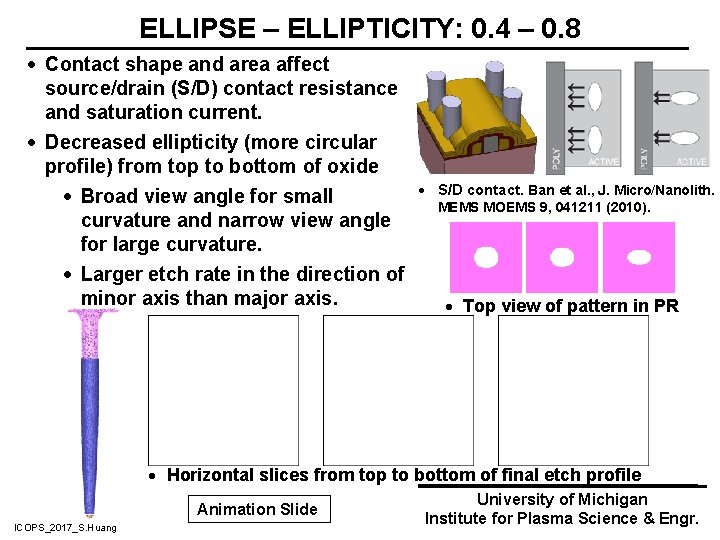
ELLIPSE – ELLIPTICITY: 0. 4 – 0. 8 · Contact shape and area affect source/drain (S/D) contact resistance and saturation current. · Decreased ellipticity (more circular profile) from top to bottom of oxide · Broad view angle for small curvature and narrow view angle for large curvature. · Larger etch rate in the direction of minor axis than major axis. · S/D contact. Ban et al. , J. Micro/Nanolith. MEMS MOEMS 9, 041211 (2010). · Top view of pattern in PR · Horizontal slices from top to bottom of final etch profile Animation Slide ICOPS_2017_S. Huang University of Michigan Institute for Plasma Science & Engr.
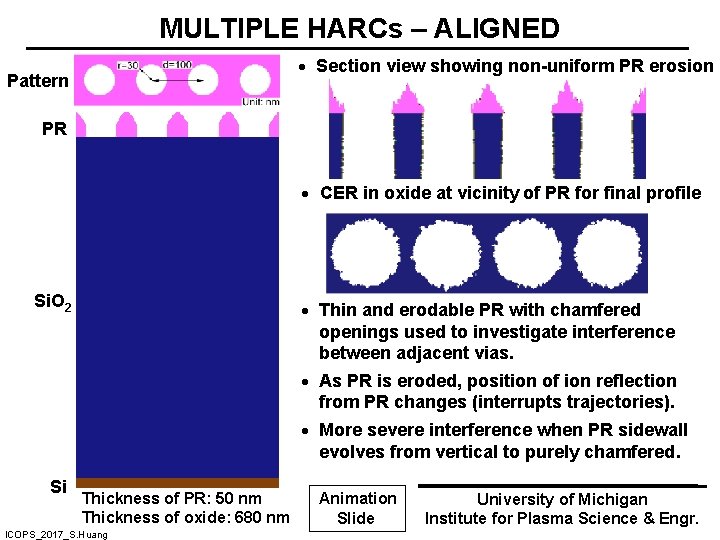
MULTIPLE HARCs – ALIGNED · Section view showing non-uniform PR erosion Pattern PR · CER in oxide at vicinity of PR for final profile Si. O 2 Si · Thin and erodable PR with chamfered openings used to investigate interference between adjacent vias. · As PR is eroded, position of ion reflection from PR changes (interrupts trajectories). · More severe interference when PR sidewall evolves from vertical to purely chamfered. Thickness of PR: 50 nm Thickness of oxide: 680 nm ICOPS_2017_S. Huang Animation Slide University of Michigan Institute for Plasma Science & Engr.
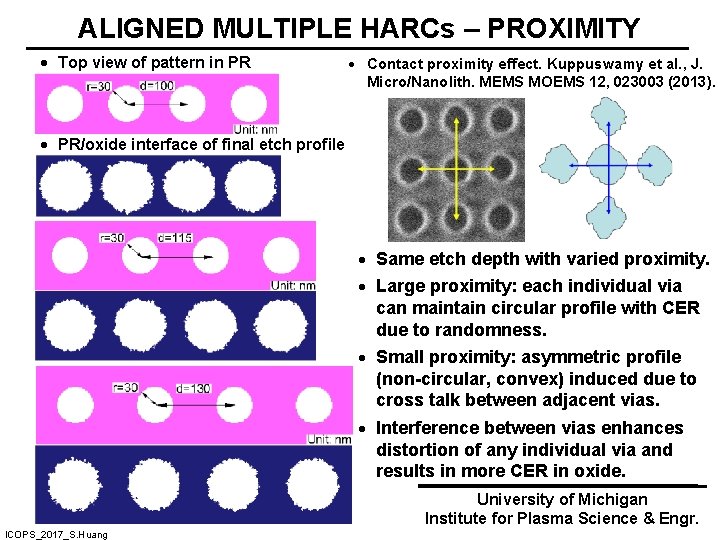
ALIGNED MULTIPLE HARCs – PROXIMITY · Top view of pattern in PR · Contact proximity effect. Kuppuswamy et al. , J. Micro/Nanolith. MEMS MOEMS 12, 023003 (2013). · PR/oxide interface of final etch profile · Same etch depth with varied proximity. · Large proximity: each individual via can maintain circular profile with CER due to randomness. · Small proximity: asymmetric profile (non-circular, convex) induced due to cross talk between adjacent vias. · Interference between vias enhances distortion of any individual via and results in more CER in oxide. University of Michigan Institute for Plasma Science & Engr. ICOPS_2017_S. Huang
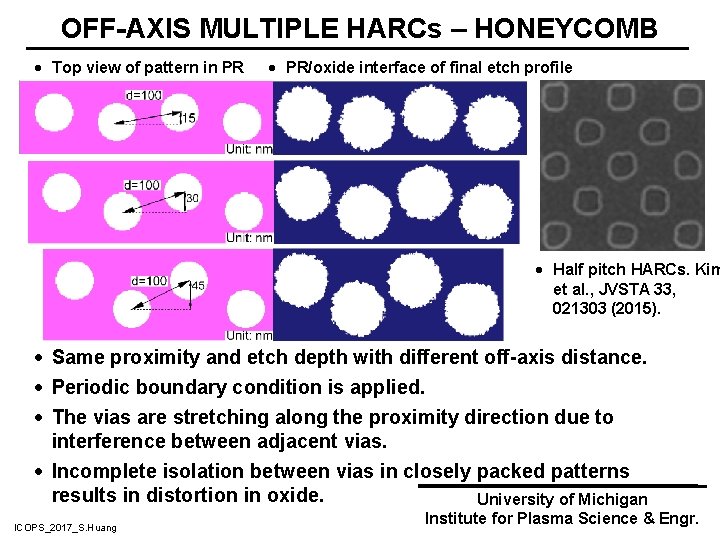
OFF-AXIS MULTIPLE HARCs – HONEYCOMB · Top view of pattern in PR · PR/oxide interface of final etch profile · Half pitch HARCs. Kim et al. , JVSTA 33, 021303 (2015). · Same proximity and etch depth with different off-axis distance. · Periodic boundary condition is applied. · The vias are stretching along the proximity direction due to interference between adjacent vias. · Incomplete isolation between vias in closely packed patterns results in distortion in oxide. University of Michigan ICOPS_2017_S. Huang Institute for Plasma Science & Engr.
CONCLUDING REMARKS · Contact edge roughness (CER) in the etching of single and multiple HARCs in Si. O 2 was investigated using 3 D-MCFPM. · Transfer of different types of roughness (e. g. , scalloped, convex and elliptic) from PR pattern into oxide: · CER dissipates as etch depth (AR) increases due to finite IAD and reflection from sidewalls with large angles. · Depth that scalloping can be transferred into oxide decreases as IAD varies from anisotropic to broad. · Interference between adjacent vias in closely packed pattern enhances distortion of any individual via and more CER in oxide. · As proximity decreases, asymmetric profile (e. g. , non-circular, convex, elliptic) induced due to interference between vias. · Off-axis vias: edges of vias stretch along the proximity direction due to thin and incomplete isolation by PR. ICOPS_2017_S. Huang University of Michigan Institute for Plasma Science & Engr.