
CONSUMPTION FUNCTION by Dr K BHASKAR RAO Lecturer
CONSUMPTION FUNCTION by Dr. K. BHASKAR RAO Lecturer Department of Economics K R K Government Degree College ADDANKI, PRAKASAM (Dt) ANDHRA PRADESH
INTRODUCTION �French Economist John Baptist Say (J B Say) market theory says that the Supply is the whole and sole factor in the economy �Always Economy with full Employment �Unemployment is the only rare condition �There is an invisible hand in the economy
Introduction �Maximum utilization of resources �“Supply creates its own demand” �Free Economy �No government role in the economy �Laissez-faire theory �Government role is very nominal like Defense, Law and order, protection of country �Keynesian theory of Economics says that where and when the Aggregate Demand is equal to Aggregate Supply
Keynesian theory of Employment �The book published by Keynes in the name of “General Theory of Employment, interest and money in 1936” �The theory says that a good relation between employment and production �Depends on Aggregate Demand Aggregate Supply �If AD and AS are equal the Effective Demand has taken place
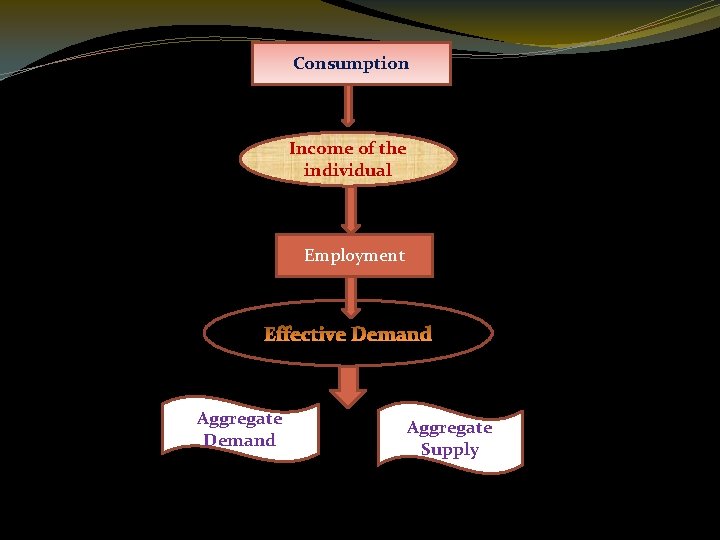
Consumption Income of the individual Employment Aggregate Demand Aggregate Supply
Consumption function As per Keynesian analysis There are two major factor 1. Income 2. Expenditure The theory explains the relationship between these aspects In this theory only the Income is the basic component It discuss about the relation between income and consumption of the individuals
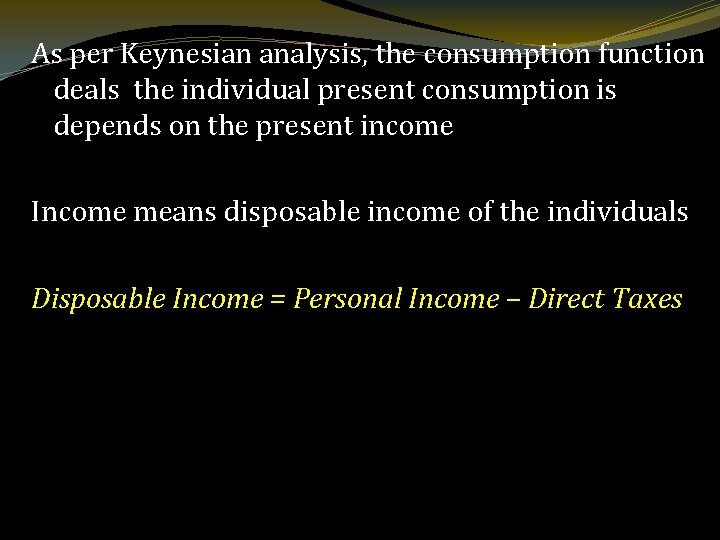
As per Keynesian analysis, the consumption function deals the individual present consumption is depends on the present income Income means disposable income of the individuals Disposable Income = Personal Income – Direct Taxes
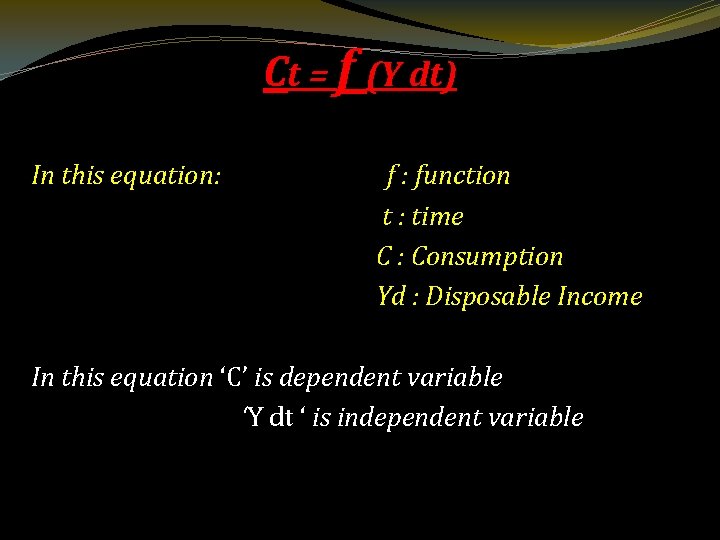
Ct = f (Y dt) In this equation: f : function t : time C : Consumption Yd : Disposable Income In this equation ‘C’ is dependent variable ‘Y dt ‘ is independent variable
As per the law, if the disposable income increases consumption also increases with decreasing rate Hence, theory is called as “Fundamental Psychological Law”
Consumption function - concepts There are two types of concepts in theory 1. Average Propensity to Consume (APC) 2. Marginal Propensity to Consume (MPC)
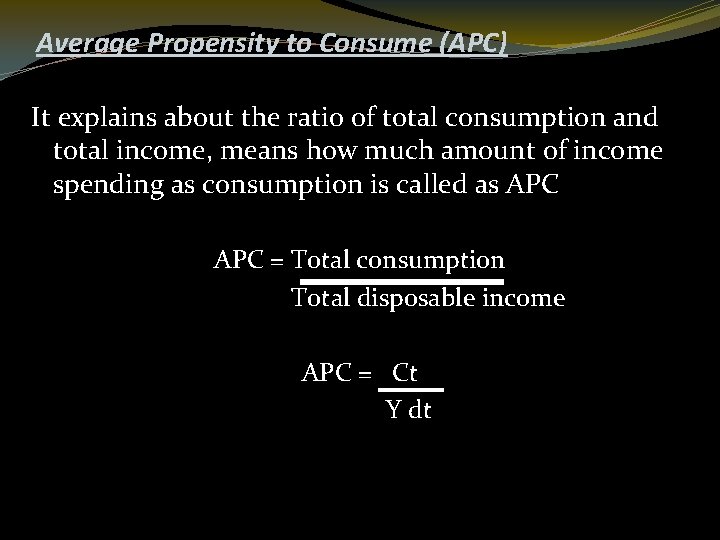
Average Propensity to Consume (APC) It explains about the ratio of total consumption and total income, means how much amount of income spending as consumption is called as APC = Total consumption Total disposable income APC = Ct Y dt
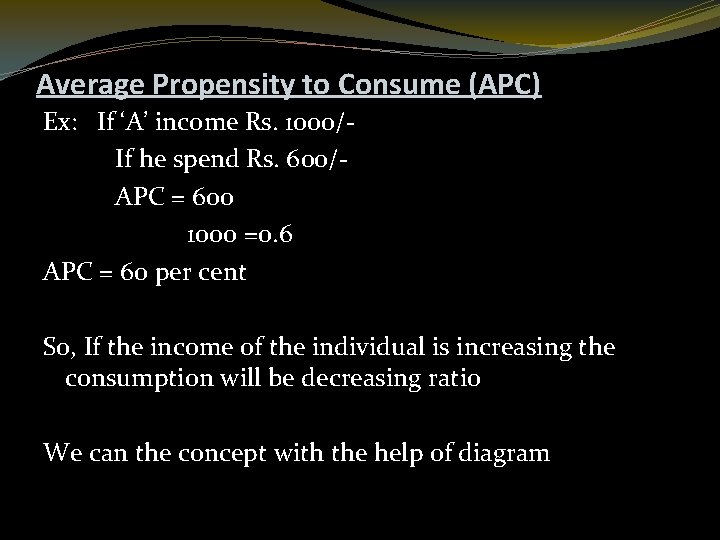
Average Propensity to Consume (APC) Ex: If ‘A’ income Rs. 1000/If he spend Rs. 600/APC = 600 1000 =0. 6 APC = 60 per cent So, If the income of the individual is increasing the consumption will be decreasing ratio We can the concept with the help of diagram
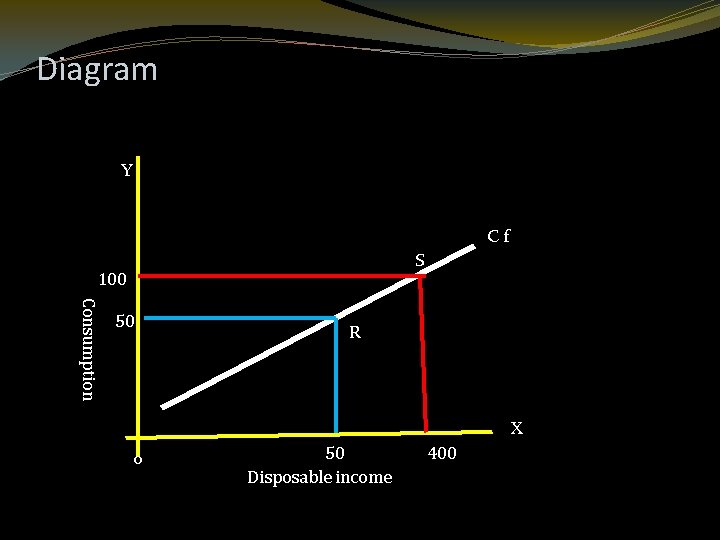
Diagram Y Cf S 100 Consumption 50 R X 0 50 Disposable income 400
In the diagram We have taken Consumption on Y axis and taken Disposable income on X axis Cf is the consumption curve. In the point R the APC is Ct/Ydt = 50/50 = 1. It means how much income we are getting the total income will be spending on the goods and services in the form of consumption There is scope for savings, APS is 0 (zero)
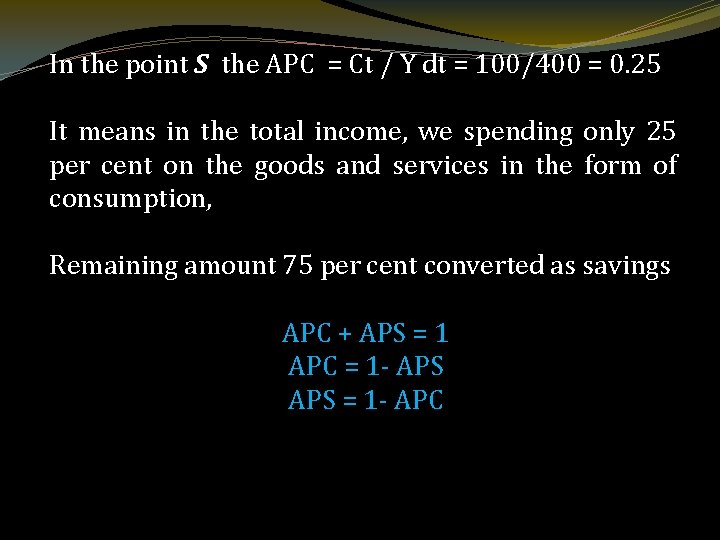
In the point S the APC = Ct / Y dt = 100/400 = 0. 25 It means in the total income, we spending only 25 per cent on the goods and services in the form of consumption, Remaining amount 75 per cent converted as savings APC + APS = 1 APC = 1 - APS = 1 - APC
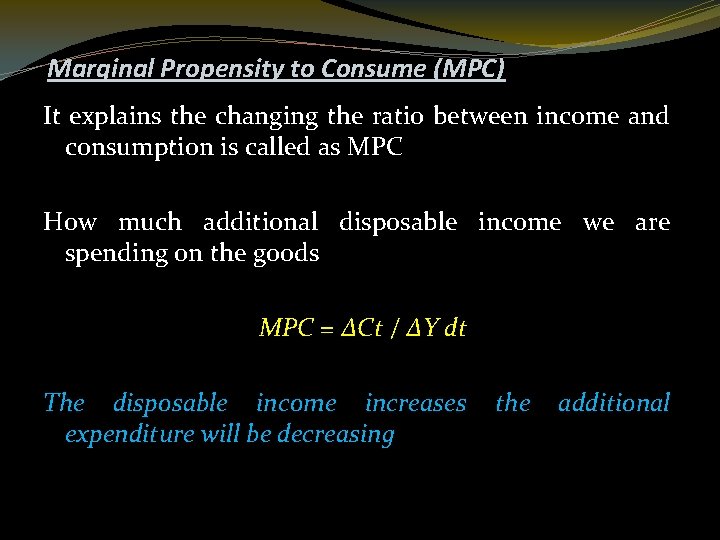
Marginal Propensity to Consume (MPC) It explains the changing the ratio between income and consumption is called as MPC How much additional disposable income we are spending on the goods MPC = ∆Ct / ∆Y dt The disposable income increases expenditure will be decreasing the additional
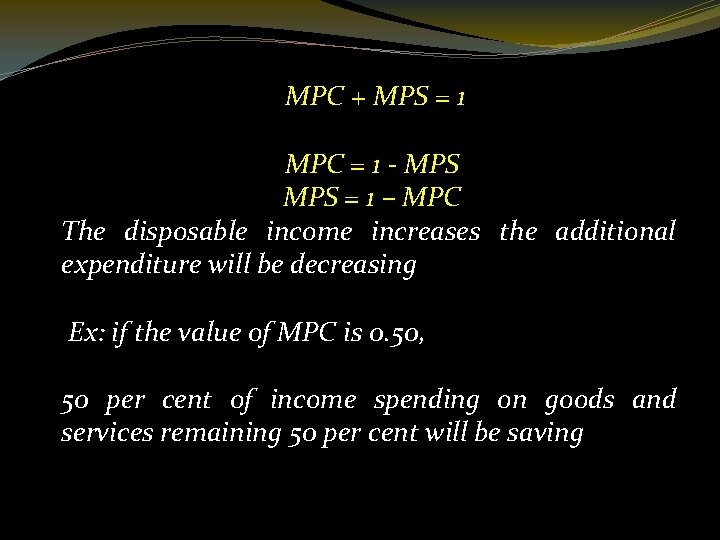
MPC + MPS = 1 MPC = 1 - MPS = 1 – MPC The disposable income increases the additional expenditure will be decreasing Ex: if the value of MPC is 0. 50, 50 per cent of income spending on goods and services remaining 50 per cent will be saving
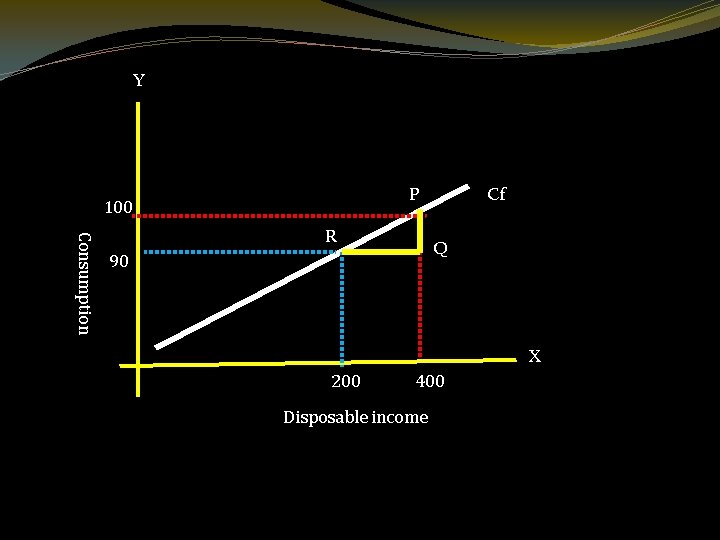
Y P 100 Consumption R Cf Q 90 X 200 400 Disposable income
Determinants of Consumption of the individuals depends on varies aspects like income of the individuals, psychology of the consumer, price of the commodity, speculation market, fashions, etc But majorly two components are very important Subjective factors Objective factors
Subjective Factors Subjective factors are psychology aspects, Its depends on the consumer behavior: these below factors are effecting the consumption of the individuals: Create the assets and forwarded to next generation Social status with the huge number in the creation of assets in the rural areas
If we can reduce the consumption at present, they can enjoy the consumption in future Consumers are enjoying the luxuries life Unemployment Ill-health For the business purpose
Objective Factors These objective factors are also effecting the consumption pattern: all they are: Wage rate; If the wage rate increases the consumption also increases Rate of interest: Any fluctuations in the bank rate of interest the consumption will be effected Unexpected Profits also will effect the consumption
Objective Factors New goods in the markets Fashions and Social status will effect the consumption “Demonstration effect” Bank loan and Rural credit will effect the consumption Government fiscal policy (taxes, debt, expenditure) and Monetary policy is also effect the consumption of the individual
Demographical factors Stock of money Sales effect Rural indebtedness Change in the consumer tastes and preference
- Slides: 24