
Consumers motivation in responding to prescription drug advertising

- Slides: 15
Consumers’ motivation in responding to prescription drug advertising by Nithima Sumpradit, Ph. D 1 Frank J. Ascione, Pharm. D Ph. D 2 Richard P. Bagozzi, Ph. D 3 1 Thai Food and Drug Administration 2 University of Michigan 3 Rice University
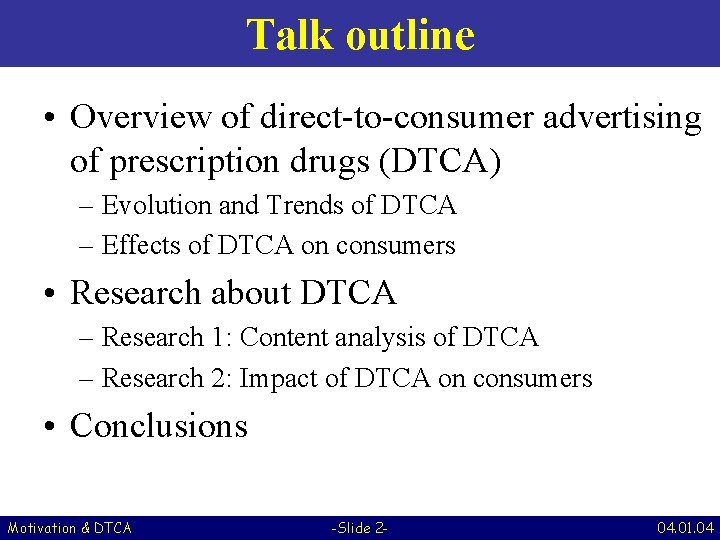
Talk outline • Overview of direct-to-consumer advertising of prescription drugs (DTCA) – Evolution and Trends of DTCA – Effects of DTCA on consumers • Research about DTCA – Research 1: Content analysis of DTCA – Research 2: Impact of DTCA on consumers • Conclusions Motivation & DTCA -Slide 2 - 04. 01. 04
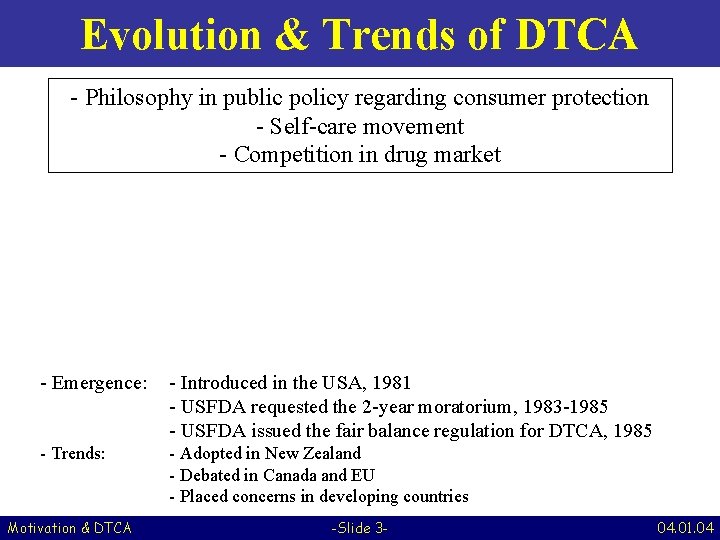
Evolution & Trends of DTCA - Philosophy in public policy regarding consumer protection - Self-care movement - Competition in drug market - Emergence: - Introduced in the USA, 1981 - USFDA requested the 2 -year moratorium, 1983 -1985 - USFDA issued the fair balance regulation for DTCA, 1985 - Trends: - Adopted in New Zealand - Debated in Canada and EU - Placed concerns in developing countries Motivation & DTCA -Slide 3 - 04. 01. 04
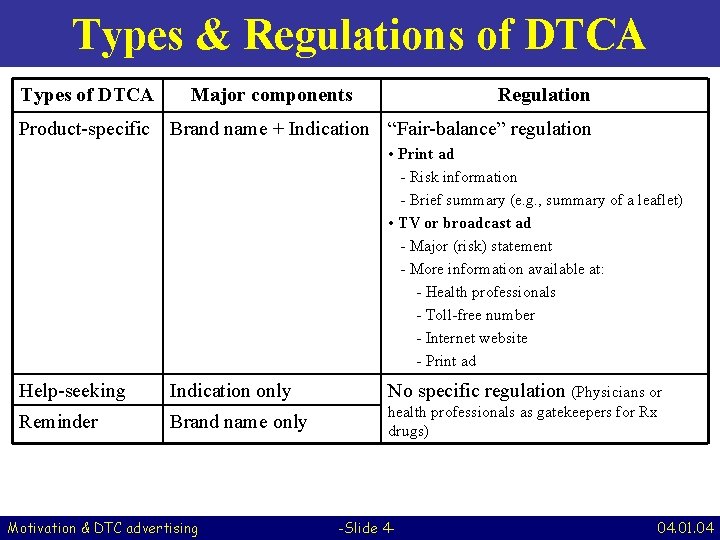
Types & Regulations of DTCA Types of DTCA Product-specific Major components Regulation Brand name + Indication “Fair-balance” regulation • Print ad - Risk information - Brief summary (e. g. , summary of a leaflet) • TV or broadcast ad - Major (risk) statement - More information available at: - Health professionals - Toll-free number - Internet website - Print ad Help-seeking Indication only No specific regulation (Physicians or Reminder Brand name only health professionals as gatekeepers for Rx drugs) Motivation & DTC advertising -Slide 4 - 04. 01. 04
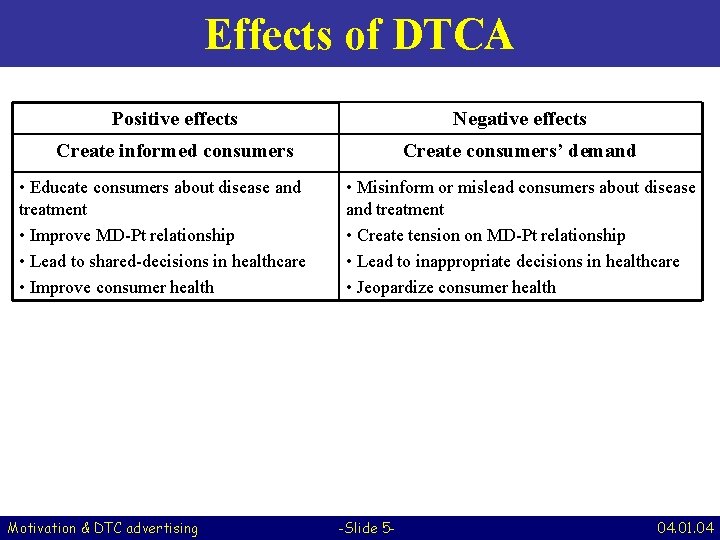
Effects of DTCA Positive effects Negative effects Create informed consumers Create consumers’ demand • Educate consumers about disease and treatment • Improve MD-Pt relationship • Lead to shared-decisions in healthcare • Improve consumer health Motivation & DTC advertising • Misinform or mislead consumers about disease and treatment • Create tension on MD-Pt relationship • Lead to inappropriate decisions in healthcare • Jeopardize consumer health -Slide 5 - 04. 01. 04
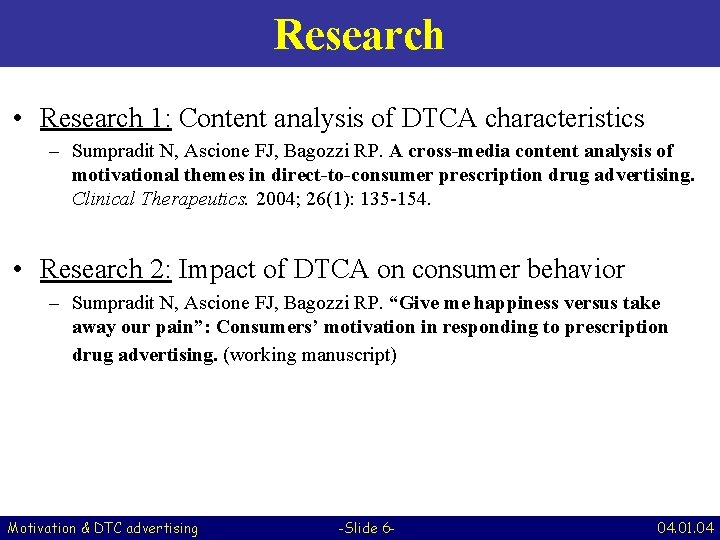
Research • Research 1: Content analysis of DTCA characteristics – Sumpradit N, Ascione FJ, Bagozzi RP. A cross-media content analysis of motivational themes in direct-to-consumer prescription drug advertising. Clinical Therapeutics. 2004; 26(1): 135 -154. • Research 2: Impact of DTCA on consumer behavior – Sumpradit N, Ascione FJ, Bagozzi RP. “Give me happiness versus take away our pain”: Consumers’ motivation in responding to prescription drug advertising. (working manuscript) Motivation & DTC advertising -Slide 6 - 04. 01. 04
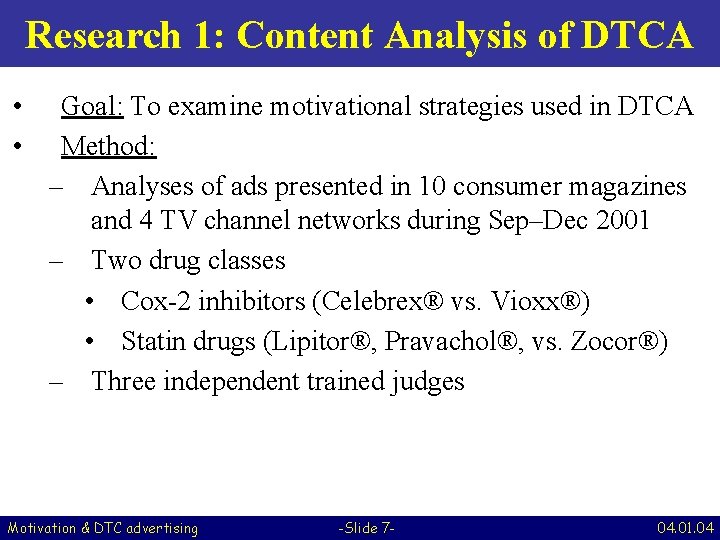
Research 1: Content Analysis of DTCA • • Goal: To examine motivational strategies used in DTCA Method: – Analyses of ads presented in 10 consumer magazines and 4 TV channel networks during Sep–Dec 2001 – Two drug classes • Cox-2 inhibitors (Celebrex® vs. Vioxx®) • Statin drugs (Lipitor®, Pravachol®, vs. Zocor®) – Three independent trained judges Motivation & DTC advertising -Slide 7 - 04. 01. 04
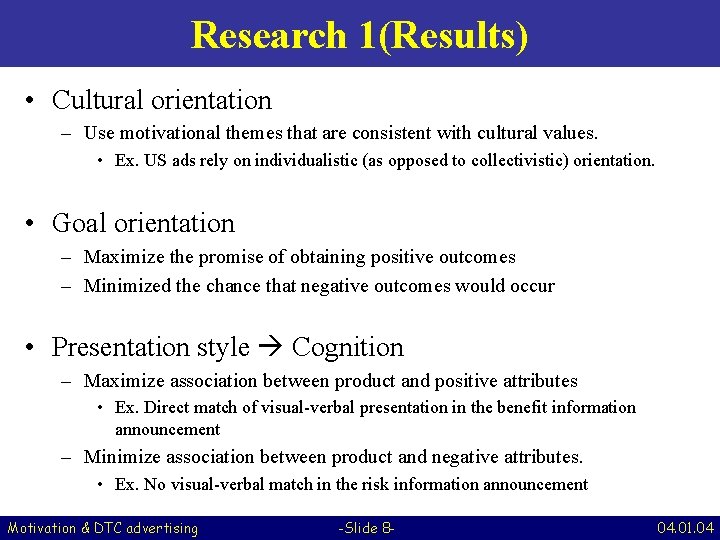
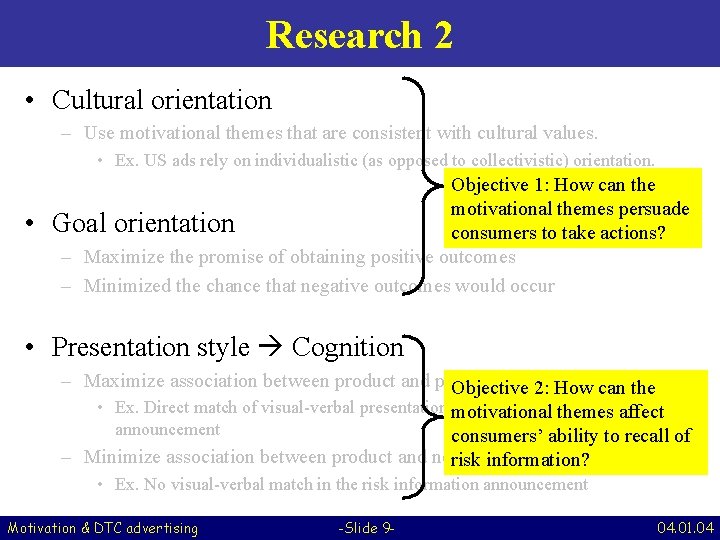
Research 1(Results) • Cultural orientation – Use motivational themes that are consistent with cultural values. • Ex. US ads rely on individualistic (as opposed to collectivistic) orientation. • Goal orientation – Maximize the promise of obtaining positive outcomes – Minimized the chance that negative outcomes would occur • Presentation style Cognition – Maximize association between product and positive attributes • Ex. Direct match of visual-verbal presentation in the benefit information announcement – Minimize association between product and negative attributes. • Ex. No visual-verbal match in the risk information announcement Motivation & DTC advertising -Slide 8 - 04. 01. 04
Research 2 • Cultural orientation – Use motivational themes that are consistent with cultural values. • Ex. US ads rely on individualistic (as opposed to collectivistic) orientation. • Objective 1: How can the motivational themes persuade Goal orientation consumers to take actions? – Maximize the promise of obtaining positive outcomes – Minimized the chance that negative outcomes would occur • Presentation style Cognition – Maximize association between product and positive attributes Objective 2: How can the • Ex. Direct match of visual-verbal presentation motivational in the benefit information themes affect announcement consumers’ ability to recall of – Minimize association between product and negative attributes. risk information? • Ex. No visual-verbal match in the risk information announcement Motivation & DTC advertising -Slide 9 - 04. 01. 04
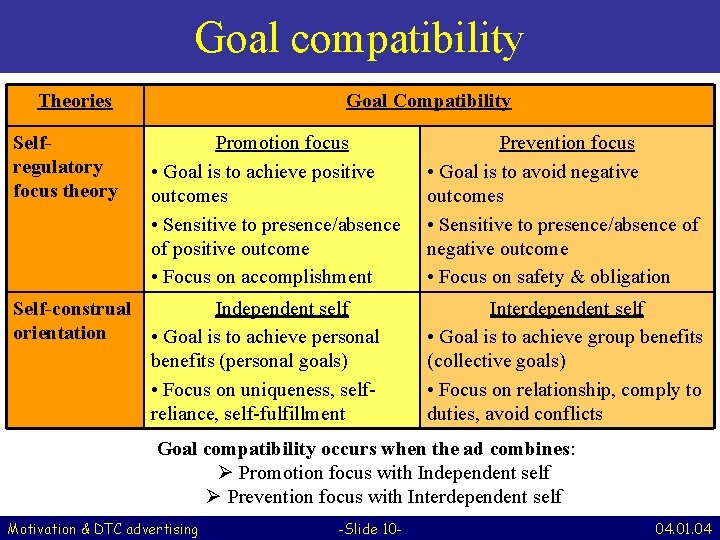
Goal compatibility Theories Selfregulatory focus theory Goal Compatibility Promotion focus • Goal is to achieve positive outcomes • Sensitive to presence/absence of positive outcome • Focus on accomplishment Self-construal Independent self orientation • Goal is to achieve personal benefits (personal goals) • Focus on uniqueness, selfreliance, self-fulfillment Prevention focus • Goal is to avoid negative outcomes • Sensitive to presence/absence of negative outcome • Focus on safety & obligation Interdependent self • Goal is to achieve group benefits (collective goals) • Focus on relationship, comply to duties, avoid conflicts Goal compatibility occurs when the ad combines: Ø Promotion focus with Independent self Ø Prevention focus with Interdependent self Motivation & DTC advertising 8 -Slide 10 - 08. 15. 03 04. 01. 04
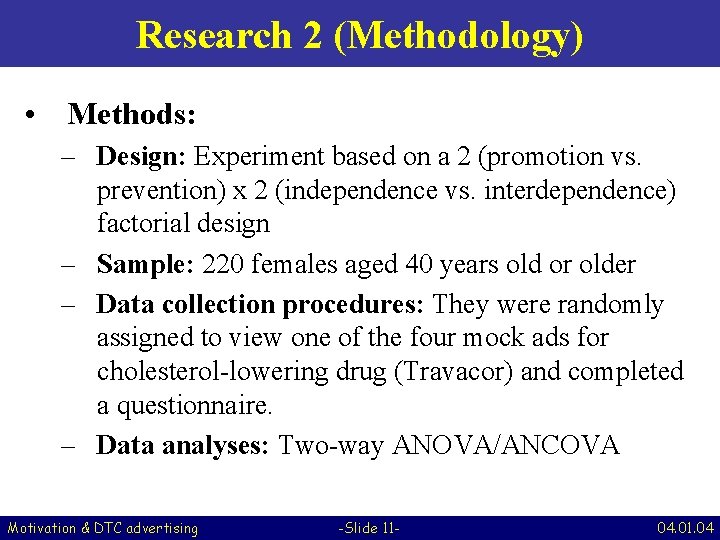
Research 2 (Methodology) • Methods: – Design: Experiment based on a 2 (promotion vs. prevention) x 2 (independence vs. interdependence) factorial design – Sample: 220 females aged 40 years old or older – Data collection procedures: They were randomly assigned to view one of the four mock ads for cholesterol-lowering drug (Travacor) and completed a questionnaire. – Data analyses: Two-way ANOVA/ANCOVA Motivation & DTC advertising -Slide 11 - 04. 01. 04
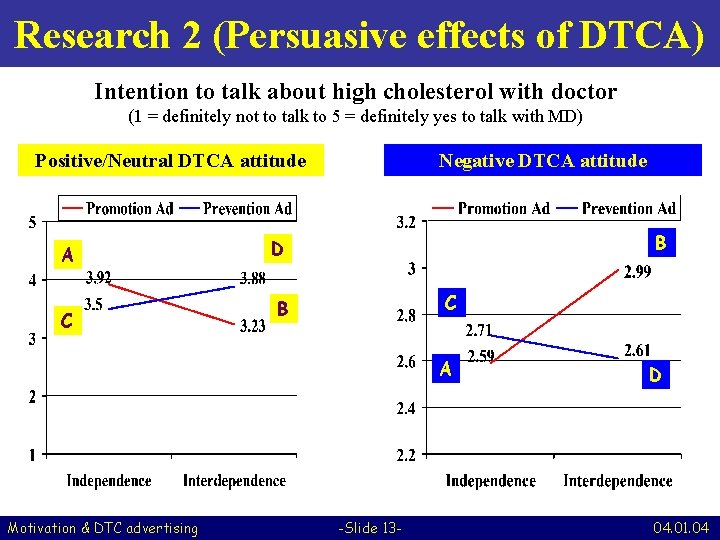
Research 2 (Persuasive effects of DTCA) Intention to talk about high cholesterol with doctor (1 = definitely not to talk to 5 = definitely yes to talk with MD) Positive/Neutral DTCA attitude A C Negative DTCA attitude B D C B A Motivation & DTC advertising -Slide 13 - D 04. 01. 04
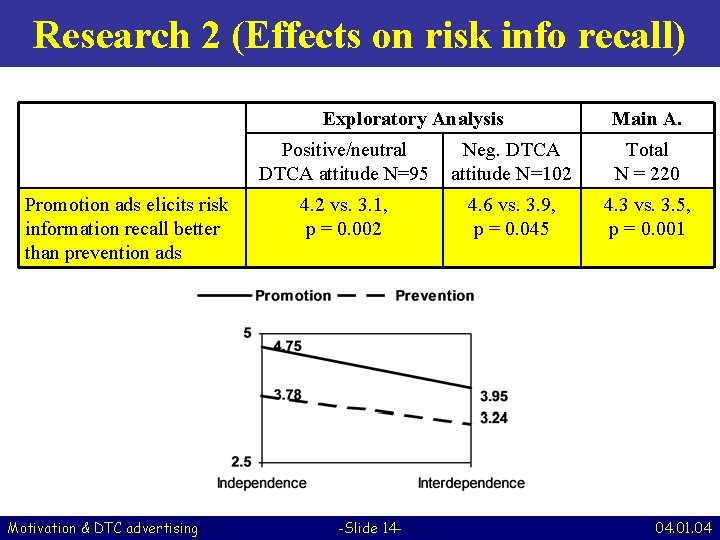
Research 2 (Effects on risk info recall) Exploratory Analysis Promotion ads elicits risk information recall better than prevention ads Motivation & DTC advertising Main A. Positive/neutral DTCA attitude N=95 Neg. DTCA attitude N=102 Total N = 220 4. 2 vs. 3. 1, p = 0. 002 4. 6 vs. 3. 9, p = 0. 045 4. 3 vs. 3. 5, p = 0. 001 21 -Slide 14 - 08. 15. 03 04. 01. 04 03. 27. 04
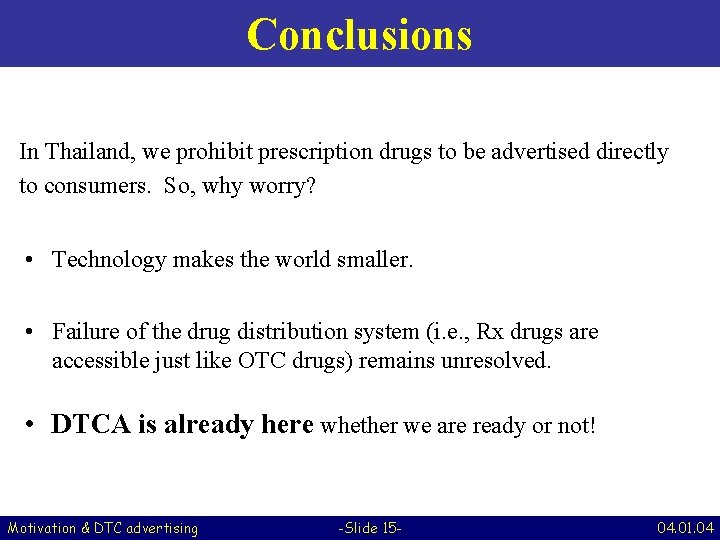
Conclusions In Thailand, we prohibit prescription drugs to be advertised directly to consumers. So, why worry? • Technology makes the world smaller. • Failure of the drug distribution system (i. e. , Rx drugs are accessible just like OTC drugs) remains unresolved. • DTCA is already here whether we are ready or not! Motivation & DTC advertising -Slide 15 - 04. 01. 04
Definitely shrunk if it’s a counterfeit drug. For questions about impotence diseases, please call 0 -2664 -5888 [Insert Logos] Pfizer – an expert in research and development for pharmaceuticals for sexual impotence diseases Source: Home & Lady, August 2546