
Consumer Surplus The concept of consumer surplus CS

- Slides: 20
Consumer Surplus • The concept of consumer surplus (CS) was first formulated by Dupuit in 1844 to measure the social benefits of public goods such as canals, bridge, National High Way. Marshall further refined and popularised this in his ‘Principles of Economics’ published in 1890. • He explained the concept of consumer’s surplus with the help of his marginal utility theory.
Consumer Surplus • The idea of consumer’s surplus can be explained in this way. • A consumer is willing to pay a maximum price to purchase one unit of a commodity in the market. • This price can be called the demand price of the consumer. • In practice the consumer may not have to pay this maximum price. • If we call the price prevailing in the market as actual price, then it can be seen that very often the actual price is less than the individual demand price.
Consumer Surplus • The consumer’s surplus is the difference between the individual demand price and the actual price. • Hence, Consumer’s Surplus = the price a consumer is ready to pay (the individual demand price) – the price he actually pays. • This can be explained with the help of an example. • Suppose a consumer needs a pair of shoes. He is willing to pay Rs. 100 for his one choice able pair of shoes. Then this Rs. 100 is his individual demand price for a pair of shoes. Now the consumer goes to the market and finds that the price of a pair of shoes of his choice if Rs. 80. The in case of purchase of this pair of shoes , the consumer surplus is Rs. (100 80)=Rs. 20.
Consumer Surplus • We know that the price the consumer is willing to pay for any unit of a commodity is equal to the marginal utility (MU) of that unit of the commodity. • Now suppose that the consumer purchases some units of a commodity. • Naturally the MU utility of the consumer from the second unit is less that the MU from the first unit; MU utility from third unit is less than that of the MU utility of second unit, etc.
Consumer Surplus • Therefore, the maximum price that the consumer is willing to pay for the second unit is less than the maximum price of the first unit. • The marginal utilities for different units can be regarded as the maximum price for these units. • Now, if perfect competition prevails in the market, all units of the commodity can be obtained at a fixed price. • Let us suppose that the consumer purchases the four units of the commodity.
Consumer Surplus • Then, from the analysis of the consumer’s equilibrium, we know that for the fourth unit, price and marginal utility will be equal to each other. This means the price that the consumer is willing to pay for the fourth unit is in fact the market price. But for, first, second and third units the MU is greater that the market price. Therefore, for the first unit the consumer will have a CS and this CS is equal to the difference between the MU of the first unit and the actual price of the commodity.
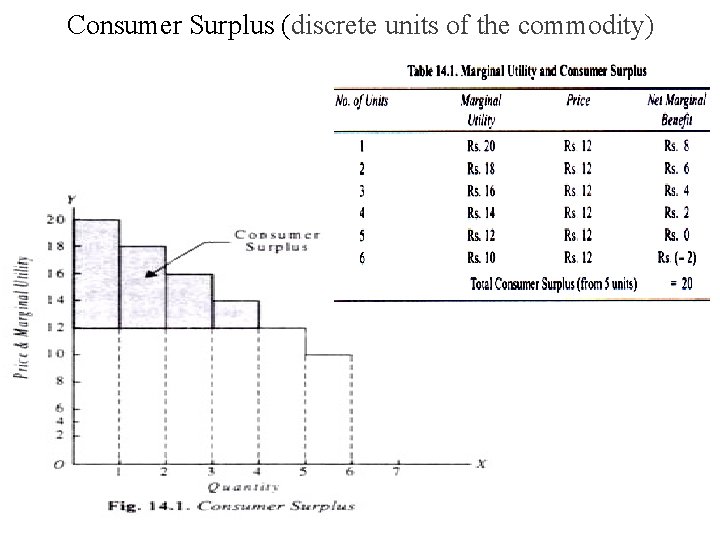
Consumer Surplus • Similarly, the CS for the second unit is the difference between the MU of the second unit and price. • Thus, the differences between the marginal utilities of different units and the price can be called CS for these different units. • This can be explained by the following table:
• • Consumer Surplus Let us suppose that the consumer is purchasing oranges. The price per orange is 50 paise. Now, the consumer gets MU utility of Rs. 2 from the first orange. Therefore, for the first orange the consumer is ready to pay the maximum price of Rs. 2. But the actual expenditure for the first orange is 0. 50 paise. Therefore, for the first orange, the consumer’s surplus is Rs. (2 0. 50)=Rs. 1. 50 For the second orange, the CS is Rs. (1. 50 0. 50)=Rs. 1. 00 Similarly for the third orange, the CS is Rs. (1. 00 0. 50)= Rs. 0. 50. Adding the consumer’s surplus of all the units, we get the total consumer’s surplus of Rs. 3. 00, and this total consumer’s surplus is equal to the maximum net utility.
Consumer Surplus Calculation of Consumer’s Surplus Amount of the Commodity (1) Total Utility (TU) (Rs. ) (2) Marginal Utility (MU) (Rs. ) (3) Price of the commodity (Rs. ) (4) Consumer’s Surplus (CS) (Rs. ) (5)=(3) (4) Total Expenditure (TE) (Rs. ) (6)=(1)*0. 50 Net Utility (NU) (Rs. ) (7)=(2) (6) 1 2. 00 0. 50 1. 50 2 3. 50 1. 50 0. 50 1. 00 2. 50 3 4. 50 1. 00 0. 50 1. 50 3. 00 4 5. 00 0. 50 0. 00 2. 00 3. 00
Consumer Surplus • It can be measured in another way also. • For purchasing and consuming 4 units of oranges, the total utility (TU) of the consumer becomes Rs. 5 and for purchasing 4 units of oranges the total expenditure (TE) of the consumer is Rs. 2. 00. • The difference between total utility and total expenditure is. , Rs. (5 2)=Rs. 3. 00 is the consumer’s total surplus. • Total consumer’s surplus=Total Utility (TU) Total expenditure (TE)
Consumer Surplus (discrete units of the commodity)
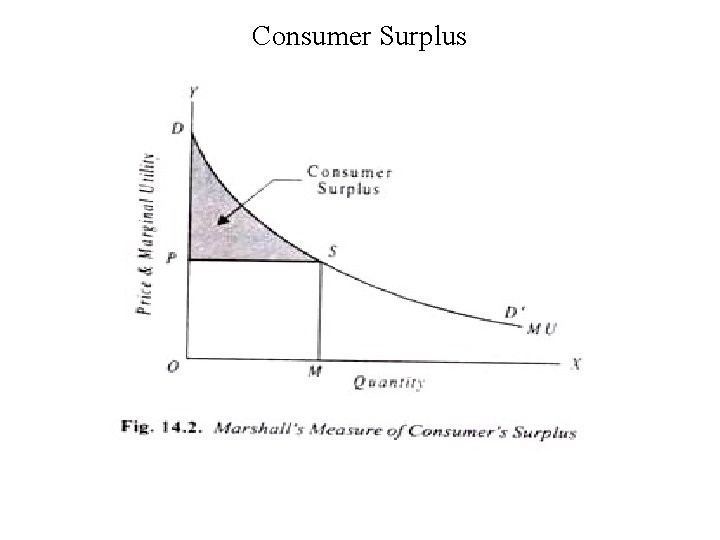
Consumer Surplus • The measurement of consumer surplus from a commodity from the demand or marginal utility curve is illustrated in Fig. 14. 2 in which along the X axis the amount of the commodity has been measured and on the Y axis the marginal utility (or willingness to pay for the commodity) and the price of the commodity are mea sured
Consumer Surplus
Consumer Surplus • DD’ is the demand or marginal utility curve which is sloping downward, indicating that as the consumer buys more units of the commodity falls, marginal utility of the additional units of the commodity. • If OP is the price that prevails in the market, then the consumer will be in equilibrium when he buys OM units of the commodity, since at OM units, marginal utility from a unit of the commodity is equal to the given price OP.
Consumer Surplus • The Mth unit of the commodity does not yield any consumer’s surplus to the consumer since this is the last unit pur chasedand for this price paid is equal to the marginal utility which indicates the price that he is prepared to pay rather than go without it. • But units before Mth unit, marginal utility is greater than the price and. therefore, these units yield consumer’s surplus to the consumer. The total utility of a certain quantity of a commodity to a consumer can be known by summing up the marginal utilities of the various units purchased.
Consumer Surplus • The total utility derived by the consumer from OM units of the commodity will be equal to the area under the demand or marginal utility curve up to point M. That is, the total utility of OMth units is equal to ODSM.
Consumer Surplus • In other words, for OM units of the good the consumer will be prepared to pay the sum equal to Rs. ODSM. But given the price equal to OP, the consumer will actually pay the sum equal to Rs. OPSM for OM units of the good. It is thus clear that the consumer derives extra utility equal to (ODSM – OPSM) = DPS, which has been shaded in Fig. 14. 2. • To conclude when we draw a demand curve, the monetary measure of consumer surplus can be ob tained by the area under the demand curve over and above the rectangular area representing the total market value (i. e. , PQ. or the area OPSM) of the amount of the commodity purchased.
Consumer Surplus • If market price of the commodity rises above OP, the consumer will buy fewer units of the commodity than OM. As a result, consumer’s surplus obtained by him from his purchase will decline. • On the other hand, if price falls below OP, the consumer will be in equilibrium when he is purchasing more units of the commodity than OM. As a result of this, the consumer’s surplus will increase. • Thus, given the marginal utility curve of the consumer, the higher the price, the smaller the consumer’s surplus and the lower the price, the greater the consumer’s surplus.
Consumer Surplus • It worth noting here that in our analysis of consumer’s surplus, we have assumed that perfect competition prevails in the market so that the consumer faces a given price, whatever the amount of the commodity he purchases. • But if seller of a commodity discriminates the prices and charges different prices for the different units of the good, some units at a higher price and some at a lower price, then in this case consumer’s surplus will be smaller.
Consumer Surplus • Thus, when the seller makes price discrimination and sells different units of a good at different prices, the consumer will obtain smaller amount of consumer’s surplus than under perfect competition. If the seller indulges in perfect price discrimination, that is, if he charges price for each unit of the commodity equal to what any consumer will be prepared to pay for it, then in that case no consumer’s surplus will acquire to the consumer.