
Consumer Preferences Utility Functions and Budget Lines Overheads
Consumer Preferences, Utility Functions and Budget Lines Overheads
Utility is a measure of satisfaction or pleasure Utility is defined as the pleasure or satisfaction obtained from consuming goods and services Utility is defined on the entire consumption bundle of the consumer
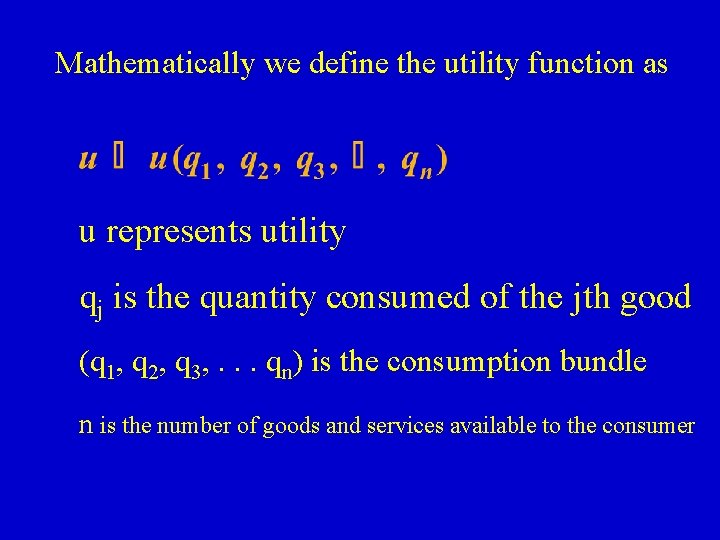
Mathematically we define the utility function as u represents utility qj is the quantity consumed of the jth good (q 1, q 2, q 3, . . . qn) is the consumption bundle n is the number of goods and services available to the consumer
Marginal utility is defined as the increment in utility an individual enjoys from consuming an additional unit of a good or service.
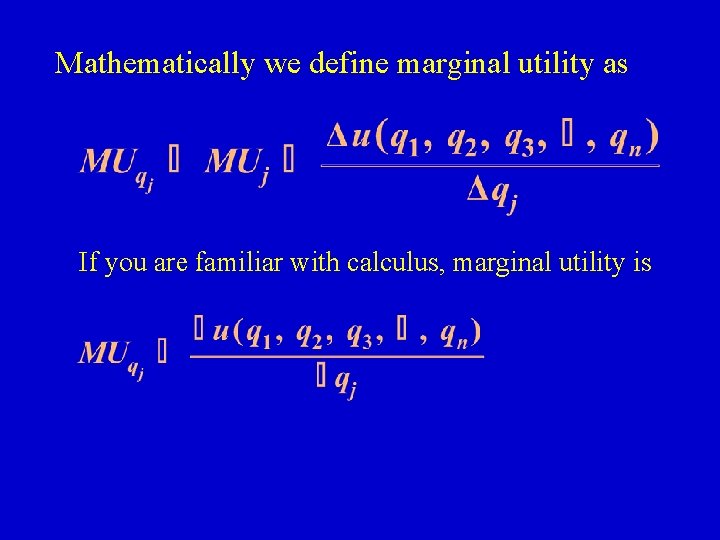
Mathematically we define marginal utility as If you are familiar with calculus, marginal utility is
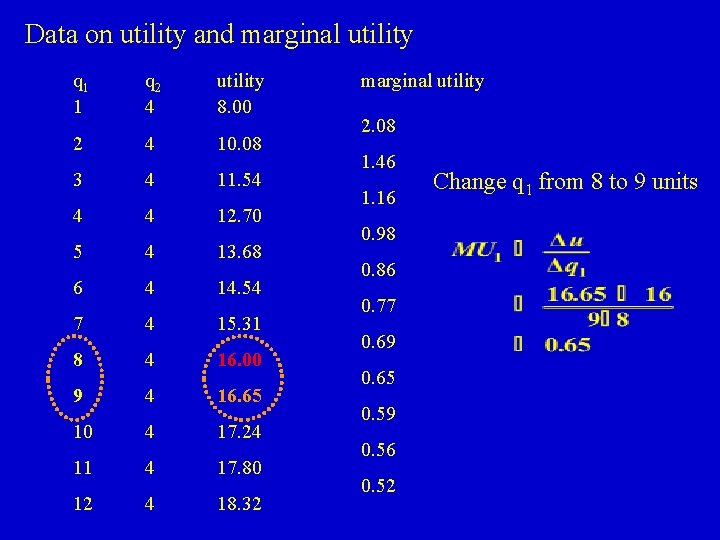
Data on utility and marginal utility q 1 1 q 2 4 utility 8. 00 2 4 10. 08 3 4 11. 54 4 4 12. 70 5 4 13. 68 6 4 14. 54 7 4 15. 31 8 4 16. 00 9 4 16. 65 10 4 17. 24 11 4 17. 80 12 4 18. 32 marginal utility 2. 08 1. 46 1. 16 0. 98 0. 86 0. 77 0. 69 0. 65 0. 59 0. 56 0. 52 Change q 1 from 8 to 9 units
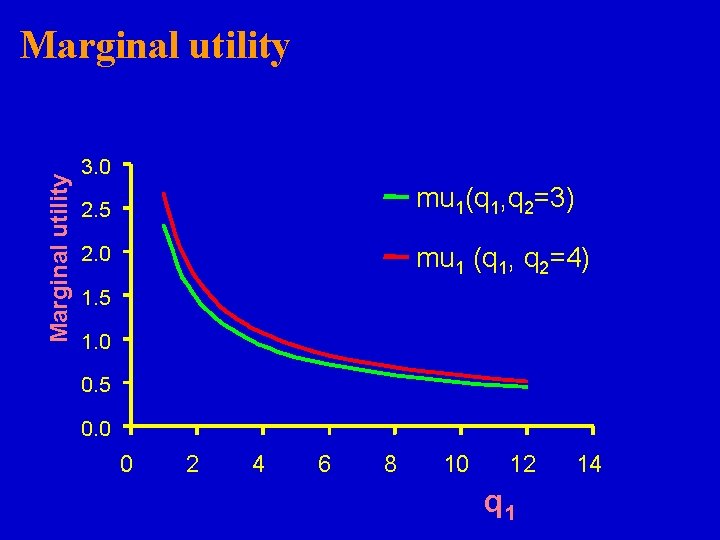
Marginal utility 3. 0 2. 5 mu 1(q 1, q 2=3) 2. 0 mu 1 (q 1, q 2=4) 1. 5 1. 0 0. 5 0. 0 0 2 4 6 8 10 12 q 1 14
Law of diminishing marginal utility The law of diminishing marginal utility says that as the consumption of a good of service increases, marginal utility decreases. The idea is that the marginal utility of a good diminishes, with every increase in the amount of it that a consumer has.
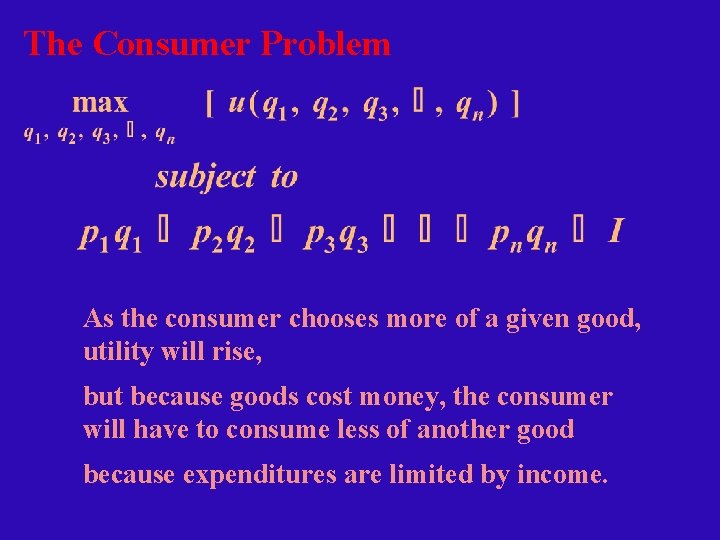
The Consumer Problem As the consumer chooses more of a given good, utility will rise, but because goods cost money, the consumer will have to consume less of another good because expenditures are limited by income.
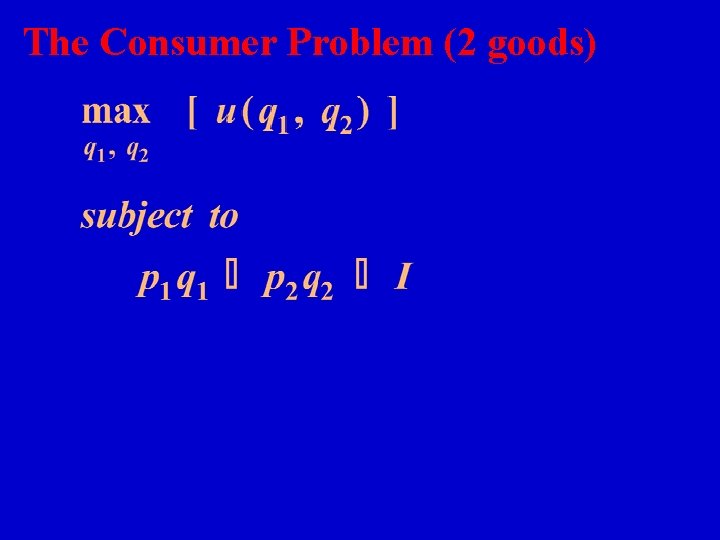
The Consumer Problem (2 goods)
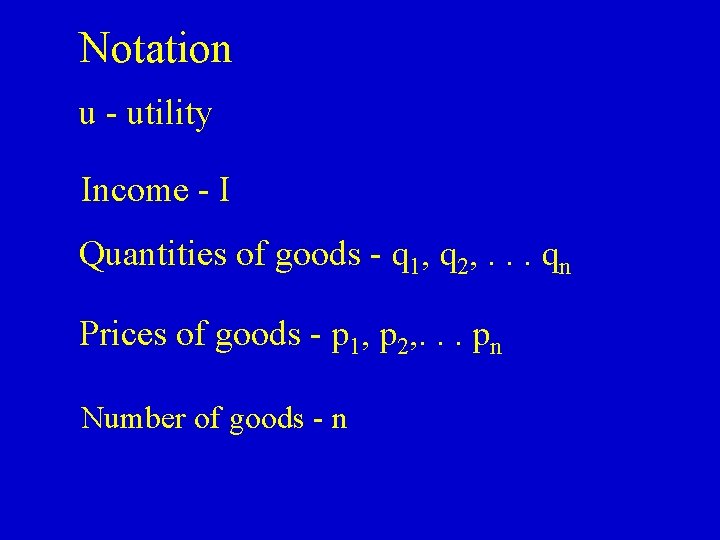
Notation u - utility Income - I Quantities of goods - q 1, q 2, . . . qn Prices of goods - p 1, p 2, . . . pn Number of goods - n
Optimal consumption is along the budget line Given that income is allocated among a fixed number of categories and all goods have a positive marginal utility, the consumer will always choose a point on the budget line. Why?
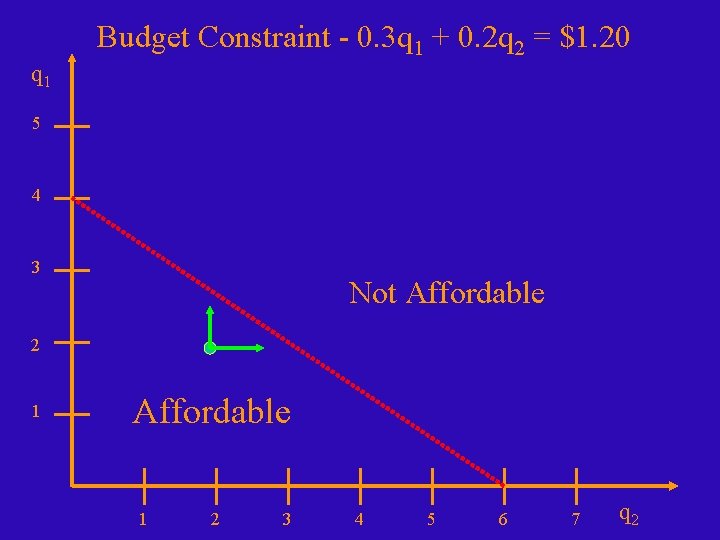
Budget Constraint - 0. 3 q 1 + 0. 2 q 2 = $1. 20 q 1 5 4 3 Not Affordable 2 1 Affordable 1 2 3 4 5 6 7 q 2
Marginal decision making To make the best of a situation, decision makers should consider the incremental or marginal effects of taking any action. In analyzing consumption decisions, the consumer considers small changes in the quantities consumed, as she searches for the “optimal” consumption bundle.
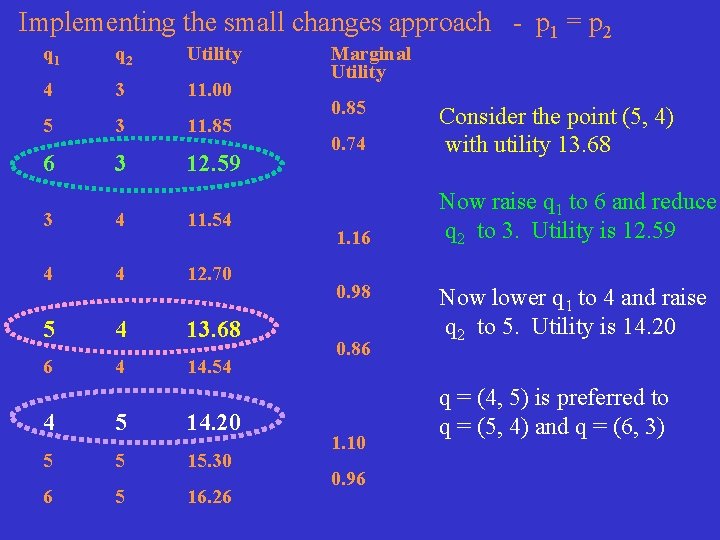
Implementing the small changes approach - p 1 = p 2 q 1 q 2 Utility 4 3 11. 00 5 3 11. 85 6 3 12. 59 3 4 11. 54 4 4 12. 70 5 4 13. 68 6 4 14. 54 4 5 14. 20 5 5 15. 30 6 5 16. 26 Marginal Utility 0. 85 0. 74 Consider the point (5, 4) with utility 13. 68 1. 16 Now raise q 1 to 6 and reduce q 2 to 3. Utility is 12. 59 0. 98 0. 86 1. 10 0. 96 Now lower q 1 to 4 and raise q 2 to 5. Utility is 14. 20 q = (4, 5) is preferred to q = (5, 4) and q = (6, 3)
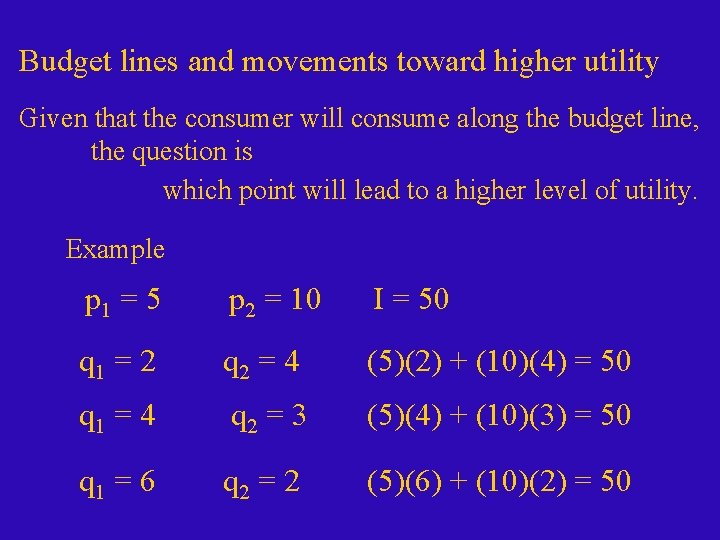
Budget lines and movements toward higher utility Given that the consumer will consume along the budget line, the question is which point will lead to a higher level of utility. Example p 1 = 5 p 2 = 10 I = 50 q 1 = 2 q 2 = 4 (5)(2) + (10)(4) = 50 q 1 = 4 q 2 = 3 (5)(4) + (10)(3) = 50 q 1 = 6 q 2 = 2 (5)(6) + (10)(2) = 50
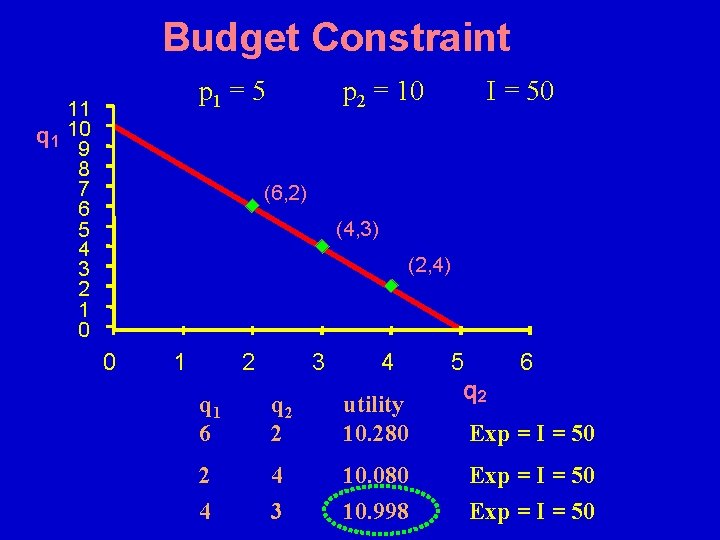
Budget Constraint p 1 = 5 11 q 1 10 9 8 7 6 5 4 3 2 1 0 p 2 = 10 I = 50 (6, 2) (4, 3) (2, 4) 0 1 2 3 4 q 1 6 q 2 2 utility 10. 280 2 4 4 3 10. 080 10. 998 5 6 q 2 Exp = I = 50
Indifference Curves An indifference curve represents all combinations of two categories of goods that make the consumer equally well off.
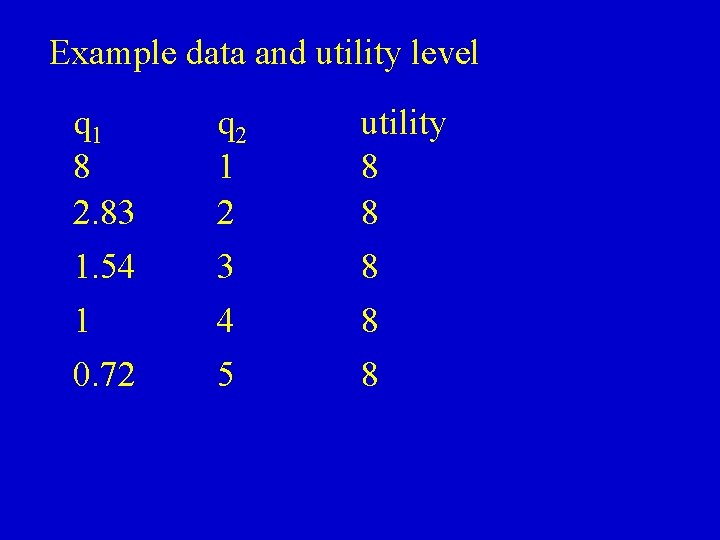
Example data and utility level q 1 8 2. 83 1. 54 1 0. 72 q 2 1 2 3 4 5 utility 8 8 8
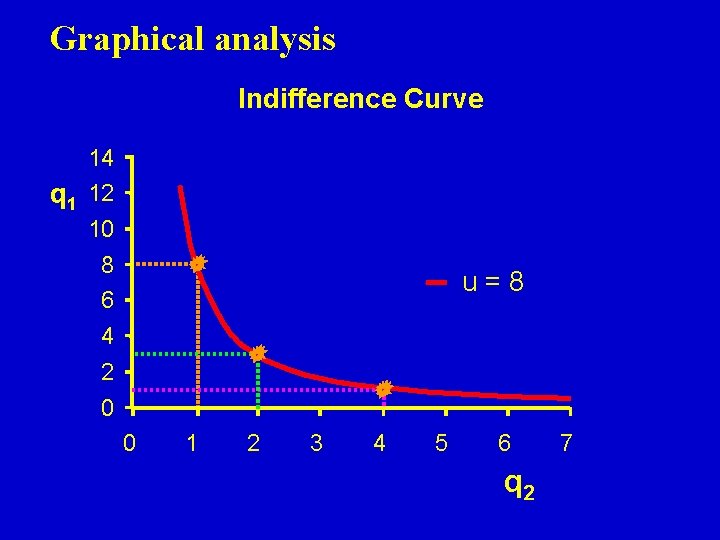
Graphical analysis Indifference Curve 14 q 1 12 10 8 u=8 6 4 2 0 0 1 2 3 4 5 6 q 2 7
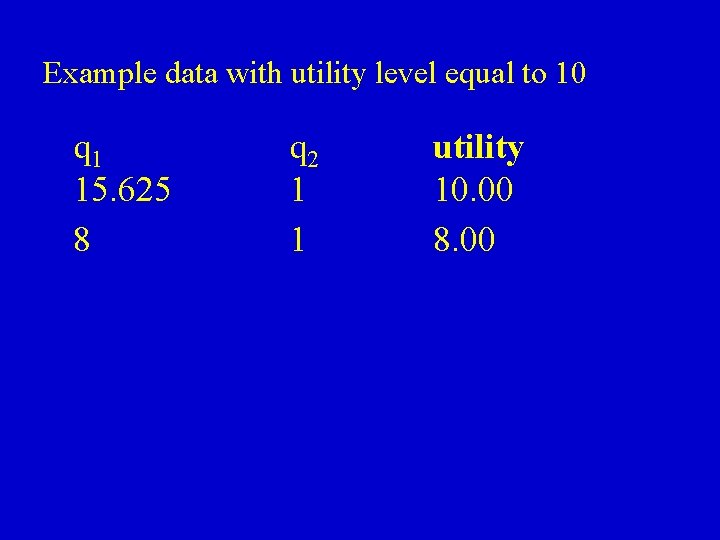
Example data with utility level equal to 10 q 1 15. 625 8 q 2 1 1 utility 10. 00 8. 00
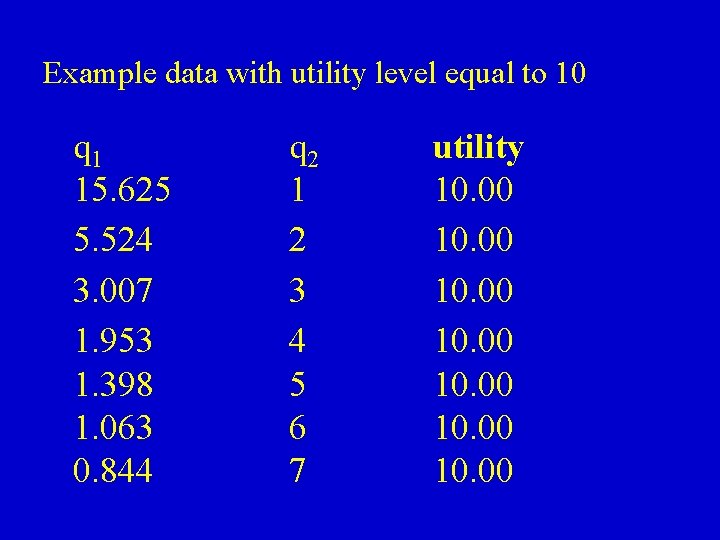
Example data with utility level equal to 10 q 1 15. 625 5. 524 3. 007 1. 953 1. 398 1. 063 0. 844 q 2 1 2 3 4 5 6 7 utility 10. 00 10. 00
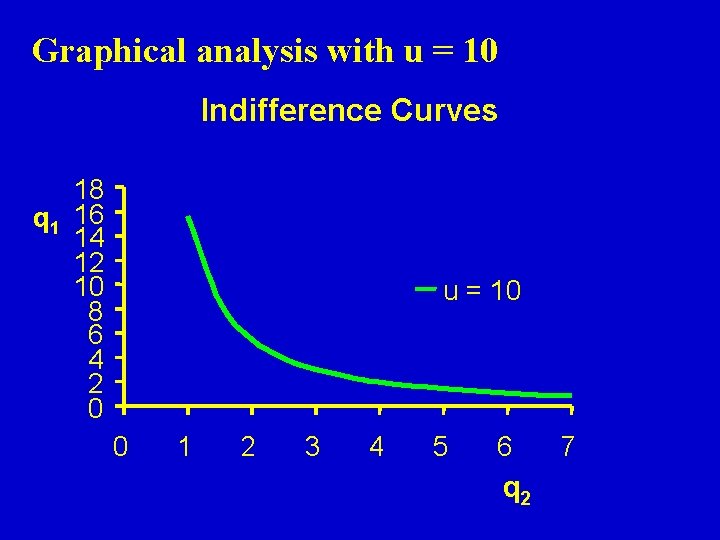
Graphical analysis with u = 10 Indifference Curves 18 q 1 16 14 12 10 8 6 4 2 0 u = 10 0 1 2 3 4 5 6 q 2 7
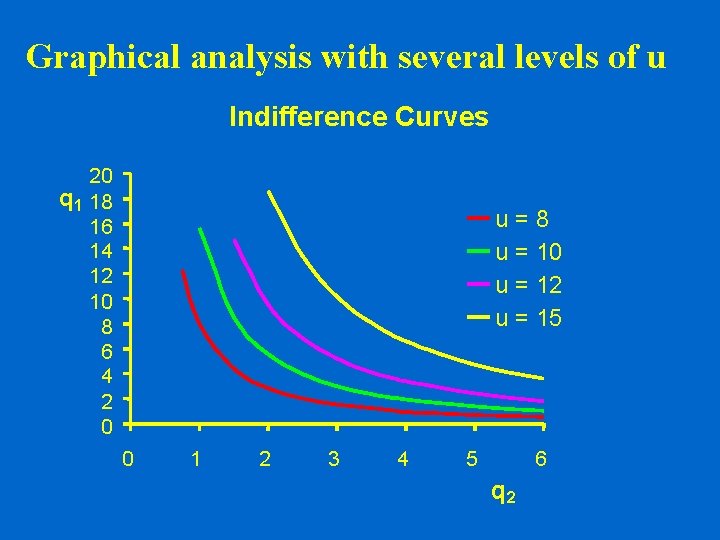
Graphical analysis with several levels of u Indifference Curves 20 q 1 18 16 14 12 10 8 6 4 2 0 u=8 u = 10 u = 12 u = 15 0 1 2 3 4 5 6 q 2
Slope of indifference curves Indifference curves normally have a negative slope If we give up some of one good, we have to get more of the other good to remain as well off The slope of an indifference curve is called the marginal rate of substitution (MRS) between good 1 and good 2
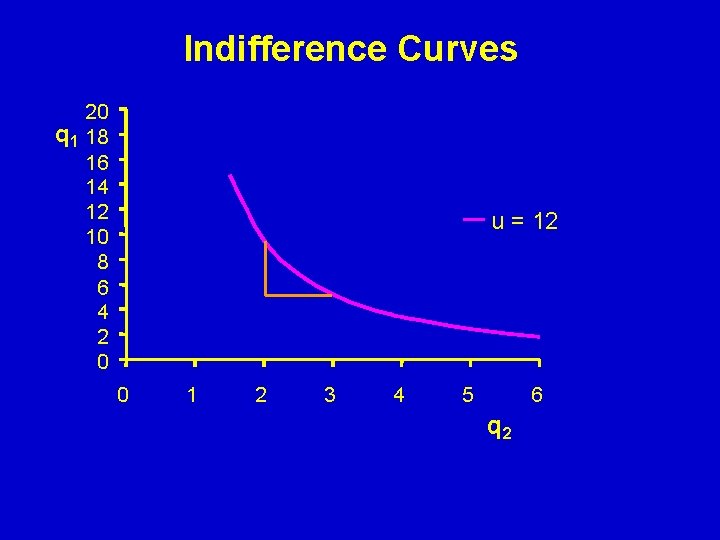
Indifference Curves 20 q 1 18 16 14 12 10 8 6 4 2 0 u = 12 0 1 2 3 4 5 6 q 2
Slope of indifference curves (MRS) The MRS tells us the decrease in the quantity of good 1 (q 1) that is needed to accompany a one unit increase in the quantity of good two (q 2), in order to keep the consumer indifferent to the change
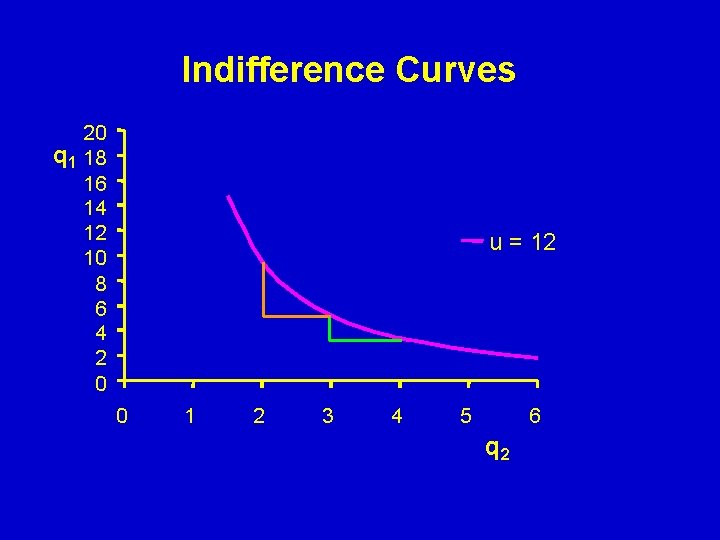
Indifference Curves 20 q 1 18 16 14 12 10 8 6 4 2 0 u = 12 0 1 2 3 4 5 6 q 2
Shape of Indifference Curves Indifference curves are convex to the origin This means that as we consume more and more of a good, its marginal value in terms of the other good becomes less.
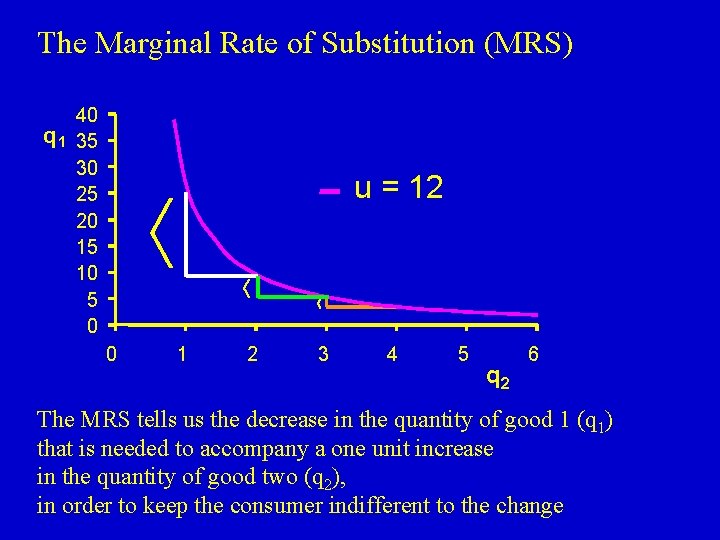
The Marginal Rate of Substitution (MRS) 40 q 1 35 30 25 20 15 10 5 0 u = 12 0 1 2 3 4 5 q 2 6 The MRS tells us the decrease in the quantity of good 1 (q 1) that is needed to accompany a one unit increase in the quantity of good two (q 2), in order to keep the consumer indifferent to the change
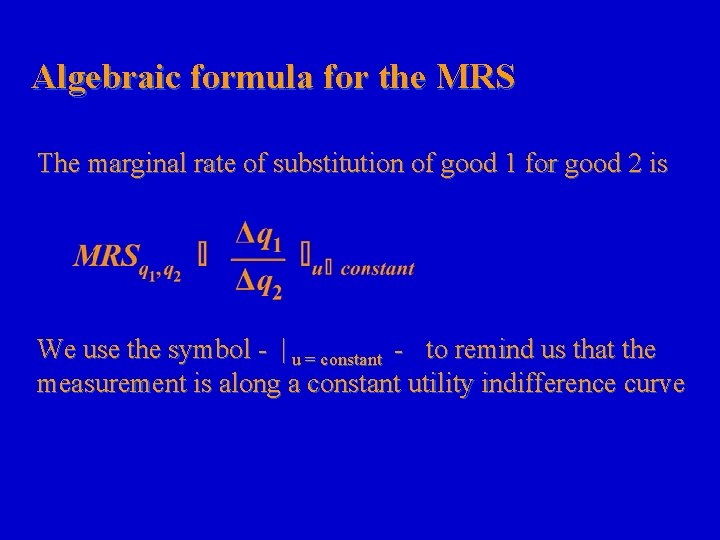
Algebraic formula for the MRS The marginal rate of substitution of good 1 for good 2 is We use the symbol - | u = constant - to remind us that the measurement is along a constant utility indifference curve
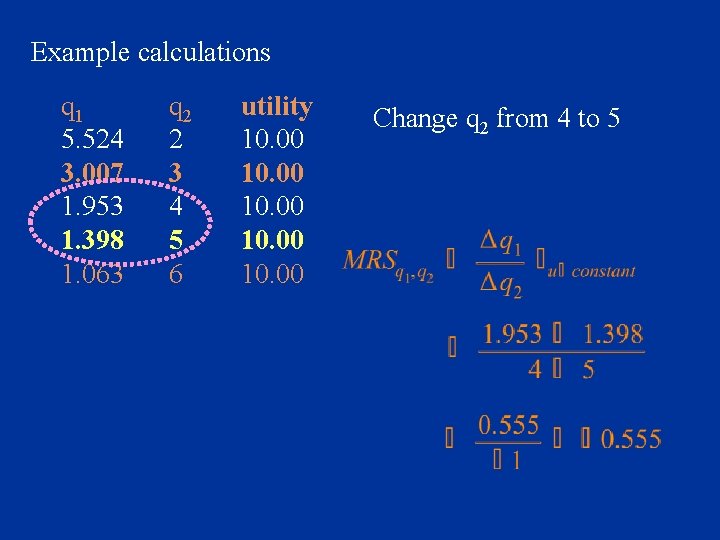
Example calculations q 1 5. 524 3. 007 1. 953 1. 398 1. 063 q 2 2 3 4 5 6 utility 10. 00 Change q 2 from 4 to 5
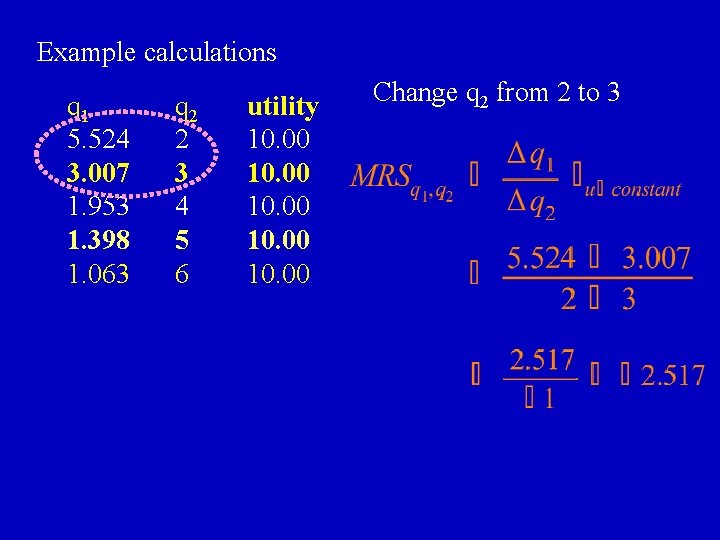
Example calculations q 1 5. 524 3. 007 1. 953 1. 398 1. 063 q 2 2 3 4 5 6 utility 10. 00 Change q 2 from 2 to 3
A declining marginal rate of substitution The marginal rate of substitution becomes larger in absolute value, as we have more of a product. The amount of a good we are willing to give up to keep utility the same, is greater when we already have a lot of it.
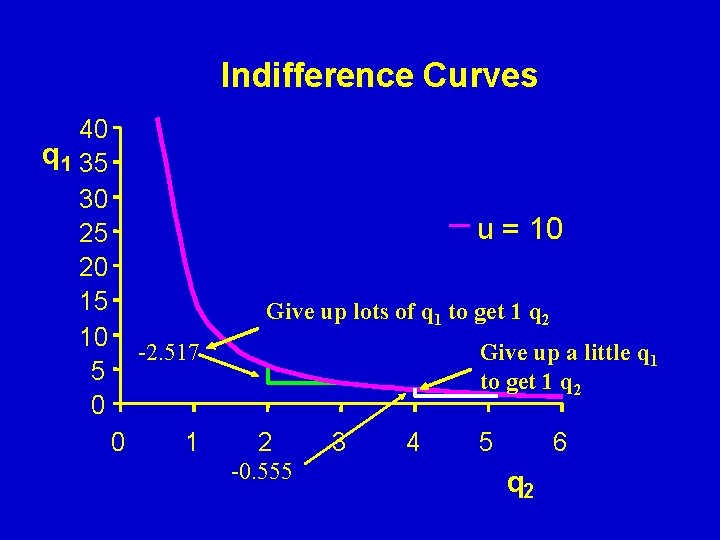
Indifference Curves 40 q 1 35 30 25 20 15 10 5 0 u = 10 Give up lots of q 1 to get 1 q 2 -2. 517 0 1 Give up a little q 1 to get 1 q 2 2 -0. 555 3 4 5 6 q 2
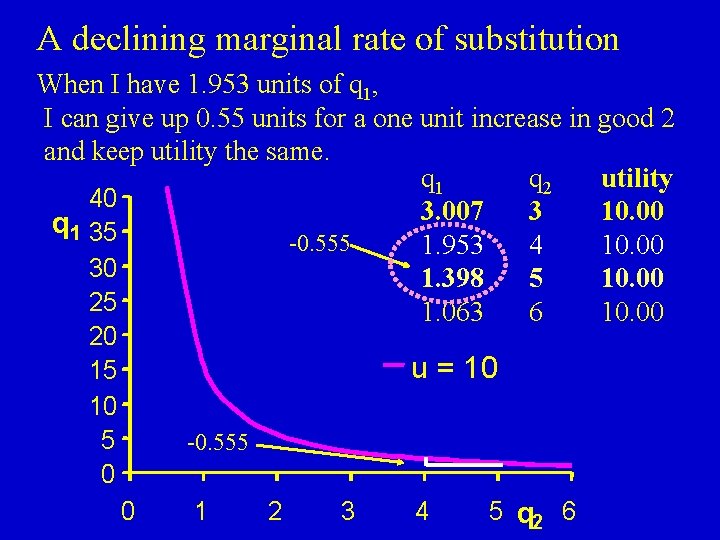
A declining marginal rate of substitution When I have 1. 953 units of q 1, I can give up 0. 55 units for a one unit increase in good 2 and keep utility the same. q 1 q 2 utility 40 3. 007 3 10. 00 q 1 35 -0. 555 1. 953 4 10. 00 30 1. 398 5 10. 00 25 1. 063 6 10. 00 20 15 10 5 0 u = 10 -0. 555 0 1 2 3 4 5 q 2 6
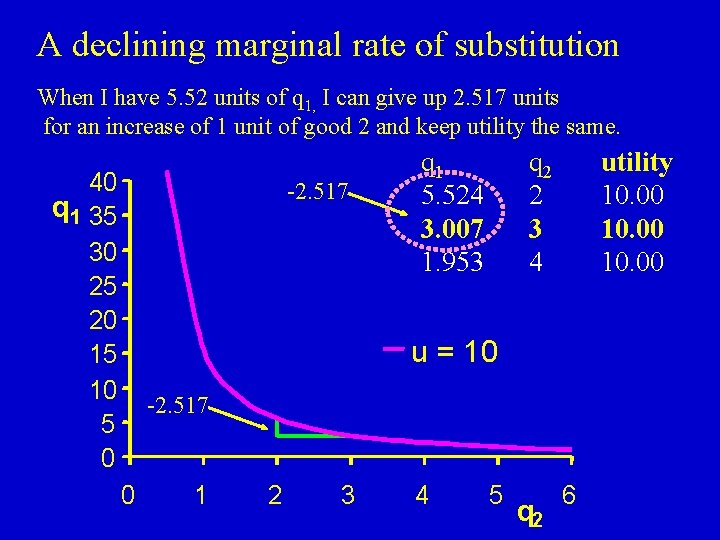
A declining marginal rate of substitution When I have 5. 52 units of q 1, I can give up 2. 517 units for an increase of 1 unit of good 2 and keep utility the same. 40 q 1 35 30 25 20 15 10 5 0 -2. 517 q 1 5. 524 3. 007 1. 953 q 2 2 3 4 utility 10. 00 u = 10 -2. 517 0 1 2 3 4 5 q 2 6
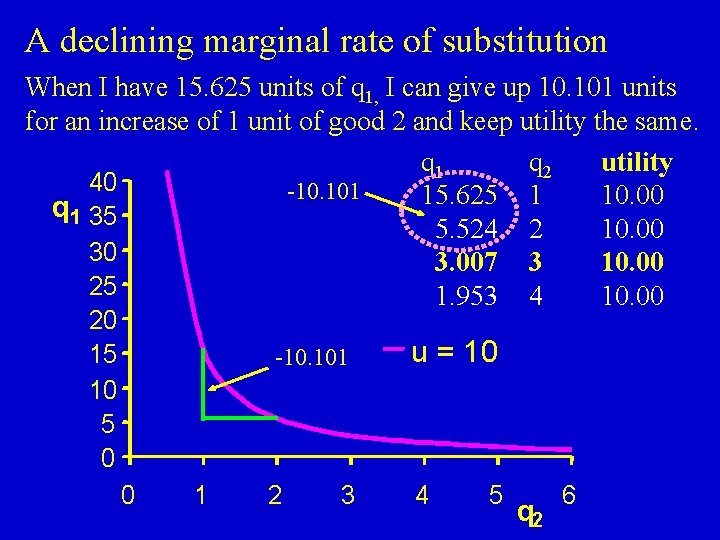
A declining marginal rate of substitution When I have 15. 625 units of q 1, I can give up 10. 101 units for an increase of 1 unit of good 2 and keep utility the same. q 1 q 2 utility 40 -10. 101 15. 625 1 10. 00 q 1 35 5. 524 2 10. 00 30 3. 007 3 10. 00 25 1. 953 4 10. 00 20 15 10 5 0 -10. 101 0 1 2 3 u = 10 4 5 q 2 6
Break
Indifference curves and budget lines We can combine indifference curves and budget lines to help us determine the optimal consumption bundle The idea is to get on the highest indifference curve allowed by our income
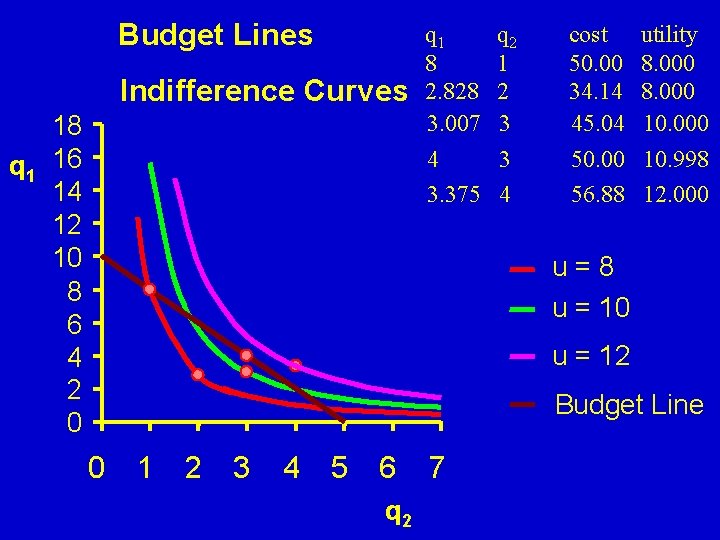
Budget Lines Indifference Curves 18 q 1 16 14 12 10 8 6 4 2 0 q 1 8 2. 828 3. 007 q 2 1 2 3 4 3 3. 375 4 cost 50. 00 34. 14 45. 04 utility 8. 000 10. 000 50. 00 10. 998 56. 88 12. 000 u=8 u = 10 u = 12 Budget Line 0 1 2 3 4 5 6 q 2 7
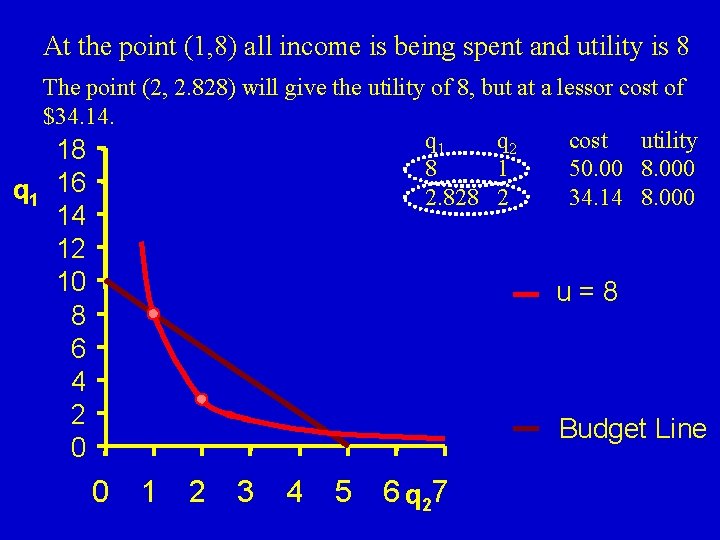
At the point (1, 8) all income is being spent and utility is 8 The point (2, 2. 828) will give the utility of 8, but at a lessor cost of $34. 14. q 1 q 2 cost utility 18 8 1 50. 00 8. 000 q 1 16 2. 828 2 34. 14 8. 000 14 12 10 8 6 4 2 0 u=8 Budget Line 0 1 2 3 4 5 6 q 27
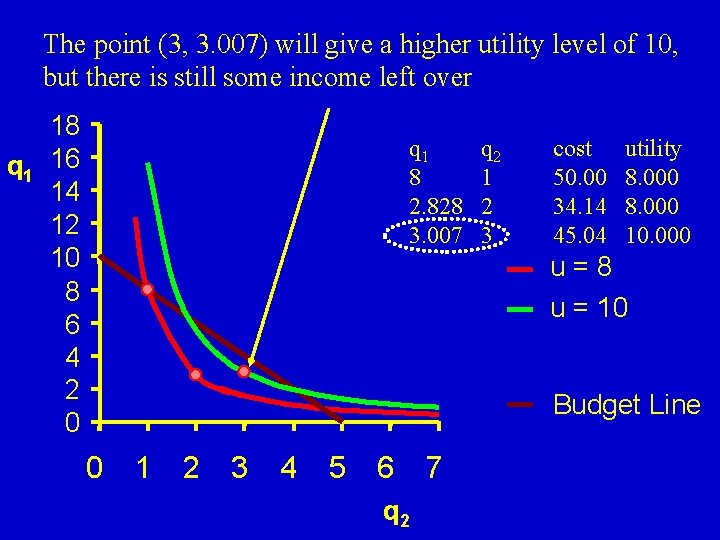
The point (3, 3. 007) will give a higher utility level of 10, but there is still some income left over 18 q 1 16 14 12 10 8 6 4 2 0 q 1 8 2. 828 3. 007 q 2 1 2 3 cost 50. 00 34. 14 45. 04 utility 8. 000 10. 000 u=8 u = 10 Budget Line 0 1 2 3 4 5 6 q 2 7
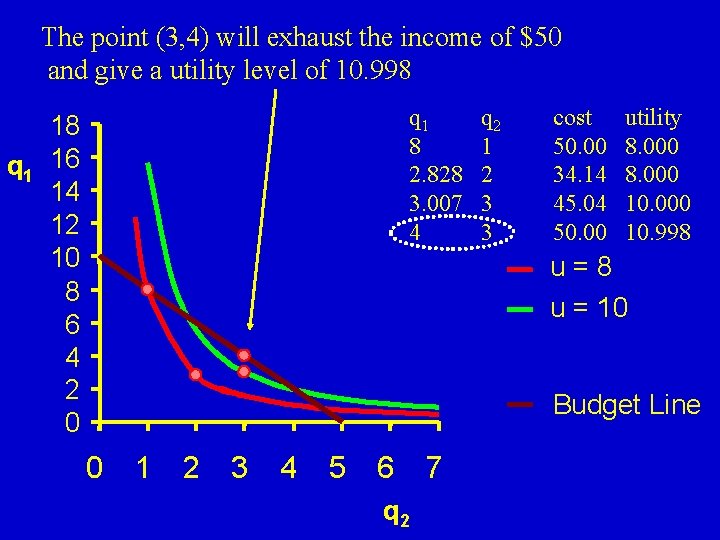
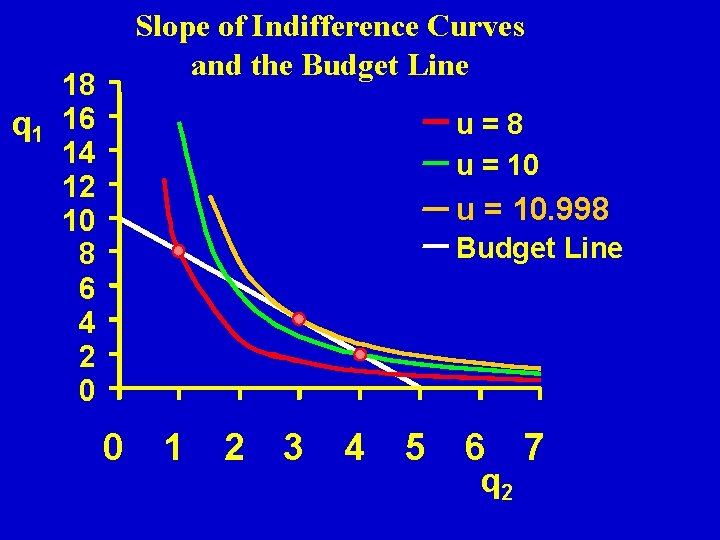
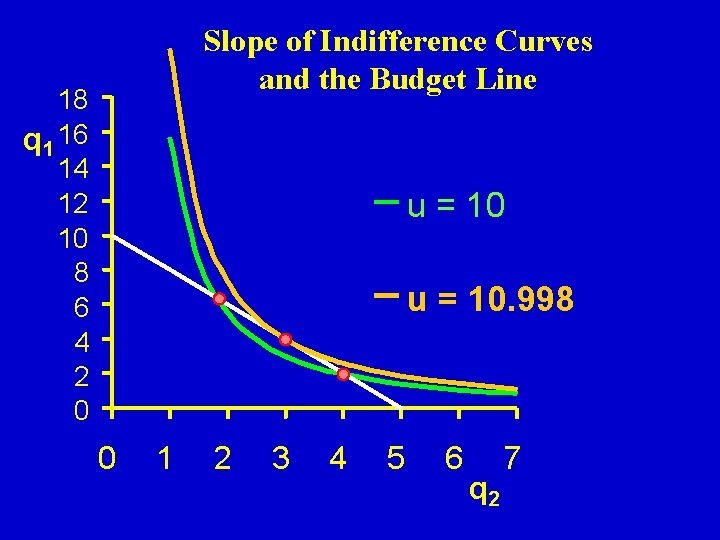
The point (3, 4) will exhaust the income of $50 and give a utility level of 10. 998 q 1 8 2. 828 3. 007 4 18 q 1 16 14 12 10 8 6 4 2 0 q 2 1 2 3 3 cost 50. 00 34. 14 45. 04 50. 00 utility 8. 000 10. 998 u=8 u = 10 Budget Line 0 1 2 3 4 5 6 q 2 7
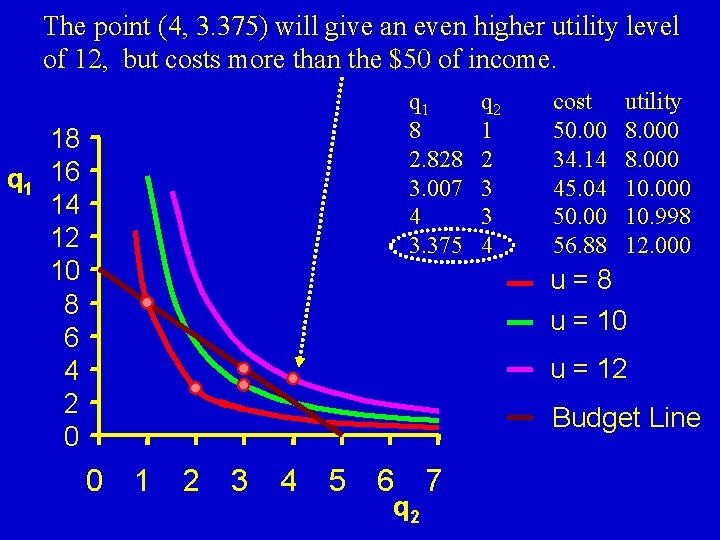
The point (4, 3. 375) will give an even higher utility level of 12, but costs more than the $50 of income. q 1 8 2. 828 3. 007 4 3. 375 18 q 1 16 14 12 10 8 6 4 2 0 q 2 1 2 3 3 4 cost 50. 00 34. 14 45. 04 50. 00 56. 88 utility 8. 000 10. 998 12. 000 u=8 u = 10 u = 12 Budget Line 0 1 2 3 4 5 6 q 2 7
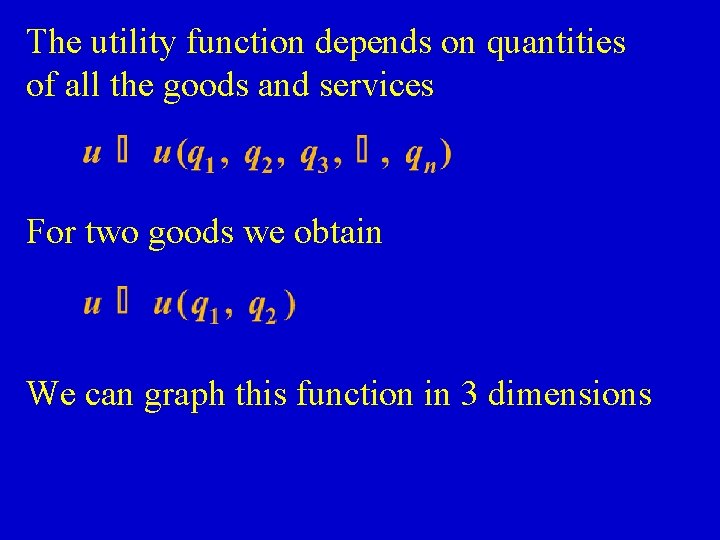
The utility function depends on quantities of all the goods and services For two goods we obtain We can graph this function in 3 dimensions
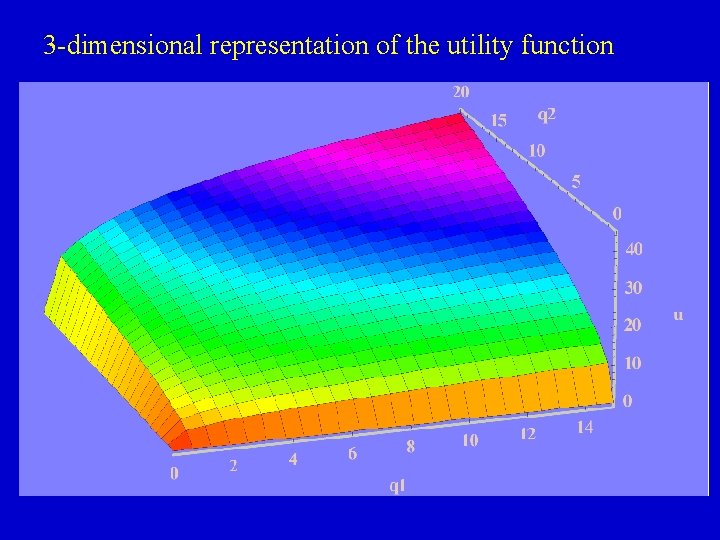
3 -dimensional representation of the utility function
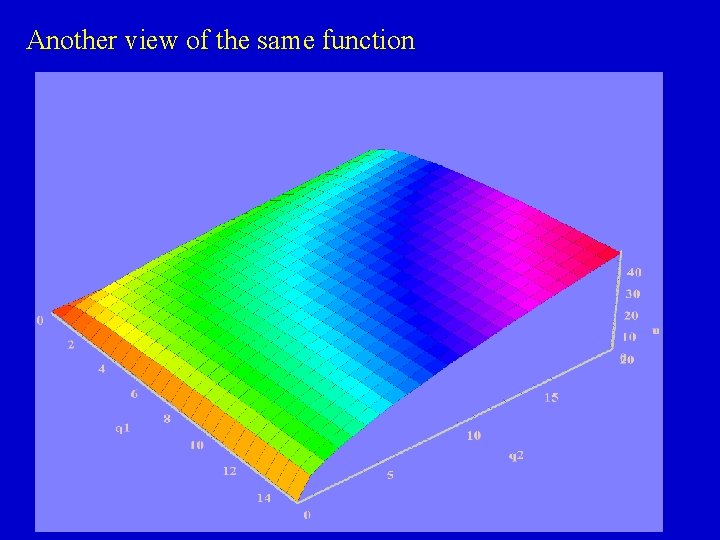
Another view of the same function
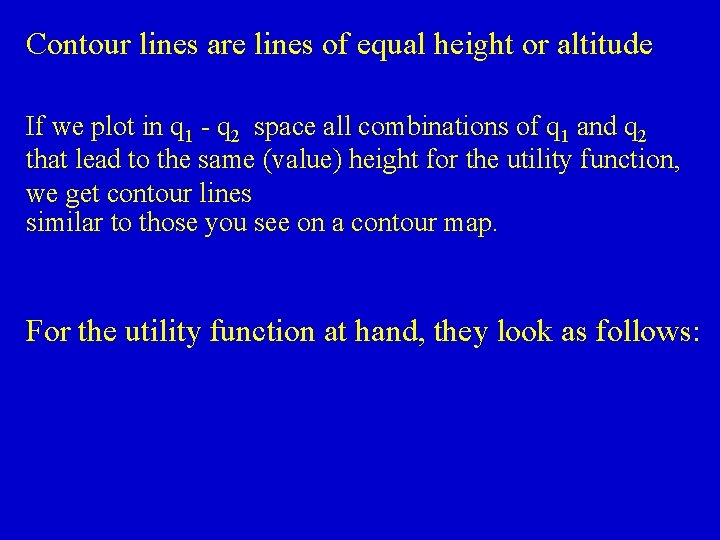
Contour lines are lines of equal height or altitude If we plot in q 1 - q 2 space all combinations of q 1 and q 2 that lead to the same (value) height for the utility function, we get contour lines similar to those you see on a contour map. For the utility function at hand, they look as follows:
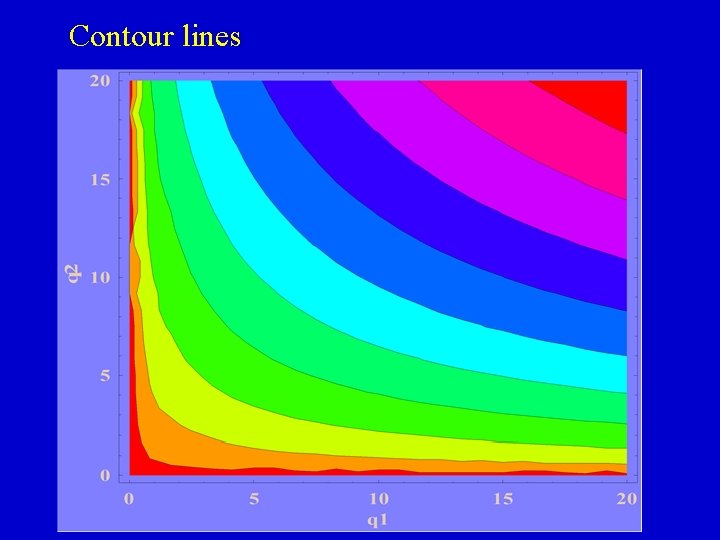
Contour lines
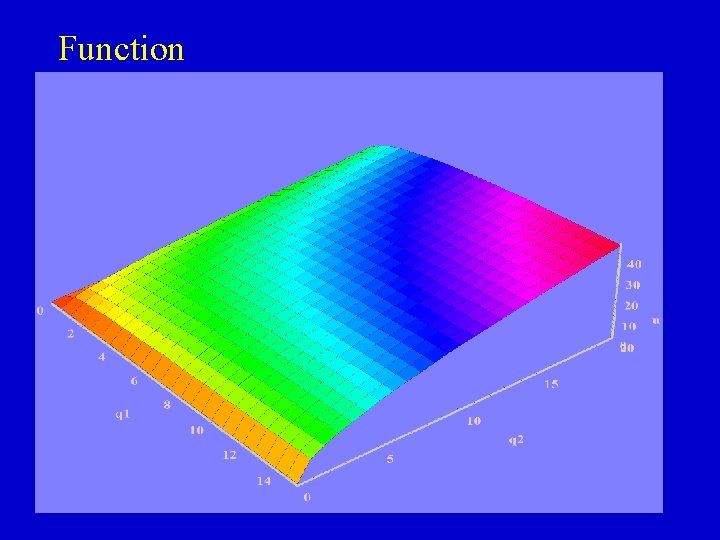
Function
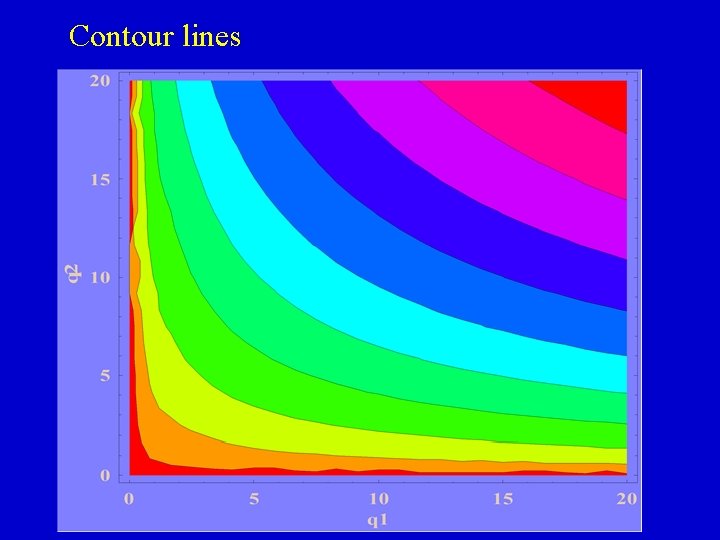
Contour lines
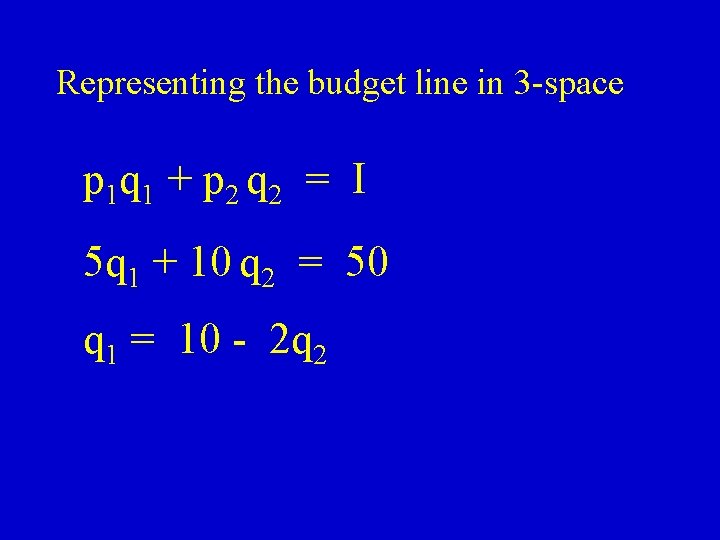
Representing the budget line in 3 -space p 1 q 1 + p 2 q 2 = I 5 q 1 + 10 q 2 = 50 q 1 = 10 - 2 q 2
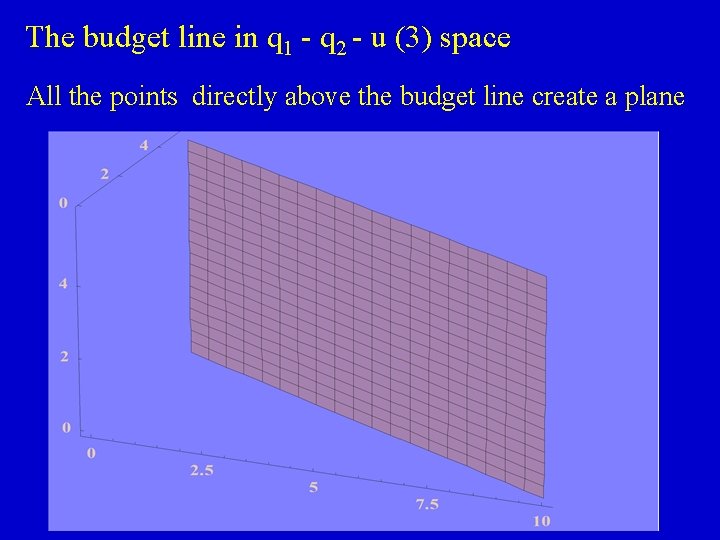
The budget line in q 1 - q 2 - u (3) space All the points directly above the budget line create a plane
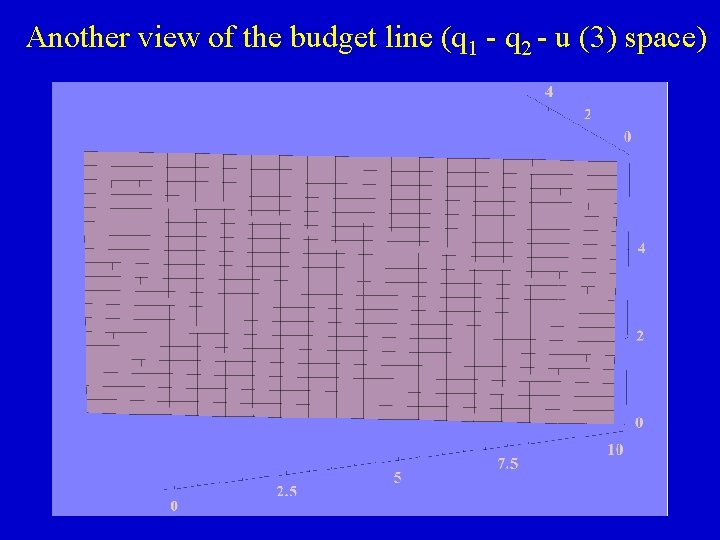
Another view of the budget line (q 1 - q 2 - u (3) space)
We can combine the budget line with the utility function to find the optimal consumption point
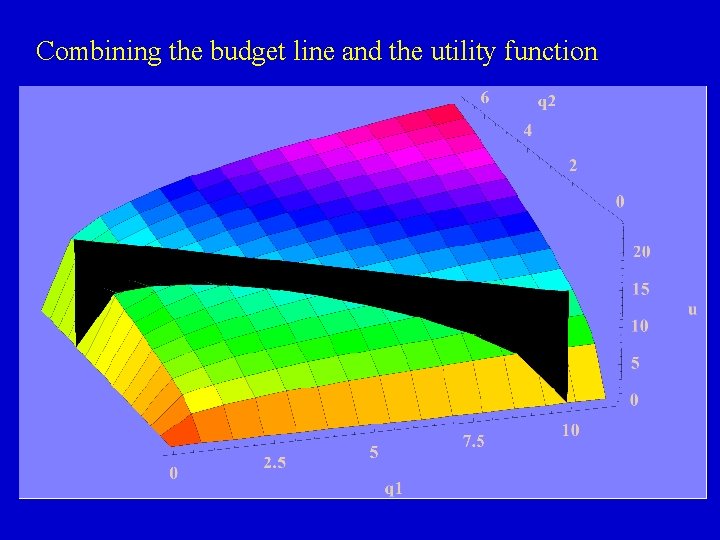
Combining the budget line and the utility function
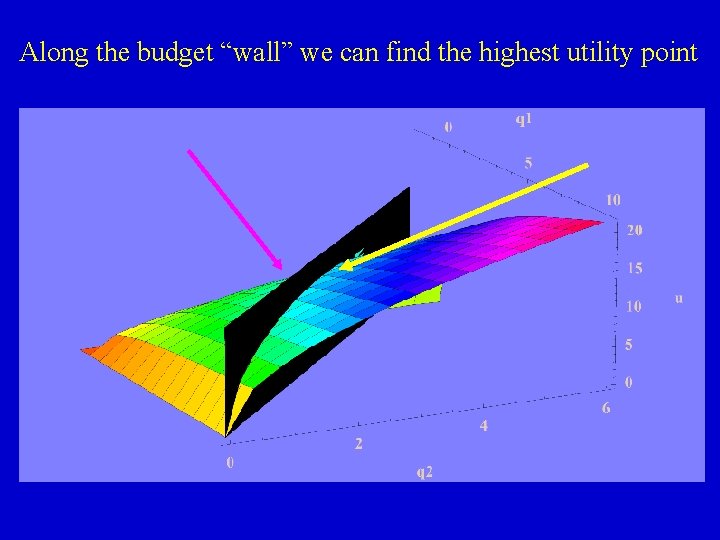
Along the budget “wall” we can find the highest utility point
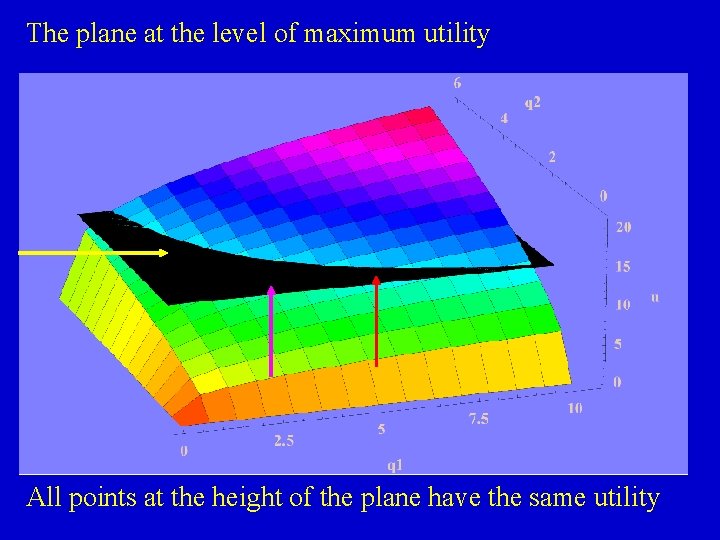
The plane at the level of maximum utility All points at the height of the plane have the same utility
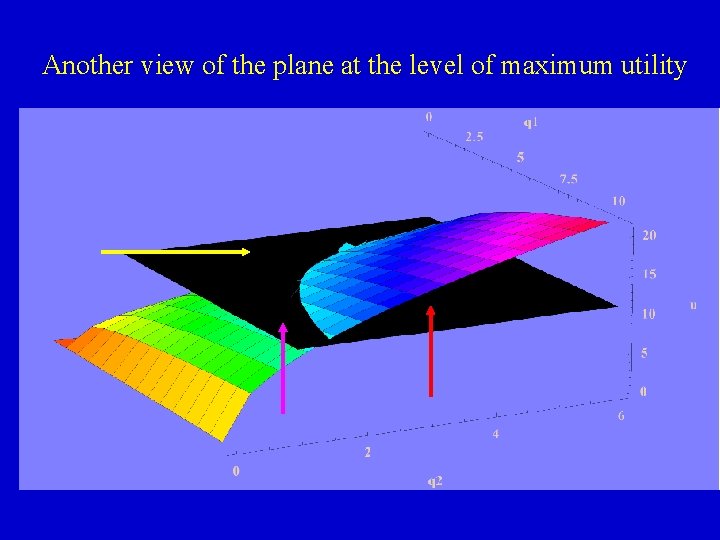
Another view of the plane at the level of maximum utility
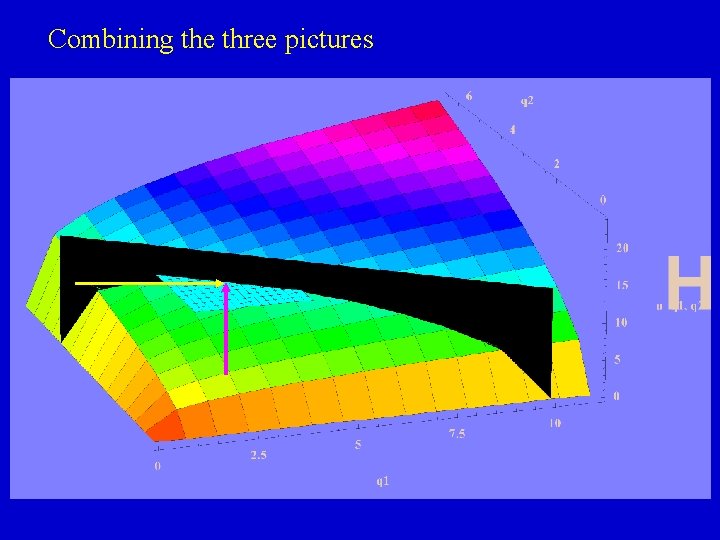
Combining the three pictures
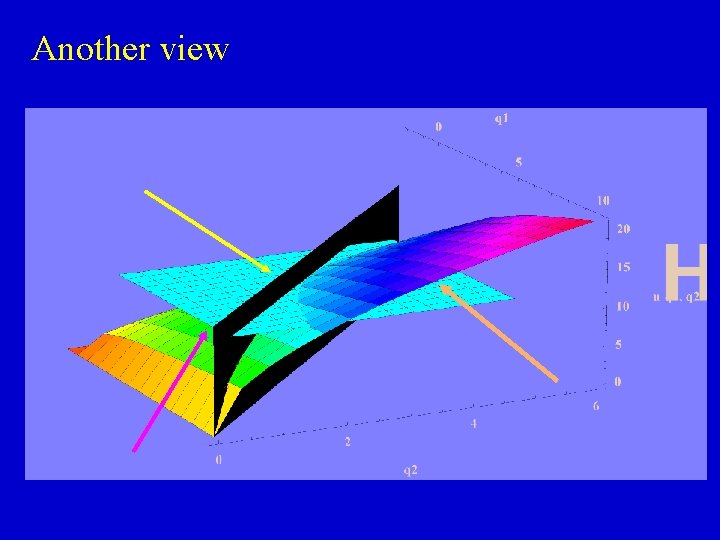
Another view
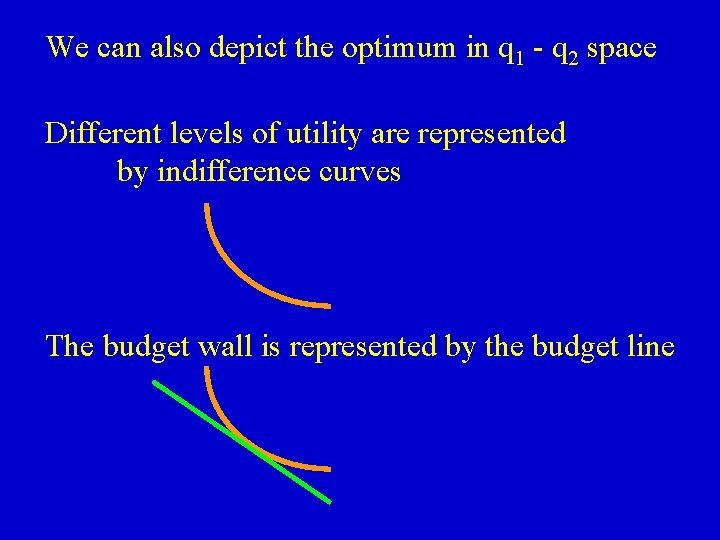
We can also depict the optimum in q 1 - q 2 space Different levels of utility are represented by indifference curves The budget wall is represented by the budget line
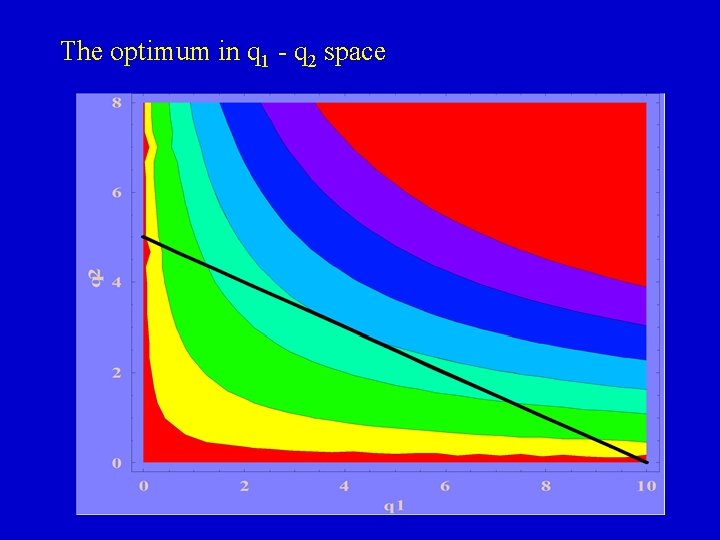
The optimum in q 1 - q 2 space
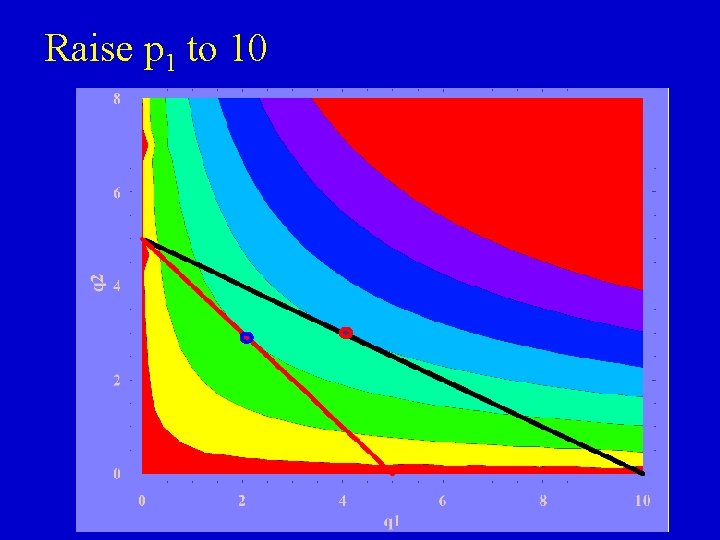
Raise p 1 to 10
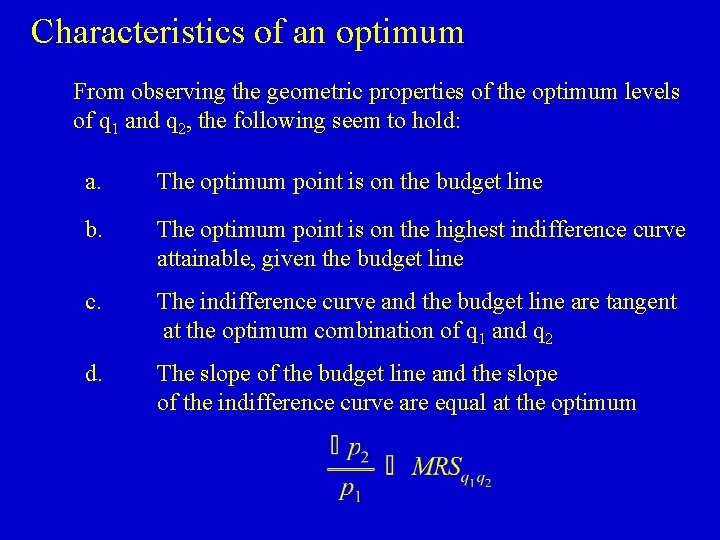
Characteristics of an optimum From observing the geometric properties of the optimum levels of q 1 and q 2, the following seem to hold: a. The optimum point is on the budget line b. The optimum point is on the highest indifference curve attainable, given the budget line c. The indifference curve and the budget line are tangent at the optimum combination of q 1 and q 2 d. The slope of the budget line and the slope of the indifference curve are equal at the optimum
Intuition for the conditions The budget line tells us the rate at which the consumer is able to trade one good for the other, given their relative prices and income
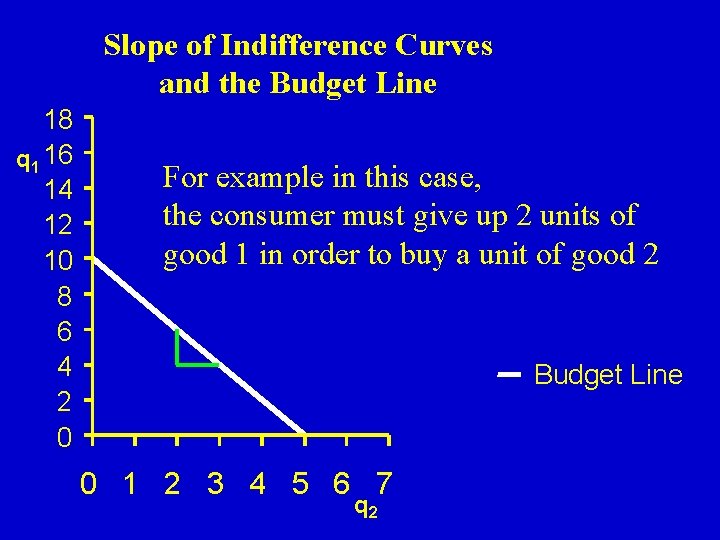
Slope of Indifference Curves and the Budget Line 18 q 1 16 14 12 10 8 6 4 2 0 For example in this case, the consumer must give up 2 units of good 1 in order to buy a unit of good 2 Budget Line 0 1 2 3 4 5 6 7 q 2
The indifference curve tells us the rate at which the consumer could trade one good for the other and remain indifferent.
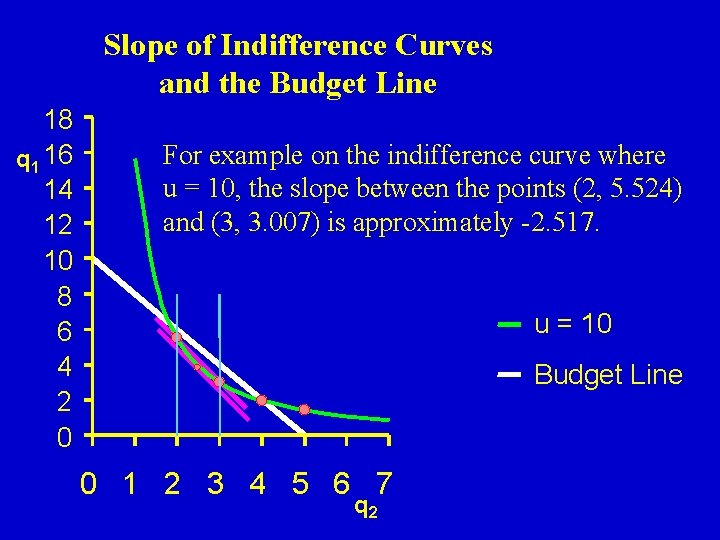
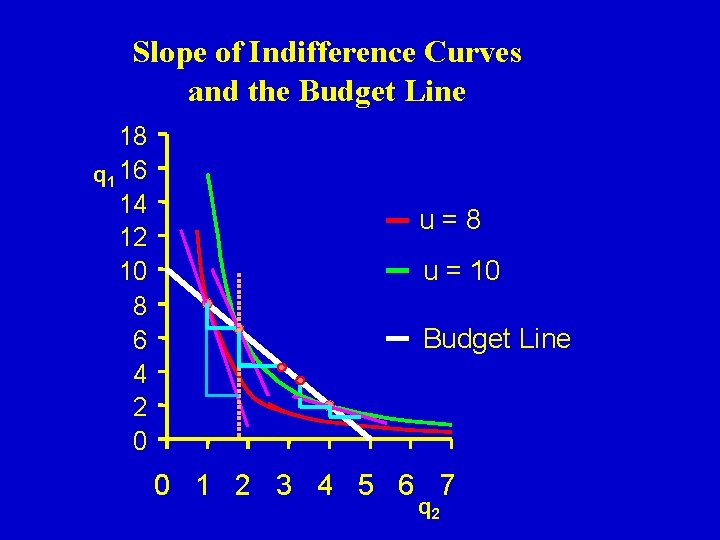
Slope of Indifference Curves and the Budget Line 18 q 1 16 14 12 10 8 6 4 2 0 For example on the indifference curve where u = 10, the slope between the points (2, 5. 524) and (3, 3. 007) is approximately -2. 517. u = 10 Budget Line 0 1 2 3 4 5 6 7 q 2
The consumer is willing give up 2. 517 units of good 1 for a unit of good 2, but only has to give up 2 units of good 1 for 1 unit of good 2 in terms of cost So give up some q 1
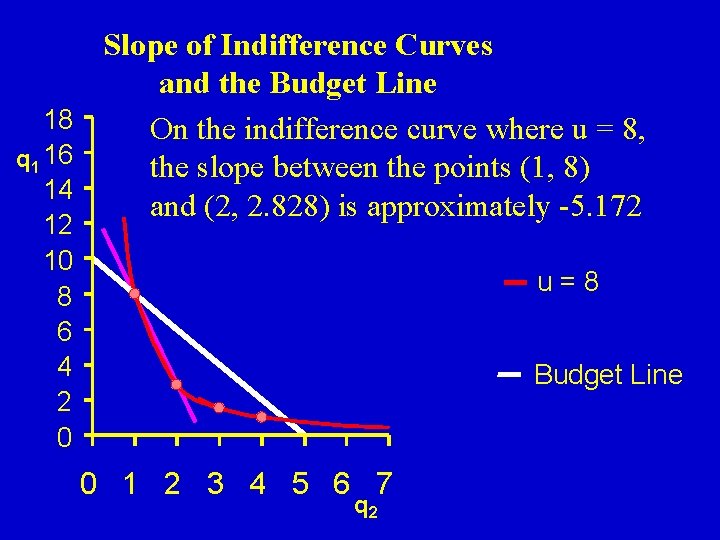
Slope of Indifference Curves and the Budget Line 18 On the indifference curve where u = 8, q 1 16 the slope between the points (1, 8) 14 and (2, 2. 828) is approximately -5. 172 12 10 8 6 4 2 0 u=8 Budget Line 0 1 2 3 4 5 6 7 q 2
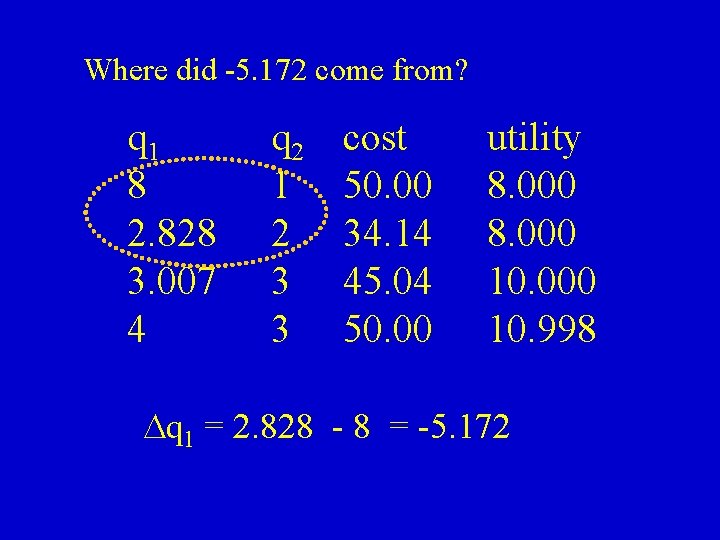
Where did -5. 172 come from? q 1 8 2. 828 3. 007 4 q 2 1 2 3 3 cost 50. 00 34. 14 45. 04 50. 00 utility 8. 000 10. 998 q 1 = 2. 828 - 8 = -5. 172
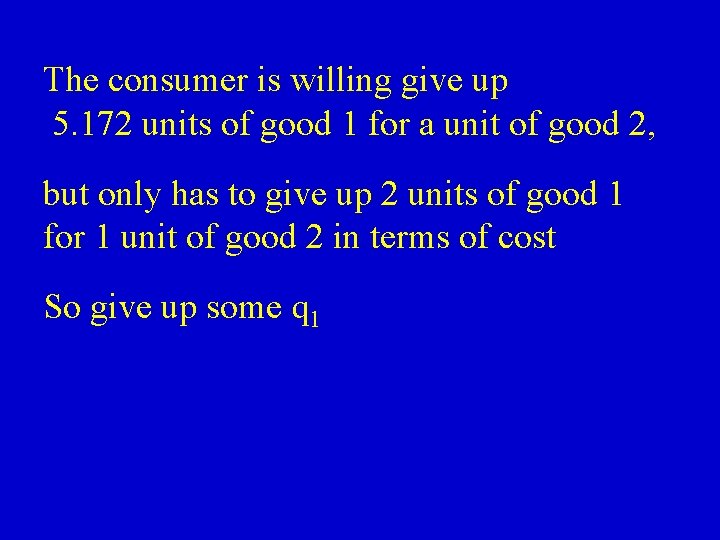
The consumer is willing give up 5. 172 units of good 1 for a unit of good 2, but only has to give up 2 units of good 1 for 1 unit of good 2 in terms of cost So give up some q 1
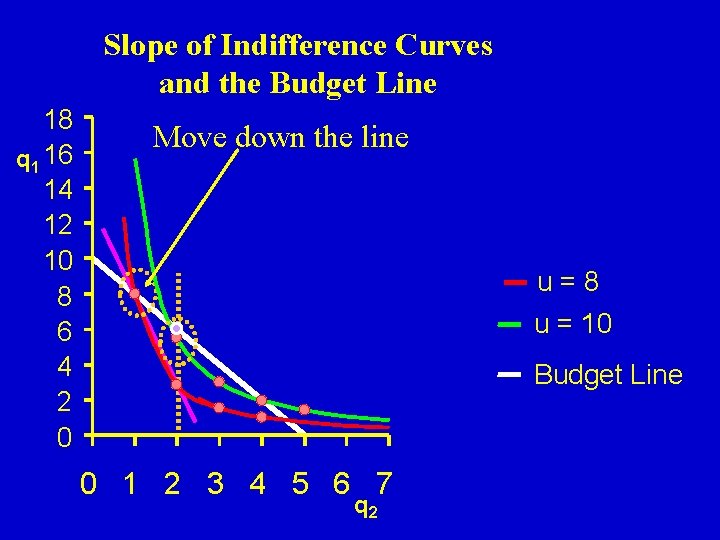
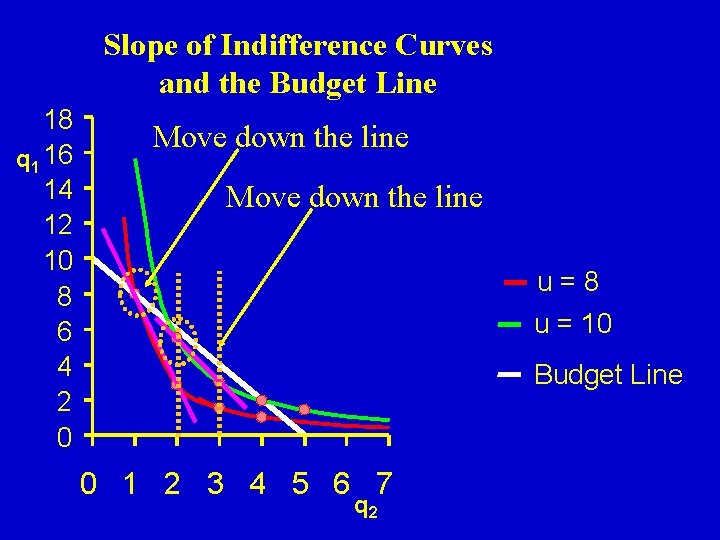
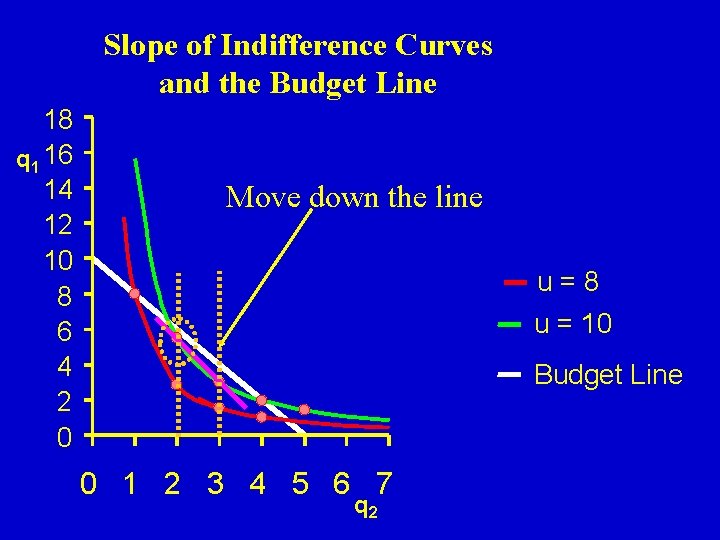
Slope of Indifference Curves and the Budget Line 18 q 1 16 14 12 10 8 6 4 2 0 Move down the line u=8 u = 10 Budget Line 0 1 2 3 4 5 6 7 q 2
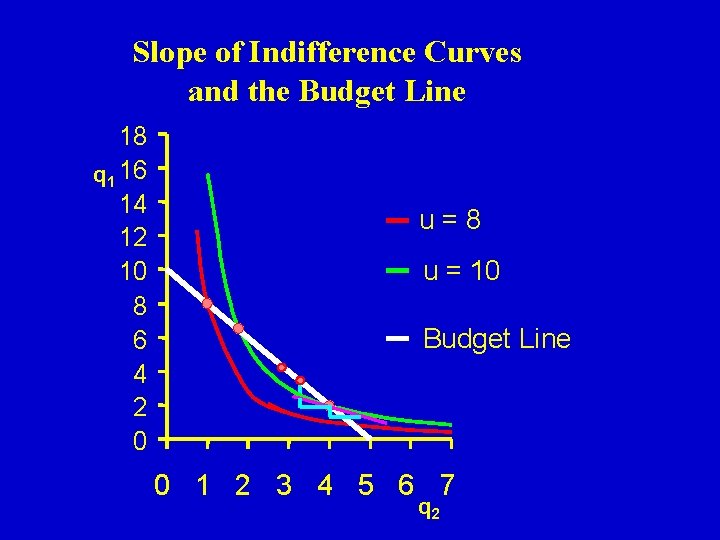
If the consumer is willing give up 5. 172 units of good 1 for a unit of good 2, but only has to give up 2 units (in terms of cost), the consumer will make the move down the budget line, and consume more of q 2
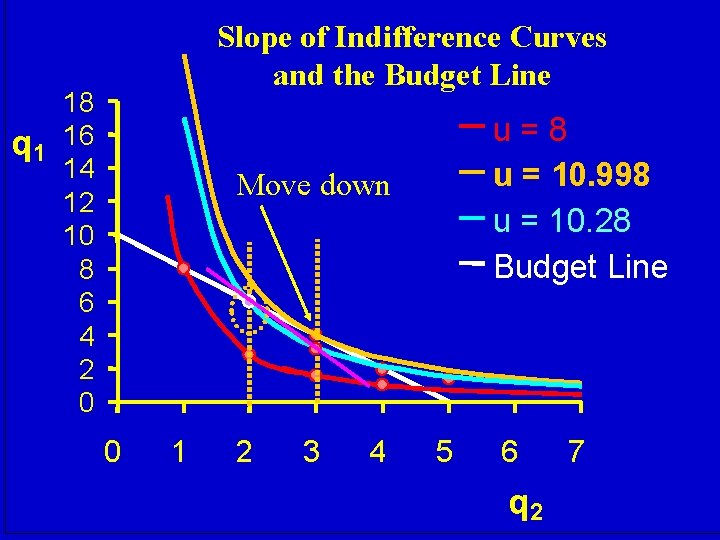
Slope of Indifference Curves and the Budget Line 18 q 1 16 14 12 10 8 6 4 2 0 u=8 u = 10. 998 u = 10. 28 Budget Line Move down 0 1 2 3 4 5 6 q 2 7
If the consumer is willing give up 2. 517 units of good 1 for a unit of good 2, but only has to give up 2 units (in terms of cost), the consumer will make the move down the budget line, and consume more of q 2
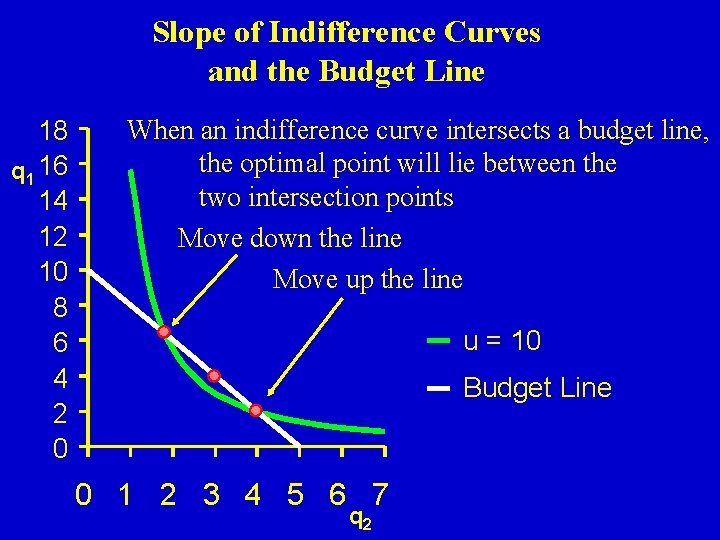
When the slope of the indifference curve is steeper than the budget line, the consumer will move down the line When the slope of the indifference curve is less steep than the budget line, the consumer will move up the line
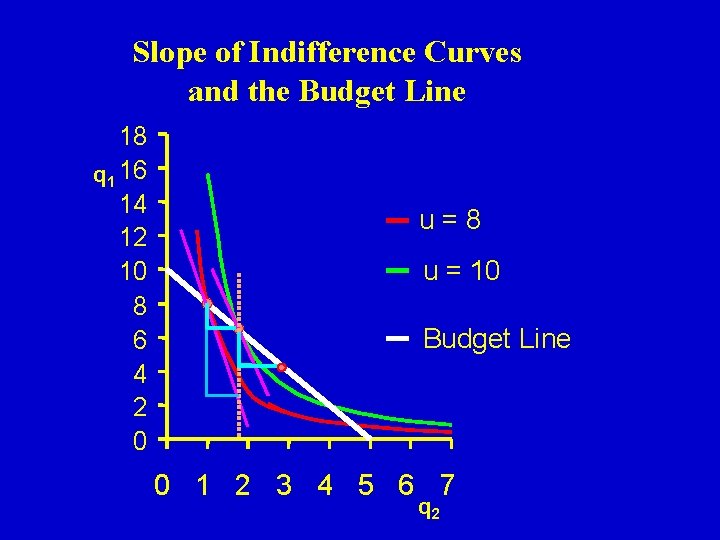
Slope of Indifference Curves and the Budget Line 18 q 1 16 14 12 10 8 6 4 2 0 u=8 u = 10 Budget Line 0 1 2 3 4 5 6 7 q 2
Slope of Indifference Curves and the Budget Line 18 q 1 16 14 12 10 8 6 4 2 0 u=8 u = 10 Budget Line 0 1 2 3 4 5 6 7 q 2
Slope of Indifference Curves and the Budget Line 18 q 1 16 14 12 10 8 6 4 2 0 u=8 u = 10. 998 Budget Line 0 1 2 3 4 5 6 q 2 7
Slope of Indifference Curves and the Budget Line 18 q 1 16 14 12 10 8 6 4 2 0 When an indifference curve intersects a budget line, the optimal point will lie between the two intersection points Move down the line Move up the line u = 10 Budget Line 0 1 2 3 4 5 6 7 q 2
Slope of Indifference Curves and the Budget Line 18 q 1 16 14 12 10 8 6 4 2 0 u = 10. 998 0 1 2 3 4 5 6 q 2 7
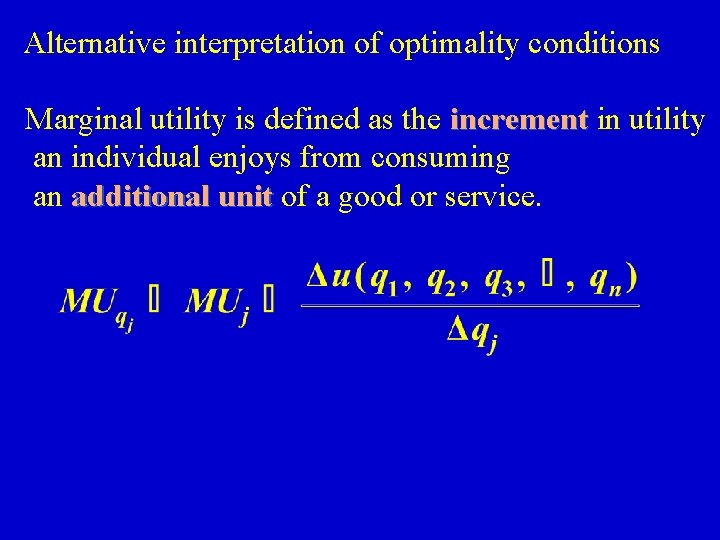
Alternative interpretation of optimality conditions Marginal utility is defined as the increment in utility an individual enjoys from consuming an additional unit of a good or service.
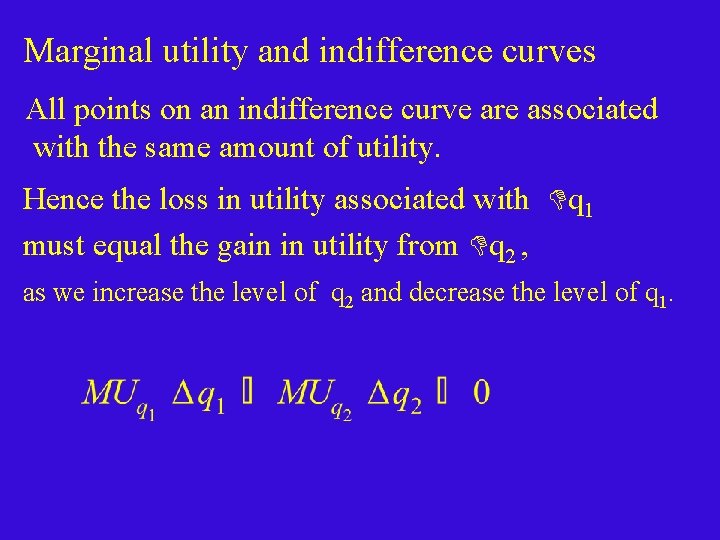
Marginal utility and indifference curves All points on an indifference curve are associated with the same amount of utility. Hence the loss in utility associated with q 1 must equal the gain in utility from q 2 , as we increase the level of q 2 and decrease the level of q 1.
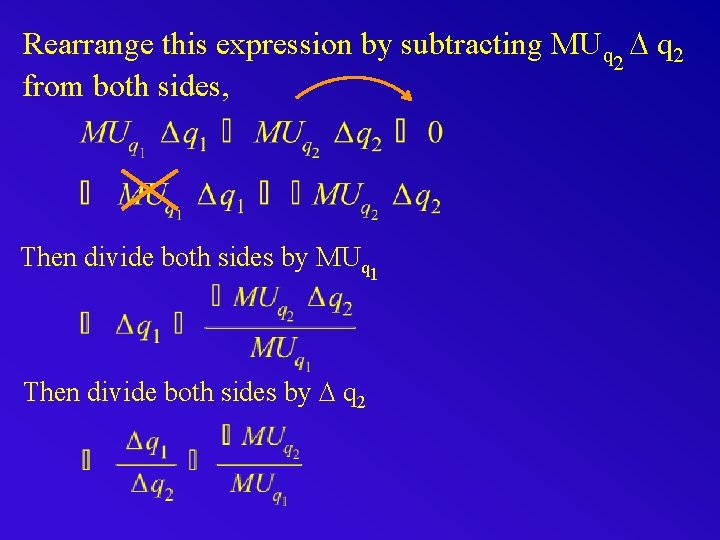
Rearrange this expression by subtracting MUq 2 from both sides, Then divide both sides by MUq 1 Then divide both sides by q 2
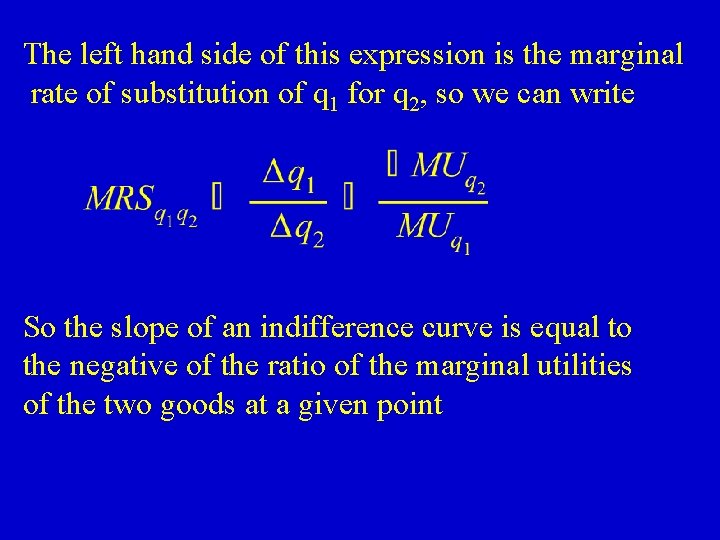
The left hand side of this expression is the marginal rate of substitution of q 1 for q 2, so we can write So the slope of an indifference curve is equal to the negative of the ratio of the marginal utilities of the two goods at a given point
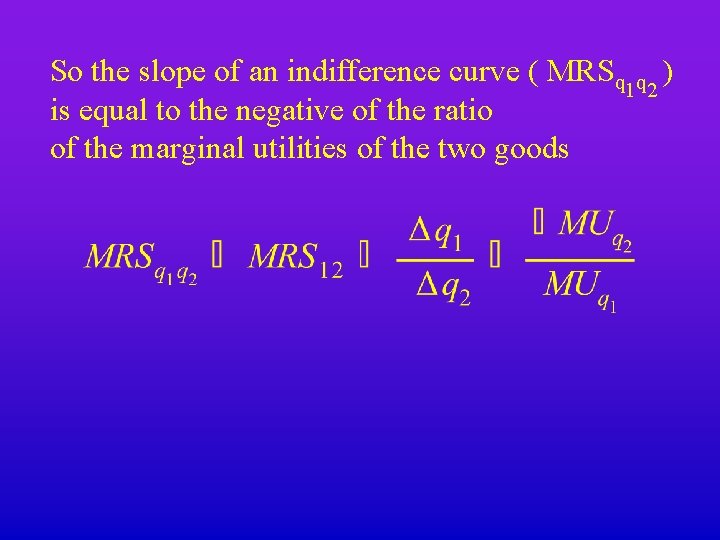
So the slope of an indifference curve ( MRSq 1 q 2 ) is equal to the negative of the ratio of the marginal utilities of the two goods
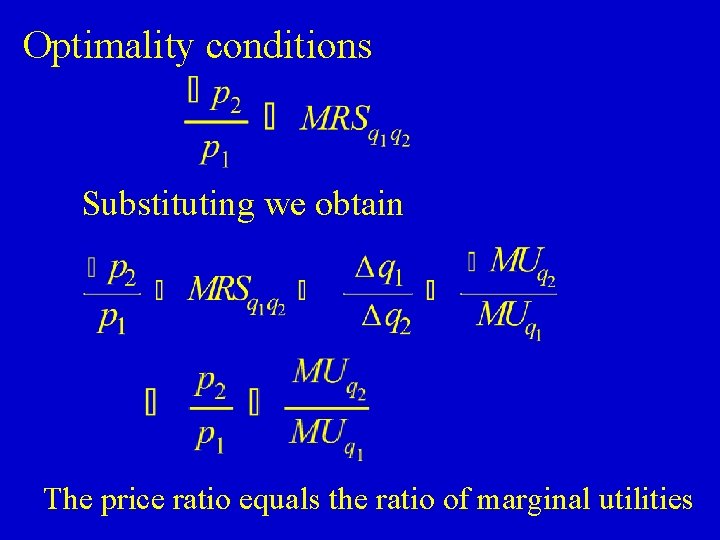
Optimality conditions Substituting we obtain The price ratio equals the ratio of marginal utilities
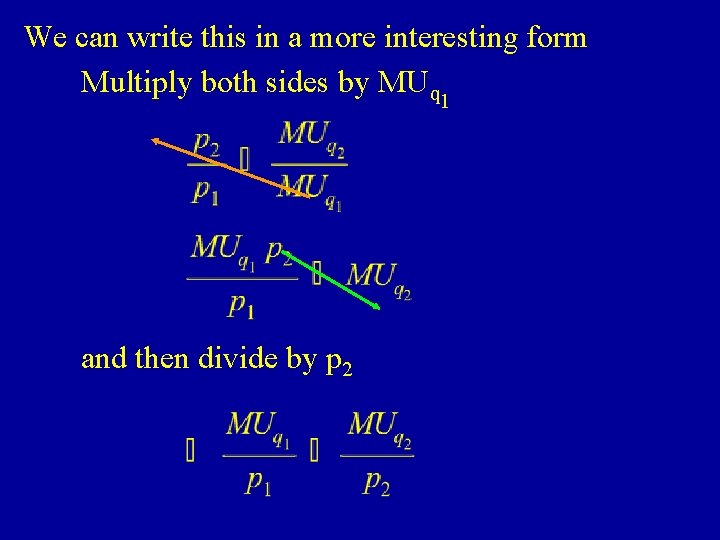
We can write this in a more interesting form Multiply both sides by MUq 1 and then divide by p 2
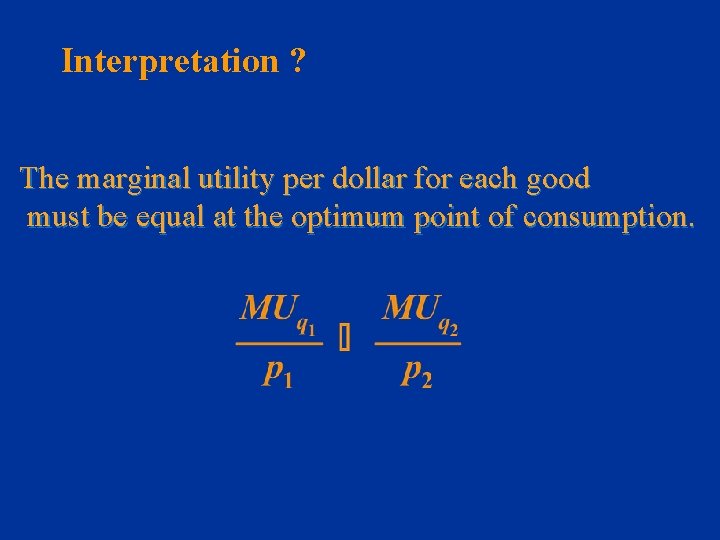
Interpretation ? The marginal utility per dollar for each good must be equal at the optimum point of consumption.
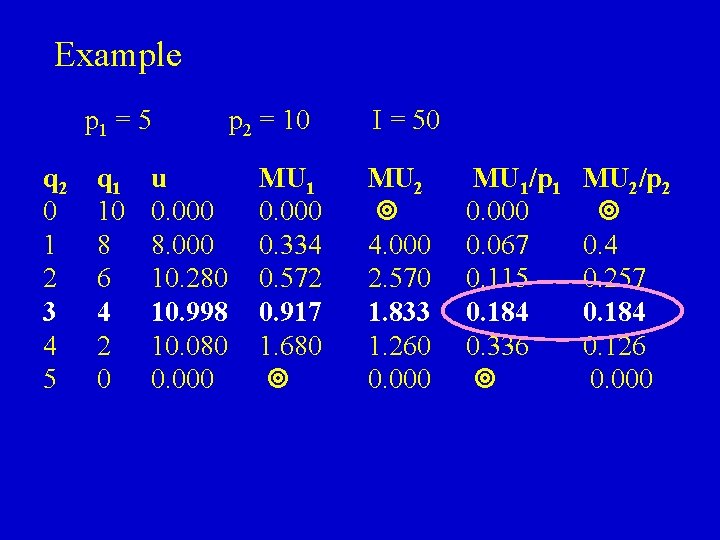
Example p 1 = 5 q 2 0 1 2 3 4 5 q 1 10 8 6 4 2 0 u 0. 000 8. 000 10. 280 10. 998 10. 080 0. 000 p 2 = 10 MU 1 0. 000 0. 334 0. 572 0. 917 1. 680 I = 50 MU 2 4. 000 2. 570 1. 833 1. 260 0. 000 MU 1/p 1 0. 000 0. 067 0. 115 0. 184 0. 336 MU 2/p 2 0. 4 0. 257 0. 184 0. 126 0. 000
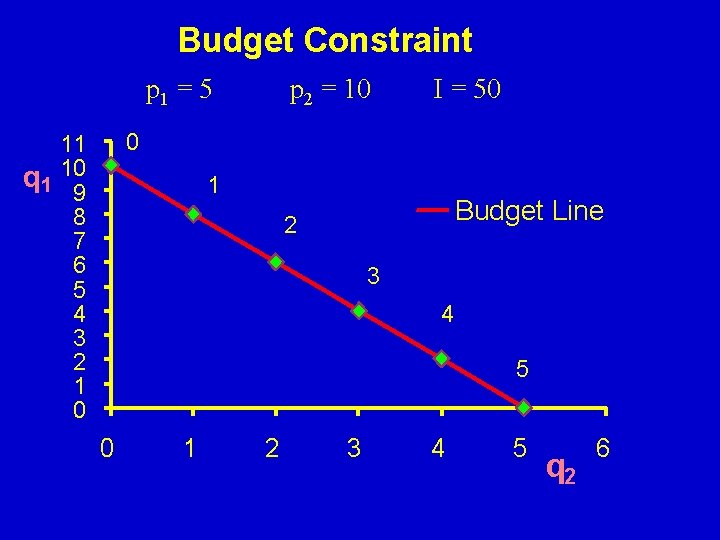
Budget Constraint p 1 = 5 p 2 = 10 I = 50 0 11 q 1 109 8 7 6 5 4 3 2 1 0 1 Budget Line 2 3 4 5 0 1 2 3 4 5 q 2 6
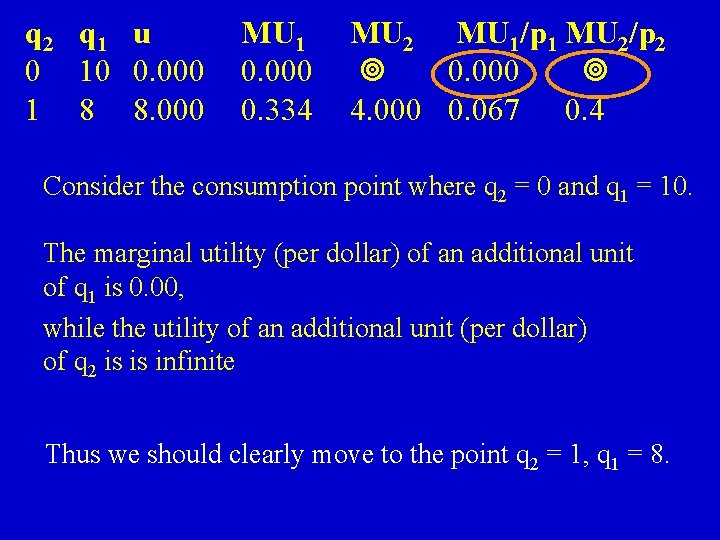
q 2 q 1 u 0 10 0. 000 1 8 8. 000 MU 1 0. 000 0. 334 MU 2 MU 1/p 1 MU 2/p 2 0. 000 4. 000 0. 067 0. 4 Consider the consumption point where q 2 = 0 and q 1 = 10. The marginal utility (per dollar) of an additional unit of q 1 is 0. 00, while the utility of an additional unit (per dollar) of q 2 is is infinite Thus we should clearly move to the point q 2 = 1, q 1 = 8.
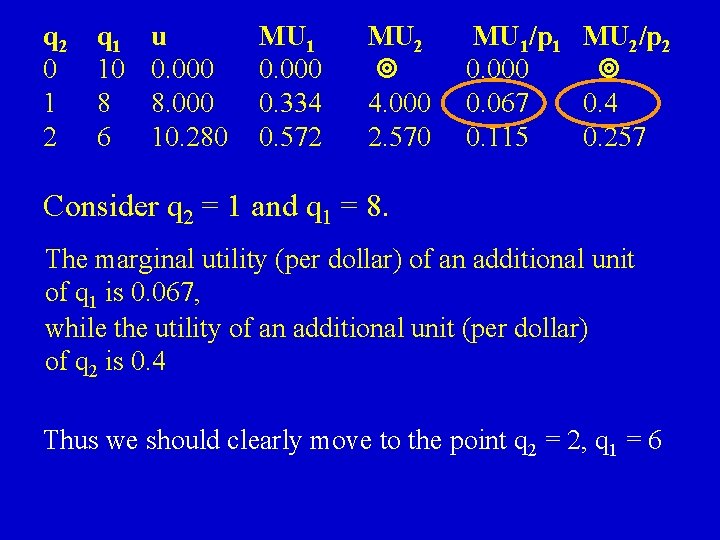
q 2 0 1 2 q 1 10 8 6 u 0. 000 8. 000 10. 280 MU 1 0. 000 0. 334 0. 572 MU 2 4. 000 2. 570 MU 1/p 1 MU 2/p 2 0. 000 0. 067 0. 4 0. 115 0. 257 Consider q 2 = 1 and q 1 = 8. The marginal utility (per dollar) of an additional unit of q 1 is 0. 067, while the utility of an additional unit (per dollar) of q 2 is 0. 4 Thus we should clearly move to the point q 2 = 2, q 1 = 6
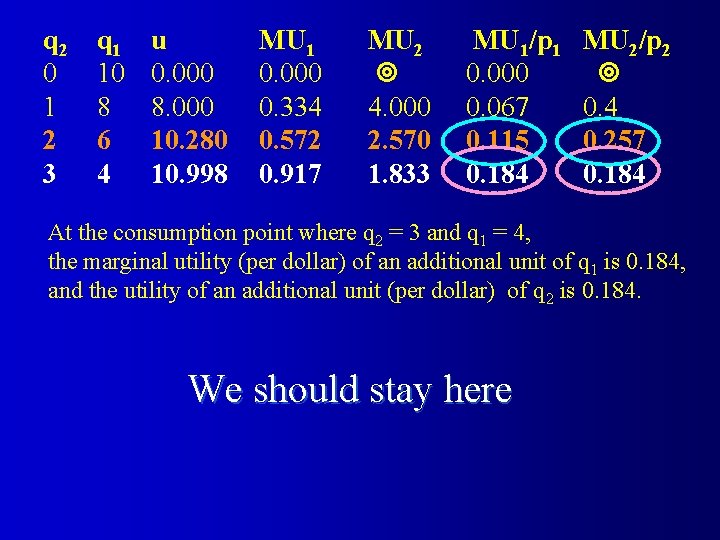
q 2 0 1 2 3 q 1 10 8 6 4 u 0. 000 8. 000 10. 280 10. 998 MU 1 0. 000 0. 334 0. 572 0. 917 MU 2 4. 000 2. 570 1. 833 MU 1/p 1 0. 000 0. 067 0. 115 0. 184 MU 2/p 2 0. 4 0. 257 0. 184 At the consumption point where q 2 = 3 and q 1 = 4, the marginal utility (per dollar) of an additional unit of q 1 is 0. 184, and the utility of an additional unit (per dollar) of q 2 is 0. 184. We should stay here
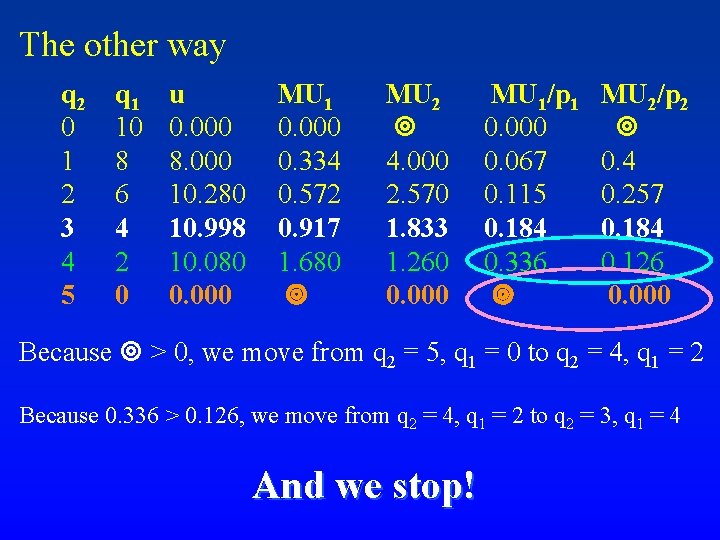
The other way q 2 0 1 2 3 4 5 q 1 10 8 6 4 2 0 u 0. 000 8. 000 10. 280 10. 998 10. 080 0. 000 MU 1 0. 000 0. 334 0. 572 0. 917 1. 680 MU 2 4. 000 2. 570 1. 833 1. 260 0. 000 MU 1/p 1 0. 000 0. 067 0. 115 0. 184 0. 336 MU 2/p 2 0. 4 0. 257 0. 184 0. 126 0. 000 Because > 0, we move from q 2 = 5, q 1 = 0 to q 2 = 4, q 1 = 2 Because 0. 336 > 0. 126, we move from q 2 = 4, q 1 = 2 to q 2 = 3, q 1 = 4 And we stop!
The End
Slope of Indifference Curves and the Budget Line 18 q 1 16 14 12 10 8 6 4 2 0 u=8 u = 10 Budget Line 0 1 2 3 4 5 6 7 q 2
Slope of Indifference Curves and the Budget Line 18 q 1 16 14 12 10 8 6 4 2 0 Move down the line u=8 u = 10 Budget Line 0 1 2 3 4 5 6 7 q 2
Slope of Indifference Curves and the Budget Line 18 q 1 16 14 12 10 8 6 4 2 0 Move down the line u=8 u = 10 Budget Line 0 1 2 3 4 5 6 7 q 2
- Slides: 102