
Consumer Learning Consumer Behaviour Canadian Edition SchiffmanKanukDas Copyright
Consumer Learning Consumer Behaviour Canadian Edition Schiffman/Kanuk/Das Copyright © 2006 Pearson Education Canada Inc.
Consumer Learning A process by which individuals acquire the purchase and consumption knowledge and experience that they apply to future related behaviour. Copyright © 2006 Pearson Education Canada Inc. 6 -2
Importance of Learning n Marketers must teach consumers: – where to buy – how to use – how to maintain – how to dispose of products Copyright © 2006 Pearson Education Canada Inc. 6 -3
LEARNING Learning: perubahan perilaku yang relatif permanen yang disebabkan oleh pengalaman (learning refers to a relative permanent change in behavior that is caused by experience). 2. Pengalaman dimaksud bisa langsung atau sengaja (intensional), bisa pula pengalaman orang lain, bisa pula pembelajaran tidak sengaja yang tanpa diikuti oleh praktek yang disebut accidental learning. 3. Encompasses the total range of learning, from simple to complex problem solving 4. Learning adalah proses yang berlangsung terusmenerus. Pengetahuan kita tentang dunia sekitar direvisi terus-menerus, karena kita juga bertemu dengan stimuli baru hari demi hari (Solomon, Michael. R) 1.
Learning Processes n Intentional – learning acquired as a result of a careful search for information n Incidental -- learning acquired by accident or without much effort Copyright © 2006 Pearson Education Canada Inc. 6 -5
Learning Theories n Behavioural Theories: n Theories based on the premise that learning takes place as the result of observable responses to external stimuli. Also known as stimulus response theory. Copyright © 2006 Pearson Education Canada Inc. Cognitive Theories: A theory of learning based on mental information processing, often in response to problem solving. 6 -6
Behavioural Learning Theories n Classical Conditioning n Instrumental Conditioning n Modeling or Observational Learning Copyright © 2006 Pearson Education Canada Inc. 6 -7
BEHAVIORAL THEORY Berpandangan bahwa learning merupakan suatu mekanisme proses: STIMULUS LEARNING n Premise: Observable responses to specific external stimuli signal that learning has taken place. n Behavioral theorist are not so much concerned with the process of learning n Dua teori yang terkenal: CLASSICAL CONDITIONING dan INSTRUMENTAL CONDITIONING. n
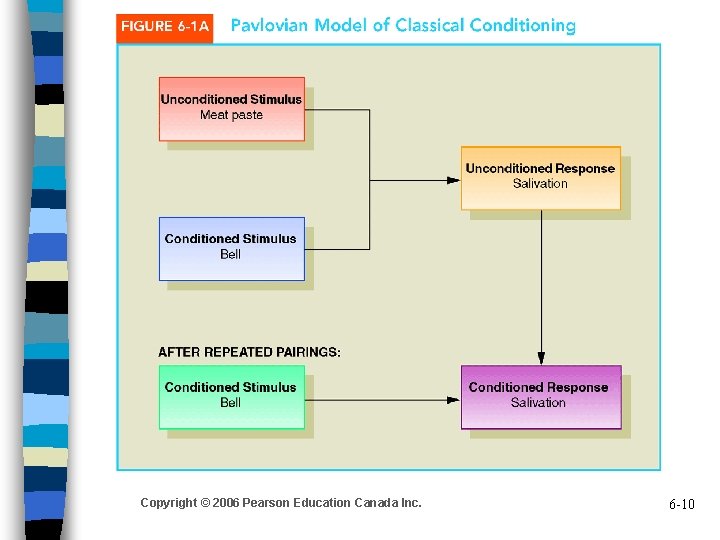
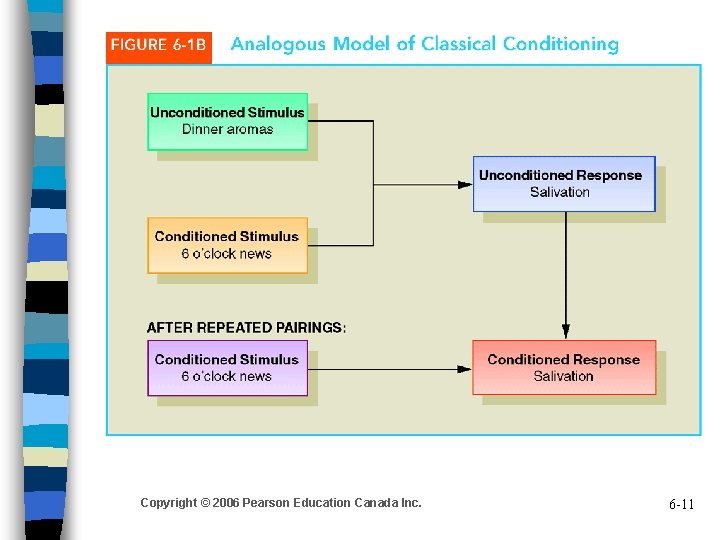
Classical Conditioning n Pairing a stimulus with another stimulus that elicits a known response to produce the same response when used alone. n http: //almaz. com/nobel/medicine/1904 a. htm l Copyright © 2006 Pearson Education Canada Inc. 6 -9
Copyright © 2006 Pearson Education Canada Inc. 6 -10
Copyright © 2006 Pearson Education Canada Inc. 6 -11
Classical conditioning – cont’d n Classical conditioning is the learning of associations among events that allows us to anticipate and represent our environment. n From this viewpoint, classical conditioning is not reflexive action, but rather the acquisition of new knowledge Copyright © 2006 Pearson Education Canada Inc. 6 -12
THE DEVELOPMENT OF CLASSICAL CONDITIONING n Neo-Pavlovian Theory, Cognitive Associative Learning n The relationship between CS (bell) and US (meat) influenced dog’s expectation, which in turn influenced their behavior. n Jadi, classical conditioning bukan tindakan spontan, tetapi cognitive associative learning, the acquisition of new knowledge about the world
Neo-Pavlovian Conditioning How to create strong association between CS and US? n Forward Conditioning (CS Precedes US) n Repeated Pairings of CS and US n A CS and US that Logically Belong to Each Other n A CS that is Novel and Unfamiliar n A US that is Biologically or Symbolically Salient Copyright © 2006 Pearson Education Canada Inc. 6 -14
Strategic Applications of Classical Conditioning n Repetition n Stimulus Generalization – The inability to perceive differences between slightly dissimilar stimuli. n Stimulus Discrimination Copyright © 2006 Pearson Education Canada Inc. 6 -15
Repetition n Repetition increases strength of associations and slows forgetting n but over time may result in advertising wearout. n Cosmetic variations reduce satiation. Copyright © 2006 Pearson Education Canada Inc. 6 -16
Three-Hit Theory n Repetition is the basis for the idea that three exposures to an ad are necessary for the ad to be effective n The number of actual repetitions to equal three exposures is in question. Copyright © 2006 Pearson Education Canada Inc. 6 -17
Stimulus Generalization n The inability to perceive differences between slightly dissimilar stimuli. n Marketing applications – Product Line, Form and Category Extensions – Family Branding – Licensing – Generalizing Usage Situations – Internally, inclusive Copyright © 2006 Pearson Education Canada Inc. 6 -18
Stimulus Discrimination n The ability to select a specific stimulus from among similar stimuli because of perceived differences. n Assosiasi eksklusif externally Copyright © 2006 Pearson Education Canada Inc. 6 -19
Classical Conditioning and Marketing Strategy n Identify and pair product with a known, well -liked stimulus – More attention – More favourable attitudes – Greater intention to buy the product – Learning of key attributes n Use stimulus generalization effectively » Continued Copyright © 2006 Pearson Education Canada Inc. 6 -20
Classical Conditioning and Marketing Strategy n Distinguish the product through effective use of stimulus discrimination Copyright © 2006 Pearson Education Canada Inc. 6 -21
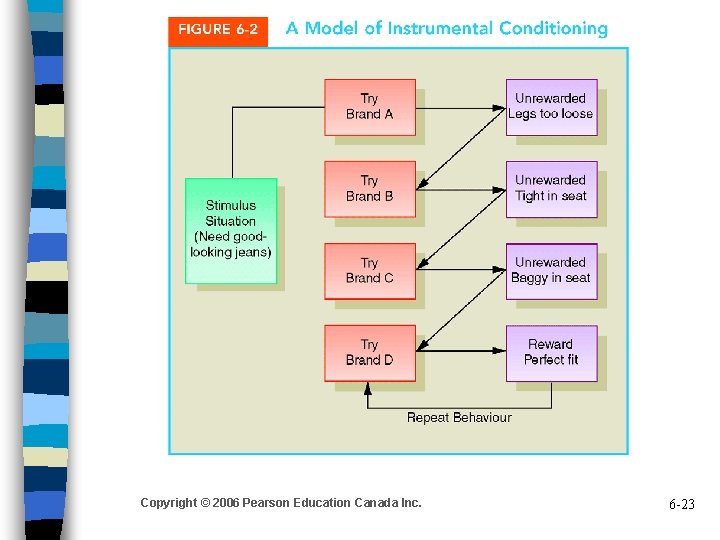
Instrumental (Operant) Conditioning n learning based on a trial-and-error process, with habits forced as the result of positive experiences (reinforcement) Copyright © 2006 Pearson Education Canada Inc. 6 -22
Copyright © 2006 Pearson Education Canada Inc. 6 -23
Instrumental Conditioning n Consumers learn by means of trial and error process in which some purchase behaviours result in more favorable outcomes (rewards) than other purchase behaviours. n A favorable experience is instrumental in teaching the individual to repeat a specific behaviour. Copyright © 2006 Pearson Education Canada Inc. 6 -24
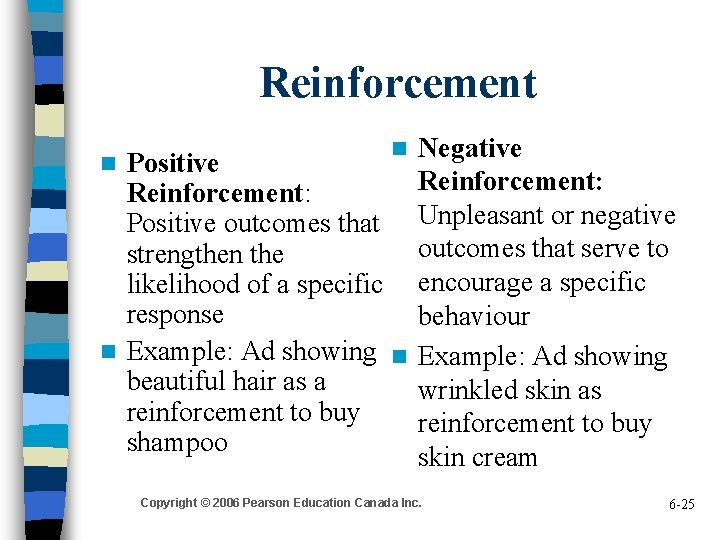
Reinforcement n Positive Reinforcement: Positive outcomes that strengthen the likelihood of a specific response n Example: Ad showing n beautiful hair as a reinforcement to buy shampoo n Negative Reinforcement: Unpleasant or negative outcomes that serve to encourage a specific behaviour Example: Ad showing wrinkled skin as reinforcement to buy skin cream Copyright © 2006 Pearson Education Canada Inc. 6 -25
Other Concepts in Reinforcement n Punishment – Choose reinforcement rather than punishment n Extinction - Combat with consumer satisfaction n Forgetting – Combat with repetition Copyright © 2006 Pearson Education Canada Inc. 6 -26
Extinction n Extinction is the disappearance of a previously learned behavior when the behavior is not reinforced. n Extinction can occur in all types of behavioral conditioning, but it is most often associated with operant conditioning Copyright © 2006 Pearson Education Canada Inc. 6 -27
Instrumental Conditioning and Marketing n Make the product the ultimate reward n Provide samples and free trials n Provide non-product rewards n Practice relationship marketing n Reinforcement Schedules – Shaping n Massed versus Distributed Learning Copyright © 2006 Pearson Education Canada Inc. 6 -28
COGNITIVE LEARNING n Learning based on mental activity n Consider human being as problem solver n Learning involves complex mental processing of information

Cognitive Learning Theory n Learning through problem solving, which enables individuals to gain some control over their environment. n Three types: – Observational learning/modelling – Iconic Rote Learning – Reasoning Copyright © 2006 Pearson Education Canada Inc. 6 -30
Observational Learning n individuals learn by observing the behaviour of others, and consequences of such behaviour. n Also known as modeling or vicarious learning. Copyright © 2006 Pearson Education Canada Inc. 6 -31
Iconic Rote Learning n Learning concepts through simple repetition – Repeated ads teach consumers about a product’s attributes Copyright © 2006 Pearson Education Canada Inc. 6 -32
Reasoning n Highest level of cognitive learning n Involves creative thinking n Depends on how information is processed and stored Copyright © 2006 Pearson Education Canada Inc. 6 -33
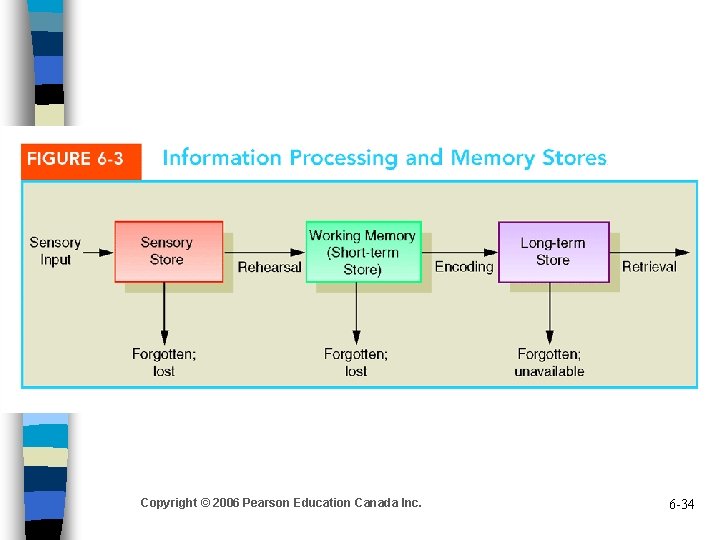
Copyright © 2006 Pearson Education Canada Inc. 6 -34
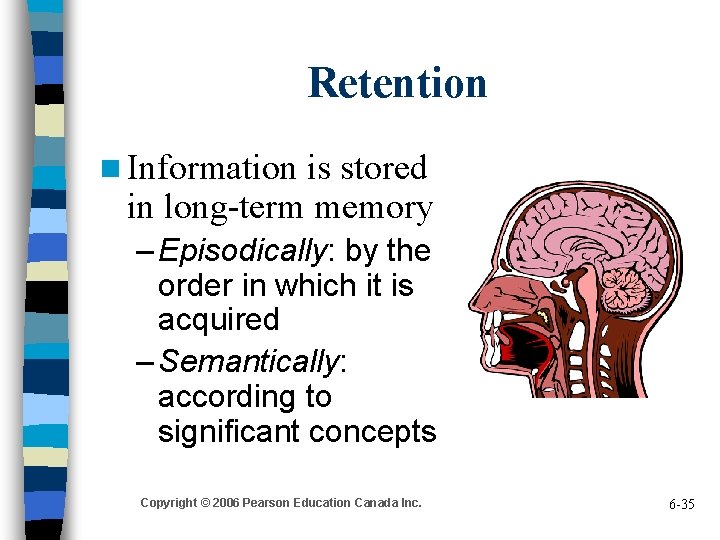
Retention n Information is stored in long-term memory – Episodically: by the order in which it is acquired – Semantically: according to significant concepts Copyright © 2006 Pearson Education Canada Inc. 6 -35
Information processing and Involvement Theory n Central and Peripheral Routes to Persuasion – highly involved consumers are best reached through ads that focus on the specific attributes of the product (the central route) – uninvolved consumers can be attracted through peripheral advertising cues such as the model or the setting (the peripheral route). Copyright © 2006 Pearson Education Canada Inc. 6 -36
Elaboration Likelihood Model (ELM) n a person’s level of involvement during message processing determines which route to persuasion is likely to be effective Copyright © 2006 Pearson Education Canada Inc. 6 -37
n Dalam mengelaborasi pesan (message), individu akan menempuh dua jalur berdasarkan keterlibatan (involvement). Mereka yang memiliki keterlibatan tinggi, akan menempuh rute pusat (central route), yaitu mengelaborasi informasi atau argument utama. Audiens yang memiliki keterlibatan rendah akan menempuh rute pinggiran (pheripheral route), yaitu mengelaborasi cues atau bagian stimuli yang bukan informasi atau argument (seperti estetika, bintang iklan) Copyright © 2006 Pearson Education Canada Inc. 6 -38
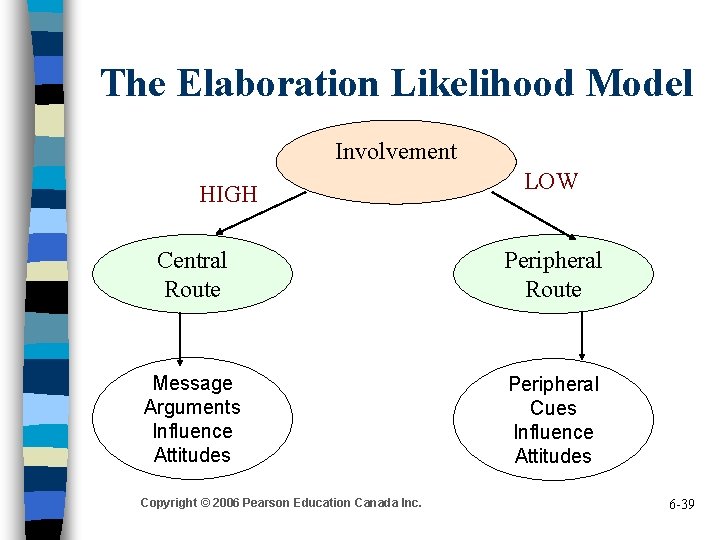
The Elaboration Likelihood Model Involvement HIGH LOW Central Route Peripheral Route Message Arguments Influence Attitudes Peripheral Cues Influence Attitudes Copyright © 2006 Pearson Education Canada Inc. 6 -39
Cognitive Learning and Marketing Strategy n Use rote learning to teach consumers about the brand n Use reasoning or problem solving for complex or high-involvement products n Use modelling to extinguish negative behaviour n Use knowledge of information processing to help consumers store, retain and retrieve messages. Copyright © 2006 Pearson Education Canada Inc. 6 -40
Measures of Consumer Learning n Recognition and Recall Measures – Aided and Unaided Recall n Cognitive Responses to Advertising n Copy-testing Measures n Attitudinal and Behavioural Measures of Brand Loyalty Copyright © 2006 Pearson Education Canada Inc. 6 -41
QUESTIONS 1. 2. 3. 4. Pantene uses Ariel Peterpan as brand endorser. Can your view based on this from learning concept? Imagine that Toyota Innova uses Kahiyang Ayu as brand endorser. Is it make sense from Cognitive Associative Learning? Many companies use SHAPING in their marketing practices. Can you identify marketing practices that can be categorized as SHAPING? COLA, a brand in soft drink category, sound slightly similar with COCACOLA. Is the use of that brand name make sense based-on learning concept?
QUESTIONS Can classical conditioning, instrumental conditioning (both are categorized as behavioral learning), and cognitive learning, be practiced simultaneously? 6. Awalnya ada pasta gigi Pepsodent. Belakangan dibuat sikat gigi pepsoden. Kenapa sikat gigi tidak 5.
QUESTIONS 7. Generalisasi stimulus dan diskriminasi stimulus merupakan dua di antara aplikasi classical conditioning. Keduanya merupakan aplikasi yang bertolak belakang. Kapan perusahaan melakukan generalisasi stimulus? Pada kondisi bagaimana perusahaan dapat melakukan diskriminasi stimulus?
- Slides: 44