
Consumer Ethics Consumer Social Responsibility Dr Afida Arif
Consumer Ethics & Consumer Social Responsibility Dr. Afida Arif PSP 4200 - Etika Pengguna & Peniaga Week 5 1 1

Consumer Ethics n Definition by Muncy & Vitell (1992): ‘The moral principles & standards that guide behavior of individuals or groups as they obtain, use and dispose of goods and services’ 2
Consumer Ethics Consumer ethics refers to the moral values & beliefs that individuals or groups observe when they buy, consumer and dispose of products & services n Also refers to the role of ethics in decisionmaking, including misconduct in the marketplace by consumers (e. g. shop lifting, failing to declare undercharging, buying counterfeit goods & downloading pirated digital products). n 3
Consumer Ethics Scale n Muncy 1. 2. 3. 4. 5. & Vitell ethics scale: Actively benefiting from illegal activities Passively benefiting Actively benefiting from deceptive but legal practices No harm activities Do the right thing (recently included in 2005) 4
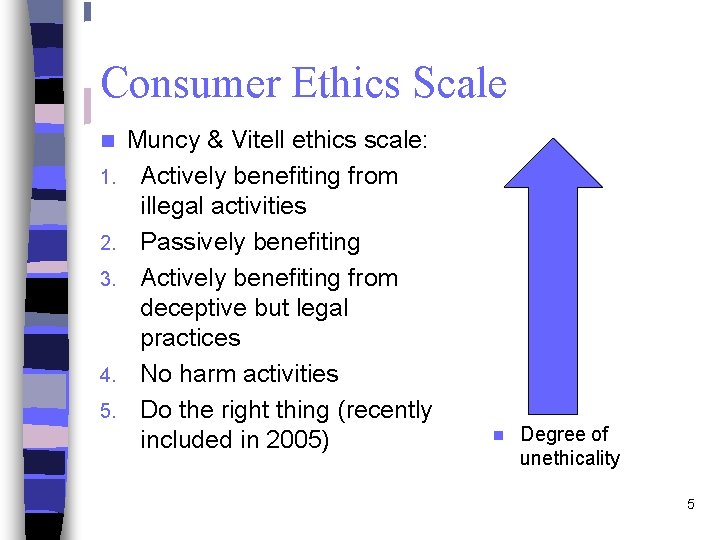
Consumer Ethics Scale n 1. 2. 3. 4. 5. Muncy & Vitell ethics scale: Actively benefiting from illegal activities Passively benefiting Actively benefiting from deceptive but legal practices No harm activities Do the right thing (recently included in 2005) n Degree of unethicality 5
Consumer Ethics Scale 1. Actively benefiting from illegal activities Consumer actively taking advantage of a situation at the expense of the seller. Examples: n Returning damaged goods when the damage was your own fault n Giving misleading price information to a cashier when the price tag has been peeled off n Drinking a can of soda in a store without paying for it 6
Consumer Ethics Scale 2. Passively benefiting Consumers passively benefiting themselves due to the seller’s mistake. Examples: n Not saying anything when the waiter or waitress miscalculates a bill in your favour n Getting too much change and not saying anything n Lying about a child’s age to get a lower price 7
Consumer Ethics Scale 3. Actively benefiting from deceptive but legal practices Consumers actively involved in unethical but not necessarily illegal practices. But still, the actions are morally questionable. Examples: n Keeps quiet when a waitress at the fast food restaurant serves you first instead of the other customer lining up in front of him n Returning merchandise to a store by claiming that it was a gift when it was not 8
Consumer Ethics Scale 4. No harm activities Behaviour that is not seen as harmful to others. Examples: n Installing a software on your computer without buying it n Downloading music from internet instead of buying it n Returning merchandise after buying it and not liking it n Spending over an hour trying on clothing and not buying anything 9
Consumer Ethics Scale 5. Do the right thing (added in 2005) Represents consumers’ desire to recycle products and ‘do the right thing’ Example: n Purchasing something made of recycled materials even though it is more expensive n Not buying products from companies that you believe don’t treat employees fairly 10
Ethical consumerism n Ethical consumerism is a growing phenomenon n An increasing number of people make their consumption decisions on the basis of ethical values, such as environmentally friendly products and production methods, labour standards (wage rates & working conditions) and human rights 11
Same Concept – Different Labels? n Consumer ethics n Consumer citizen n Political consumerism n Consumer social responsibility 12
Consumer Citizenship n n n Citizenship is defined as the ongoing contribution of citizens to solving community and public problems and creating the world around us. There are three elements to citizenship education: the civil, the political and the social elements. The civil element refers to community involvement The political element refers to learning about, and how to make oneself effective in public life The social element refers to social and moral responsibilities wherein people learn selfconfidence and socially and morally responsible behaviour 13
Consumer Citizenship n If people were sensitized to see themselves as consumer-citizens, a sense of morality, ethics and community could emerge again in the world. Citizens and consumers tend to see themselves in narrow roles…the time is roles right to merge the notions of consumercitizenship leading to an opportunity to socialize people to be responsible, socially aware consumers willing to make reasoned judgments and sacrifices for the common good. (Mc. Gregor, 2002) 14
Political Consumerism A different view of citizens engagement in politics. n Political connection between our daily consumer choices and important global issues of environmentalism, labour rights, human rights and sustainable development. n Political consumerism is when market place is used to ask consumers to think about consumer society in new ways – fight for rights of workers & animals, against use of pesticides, GMO, sweat shops etc. n 15
Political Consumerism Consumer choice of producers and products with the goal of changing objectionable institutional or market practices n It is based on attitudes and values regarding issues of justice, fairness or non-economic issues that concern personal and family wellbeing and ethical or political assessment of favourable and unfavourable business and government practice n Boycott to express political sentiment n Buycott – use labelling schemes to support corporations that represent values – environmentalism, fair trade etc 16 n
The Other CSR: Consumer Social Responsibility (Cn. SR) n Con. SR is the emerging body of research into consumers as a force for good. n The concept of Con. SR could be simply to define it analogous to the four dimensions of Corporate Social Responsibility (CSR) 17
Con. SR n There are four kinds of CSR – legal, economic, ethical & philanthropic; in applying CSR to Con. SR, a consumer therefore has: – an economic responsibility to support themselves and/or contribute to their household – a responsibility to respect the law – social norms to follow such as • honesty (ethical) & • charitable giving (philanthropic) 18
Con. SR A key difference in ethical expectations of businesses compared to individuals is probably that our expectations of moral behaviour go beyond simple social norms, to reflect the scale and power of large businesses, and the influence that they can wield within society n The same cannot be said for individual consumers, whose individual philanthropic gestures or ethical decisions will be unlikely to have a meaningful impact n 19
Con. SR n However, collectively consumers have the potential to wield considerable power, and when mobilized through the power of the internet or other media they can sometimes combine to wield it very effectively through boycotts, or other forms of campaign to promote change. 20
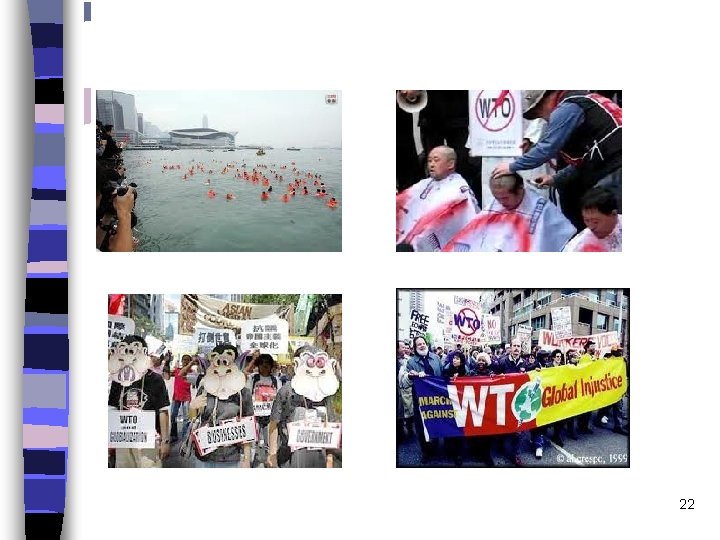
Con. SR shows up in three ways: 1. Expressed activity with respect to specific causes – such as donations or willingness to be involved in protests and boycotts • Increasing number of large scale protests directed at multinational corporations and international organizations • Demonstrators during large-scale meetings such as WTO, World Bank, IMF, World Economic Forum 21
22
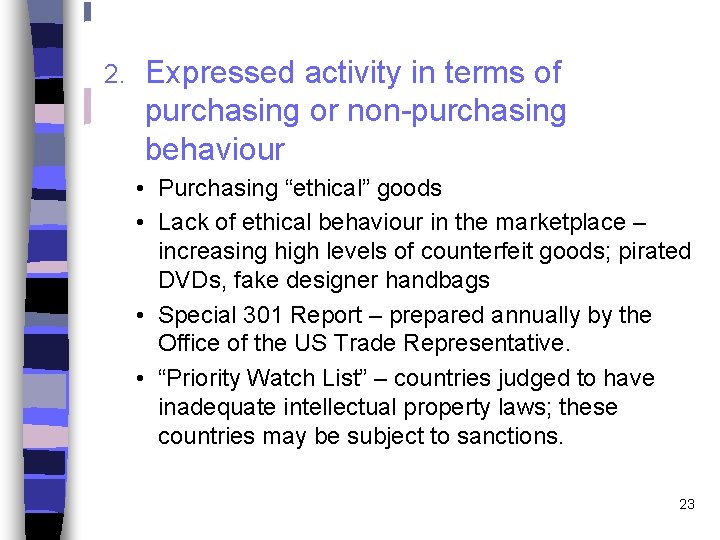
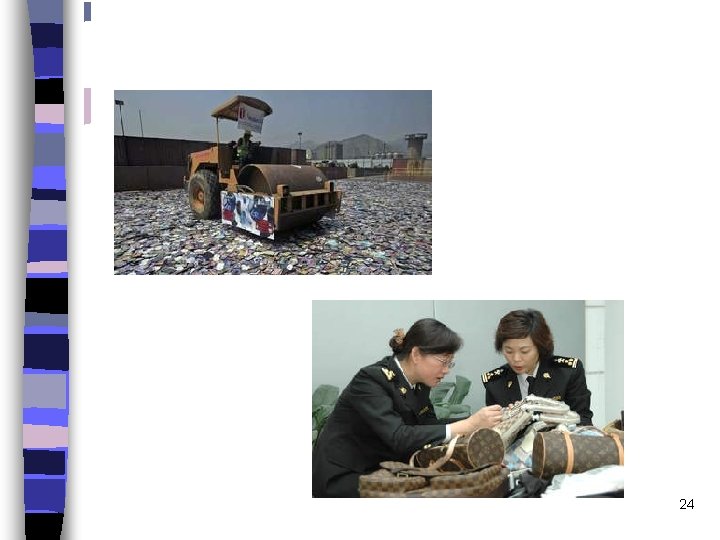
2. Expressed activity in terms of purchasing or non-purchasing behaviour • Purchasing “ethical” goods • Lack of ethical behaviour in the marketplace – increasing high levels of counterfeit goods; pirated DVDs, fake designer handbags • Special 301 Report – prepared annually by the Office of the US Trade Representative. • “Priority Watch List” – countries judged to have inadequate intellectual property laws; these countries may be subject to sanctions. 23
24
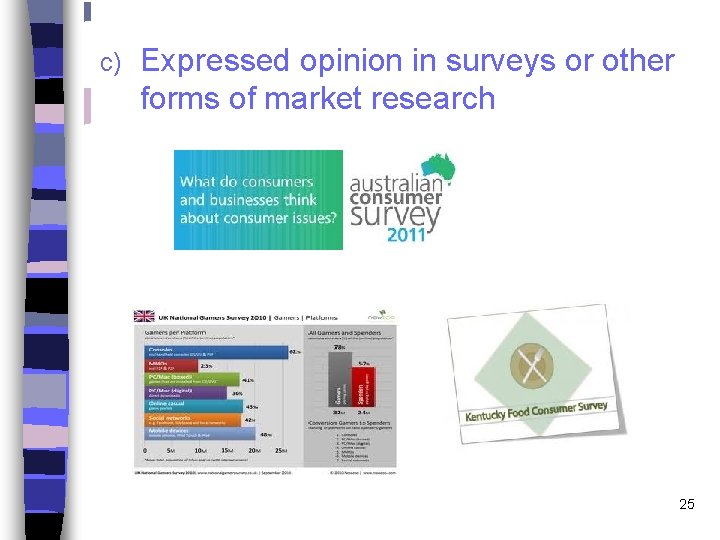
c) Expressed opinion in surveys or other forms of market research 25
Surveys and market research is the most common means by which Cn. SR is measured n Recent studies on ethical consumerism suggest that consumers are giving increasing consideration to the ethical components of products and business processes and that these concerns have financial implications for the business involved n E. g. a GMI poll across US, UK, India, Australia, Canada and some European countries found that 54% consumers would be prepared to pay more for organic, environmentally friendly or fair-trade products – in each country, the majority were positive to ethical consumerism n 26
When Cn. SR is measured by methods (1) & (3), a very positive picture of consumer involvement in ethical issues emerges n But when Cn. SR is measured by (2), a different picture appears – one that suggests that consumers are not willing to put their money where their mouth is – ‘morals stop at the pocketbook. People say that they care, but they will always buy the cheaper brand’. n Cn. SR must be understood as one component of the complex consumer-decision making process – only in this way can we develop effective and meaningful approaches that engage the potentially social consumer n 27
Consumer decision making and choice: is ethical consumerism possible? The purchase and consumption of ethical products require that large amount of effort be invested in information acquisition and decision making n Consumer also have to be willing to pay higher prices for these products n Consumer decision-making process? n 28
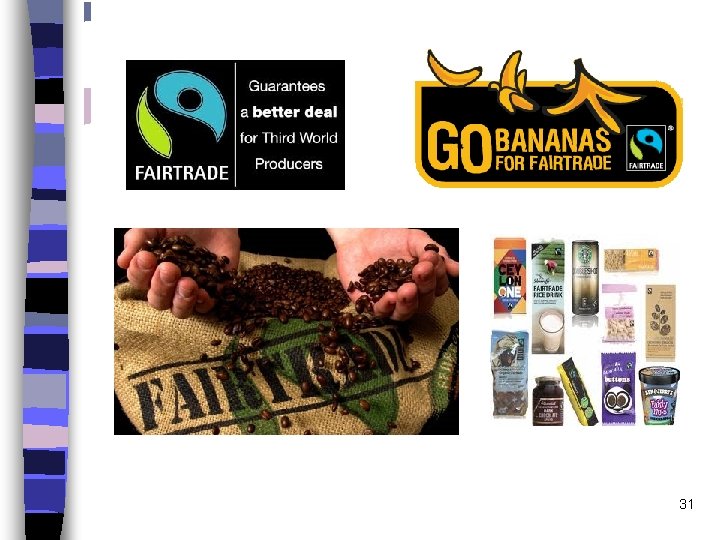
Ethical Consumerism – Four Types of Ethical Buying 1. Positive Buying This means favouring particular ethical products e. g. fair -trade, organic products & green products. • Food: includes free range and freedom food eggs, organic food, vegetarian meat alternatives and fair trade sales; • Fuel and Light: green energy sales • Household Goods: eco-labelled household appliances and cleaning products marketed as environmentally friendly • Personal Items: cosmetics and toiletries not tested on animals 29
Fair-Trade n Ethical trade refers to international trade that aims at preventing the injustices of global trade, such as child and low-paid labour, pollution of the environment, infringement of human rights and inequalities in development caused by globalization 30
31
Fair-trade is an alternative approach to conventional trade and is based on a partnership between producers and consumers. n When farmers can sell on Fair-trade terms, it provides them with a better deal and improved terms of trade. This allows them the opportunity to improve their lives and plan for their future. n Fair-trade offers consumers a powerful way to reduce poverty through their every day shopping. n 32
When a product carries the FAIR-TRADE mark it means the producers and traders have met Fairtrade Standards. n The Fair-trade Standards are designed to address the imbalance of power in trading relationships, unstable markets and the injustices of conventional trade. n In 2009, Fair-trade International along with the World Fair Trade Organization adopted the Charter of Fair Trade Principles, which provides a single international reference point for Fair Trade. n 33
n In order to make ethical choices, consumers need information. n Today consumers should be more informed and educated, and aware of what is required of products as well as their rights and responsibilities as consumers. 34
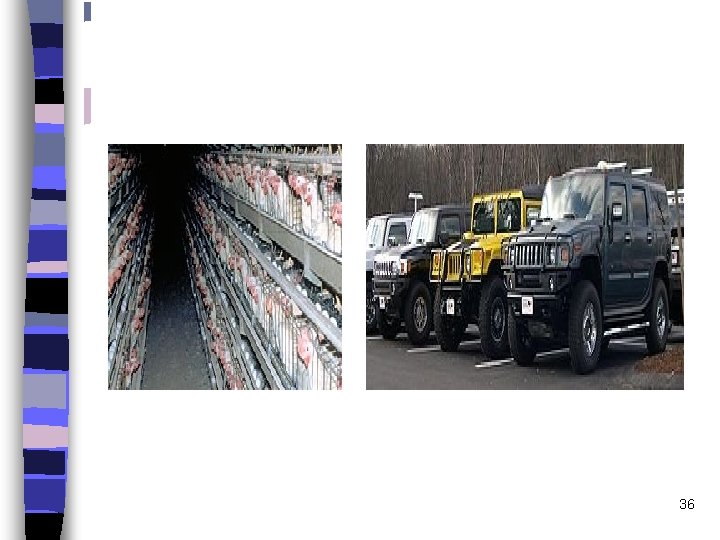
Ethical Consumerism – Four Types of Ethical Buying 2. Negative Purchasing n Avoid products that you disapprove of. n Boycott to protest governmental or corporate policy. n E. g. sweatshops (human rights), gas-guzzling cars (environment), Israel products (political), battery eggs, fur jacket (animal rights) 35
36
Consumer Boycotts n Boycotts offer campaign groups and/or individuals the chance to exert economic pressure on companies. n They are particularly appropriate when governments are unwilling or unable to introduce reforms 37
They can also be especially empowering for consumers through the process of actively rejecting something produced or sold in an unethical way n A company usually becomes a target due to questionable business practices such as testing on animals or using sweatshop labour. n Companies are sensitive to boycotts because they can have serious financial implications. Once boycotted few consumers return to a brand - so companies can lose a customer for life. n 38
Research carried out by the UK Co-operative bank in 2007 put the value of UK boycotts at around £ 2, 500 million - food and drink boycotts were valued at £ 1, 144 m, travel boycotts £ 817 m, and clothing boycotts £ 338 m. n More recent research by You. Gov showed that half of customers will boycott companies that fail to give good service. Four in five people will tell friends and family not to use firms that disappoint. Another quarter put negative reviews online. n 39
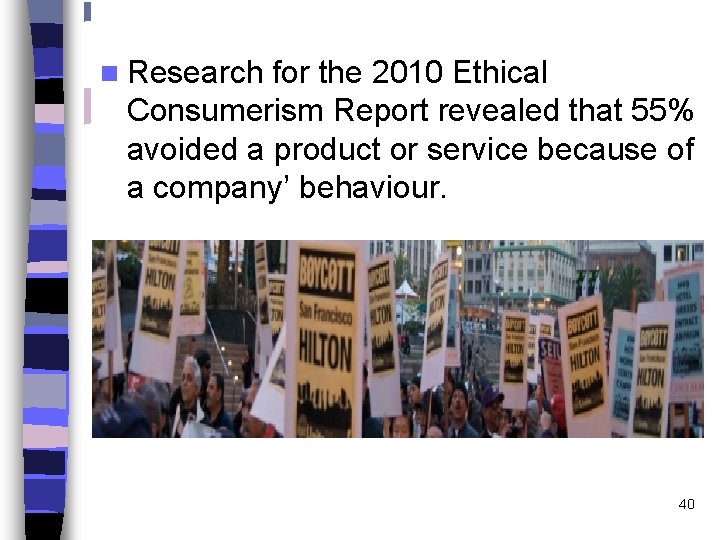
n Research for the 2010 Ethical Consumerism Report revealed that 55% avoided a product or service because of a company’ behaviour. 40
3. Company-Based Purchasing This means targeting a business as a whole and avoiding all the products made by one company. For example, the Nestle boycott has targeted all its brands and subsidiaries in a bid to get the company to change the way it markets its baby milk formula across the world. 41
n Fully-Screened Approach This means looking both at companies and at products and evaluating which product is the most ethical overall. 42
- Slides: 42