
Consumer Complaint Monitoring System USDA Presentation for the

- Slides: 28
Consumer Complaint Monitoring System USDA Presentation for the Public Meeting on Foreign Material Contamination September 24, 2002 Kimberly J. Elenberg, RN, BSN Human Health Sciences Division Food Safety and Inspection Service
FSIS’ Role in Protecting the Nation’s Food Supply 1906 Federal Meat Inspection n n 1957 Poultry Inspection Programs 1967 -68 Wholesome Meat and Poultry Act 1995 Egg Products 1996 Hazard Analysis and Critical Control Point (HACCP) Jump to first page
Jump to first page
Consumer’s Voice n n n 1999 OIG reviewed HACCP activities Food Safety Initiative Handling of consumer complaints Jump to first page
Consumer Complaints FSIS uses consumer complaints to help identify unsafe meat, poultry, and egg products in commerce that may have to be removed from commerce.
Purpose: Consumer Complaint Monitoring System (CCMS) is a passive surveillance system designed to document and track all consumer complaints that are reported to the Food Safety and Inspection Service. Jump to first page
Definition of a Consumer Complaint n n n Any complaint reported to FSIS that is initiated by a consumer, or on behalf of a consumer, that is related to an FSISinspected product Complaints are alleged by consumer Not possible to verify all complaints Jump to first page
Intake Areas n n n n USDA Meat and Poultry Hotline Compliance and Investigation Division District Offices Office of Public Health and Science (OPHS) Labeling and Food Protection State or Local Health Departments Other Federal Agencies Jump to first page
Examples of Complaints n Complaints associated with consumption of a meat, poultry or egg product that allege: u an illness u an injury u foreign object/material u an allergic reaction u underprocessing of a ready-to-eat (RTE) product u misbranding u economic adulteration u inferior quality Jump to first page
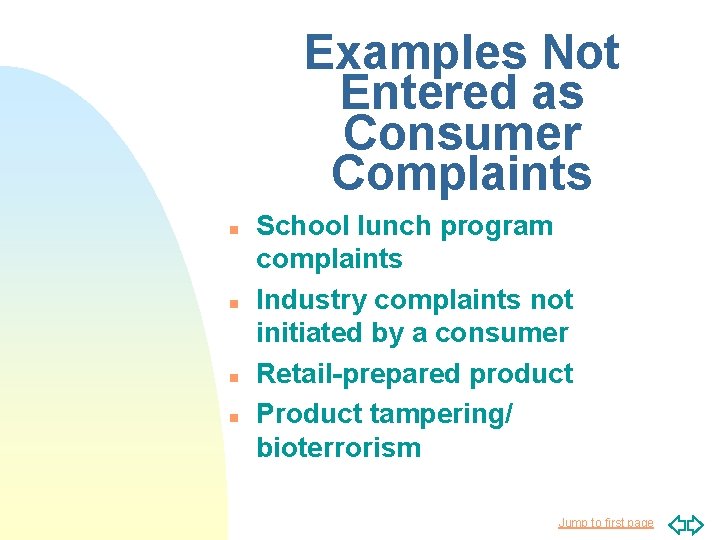
Examples Not Entered as Consumer Complaints n n School lunch program complaints Industry complaints not initiated by a consumer Retail-prepared product Product tampering/ bioterrorism Jump to first page
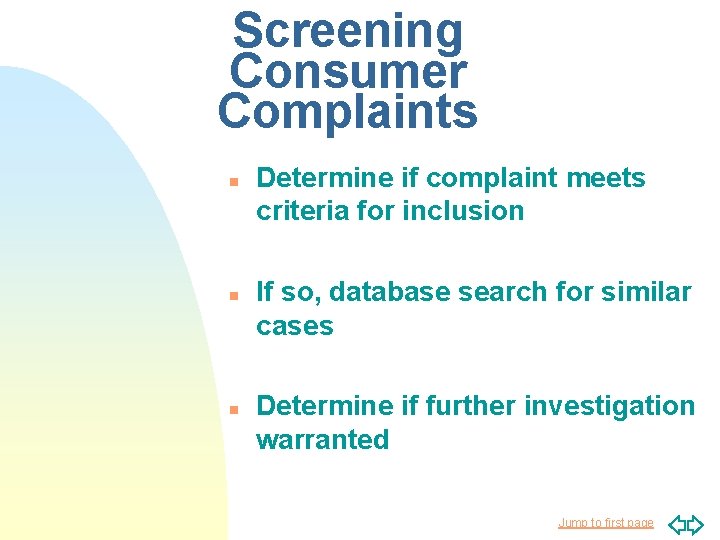
Screening Consumer Complaints n n n Determine if complaint meets criteria for inclusion If so, database search for similar cases Determine if further investigation warranted Jump to first page
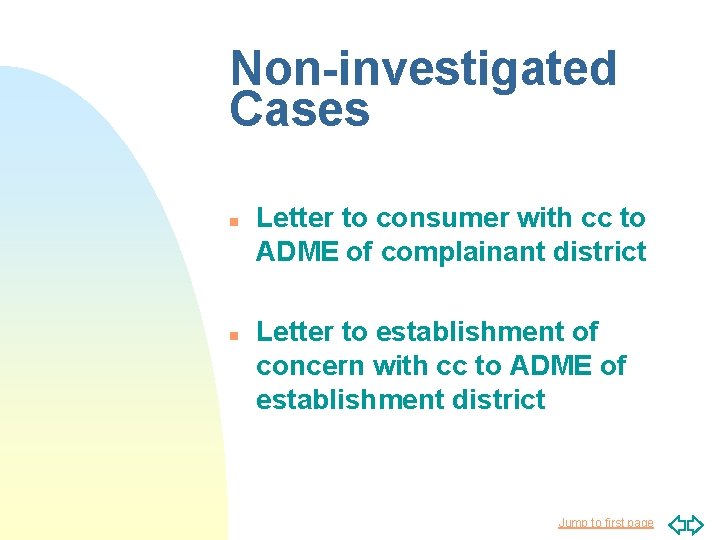
Non-investigated Cases n n Letter to consumer with cc to ADME of complainant district Letter to establishment of concern with cc to ADME of establishment district Jump to first page
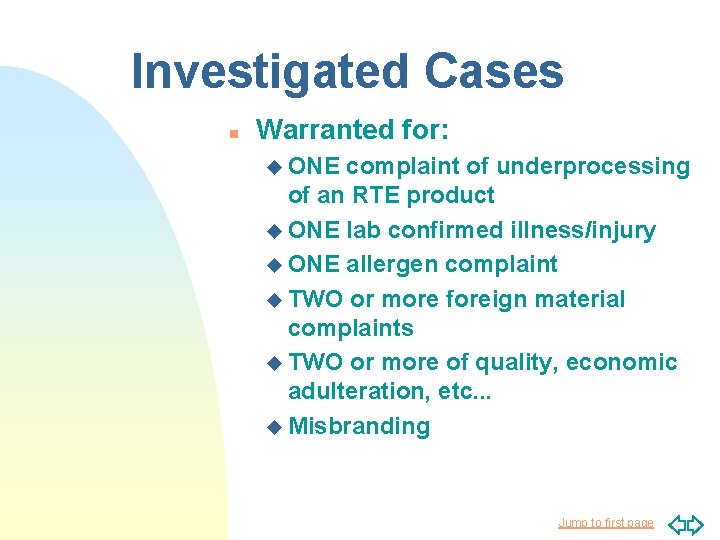
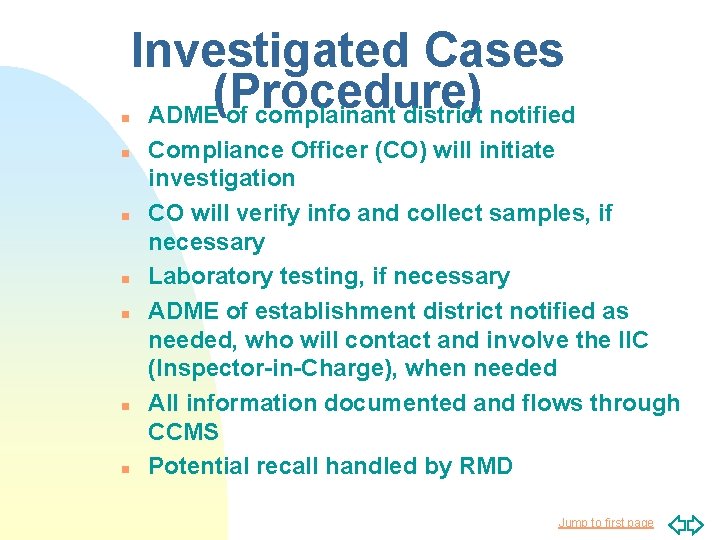
Investigated Cases n Warranted for: u ONE complaint of underprocessing of an RTE product u ONE lab confirmed illness/injury u ONE allergen complaint u TWO or more foreign material complaints u TWO or more of quality, economic adulteration, etc. . . u Misbranding Jump to first page
Investigated Cases (Procedure) ADME of complainant district notified n n n n Compliance Officer (CO) will initiate investigation CO will verify info and collect samples, if necessary Laboratory testing, if necessary ADME of establishment district notified as needed, who will contact and involve the IIC (Inspector-in-Charge), when needed All information documented and flows through CCMS Potential recall handled by RMD Jump to first page
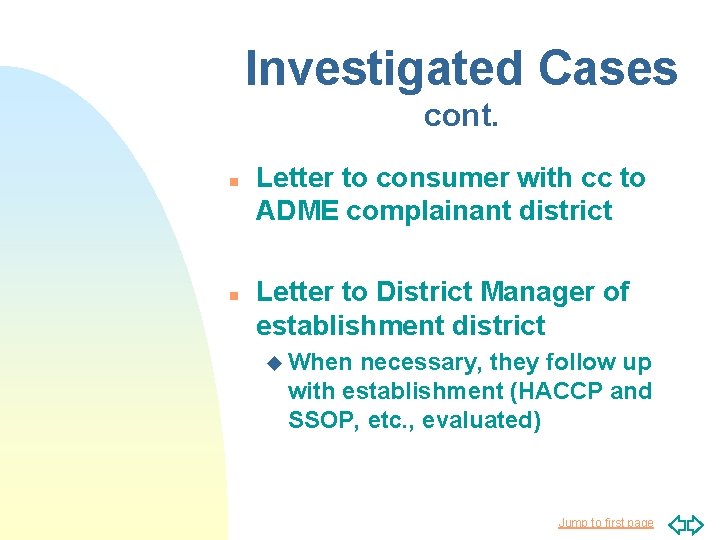
Investigated Cases cont. n n Letter to consumer with cc to ADME complainant district Letter to District Manager of establishment district u When necessary, they follow up with establishment (HACCP and SSOP, etc. , evaluated) Jump to first page
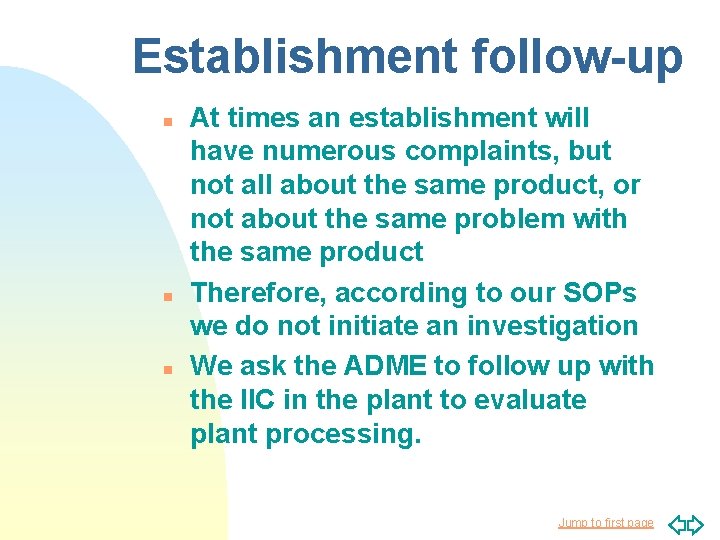
Establishment follow-up n n n At times an establishment will have numerous complaints, but not all about the same product, or not about the same problem with the same product Therefore, according to our SOPs we do not initiate an investigation We ask the ADME to follow up with the IIC in the plant to evaluate plant processing. Jump to first page
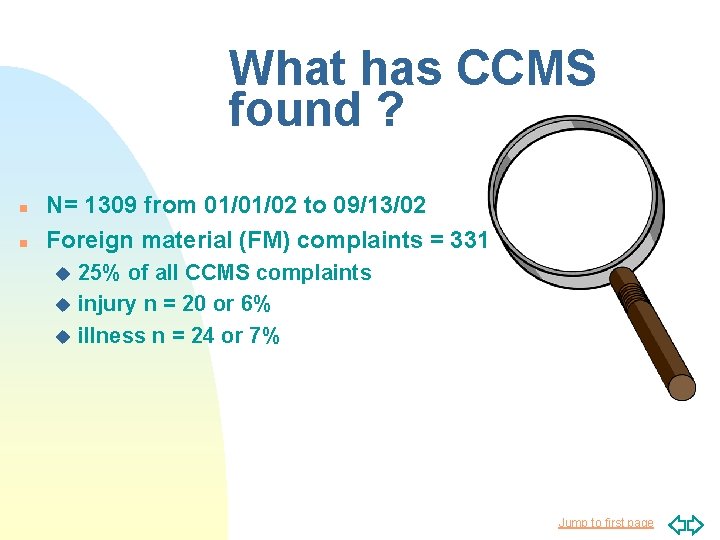
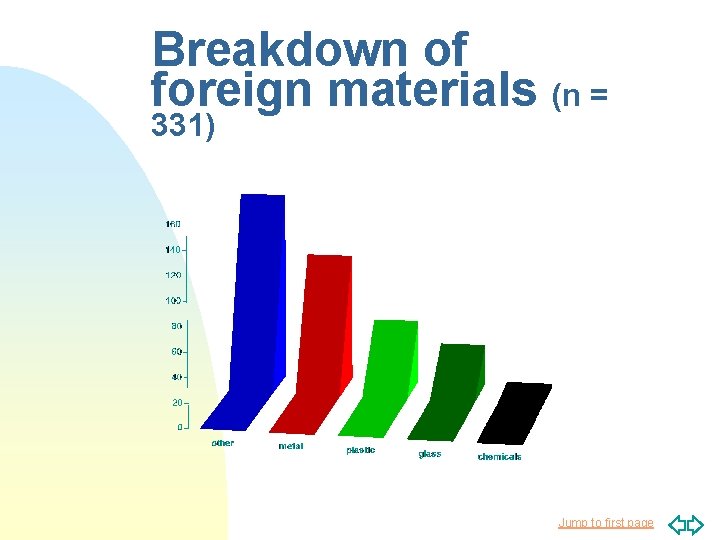
What has CCMS found ? n n N= 1309 from 01/01/02 to 09/13/02 Foreign material (FM) complaints = 331 25% of all CCMS complaints u injury n = 20 or 6% u illness n = 24 or 7% u Jump to first page
Breakdown of foreign materials (n = 331) Jump to first page
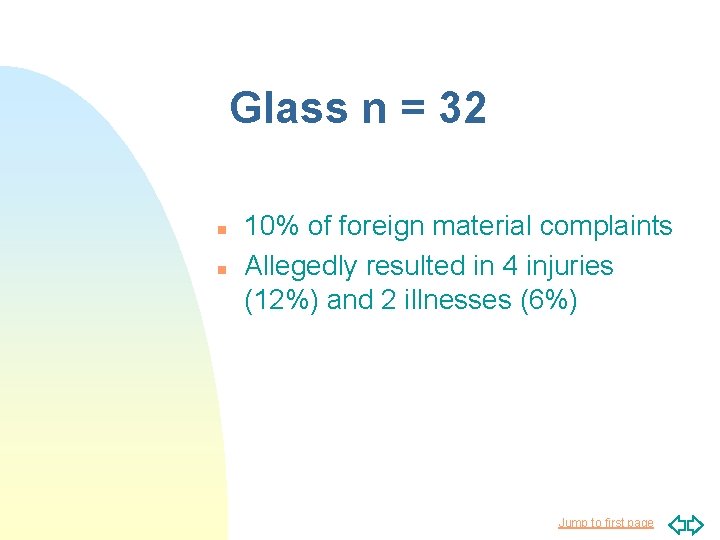
Glass n = 32 n n 10% of foreign material complaints Allegedly resulted in 4 injuries (12%) and 2 illnesses (6%) Jump to first page
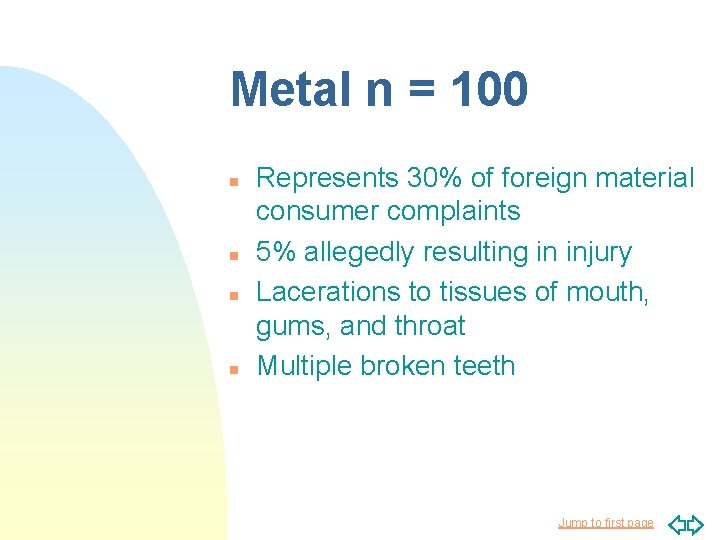
Metal n = 100 n n Represents 30% of foreign material consumer complaints 5% allegedly resulting in injury Lacerations to tissues of mouth, gums, and throat Multiple broken teeth Jump to first page
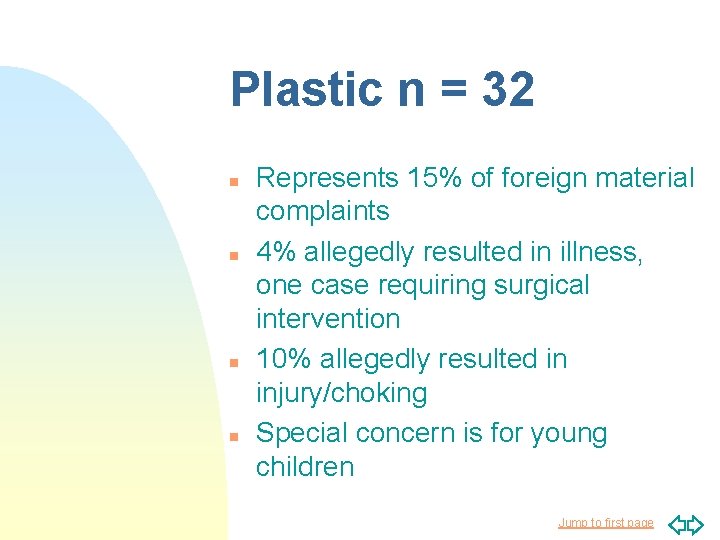
Plastic n = 32 n n Represents 15% of foreign material complaints 4% allegedly resulted in illness, one case requiring surgical intervention 10% allegedly resulted in injury/choking Special concern is for young children Jump to first page
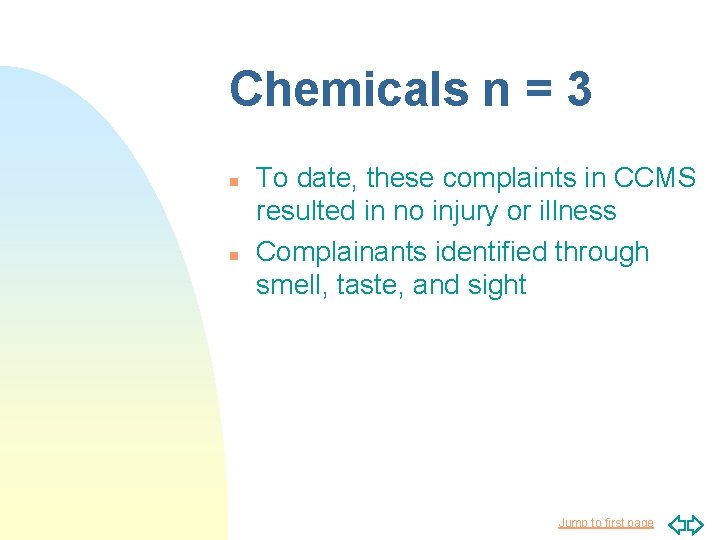
Chemicals n = 3 n n To date, these complaints in CCMS resulted in no injury or illness Complainants identified through smell, taste, and sight Jump to first page
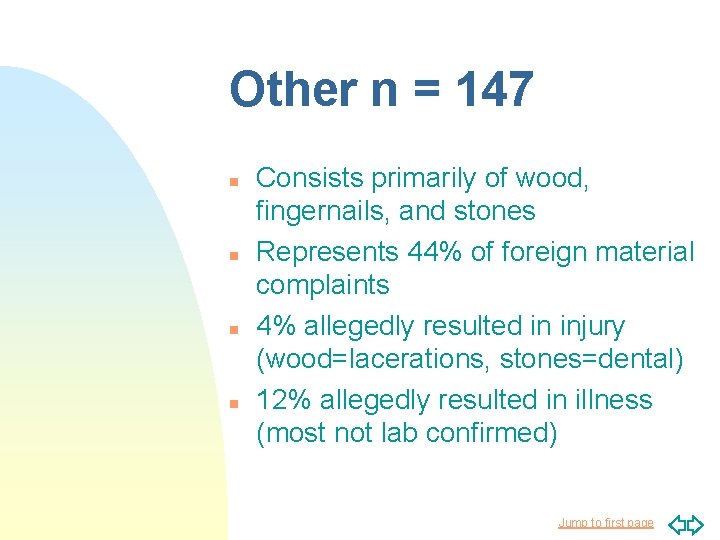
Other n = 147 n n Consists primarily of wood, fingernails, and stones Represents 44% of foreign material complaints 4% allegedly resulted in injury (wood=lacerations, stones=dental) 12% allegedly resulted in illness (most not lab confirmed) Jump to first page
Hamilton and Polter 1989 Hyman 1993 5% of foreign material in food results in minor to serious injury
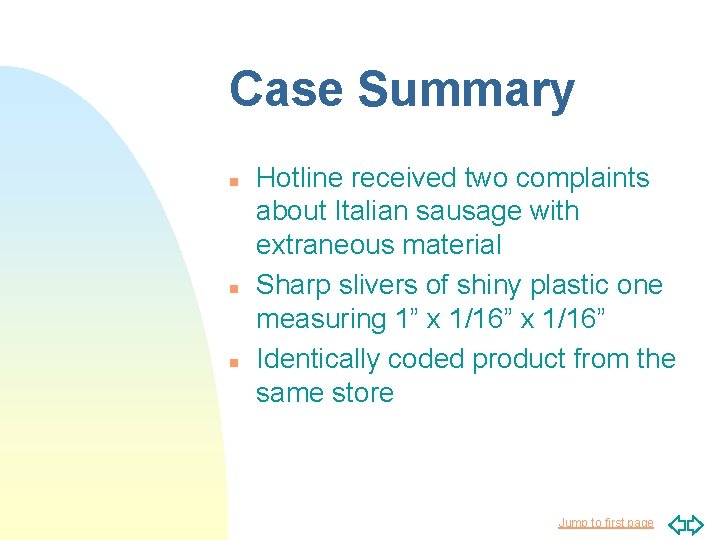
Case Summary n n n Hotline received two complaints about Italian sausage with extraneous material Sharp slivers of shiny plastic one measuring 1” x 1/16” Identically coded product from the same store Jump to first page
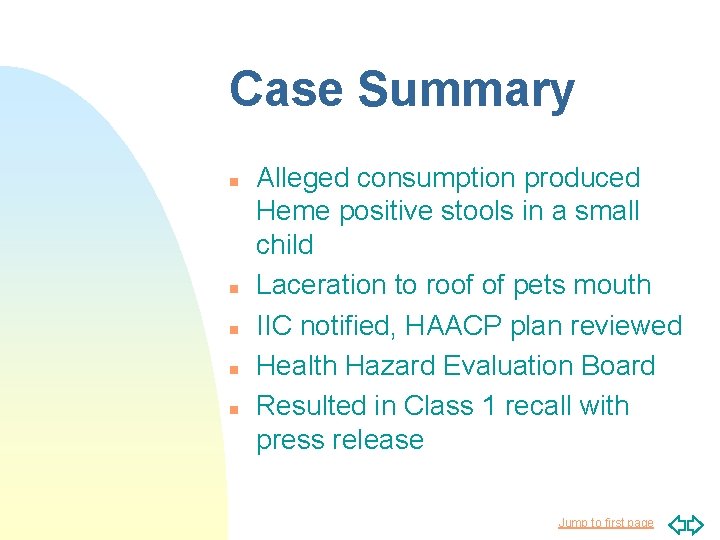
Case Summary n n n Alleged consumption produced Heme positive stools in a small child Laceration to roof of pets mouth IIC notified, HAACP plan reviewed Health Hazard Evaluation Board Resulted in Class 1 recall with press release Jump to first page
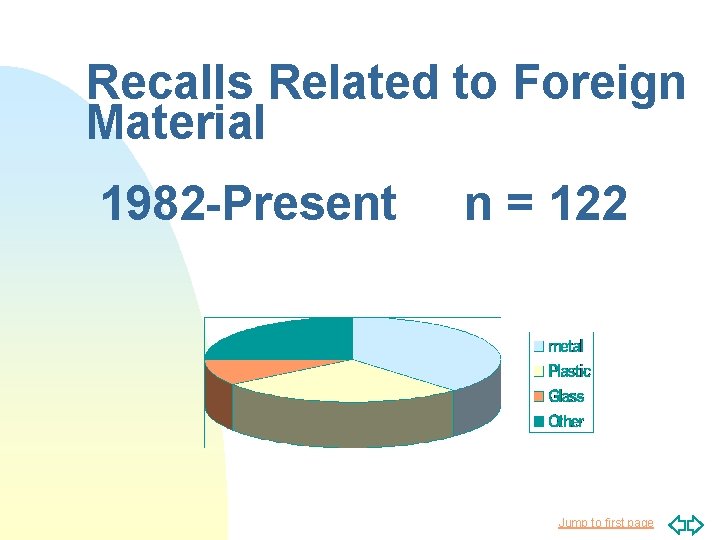
Recalls Related to Foreign Material 1982 -Present n = 122 Jump to first page
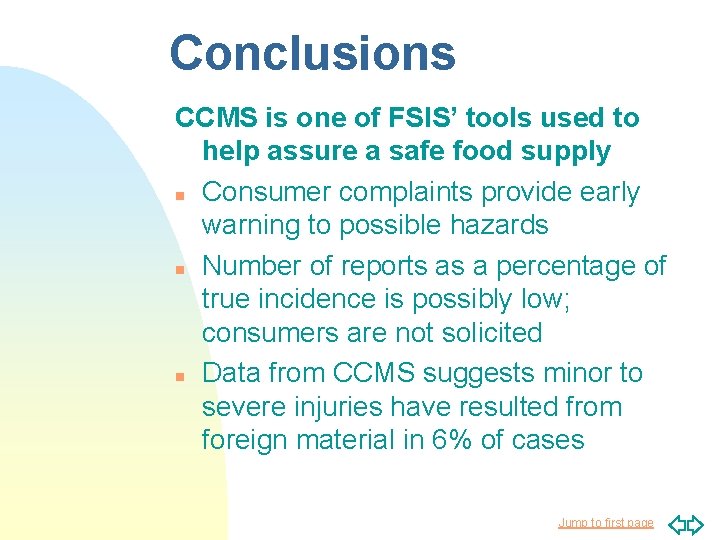
Conclusions CCMS is one of FSIS’ tools used to help assure a safe food supply n Consumer complaints provide early warning to possible hazards n Number of reports as a percentage of true incidence is possibly low; consumers are not solicited n Data from CCMS suggests minor to severe injuries have resulted from foreign material in 6% of cases Jump to first page