
Consumer Choice and Demand Power Point Slides prepared




- Slides: 40
Consumer Choice and Demand Power. Point Slides prepared by: Andreea CHIRITESCU Eastern Illinois University © 2014 Cengage Learning. All Rights Reserved. May not be copied, scanned, or duplicated, in whole or in part, except for use as permitted in a license distributed with a certain product or service or otherwise on a password-protected website for classroom use.
• Why are newspapers sold in vending machines that allow you to take more than one? • How much do you eat when you can eat all you want? • Why don’t restaurants allow doggie bags with their all-you-can-eat specials? • What cures cabin fever and spring fever? • What has replaced illegal drug sales as the most common crime in Florida? © 2014 Cengage Learning. All Rights Reserved. May not be copied, scanned, or duplicated, in whole or in part, except for use as permitted in a license distributed with a certain product or service or otherwise on a password-protected website for classroom use. 2
Utility Analysis • Utility – Sense of pleasure, or satisfaction that comes from consumption – Is subjective – Depends on your tastes and preferences • Your likes and dislikes in consumption • Assumption – Tastes are given and relatively stable © 2014 Cengage Learning. All Rights Reserved. May not be copied, scanned, or duplicated, in whole or in part, except for use as permitted in a license distributed with a certain product or service or otherwise on a password-protected website for classroom use. 3
Utility Analysis • Total utility – Total satisfaction you derive from consumption • Of consuming a particular good • Or from all consumption • Marginal utility – Change in total utility from one-unit change in your consumption of a good © 2014 Cengage Learning. All Rights Reserved. May not be copied, scanned, or duplicated, in whole or in part, except for use as permitted in a license distributed with a certain product or service or otherwise on a password-protected website for classroom use. 4
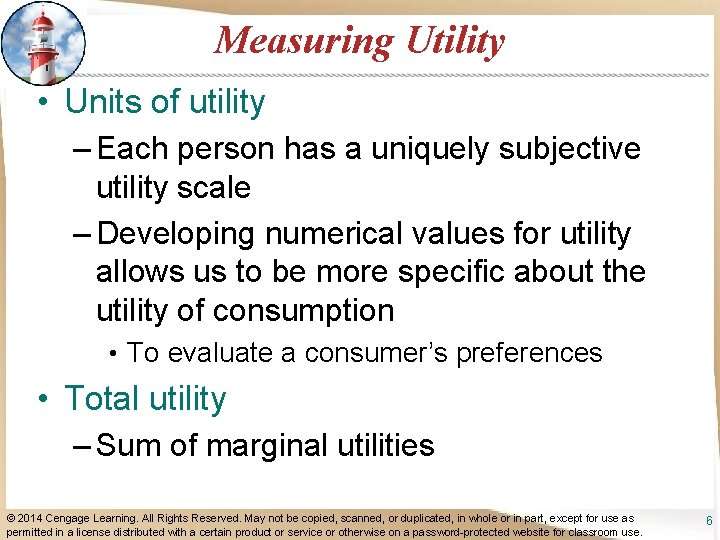
Law of Diminishing Marginal Utility • The law of diminishing marginal utility – The more of a good consumed – The smaller the increase in total utility – Other things constant • Marginal utility from each additional unit – Declines as more is consumed • Disutility – Negative marginal utility © 2014 Cengage Learning. All Rights Reserved. May not be copied, scanned, or duplicated, in whole or in part, except for use as permitted in a license distributed with a certain product or service or otherwise on a password-protected website for classroom use. 5
Measuring Utility • Units of utility – Each person has a uniquely subjective utility scale – Developing numerical values for utility allows us to be more specific about the utility of consumption • To evaluate a consumer’s preferences • Total utility – Sum of marginal utilities © 2014 Cengage Learning. All Rights Reserved. May not be copied, scanned, or duplicated, in whole or in part, except for use as permitted in a license distributed with a certain product or service or otherwise on a password-protected website for classroom use. 6
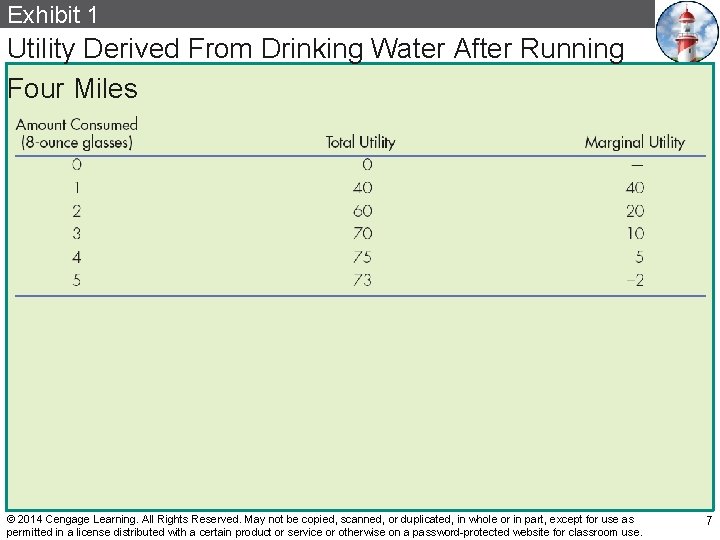
Exhibit 1 Utility Derived From Drinking Water After Running Four Miles © 2014 Cengage Learning. All Rights Reserved. May not be copied, scanned, or duplicated, in whole or in part, except for use as permitted in a license distributed with a certain product or service or otherwise on a password-protected website for classroom use. 7
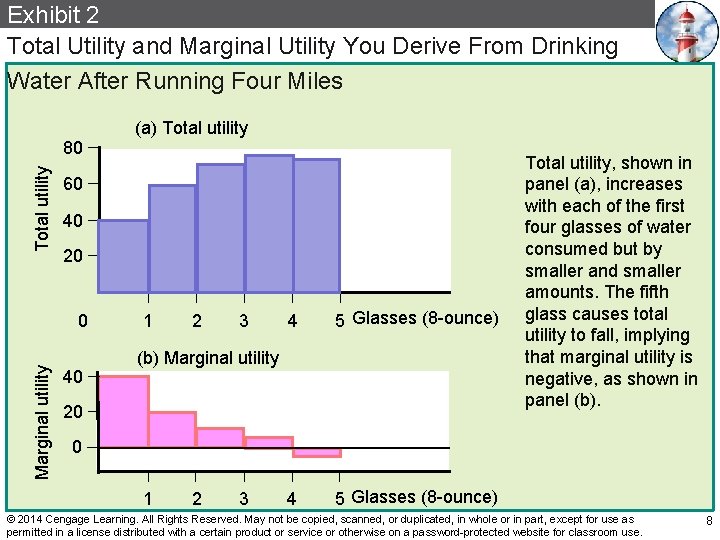
Exhibit 2 Total Utility and Marginal Utility You Derive From Drinking Water After Running Four Miles Total utility 80 60 40 20 0 Marginal utility (a) Total utility 40 1 2 3 4 5 Glasses (8 -ounce) (b) Marginal utility 20 Total utility, shown in panel (a), increases with each of the first four glasses of water consumed but by smaller and smaller amounts. The fifth glass causes total utility to fall, implying that marginal utility is negative, as shown in panel (b). 0 1 2 3 © 2014 Cengage Learning. All Rights Reserved. May not be copied, scanned, or duplicated, in whole or in part, except for use as permitted in a license distributed with a certain product or service or otherwise on a password-protected website for classroom use. 8
Utility Maximization without Scarcity • Purpose of consumption – To maximize total utility • According to your tastes • Free good – Increase consumption as long as marginal utility is positive • Two free goods – Increase consumption of each good until the marginal utility of each is 0 © 2014 Cengage Learning. All Rights Reserved. May not be copied, scanned, or duplicated, in whole or in part, except for use as permitted in a license distributed with a certain product or service or otherwise on a password-protected website for classroom use. 9
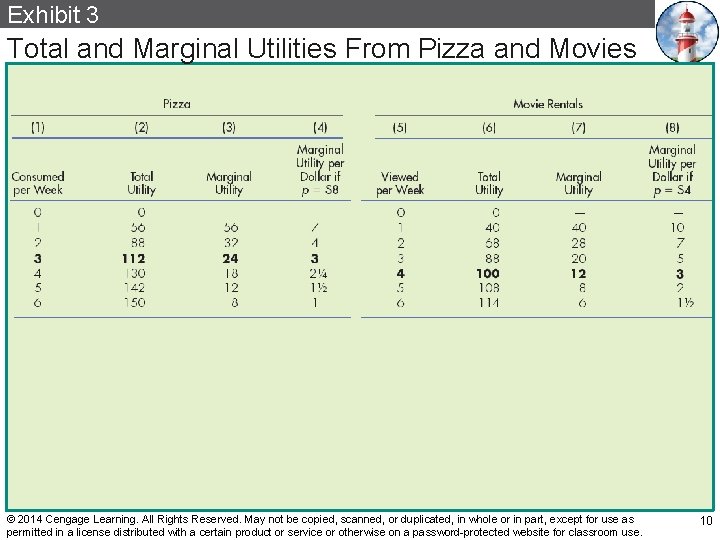
Exhibit 3 Total and Marginal Utilities From Pizza and Movies © 2014 Cengage Learning. All Rights Reserved. May not be copied, scanned, or duplicated, in whole or in part, except for use as permitted in a license distributed with a certain product or service or otherwise on a password-protected website for classroom use. 10
Utility Maximization with Scarcity • Goods – Are scarce, not free • Consumption – According to your tastes, preferences – Limited by income – Maximize total utility • Maximize utility: equilibrium – Any affordable change will reduce utility © 2014 Cengage Learning. All Rights Reserved. May not be copied, scanned, or duplicated, in whole or in part, except for use as permitted in a license distributed with a certain product or service or otherwise on a password-protected website for classroom use. 11
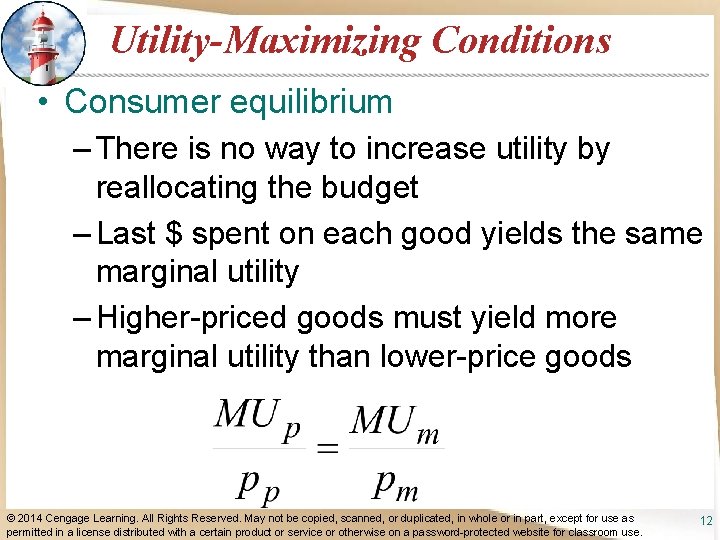
Utility-Maximizing Conditions • Consumer equilibrium – There is no way to increase utility by reallocating the budget – Last $ spent on each good yields the same marginal utility – Higher-priced goods must yield more marginal utility than lower-price goods © 2014 Cengage Learning. All Rights Reserved. May not be copied, scanned, or duplicated, in whole or in part, except for use as permitted in a license distributed with a certain product or service or otherwise on a password-protected website for classroom use. 12
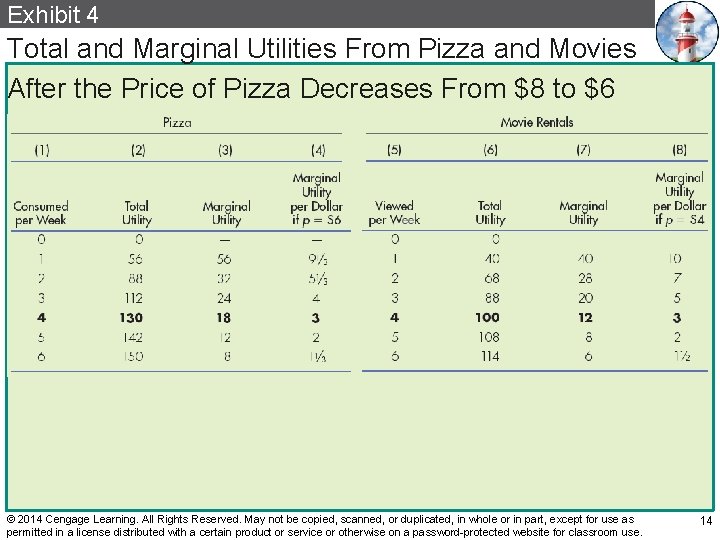
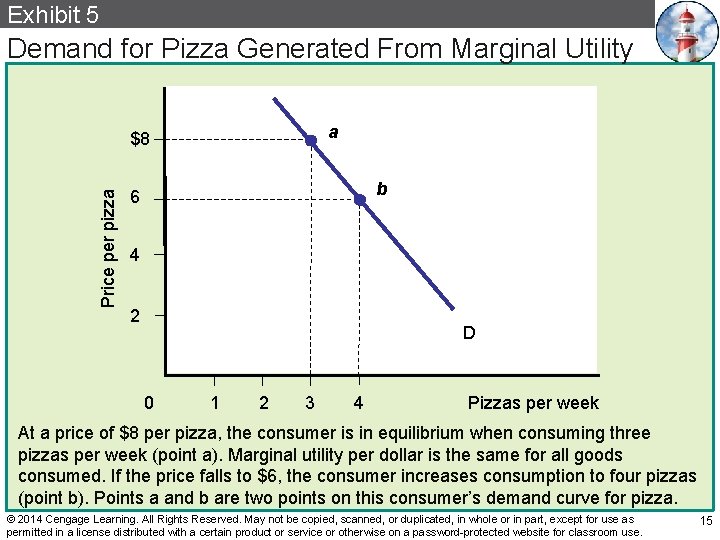
MU and the Law of Demand • Exhibit 3 – Max U; budget = $40 • Qp = 3; Pp = $8; one point on D curve • (Qm = 4 ; Pm = $4) • Price of pizza drops to $6, other things constant (Exhibit 4) – Max U; budget = $40 • Qp = 4; Pp = $6; second point on D curve • (Qm = 4 ; Pm = $4) © 2014 Cengage Learning. All Rights Reserved. May not be copied, scanned, or duplicated, in whole or in part, except for use as permitted in a license distributed with a certain product or service or otherwise on a password-protected website for classroom use. 13
Exhibit 4 Total and Marginal Utilities From Pizza and Movies After the Price of Pizza Decreases From $8 to $6 © 2014 Cengage Learning. All Rights Reserved. May not be copied, scanned, or duplicated, in whole or in part, except for use as permitted in a license distributed with a certain product or service or otherwise on a password-protected website for classroom use. 14
Exhibit 5 Demand for Pizza Generated From Marginal Utility a Price per pizza $8 b 6 4 2 D 0 1 2 3 4 Pizzas per week At a price of $8 per pizza, the consumer is in equilibrium when consuming three pizzas per week (point a). Marginal utility per dollar is the same for all goods consumed. If the price falls to $6, the consumer increases consumption to four pizzas (point b). Points a and b are two points on this consumer’s demand curve for pizza. © 2014 Cengage Learning. All Rights Reserved. May not be copied, scanned, or duplicated, in whole or in part, except for use as permitted in a license distributed with a certain product or service or otherwise on a password-protected website for classroom use. 15
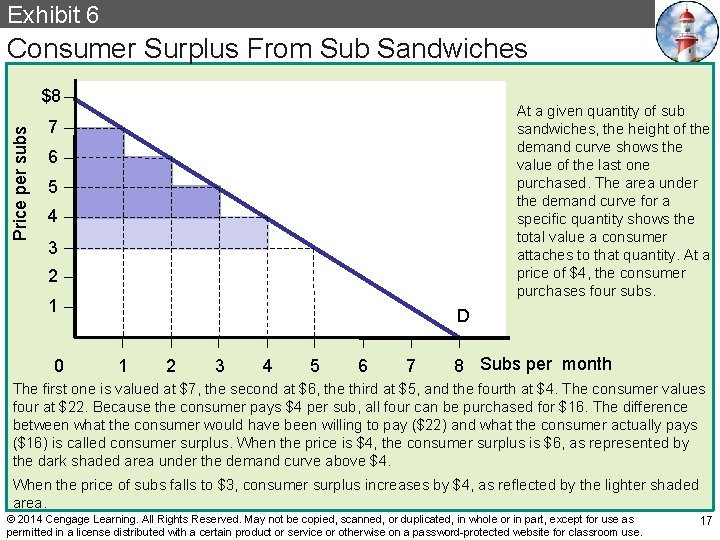
Consumer Surplus • Marginal valuation – The dollar value of the marginal utility derived from consuming each additional unit of a good • Consumer surplus – Consumer bonus – Value of total utility minus total spending – Area under the demand curve, above the price © 2014 Cengage Learning. All Rights Reserved. May not be copied, scanned, or duplicated, in whole or in part, except for use as permitted in a license distributed with a certain product or service or otherwise on a password-protected website for classroom use. 16
Exhibit 6 Consumer Surplus From Sub Sandwiches Price per subs $8 At a given quantity of sub sandwiches, the height of the demand curve shows the value of the last one purchased. The area under the demand curve for a specific quantity shows the total value a consumer attaches to that quantity. At a price of $4, the consumer purchases four subs. 7 6 5 4 3 2 1 0 D 1 2 3 4 5 6 7 8 Subs per month The first one is valued at $7, the second at $6, the third at $5, and the fourth at $4. The consumer values four at $22. Because the consumer pays $4 per sub, all four can be purchased for $16. The difference between what the consumer would have been willing to pay ($22) and what the consumer actually pays ($16) is called consumer surplus. When the price is $4, the consumer surplus is $6, as represented by the dark shaded area under the demand curve above $4. When the price of subs falls to $3, consumer surplus increases by $4, as reflected by the lighter shaded area. © 2014 Cengage Learning. All Rights Reserved. May not be copied, scanned, or duplicated, in whole or in part, except for use as permitted in a license distributed with a certain product or service or otherwise on a password-protected website for classroom use. 17
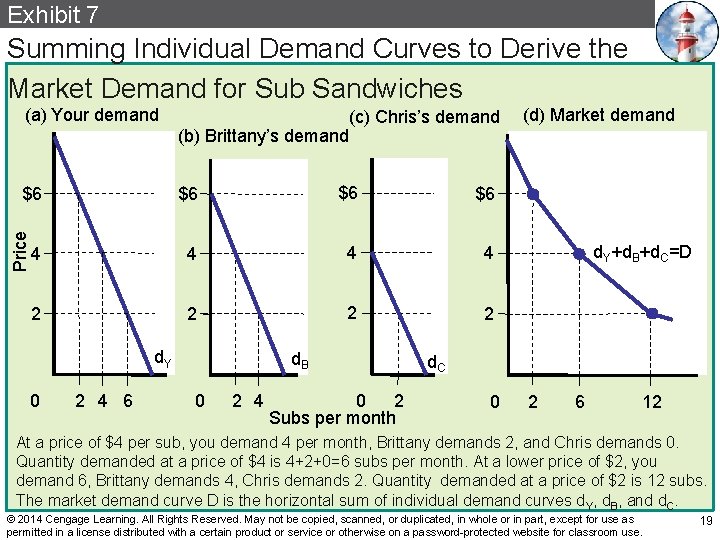
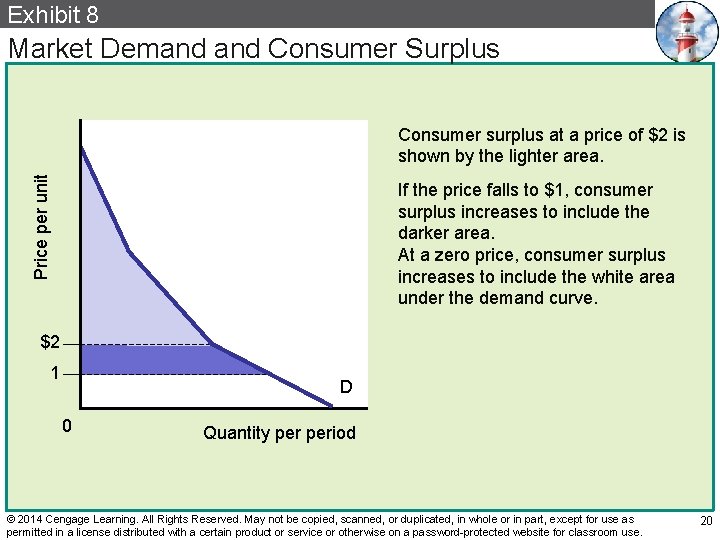
Market Demand Consumer Surplus • Market demand curve – Horizontal sum of individual D curves – Total quantity demanded, period, by all consumers, at various prices • Consumer surplus for the market – Amount consumers are willing to pay minus amount they pay – Net benefit for consumers – Economic welfare © 2014 Cengage Learning. All Rights Reserved. May not be copied, scanned, or duplicated, in whole or in part, except for use as permitted in a license distributed with a certain product or service or otherwise on a password-protected website for classroom use. 18
Exhibit 7 Summing Individual Demand Curves to Derive the Market Demand for Sub Sandwiches (c) Chris’s demand (b) Brittany’s demand $6 $6 4 4 2 2 Price (a) Your demand d. Y 0 2 4 6 d. B 0 2 4 0 2 Subs per month (d) Market demand d. Y+d. B+d. C=D d. C 0 2 6 12 At a price of $4 per sub, you demand 4 per month, Brittany demands 2, and Chris demands 0. Quantity demanded at a price of $4 is 4+2+0=6 subs per month. At a lower price of $2, you demand 6, Brittany demands 4, Chris demands 2. Quantity demanded at a price of $2 is 12 subs. The market demand curve D is the horizontal sum of individual demand curves d. Y, d. B, and d. C. © 2014 Cengage Learning. All Rights Reserved. May not be copied, scanned, or duplicated, in whole or in part, except for use as permitted in a license distributed with a certain product or service or otherwise on a password-protected website for classroom use. 19
Exhibit 8 Market Demand Consumer Surplus Price per unit Consumer surplus at a price of $2 is shown by the lighter area. If the price falls to $1, consumer surplus increases to include the darker area. At a zero price, consumer surplus increases to include the white area under the demand curve. $2 1 D 0 Quantity period © 2014 Cengage Learning. All Rights Reserved. May not be copied, scanned, or duplicated, in whole or in part, except for use as permitted in a license distributed with a certain product or service or otherwise on a password-protected website for classroom use. 20
The Marginal Value of Free Medical Care • Government-subsidized medical care – The elderly and those on welfare – State and federal taxpayers spend more than $750 billion a year – Nearly 100 million Medicare and Medicaid recipients – More than $7, 500 per beneficiary © 2014 Cengage Learning. All Rights Reserved. May not be copied, scanned, or duplicated, in whole or in part, except for use as permitted in a license distributed with a certain product or service or otherwise on a password-protected website for classroom use. 21
The Marginal Value of Free Medical Care • Medicaid – The largest and fastest growing spending category in most state budgets – Beneficiaries pay only a tiny share of Medicaid costs – Most services are free © 2014 Cengage Learning. All Rights Reserved. May not be copied, scanned, or duplicated, in whole or in part, except for use as permitted in a license distributed with a certain product or service or otherwise on a password-protected website for classroom use. 22
The Marginal Value of Free Medical Care • Free medical care – Consumed until marginal utility = 0 – Consumer surplus for the beneficiaries: entire area under the demand curve – High marginal cost to taxpayers ($750 billions a year) – Possibility of waste, fraud, and abuse • “Improper payments” to Medicare and Medicaid: $100 billion a year – Less incentive for healthy behavior © 2014 Cengage Learning. All Rights Reserved. May not be copied, scanned, or duplicated, in whole or in part, except for use as permitted in a license distributed with a certain product or service or otherwise on a password-protected website for classroom use. 23
The Marginal Value of Free Medical Care • Charge $1 per doctor visit – Reduce office visits by 8% – Substantial consumer surplus – Reduce cost to taxpayers • Increase in the average travel time to a free health clinic – By 10%: reduced visits by 10% – By 10 minutes: visits dropped 40% © 2014 Cengage Learning. All Rights Reserved. May not be copied, scanned, or duplicated, in whole or in part, except for use as permitted in a license distributed with a certain product or service or otherwise on a password-protected website for classroom use. 24
Role of Time in Demand • Consumption – Money price – Time price • Willing to pay premium for time-saving goods – Opportunity cost of time • Differences in the opportunity cost of time among consumers – Shape consumption patterns © 2014 Cengage Learning. All Rights Reserved. May not be copied, scanned, or duplicated, in whole or in part, except for use as permitted in a license distributed with a certain product or service or otherwise on a password-protected website for classroom use. 25
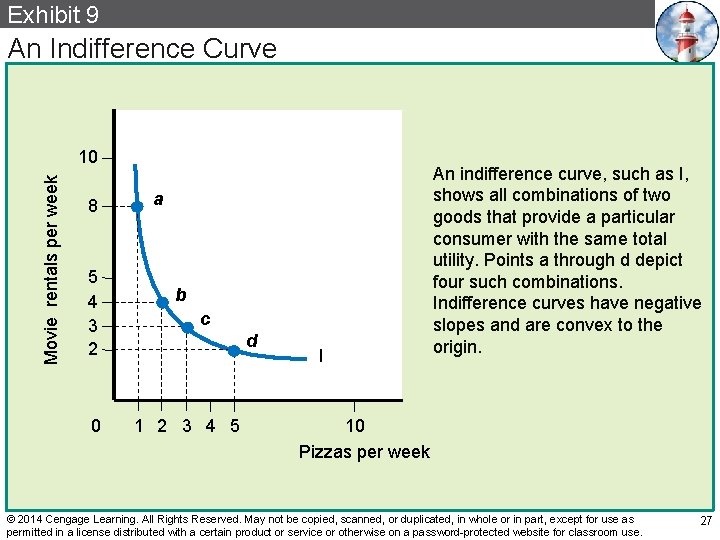
Appendix Indifference Curves and Utility Maximization • Indifference curve – Combinations of goods reflect the same total utility – Slopes downward to right – Convex to origin © 2014 Cengage Learning. All Rights Reserved. May not be copied, scanned, or duplicated, in whole or in part, except for use as permitted in a license distributed with a certain product or service or otherwise on a password-protected website for classroom use. 26
Exhibit 9 An Indifference Curve Movie rentals per week 10 8 5 4 3 2 0 a b c d 1 2 3 4 5 I An indifference curve, such as I, shows all combinations of two goods that provide a particular consumer with the same total utility. Points a through d depict four such combinations. Indifference curves have negative slopes and are convex to the origin. 10 Pizzas per week © 2014 Cengage Learning. All Rights Reserved. May not be copied, scanned, or duplicated, in whole or in part, except for use as permitted in a license distributed with a certain product or service or otherwise on a password-protected website for classroom use. 27
Appendix Indifference Curves and Utility Maximization • Marginal rate of substitution, MRS – Number of units of one good that you are willing to give up to get one more unit of the other god • Neither gaining nor losing utility in the process – Willingness to trade – Slope of indifference curve • Law of diminishing MRS – Diminishing slope of indifference curve © 2014 Cengage Learning. All Rights Reserved. May not be copied, scanned, or duplicated, in whole or in part, except for use as permitted in a license distributed with a certain product or service or otherwise on a password-protected website for classroom use. 28
Appendix Indifference Curves and Utility Maximization • Indifference map – Graphical representation of consumer’s tastes – Each indifference curve: different utility levels – The further indifference curve from origin • The higher the utility • More of both goods © 2014 Cengage Learning. All Rights Reserved. May not be copied, scanned, or duplicated, in whole or in part, except for use as permitted in a license distributed with a certain product or service or otherwise on a password-protected website for classroom use. 29
Exhibit 10 Movie rentals per week An Indifference Map 10 5 I 1 0 5 I 2 I 3 I 4 10 Pizzas per week Indifference curves I 1 through I 4 are four examples from a particular consumer’s indifference map. Indifference curves farther from the origin depict higher levels of utility. A line intersects each higher indifference curve, reflecting more of both goods. © 2014 Cengage Learning. All Rights Reserved. May not be copied, scanned, or duplicated, in whole or in part, except for use as permitted in a license distributed with a certain product or service or otherwise on a password-protected website for classroom use. 30
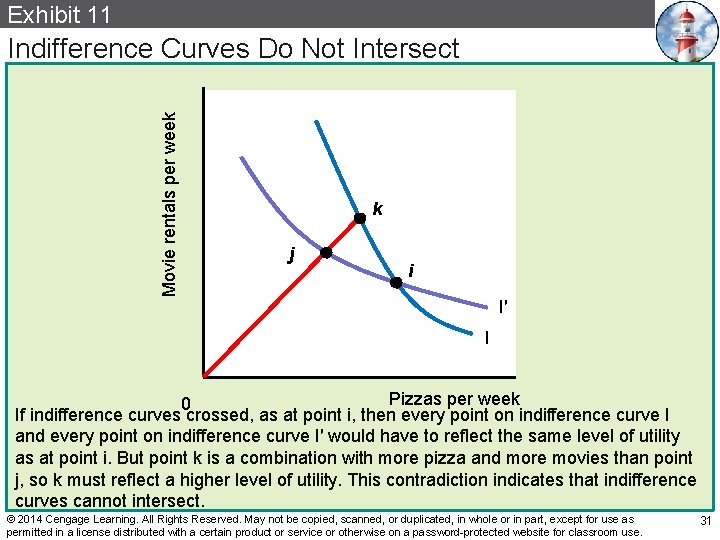
Exhibit 11 Movie rentals per week Indifference Curves Do Not Intersect k j i I′ I Pizzas per week 0 If indifference curves crossed, as at point i, then every point on indifference curve I and every point on indifference curve I′ would have to reflect the same level of utility as at point i. But point k is a combination with more pizza and more movies than point j, so k must reflect a higher level of utility. This contradiction indicates that indifference curves cannot intersect. © 2014 Cengage Learning. All Rights Reserved. May not be copied, scanned, or duplicated, in whole or in part, except for use as permitted in a license distributed with a certain product or service or otherwise on a password-protected website for classroom use. 31
Appendix Indifference Curves and Utility Maximization • Properties of indifference curves: – One indifference curve = a constant level of utility • Consumer - indifferent among all consumption combinations along a given curve – If total utility is to remain constant • An increase in the consumption of one good – Must be offset by a decrease in the consumption of the other good • Indifference curve slopes downward to right © 2014 Cengage Learning. All Rights Reserved. May not be copied, scanned, or duplicated, in whole or in part, except for use as permitted in a license distributed with a certain product or service or otherwise on a password-protected website for classroom use. 32
Appendix Indifference Curves and Utility Maximization • Properties of indifference curves: – Because of the law of diminishing MRS • Indifference curves bow in toward the origin – Higher indifference curves represent higher levels of utility – Indifference curves do not intersect © 2014 Cengage Learning. All Rights Reserved. May not be copied, scanned, or duplicated, in whole or in part, except for use as permitted in a license distributed with a certain product or service or otherwise on a password-protected website for classroom use. 33
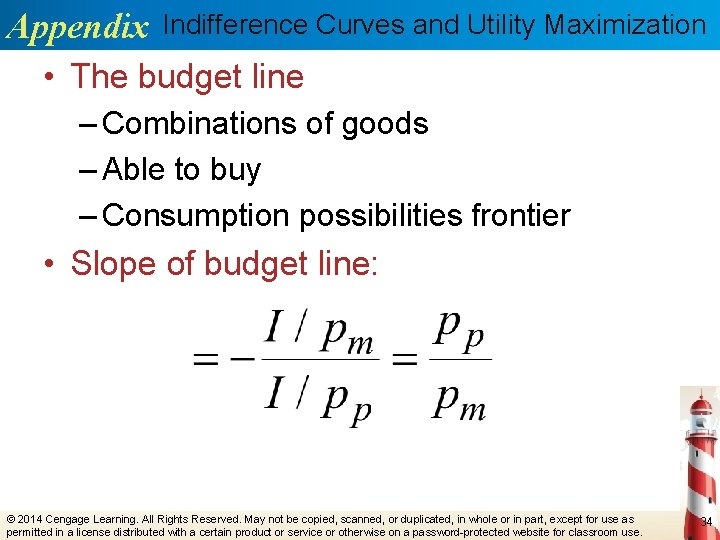
Appendix Indifference Curves and Utility Maximization • The budget line – Combinations of goods – Able to buy – Consumption possibilities frontier • Slope of budget line: © 2014 Cengage Learning. All Rights Reserved. May not be copied, scanned, or duplicated, in whole or in part, except for use as permitted in a license distributed with a certain product or service or otherwise on a password-protected website for classroom use. 34
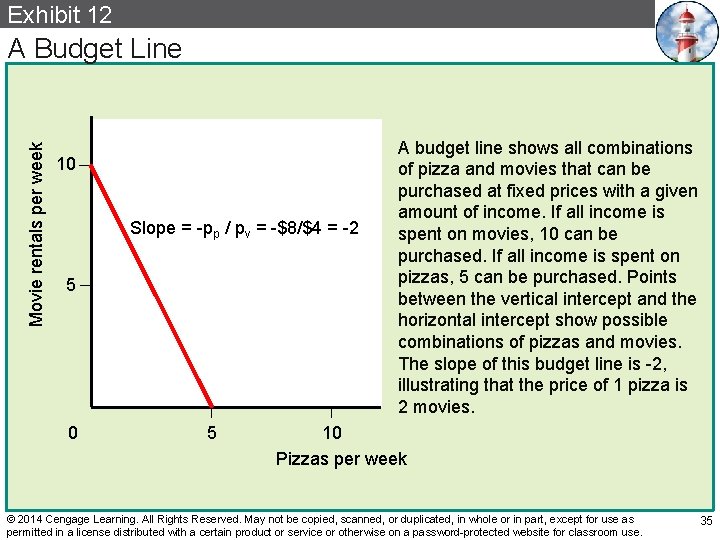
Exhibit 12 Movie rentals per week A Budget Line 10 Slope = -pp / pv = -$8/$4 = -2 5 0 5 A budget line shows all combinations of pizza and movies that can be purchased at fixed prices with a given amount of income. If all income is spent on movies, 10 can be purchased. If all income is spent on pizzas, 5 can be purchased. Points between the vertical intercept and the horizontal intercept show possible combinations of pizzas and movies. The slope of this budget line is -2, illustrating that the price of 1 pizza is 2 movies. 10 Pizzas per week © 2014 Cengage Learning. All Rights Reserved. May not be copied, scanned, or duplicated, in whole or in part, except for use as permitted in a license distributed with a certain product or service or otherwise on a password-protected website for classroom use. 35
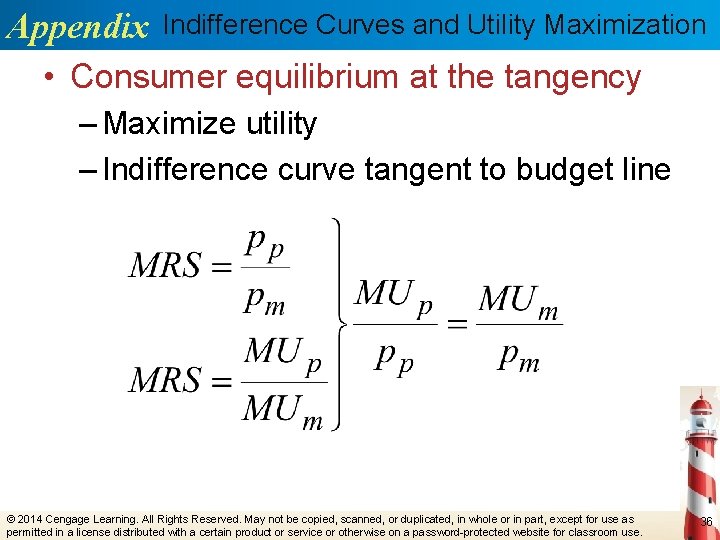
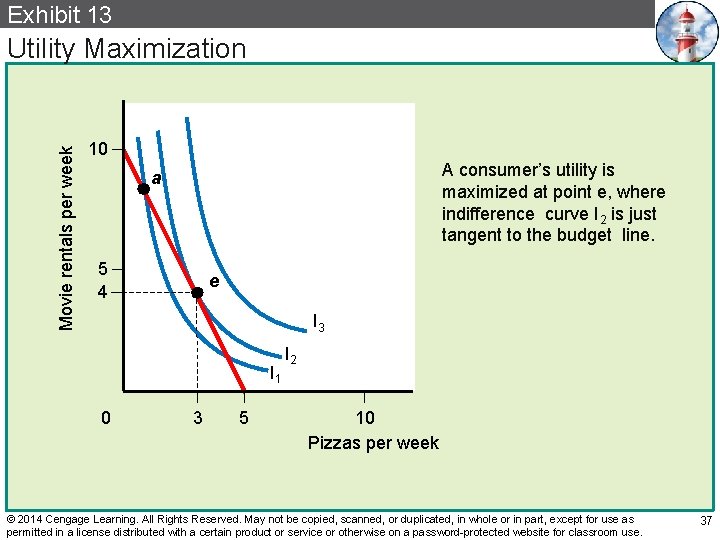
Appendix Indifference Curves and Utility Maximization • Consumer equilibrium at the tangency – Maximize utility – Indifference curve tangent to budget line © 2014 Cengage Learning. All Rights Reserved. May not be copied, scanned, or duplicated, in whole or in part, except for use as permitted in a license distributed with a certain product or service or otherwise on a password-protected website for classroom use. 36
Exhibit 13 Movie rentals per week Utility Maximization 10 A consumer’s utility is maximized at point e, where indifference curve I 2 is just tangent to the budget line. a 5 4 e I 3 I 1 0 3 5 I 2 10 Pizzas per week © 2014 Cengage Learning. All Rights Reserved. May not be copied, scanned, or duplicated, in whole or in part, except for use as permitted in a license distributed with a certain product or service or otherwise on a password-protected website for classroom use. 37
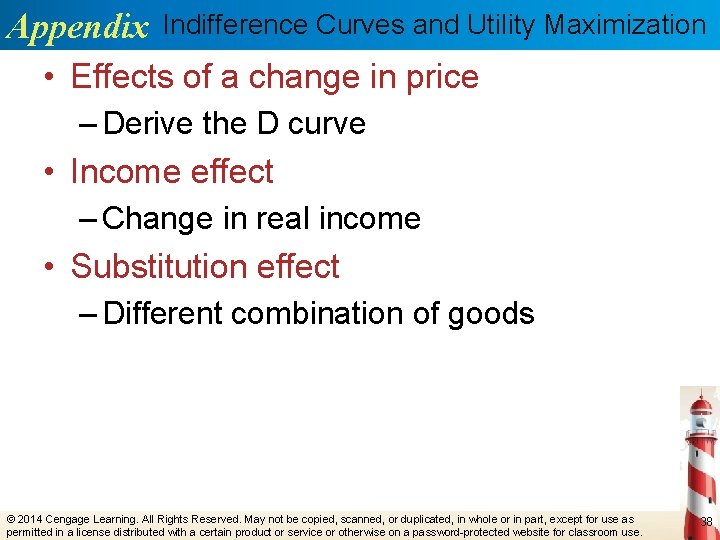
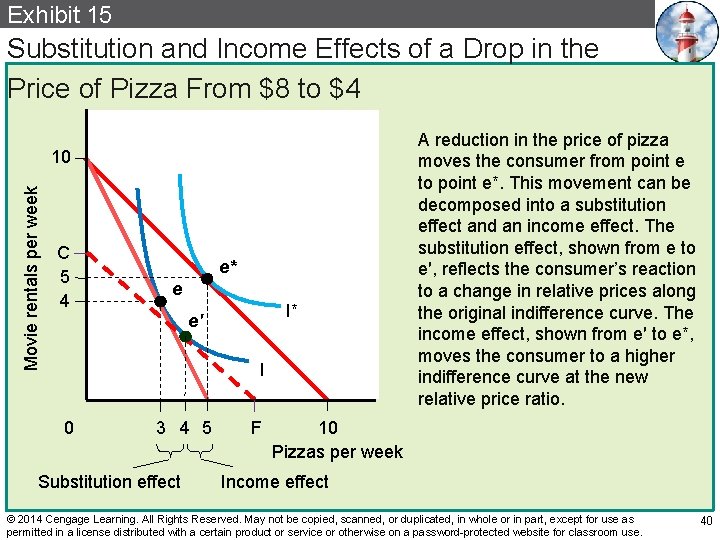
Appendix Indifference Curves and Utility Maximization • Effects of a change in price – Derive the D curve • Income effect – Change in real income • Substitution effect – Different combination of goods © 2014 Cengage Learning. All Rights Reserved. May not be copied, scanned, or duplicated, in whole or in part, except for use as permitted in a license distributed with a certain product or service or otherwise on a password-protected website for classroom use. 38
Exhibit 14 Effect of a Drop in the Price of Pizza (a) Movies per week 10 5 4 e I″ I 0 Price per pizza e″ $8 6 (b) 3 4 5 6. 67 Pizzas per week A reduction in the price of pizza rotates the budget line rightward in panel (a). The consumer is back in equilibrium at point e″ along the new budget line. Panel (b) shows that a drop in the price of pizza from $8 to $6 increases quantity demanded from 3 to 4 pizzas. Price and quantity demanded are inversely related. e e″ D 0 3 4 Pizzas per week © 2014 Cengage Learning. All Rights Reserved. May not be copied, scanned, or duplicated, in whole or in part, except for use as permitted in a license distributed with a certain product or service or otherwise on a password-protected website for classroom use. 39
Exhibit 15 Substitution and Income Effects of a Drop in the Price of Pizza From $8 to $4 Movie rentals per week 10 C 5 4 e* e I* e′ I 0 3 4 5 Substitution effect F A reduction in the price of pizza moves the consumer from point e to point e*. This movement can be decomposed into a substitution effect and an income effect. The substitution effect, shown from e to e′, reflects the consumer’s reaction to a change in relative prices along the original indifference curve. The income effect, shown from e′ to e*, moves the consumer to a higher indifference curve at the new relative price ratio. 10 Pizzas per week Income effect © 2014 Cengage Learning. All Rights Reserved. May not be copied, scanned, or duplicated, in whole or in part, except for use as permitted in a license distributed with a certain product or service or otherwise on a password-protected website for classroom use. 40