
Consumer Boredom Sammy Toyoki Todays agenda A brief
Consumer Boredom Sammy Toyoki
Today’s agenda • A brief historical review of boredom (circa 15 th-19 th centuries) • A brief talk about ’modern boredom’ (circa early 20 th – 21 th centuries) (including Barbalet’s (1999) ideas. • My personal thesis about consumer boredom and its social function(s) in consumption based phenomena (what is boredom; what is its imperative; how do we try to enact this imperative? ) • Discussing your ACQ questions : )
Warming up • During this class, we will explore consumer boredom and its experiential functions in consumption-based processes. • Based on Barbalet (1999), we may tentatively define consumer boredom as experience of absence of meaningfulness that is at once an imperative to restore such meaning deficit through affectively involving consumption practices
Introducing Consumer Boredom • Existing discourse on boredom is unsurprisingly dominated by critiques of late modernity (Gardiner 2012; Healey 1984; Kuhn 1976) and of course, of consumerist society (Campbell 1987; Mann 2016; Meyer-Spacks 1995). • In this broad vein, consumer boredom is primarily seen as a social problem, epitomizing, at individual and cultural levels, the disaffection and malaise felt towards the banalization of mass consumerist life. • But importantly to consumption scholarship, consumer boredom can also serve as an emotional shield, commonly manifesting as a form of affective resistance against the objective conditions of late capitalist society and the crisis of modern subjectivity it suggests (Goodstein 2005; Klapp 1986).
Boredom as a historically specific experience • Boredom is a historical construct with many names (e. g. acedia; tedium vitae; ennui; spleen; Langeweile). • While these expressions of malaise differ to some degree in their meanings due to the reflective rhetoric of their eras, they are all said to have represented an emotional response to perceived objective reality (Goodstein 2005; Meyer-Spacks 1995; Svendsen 2005) • The forms of malaise people have historically felt towards their objective cultural realities, we propose, are closely tied to then governing notions of individual self, the individual’s relation to society, and the kinds of fulfilment and tolerance for non-fulfilment (i. e. remedial imperatives) such self-conceptions held (Baumeister 1987).
Middle-ages to early modernity (circa 15 th to 18 th century) • During this era, the term for boredom was acedia, a capital sin denoting a condition of the soul characterized by lack of interest and indifference to anything spiritual. • Individual Self: As the ideas of Last Judgement and individual souls (Aries 1981) gradually captured social imagination, interest in an inner self gradually emerged • Individual’s relation to society: relative fixed and stable (roles; classes; feudal society) • Idea of self-fulfilment: Christian salvation (i. e. religious belief that the righteous lived under the grace of God and ultimately have a place in heaven) • Acedia’s imperative: to fend off such spiritual apathy or melancholy via participation in religious ritual and even monastic asceticism (Kuhn 1976).
Rise of Protestantism (circa 16 th-17 th century) Early modernity also witnessed the rise of Protestantism and its associated Reformation. During this time, Acedia was still the main term for boredom. • Individual Self: While rejection of papal authority, canonical law and the demystification of religious texts gave the masses a new degree of freedom in interpreting and enacting their faith, it also marked a loss of clear rules as to how to govern the inner self (Leslie 2009). • Individual’s relation to society: still relatively fixed and stable • Idea of self-fulfilment: Christian salvation was still deemed the apex of fulfilment, during this era the self-fulfilment became more and more secular (i. e. non-religious) • Acedia’s imperative: the path to salvation and overcoming sin, such as acedia, was through the imperative of Protestant work ethic (Weber 1978).
The Romanticist Era (late 18 th, early 19 th century) • During the era of Romanticism the household word for boredom was the French term ennui (Kuhn 1976). • Klapp (1986) distinguishes ennui from boredom as being a deeper, chronic feeling of malaise largely reserved for the idle aristocrats and bourgeoise that literary intelligentsia of the time (e. g. , Balzac; Baudelaire; Lord Byron; Schopenhauer; Voltaire) described as an existential sense of ‘emptiness’ arising from satiation of status and wealth (see also Raposa 1999). • Individual Self: rested not on religious but secular notions of self-fulfillment (individualism; personality; self-actualization • Individual’s relation to society: increasingly confrontational as they struggled to free themselves from the clutches of a role and class-based industrial society • Idea of self-fulfilment: e. g. romantic love; appreciation of arts and aesthetics; hedonism; escape; adventure • Ennui’s imperative: encapsulated in the need to discover and realize one’s destiny. (Baumeister 1987).
Modern Boredom – Late Industrialist Era (19 th-20 th) • The meaning of boredom as a subjective malaise of the common masses was given initial precedence in Marx’s (1967[1844]) analyses of self-alienation in capitalist labor processes, • Later on, in Weber’s (19? ? [1904] notion of disenchantment and the stifling Iron Cage of rationalist, bureaucratic styles of management (see also Braverman 1974). • During later modernity, boredom has always been associated to work and work environments (Fordism; Taylorism; Roy’s (1959) research on factory workers’ boredom-denouncing temporal practices (e. g. ‘Banana Time’) • Individual Self: burgeoning sense of disenchantment due to rapid urbanization • Individual’s relation to society: adaptive yet latently discontent over subjection by capitalist agendas (false consciousness) • Idea of self-fulfilment: A strong work ethic still remained but ‘leisure time’ also increased (with early consumerist diversions and entertainment emerging) • Alienation/disenchantment imperative: sheer survival; communality; emergence of nuclear family
The Rise of Consumerist Society • As a malady of emerging consumer society, boredom proper, however, reached its first apogee around the turn of the early 20 th century. • Concurrent with increasing ‘leisure time’ made available to the working classes was the new problematic of how to fill such idle hours in meaningful ways that still retained a productive ethos (Mann 2016). • During this era of rapid urbanization, scholars like Simmel (2002 [1903]) and Benjamin (1999 [1927]) had front row seats in observing the increasingly accelerated pace of city life, timepressures and how it affected human capacity for meaningful experiences.
![The Rise of Consumerist Society • Simmel (2002 [1903]) argued how the bored metropolitans,](http://slidetodoc.com/presentation_image_h2/524e59857e6e9aa72b62cdf8e46cb31a/image-11.jpg "The Rise of Consumerist Society • Simmel (2002 [1903]) argued how the bored metropolitans,")
The Rise of Consumerist Society • Simmel (2002 [1903]) argued how the bored metropolitans, constantly bombarded by nervous overstimulation, adapted to the affective complexity of their world through a blasé attitude or outlook, a desensitizing “incapacity to react to new stimulations with the required amount of energy” (Simmel 2002: 14 [1903]). • For Benjamin (1926), Erfahrung emphasized traditional rhythms of pre-modern life and associated auratic ability to maintain sense of community and durability in experience through story-telling. Erlebnis, in turn, signified the loss of such social aura; a disintegration of temporally cohesive story-telling, replaced by fragmented, immediate snippets of experience, disconnected information, devoid of genuine communalism and detached from sense of history (Salzani 2009). • Reflective of Simmel’s and Benjamin’s emphasis on the affective impact of urbanization on temporal experience, Heidegger (1995[1929]). argued that boredom (known in German as Langeweile that is ‘a long while’) had become the de facto mood (Stimmung) of contemporary being-in-the-world. • The concurrent Frankfurt School of Critical Theory was particularly sensitive to the discourses of loss of self and false consciousness, judiciously recording the rise of mass consumer society and its discontents (e. g. Adorno and Horkheimer (2002 [1947]); Fromm 1976; Marcuse (1991 [1964]).
The Rise of Consumer Boredom • From Simmel and Benjamin to Heidegger, the conception of selfhood in early and mid 20 th century appears to lean on sense of authenticity, and the need to preserve a minimum degree of autonomy and individuality by adapting to overwhelming societal changes, technologization of life, and not least to the traumas of the Great Wars (e. g. Goodstein 2005). • Arguably, social analyses of boredom at the time shared a practical imperative that was to simply do what ‘matters and make sense’ given the circumstances (Heidegger 1995[1929]). • Experientially speaking, the blasé attitude in Simmel, the loss of auratic interaction in Benjamin, and the allencompassing yet objectless mood of boredom in Heidegger 1995[1929]), all suggest contemporary consumer boredom to be akin to an affective state that Philips (1993) identifies as free-floating attention.
The Rise of Consumer Boredom Consumer boredom as ‘free-floating attention’ (experientially synonymous to ‘absence of meaning’) • This is a mode of being devoid of sense of directionality or intentionality (e. g. meaning!) – always waiting and looking for something but not really knowing what that something may be? Being preoccupied by lack of preoccupation (Philips 1994) • By merely observing the frequency to which people trivially fiddle with their digital devices suggests that boredom, as it is understood here, is a mood-like, enduring background of significance in today’s society. • Barbalet’s (1999) framework of boredom as absence of meaning, captures this sentiment well through his Weberian analysis of meaning’s relation to action: • Accordingly, meaning arises from the actor’s intention or purpose, but what gives rise to meaningfulness (and meaninglessness) is affective involvement. With increasingly complex digital affordances, we can seek such involvement in ways never witnessed before.
Boredom in Digital Society (Orrin Klapp 1986) • Klapp (1986) defines boredom from the perspective of the 80’s Information Society • Social scientists commonly view boredom from the perspective of ’information underload’ (e. g. too little stimulation; ’nothing to do’ etc. 9 • But Klapp also argues that today, we are more likely to be bored by ’information overload’ • Boredom as overload is not simply about increase in quantity of information – but also about • Degradation of information (communication and images that are sterile; redundant; banal) • Information as ’noise’ (communication and images that are irrelevant or interferes with desired or otherwise meaningful signals – thus defeating our ability to extract meaningfulness
Boredom in Digital Society (Marco van Leeuwen 2009) • van Leeuwen (2009) studies more recent digital phenomenon and practices and defines boredom as a failure to genuinely interact; to not fitting in, being unable to bring ourselves to care about something in particular • Drawing on Benjamin’s notion of Erlebnis – today’s society suffers from severe detachment • When communication is overwhelmingly dominated by keyboards and screens - the direct, interactive social connection of embodied and embeddedness of individuals with one another is severed • The offshoots of such boredom are (a) trading of embodied and embedded social immersion for ’connectedness’, and (b) living by an ethos of ’do-it-yourself-normativity’ (e. g. anything goes’).
Sammy’s thesis on consumer boredom • So, to finalize our class discussions, and to offer an interpretation of boredom’s social function in contemporary digitalized society, I introduce to you the concept Intentionality Artefact (IA). • In a media crazed and immersed world, meaningful embodied experiencing has become increasingly secondary and genuine social interaction replaced by frivolous and superficial digital ‘connectedness’ (e. g. Arviddson and Caliandro 2016; Cronin and Cocker 2019; Lambert 2018; Zwick and Bradshaw 2016). • In this light, IA’s, we propose, step in as pressure-valves for venting our unfortunate appetite for Benjamin’s Erlebnis: communicative exchanges that are fragmented, abrupt, partial and even toxic. But auspiciously, IA’s also appears to enable a genuine sense of Erfahrung, helping us re-cultivate auratic story-telling: a phenomenon readily observable in caring, familial digital communication and communities.
Sammy’s thesis on consumer boredom • Individual Self: Thus, contemporary digital selves represent both a fading of a focused self but also a return of individual social aura (van Leuuven 2009). • Individual’s relation to society: our relation to society, at least in terms of social media consumption – is neither fixed, struggling or adaptive – but a manipulative form of agency – a power to act with little regard for real-life normativity, and an apparent power over public opinion however trivial or untruthful the subject matter (Campbell 2009). Consider Trump’s tweets and attacks on media as producing ‘fake news’! • Idea of self-fulfilment: Excluding above-mentioned (positive) auratic interaction, fulfilment of self tends towards desire for public recognition, narcissistic and short-lived as it is (Campbell 1987; Lasch 1976). • Consumer Boredom’s Imperative: To retain a sense of meaning and directionality by any digitally available means – be that benevolent or toxic behavior
ACQ questions - Barbalet • Experiencing boredom is very common for people and it occurs often. Consumption markets often aim to encourage people to be involved and participate in them. What would be the key aspects in utilizing boredom of people to the market’s/brand’s advantage? Are some companies already doing this well? (think of the opposite of boredom!) • Everyone’s life is so hectic nowadays that boredom seems to be a goal every now and then. Are there any benefits in being bored or is there any research around that topic? (consider how boredom is an emotional defence, e. g. a blasé attitude) • Where could it stem from that even today, many corporations do not provide adequately meaningful work to employees, or even try to provide other modes of finding meaning in the workplace in cases where repetitive tasks are needed? Or that “bullshit jobs” are so prevalent on the market – jobs that people feel are meaningless but have to pretend are? Doesn’t this reflect that the view managers may have of employees is rather mechanistic, instead of seeing employees as “whole humans”? (The realm of work has historically always been an incubator of boredom – (Marx; Braverman; Taylorism; Fordism)
ACQ questions - Barbalet • What is the difference between being unmotivated and being bored at work? (A semantic difference: to lack motivation signifies lack of sense of purpose, meaningful goals, self-alienation) • Although the article separates boredom, ennui, and depression quite clearly, are they also not complementary and in a sense following from one to the next? (Boredom and ennui are externally constituted whereas depression is an inner emotional state / Heidegger’s 3 levels of boredom good example of a ‘hierarchy’) • Can boredom, or the lack of meaning, be experienced subconsciously likewise as having meaning? (Yes, consider the Marxist notion of ‘false consciousness’, or, the idea of boredom having an ‘imperative’) • When Artificial Intelligence is more widely applied in the future, the boredom of people most likely is going to increase. What kind of opportunities and challenges this can pose for the marketers? (First we need to ponder whether boredom would increase in this context and how? )
ACQ questions - Miscellaneous Amine, A. , & Gicquel, Y. (2011). Rethinking resistance and anti-consumption behaviours in the light of the concept of deviance. • Boredom can explain some social processes. Deviant behavior is different from what is expected and there are different levels of deviant behavior. Overall, Amine & Gicquel (2011) state that deviant behavior has not gotten enough attention and it should be researched more in terms of consumption. Should the relationship between boredom and deviance behavior in consumption be studied? There is often an assumption at least that people who do not have meaningful things to do, tend to do criminal or deviant behavior more. (Yes, and it has been studied widely in different disciplines) Arvidsson, A. , & Caliandro, A. (2016). Brand public. • Through social media, brand publics have become common phenomenon and lots of people participate in them. They evolve around discussion through meditations like hashtags. There are no core members, just people posting one or two times about the matter. Social media has shaped people going from brand communities to brand publics. But people also use social media because they have ‘nothing better to do’. Also, boredom is known to affect social processes. Can bored behavior in social media be also one of the explanations behind this movement from communities to publics? (Absolutely yes. But more precisely, we should think of boredom as an encompassing background mood in today’s society, not just something we experience when doing things in social media, Consider Benjamin’s notion of Erlebnis: how the malady of modernity is detachment and loss of genuine social interaction. Erlebnis is, arguably, one important dimension of modern boredom as a mood)
ACQ questions - Miscellaneous Cronin, A. M. (2004). Regimes of mediation: advertising practitioners as cultural intermediaries? • As I said in my ACQ, advertisers work with meanings. How can they better utilize creating meanings in boring situations in consumption environment? (Again, think of all the conditions of boredom we have discussed and all the experiences, ways of being and practices that oppose boredom. One good way would be to reflect on the kinds of ‘imperative’ some boring consumption situation could give rise to and emphasize that) Amine, A. & Gicquel, Y. (2011) Rethinking resistance and anti-consumption behaviours in the light of the concept of deviance. • Since boredom was made sound like a negative phenomenon in the article and since the culture is so fast paced in countries like Finland, can boredom be seen as a deviance. I personally think that as a business student it is almost a taboo to say that you have free time, taking it easy has been stigmatized. (Good point and question. Is boredom normatively OK? Yes and no. Some self-help gurus say that we have lost the ability to be bored and that we need to retain it (e. g. having moments of pure idleness is good for your mental health. But if the causes of boredom for the individual are somehow detrimental to her (i. e. profound, existential boredom), or, if they come from an external source that is somehow a threat/hindrance to her – then no, it is not a positive thing (though normatively it seems that anything goes nowadays)
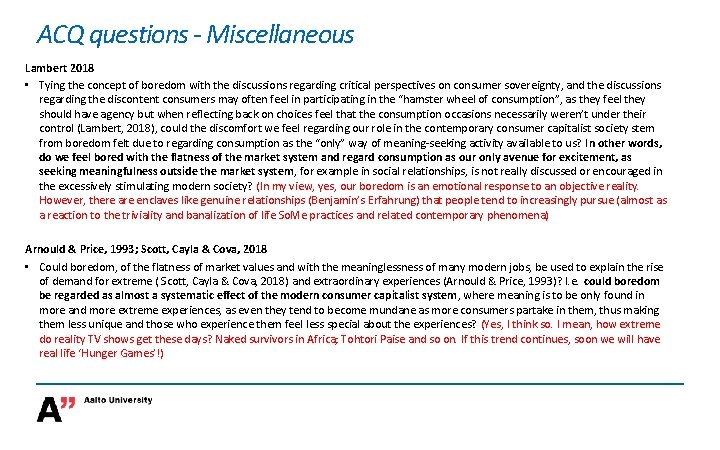
ACQ questions - Miscellaneous Lambert 2018 • Tying the concept of boredom with the discussions regarding critical perspectives on consumer sovereignty, and the discussions regarding the discontent consumers may often feel in participating in the “hamster wheel of consumption”, as they feel they should have agency but when reflecting back on choices feel that the consumption occasions necessarily weren’t under their control (Lambert, 2018), could the discomfort we feel regarding our role in the contemporary consumer capitalist society stem from boredom felt due to regarding consumption as the “only” way of meaning-seeking activity available to us? In other words, do we feel bored with the flatness of the market system and regard consumption as our only avenue for excitement, as seeking meaningfulness outside the market system, for example in social relationships, is not really discussed or encouraged in the excessively stimulating modern society? (In my view, yes, our boredom is an emotional response to an objective reality. However, there are enclaves like genuine relationships (Benjamin’s Erfahrung) that people tend to increasingly pursue (almost as a reaction to the triviality and banalization of life So. Me practices and related contemporary phenomena) Arnould & Price, 1993; Scott, Cayla & Cova, 2018 • Could boredom, of the flatness of market values and with the meaninglessness of many modern jobs, be used to explain the rise of demand for extreme ( Scott, Cayla & Cova, 2018) and extraordinary experiences (Arnould & Price, 1993)? I. e. could boredom be regarded as almost a systematic effect of the modern consumer capitalist system, where meaning is to be only found in more and more extreme experiences, as even they tend to become mundane as more consumers partake in them, thus making them less unique and those who experience them feel less special about the experiences? (Yes, I think so. I mean, how extreme do reality TV shows get these days? Naked survivors in Africa; Tohtori Paise and so on. If this trend continues, soon we will have real life ‘Hunger Games’!)
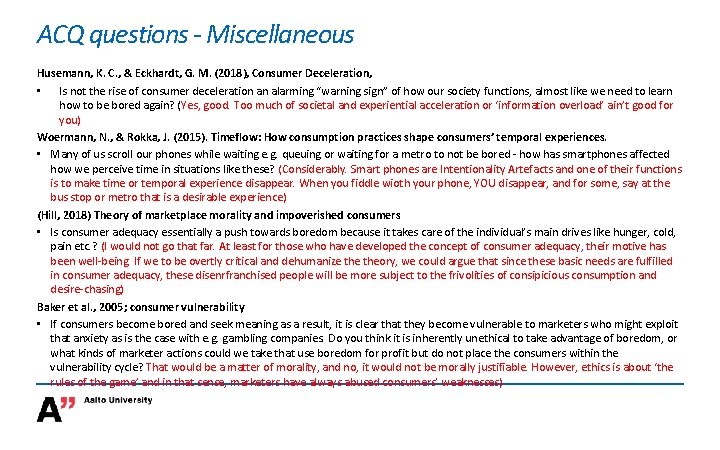
ACQ questions - Miscellaneous Husemann, K. C. , & Eckhardt, G. M. (2018), Consumer Deceleration, • Is not the rise of consumer deceleration an alarming “warning sign” of how our society functions, almost like we need to learn how to be bored again? (Yes, good. Too much of societal and experiential acceleration or ‘information overload’ ain’t good for you) Woermann, N. , & Rokka, J. (2015). Timeflow: How consumption practices shape consumers’ temporal experiences. • Many of us scroll our phones while waiting e. g. queuing or waiting for a metro to not be bored - how has smartphones affected how we perceive time in situations like these? (Considerably. Smart phones are Intentionality Artefacts and one of their functions is to make time or temporal experience disappear. When you fiddle wioth your phone, YOU disappear, and for some, say at the bus stop or metro that is a desirable experience) (Hill, 2018) Theory of marketplace morality and impoverished consumers • Is consumer adequacy essentially a push towards boredom because it takes care of the individual’s main drives like hunger, cold, pain etc. ? (I would not go that far. At least for those who have developed the concept of consumer adequacy, their motive has been well-being. If we to be overtly critical and dehumanize theory, we could argue that since these basic needs are fulfilled in consumer adequacy, these disenrfranchised people will be more subject to the frivolities of consipicious consumption and desire-chasing) Baker et al. , 2005; consumer vulnerability • If consumers become bored and seek meaning as a result, it is clear that they become vulnerable to marketers who might exploit that anxiety as is the case with e. g. gambling companies. Do you think it is inherently unethical to take advantage of boredom, or what kinds of marketer actions could we take that use boredom for profit but do not place the consumers within the vulnerability cycle? That would be a matter of morality, and no, it would not be morally justifiable. However, ethics is about ‘the rules of the game’ and in that sense, marketers have always abused consumers’ weaknesses)
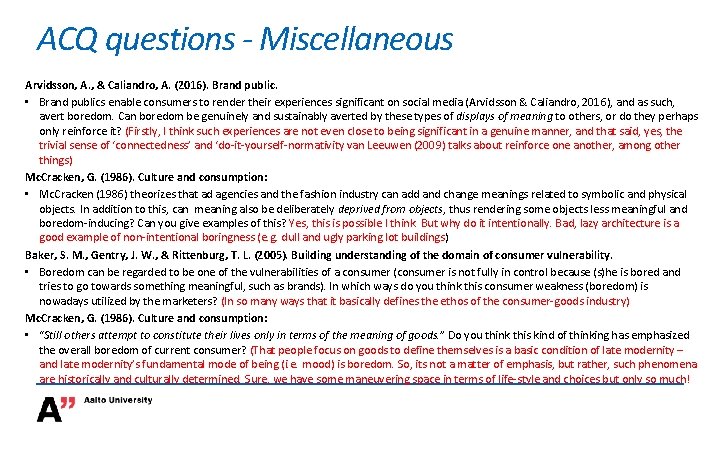
ACQ questions - Miscellaneous Arvidsson, A. , & Caliandro, A. (2016). Brand public. • Brand publics enable consumers to render their experiences significant on social media (Arvidsson & Caliandro, 2016), and as such, avert boredom. Can boredom be genuinely and sustainably averted by these types of displays of meaning to others, or do they perhaps only reinforce it? (Firstly, I think such experiences are not even close to being significant in a genuine manner, and that said, yes, the trivial sense of ‘connectedness’ and ‘do-it-yourself-normativity van Leeuwen (2009) talks about reinforce one another, among other things) Mc. Cracken, G. (1986). Culture and consumption: • Mc. Cracken (1986) theorizes that ad agencies and the fashion industry can add and change meanings related to symbolic and physical objects. In addition to this, can meaning also be deliberately deprived from objects, thus rendering some objects less meaningful and boredom-inducing? Can you give examples of this? Yes, this is possible I think. But why do it intentionally. Bad, lazy architecture is a good example of non-intentional boringness (e. g. dull and ugly parking lot buildings) Baker, S. M. , Gentry, J. W. , & Rittenburg, T. L. (2005). Building understanding of the domain of consumer vulnerability. • Boredom can be regarded to be one of the vulnerabilities of a consumer (consumer is not fully in control because (s)he is bored and tries to go towards something meaningful, such as brands). In which ways do you think this consumer weakness (boredom) is nowadays utilized by the marketers? (In so many ways that it basically defines the ethos of the consumer-goods industry) Mc. Cracken, G. (1986). Culture and consumption: • “Still others attempt to constitute their lives only in terms of the meaning of goods. ” Do you think this kind of thinking has emphasized the overall boredom of current consumer? (That people focus on goods to define themselves is a basic condition of late modernity – and late modernity’s fundamental mode of being (i. e. mood) is boredom. So, its not a matter of emphasis, but rather, such phenomena are historically and culturally determined. Sure, we have some maneuvering space in terms of life-style and choices but only so much!
![Supplementary references • Adorno, T. W. and Horkheimer, M. (2002 [1947]), Dialectic of Enlightenment,](http://slidetodoc.com/presentation_image_h2/524e59857e6e9aa72b62cdf8e46cb31a/image-25.jpg "Supplementary references • Adorno, T. W. and Horkheimer, M. (2002 [1947]), Dialectic of Enlightenment,")
Supplementary references • Adorno, T. W. and Horkheimer, M. (2002 [1947]), Dialectic of Enlightenment, California, Stanford University Press. • Barbalet, J. M. (1999), “Boredom and social meaning”, British Journal of Sociology Vol. 50 (4): 631– 646 • Baumeister, R. F. (1987), “How the Self Became a Problem: A Psychological Review of Historical Research”, Journal of Personality and Social Psychology, Vol. 52 (1): 163 -176. • Benjamin, W. (1999 [1927]), The Arcade Project, Ed. Rolf Tiedemann. Trans. Howard Eiland Kevin Mc. Laughlin, Cambridge; Harvard University Press. • Braverman 1974; Labor and Monopoly Capital: The Degradation of Work in the Twentieth Century, NY: Monthly Review Press. • Campbell, C. (1987), The Romantic Ethic and the Spirit of Modern Consumerism, London: Blackwell Publishers.
Supplementary references • Campbell, C. (2009), “Distinguishing the Power of Agency from Agentic Power: A Note on Weber and the ''Black Box'' of Personal Agency”, Sociological Theory Vol. 27 (12): 407 -418 • Fromm, E. (1976), To have or to be? London: Jonathan Cape. • Gardiner, M. E. (2012), “Henri Lefebvre and the ‘Sociology of Boredom”, Theory, Culture & Society, Vol. 29 (2): 37 -62. • Goodstein, E. (2005), Experience Without Qualities: Boredom and Modernity, California: Stanford University Press. • Healey, S. D. (1984), Boredom, Self and Culture, London: Associated University Presses. • Heidegger, M. (1995 [1929]), The Fundamental Concepts of Metaphysics: World, Finitude, Solitude, Trans. William Mc. Neill and Nicholas Walker, Bloomington: Indiana University Press
Supplementary references • Kuhn, R. (1976), The Demon of Noontide: Ennui in Western Literature, New Jersey: Princeton University Press. • Klapp, O. E. (1986), Overload and Boredom; Essays in the Quality of Life in the Information Society, London: Greenwood Press. • Leslie, I. L. (2009), From Idleness to Boredom: On the Historical Development of Boredom, in Essays on Boredom and Modernity, eds. B. Dalle Pezze and C. Salzani, Amsterdam: Rodopi: 35 -60 • Mann, S. (2016), The Science of Boredom: Why Boredom is Good, London: Robinson. • Marcuse, H. (1991 [1964]), One-Dimensional Man: Studies in the Ideology of Advanced Industrial Society, Boston: Beacon Press Books. • Marx, K. (1967 [1844]), Economic and Philosophic Manuscripts, Moscow: Progress Publishers. • Meyer-Spacks, P. (1995), Boredom: The Literary History of a State of Mind, Chicago: University of Chicago Press. • Philips, A. (1993), On Kissing, Tickling and Being Boredom: Psychoanalytic Essays on the Unexamined Life, Cambridge: Harvard University Press. •
Supplementary references • Raposa, M. L. (1999), Boredoms and the Religious Imagination, Virginia: The University of Virginia Press. • Salzani, C. (2009), The Atrophy of Experience: Walter Benjamin and Boredom, in Essays on Boredom and Modernity, eds. B. Dalle Pezze and C. Salzani, Amsterdam: Rodopi: 127 -154. • Simmel, G. (2002 [1903]) “The Metropolis and Mental Life” in The Blackwell City Reader, eds. G. Bridge and S. Watson, Oxford: Wiley-Blackwell, 2002. • Svendsen, L. (2005), A Philosophy of Boredom, trans. J. Irons, London: Reaktion Books. • van Leeuven, M. (2009), The Digitial Void: e-NNUI and experience, in Essays on Boredom and Modernity, eds. B. Dalle Pezze and C. Salzani, Amsterdam: Rodopi: 177 -202.
- Slides: 28