
Consumer Behaviour And Demand Analysis Chapter 2 CONCEPT

Consumer Behaviour And Demand Analysis Chapter 2

CONCEPT OF UTILITY
� Stanley Jevouns, a classical economist, originated the concept of “utility” as the fundamental basis of consumer’s demand for a commodity � The term utility refers to the want satisfying power of a commodity or service assumed by a consumer to constitute his demand for that particular commodity or service � It relates to the consumer’s mental attitude and experience regarding a given commodity or service
� Thus, utility of a commodity may differ from person to person �A commodity that satisfies any type of want whether morally good or bad has utility � For example, a cigarette has utility to a smoker but it is injurious to his health

UTILITY V/S SATISFACTION
� Utility implies potentiality of satisfaction in a commodity � It serves as a basis to induce the consumer to buy the commodity � But the real satisfaction is the end result of the consumption of a given commodity

TOTAL UTILITY & MARGINAL UTILITY
� Total utility (TU) is defined as the total amount of satisfaction that a person can receive from the consumption of all units of a specific product or service � Using the example above, if a person can only consume three slices of pizza and the first slice of pizza consumed yields 10 utils, the second slice of pizza consumed yields 8 utils and the third slice yields 2 utils, the total utility of pizza would be 20 utils � Each individual unit of a good or service has its own marginal utility, and the total utility is simply the sum of all the marginal utilities of the individual units
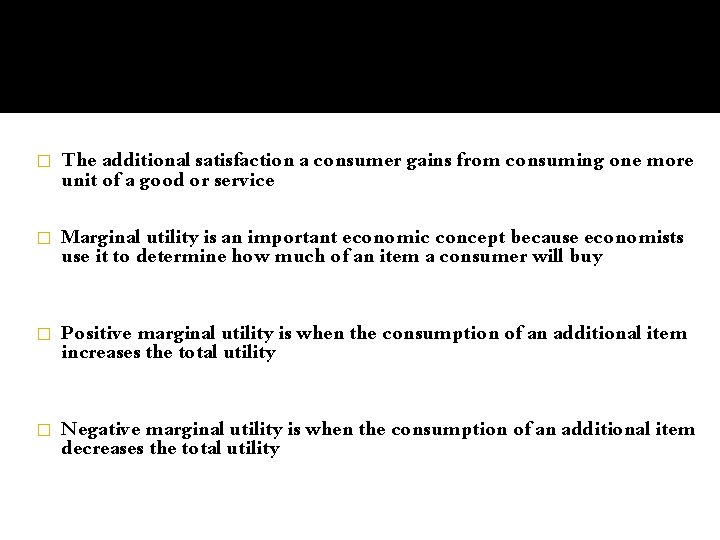
� The additional satisfaction a consumer gains from consuming one more unit of a good or service � Marginal utility is an important economic concept because economists use it to determine how much of an item a consumer will buy � Positive marginal utility is when the consumption of an additional item increases the total utility � Negative marginal utility is when the consumption of an additional item decreases the total utility

LAW OF DIMINISHING MARGINAL UTILITY
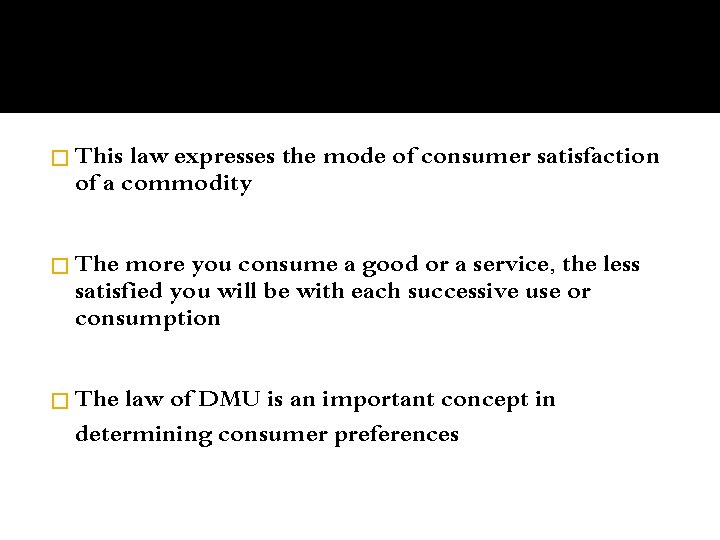
� This law expresses the mode of consumer satisfaction of a commodity � The more you consume a good or a service, the less satisfied you will be with each successive use or consumption � The law of DMU is an important concept in determining consumer preferences

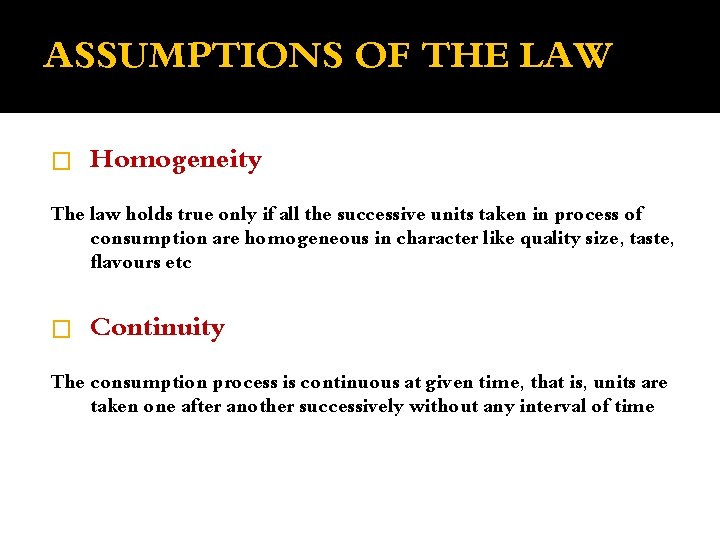
ASSUMPTIONS OF THE LAW � Homogeneity The law holds true only if all the successive units taken in process of consumption are homogeneous in character like quality size, taste, flavours etc � Continuity The consumption process is continuous at given time, that is, units are taken one after another successively without any interval of time
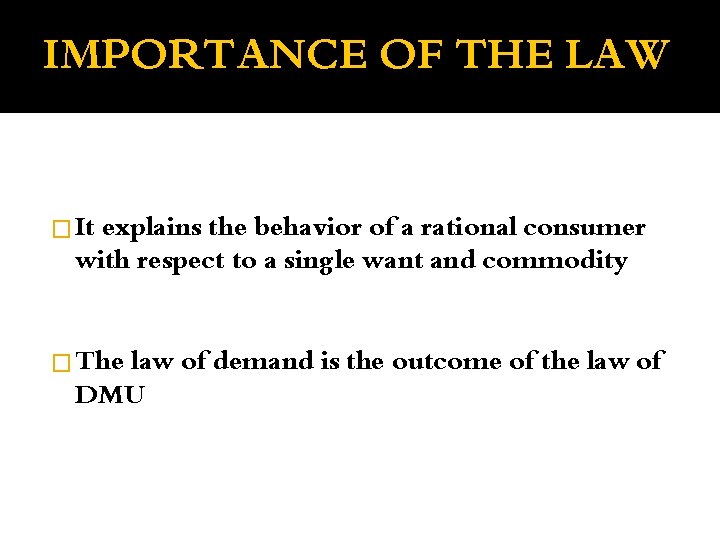
IMPORTANCE OF THE LAW � It explains the behavior of a rational consumer with respect to a single want and commodity � The law of demand is the outcome of the law of DMU
THE LAW OF EQUI-MARGINAL UTILITY
� The law of Equi-marginal utility is an extension of the law of DMU � It is also known as law of maximum satisfaction or law of substitution � A consumer has number of wants. He tries to spend limited income on different things in such a way that marginal utility of all things is equal � When he buys several things with given money income he equalizes marginal utilities of all such things
STATEMENT OF THE LAW � Other things being equal, a consumer gets maximum total utility from spending his income, when he allocates his expenditure to the purchase of different goods in such a way that the marginal utilities derived from the last unit of money spent on each item of expenditure tends to be equal, that is, to say that the consumer maximizes his satisfaction
Other things being equal includes: � Consumer has limited income � The consumer has more than one want to satisfy � The consumer is rational and seeks to maximize his wants and satisfaction � He has no control over the price of the commodity
CONCEPT OF DEMAND � Demand drives economic growth. Businesses want to increase demand so they can increase profits � Governments and central banks boost demand to end recessions, or slow it during the expansion phase of the business cycle � But what drives demand? In economics, there are five determinants for individual demand
LAW OF DEMAND A microeconomic law that states, all other factors being equal, as the price of a good or service increases, consumer demand for the good or service will decrease, and vice versa
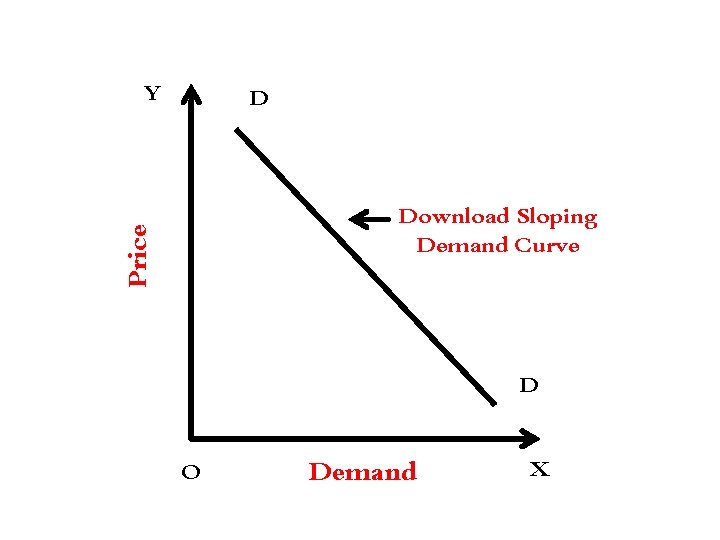
Y D Price Download Sloping Demand Curve D O Demand X
5 DETERMINANTS OF DEMAND: 1. Prices of related goods or services 2. Income of those with the demand 3. Tastes or preferences of those with the demand 4. Expectations 5. For aggregate demand, the number of buyers in the market
Prices of related goods or services � The price of complementary goods or services raises the overall cost of using the good you demand, so you'll want less � The opposite reaction occurs when the price of a substitute rises � When that happens, people will want less of the good or service � That's why Apple constantly innovates with its i. Phones and i. Pods � As soon as a substitute, such as the Droid, appears at a lower price � Apple comes out with a better product, so now the Droid isn't really a substitute
Income � When income rises, so will the quantity demanded � When income falls, so will demand � However, even if your income doubles, you won't necessarily buy twice as much of a particular good or service � There's only so many pints of ice cream you'd want to eat, no matter how rich you are � That's where the concept of marginal utility comes into the picture � The first pint of ice cream tastes delicious. You might have another. But after that the marginal utility starts to decrease to the point where you don't want any more
Tastes � This is the desire, emotion, or preference for a good or service � When tastes rise, so does the quantity demanded � Likewise, when tastes fall, it will depress the quantity demanded � This is what brand advertising is all about
Expectations �When people expect that the value of something will rise, then they demand more of it �For example, housing prices rose, but people bought more because they expected the price to continue to go up
Number of buyers in the market �The number of buyers affects overall, or aggregate, demand �As more buyers enter the market rises, so does the quantity demanded -- even if prices don't change
- Slides: 27