
Consumer Behavior How and Why People Buy Chapter
Consumer Behavior: How and Why People Buy

Chapter Objectives • Define consumer behavior and explain why consumers buy what they buy • Describe the prepurchase, and postpurchase activities that consumers engage in when making decisions • Explain how internal factors influence consumers’ decision-making processes • Show situational factors at the time and place of purchase influence consumer behavior • Explain how consumers’ relationships with other people influence their decision-making processes • Show the Internet offers consumers opportunities to participate in consumer-to-consumer marketing 2
Real People, Real Choices • Meet Daniel Grossman at Wild Planet • Creating brands/products that parents endorse and kids find cool • Future direction of Room Gear product line Ø Option 1: acknowledge that Wild Planet missed the mark and drop the line Ø Option 2: retain line concept and develop products similar to those already selling Ø Option 3: reposition the line toward either boys or girls 3
Decisions, Decisions • Consumer behavior: The process we use to select, purchase, use, and dispose of goods, services, ideas, or experiences to satisfy needs/desires • Internal, situational, and social influences 4
Steps in Consumer Decision Process • Extended problem-solving versus habitual decision-making • Involvement: relative importance of perceived consequences of the purchase • Perceived risk: choice of product has potentially negative consequences 5
Step 1: Problem Recognition • Occurs when consumer sees a significant difference between current state and ideal state • Marketers can develop ads that stimulate problem recognition 6
Step 2: Information Search • Consumers need adequate information to make a reasonable decision • Search memory and the environment for information • Internet: search engines, portals, or “shopping robots” • Behavioral targeting: Marketers deliver ads for products consumers look for, by watching what they do 7
Step 3: Evaluation of Alternatives • Consumers are interested in a small number of products, then narrow choices and compare pros/cons • Evaluative criteria: product characteristics consumers use to compare competing alternatives • Marketers point out their brand’s superiority on most important evaluative criteria. 8
Step 4: Product Choice • Deciding on one product and acting on choice • Heuristic: a mental rule of thumb used for a speedy decision, such as: Ø Price equals quality Ø Brand loyalty Ø Country of origin 9
Step 5: Postpurchase Evaluation • Consumer satisfaction/dissatisfaction after purchase of product • Expectations of product quality are met/exceeded or not • Ads/communications must create accurate expectations of product 10
Internal Influences on Consumer Behavior • Factors that cause us each to interpret information about the outside world differently: Ø Ø Ø Ø Perception Motivation Learning Attitudes Personality Age group The family life cycle Lifestyle 11
Perception • Process by which we select, organize, and interpret information from outside world • Necessary for perception to occur • Exposure: capable of registering a stimulus • Attention: mental processing activity • Interpretation: assigning meaning to a stimulus 12
Motivation • Internal state that drives us to satisfy needs by activating goal-oriented behavior 13
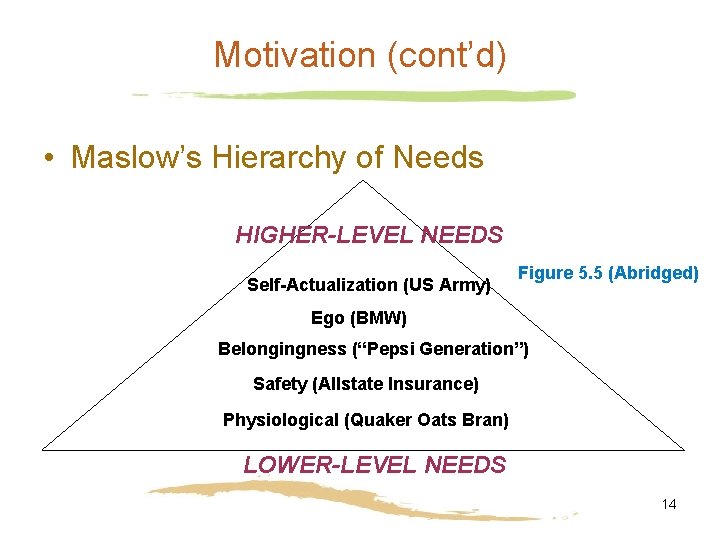
Motivation (cont’d) • Maslow’s Hierarchy of Needs HIGHER-LEVEL NEEDS Self-Actualization (US Army) Figure 5. 5 (Abridged) Ego (BMW) Belongingness (“Pepsi Generation”) Safety (Allstate Insurance) Physiological (Quaker Oats Bran) LOWER-LEVEL NEEDS 14
Learning • A change in behavior caused by information or experience • Behavioral learning Ø Classical conditioning Ø Operant conditioning Ø Stimulus generalization • Cognitive learning Ø Observational learning 15
Attitudes • Lasting evaluations of a person, object, or issue • Three attitude components Ø Affect (feeling): emotional response Ø Cognition (knowing): beliefs or knowledge Ø Behavior (doing): intention to do something • Marketers must decide which attitude component will drive consumer preferences 16
Personality • The set of unique psychological characteristics that consistently influences the way a person responds to situations in the environment • Personality traits: Innovativeness, materialism, self-confidence, sociability, need for cognition • Self-concept 17
Age Group and Family Life Cycle • Goods/services appeal to specific age group • Family Life Cycle: The stages through which family members pass as they grow older 18
Lifestyle • Lifestyle: A pattern of living that determines how people choose to spend their time, money, and energy • Psychographics: group consumers according to psychological and behavioral similarities 19
Situational Influences on Consumer Decisions • Physical environment dimensions such as décor, smells, and lighting • Arousal and pleasure determine consumers’ reaction to store environment • Time as a situational factor 20
Social Influences on Consumer Decisions • We are members of many groups that influence our buying decisions: Ø Culture/subcultures Ø Social class Ø Group memberships Ø Opinion leaders Ø Sex roles 21
Culture • The values, beliefs, customs, and tastes produced or practiced by a group of people • Rituals such as weddings and funerals • Cultural values: deeply held beliefs about right and wrong ways to live 22
Subcultures • A group within a society whose members share a distinctive set of beliefs, characteristics, or common experiences • Subcultures important to marketers are racial and ethnic groups. 23
Social Class • The overall rank or social standing of groups of people within a society, according to factors such as family background, education, occupation, and income. • Status symbols such as luxury products provide a way for people to flaunt their membership in higher social classes. 24
Group Memberships • Reference group: a set of people a consumer wants to please or imitate and that thus has an effect on an individual’s evaluations, aspirations, or behavior • Conformity means people change behavior due to group pressure. 25
Opinion Leaders • People who influence others’ attitudes or behaviors because others perceive them as possessing expertise about the product Ø Have high interest in product category Ø Update knowledge by reading, talking with salespeople, etc. Ø Impart both positive and negative product information Ø Are among the first to buy new products • 26
Gender Roles • Society’s expectations regarding appropriate attitudes, behaviors, and appearance for men and women • Consumers often associate “sex-typed” products with one gender or the other. 27
Consumer-to-Consumer E-Commerce • Online communications and purchases that occur among individuals without directly involving the manufacturer or retailer • Groups of “netizens” around the world with similar interests, united via the Internet • Popular online C 2 C formats Ø Ø Gaming Chat rooms, rings, and lists Boards Blogs 28
Real People, Real Choices • Wild Planet (Daniel Grossman) • Daniel chose option 3: reposition the line toward either boys or girls Ø The firm renamed the line Girls Livin’ in Style (GLS), which has had moderate success. 29
Marketing in Action Case: You Make the Call • What decision must Facebook. com make? • What factors are important in understanding this decision situation? • What are the alternatives? • What decision(s) do you recommend? • What are some ways to implement your recommendation? 30
Keeping It Real: Fast Forward to Next Class Decision Time at PPG Industries • Meet Vicki Holt, Senior VP, Glass & Fiber Glass for PPG Industries, Inc. • PPG’s Insulating Glazing Unit, or IGU, has an aggressive competitor marketing a complete IGU unit. • The decision: How to react to the competition. 31
- Slides: 31