
CONSULTING AND CASE INTERVIEW WORKSHOP Tepper CONSULTING CLUB
CONSULTING AND CASE INTERVIEW WORKSHOP Tepper CONSULTING CLUB October 6, 2001
Agenda • Before the Interview • Interview Summary – Fit Interviews – Case Interviews • Frameworks
Do your research on the firm!!! • What industries do they serve? • What specialty functions? • Who is the client? CEO or operational unit? • Where does the work take place? The office or the client site? • How many projects does an associate work on at a time? One or two?
Many resources are available to do your research • Firm brochures – available at COC • Firm web sites • HBS “Career Guide: Management Consulting” • Wet Feet Press “So You Want To Be a Management Consultant” [wetfeet. com] • Vault Reports “Industry Guide: Management Consulting” [vaultreports. com]
Other reference materials • Books • Vault’s Guide to “The Case Interviews” • Vault’s Guide to “Finance Interviews” • Martin Yate’s “Knock Them Dead” • Web Sites • Firm Web Sites • Vault & Wetfeet
Consulting interviews typically last 45 minutes Intro Time 2 -5 (Minutes) Fit Interview 5 -10 Case Interview 20 -25 Case Interview – Success Critical Q&A 2 -5 Total 45

The Fit Interview
Preparing for fit interviews • Do not underestimate the importance of fit – Every interview is a fit interview! • Go through your resume and have a story for each point • Practice answering key questions. Warm up for case interviews with a few: – Why consulting? Why you? Why this firm? – Tell me about xyz on your resume. – What made you decide to do xyz? – What was the greatest challenge in accomplishing xyz?

The Case Interview
Why case interviews ? ? Snapshots of Consulting Engagements Simulate a “typical” situation between a client and a consultant
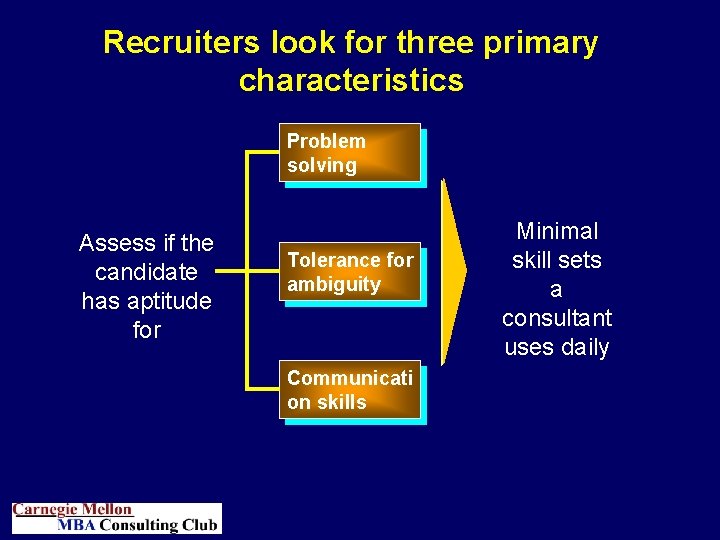
Recruiters look for three primary characteristics Problem solving Assess if the candidate has aptitude for Tolerance for ambiguity Communicati on skills Minimal skill sets a consultant uses daily
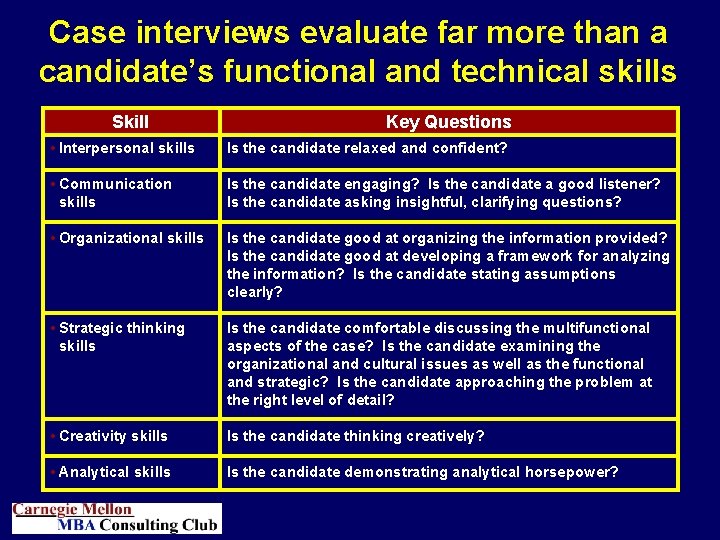
Case interviews evaluate far more than a candidate’s functional and technical skills Skill Key Questions • Interpersonal skills Is the candidate relaxed and confident? • Communication skills Is the candidate engaging? Is the candidate a good listener? Is the candidate asking insightful, clarifying questions? • Organizational skills Is the candidate good at organizing the information provided? Is the candidate good at developing a framework for analyzing the information? Is the candidate stating assumptions clearly? • Strategic thinking skills Is the candidate comfortable discussing the multifunctional aspects of the case? Is the candidate examining the organizational and cultural issues as well as the functional and strategic? Is the candidate approaching the problem at the right level of detail? • Creativity skills Is the candidate thinking creatively? • Analytical skills Is the candidate demonstrating analytical horsepower?
TYPES OF CASE INTERVIEWS AND FRAMEWORKS
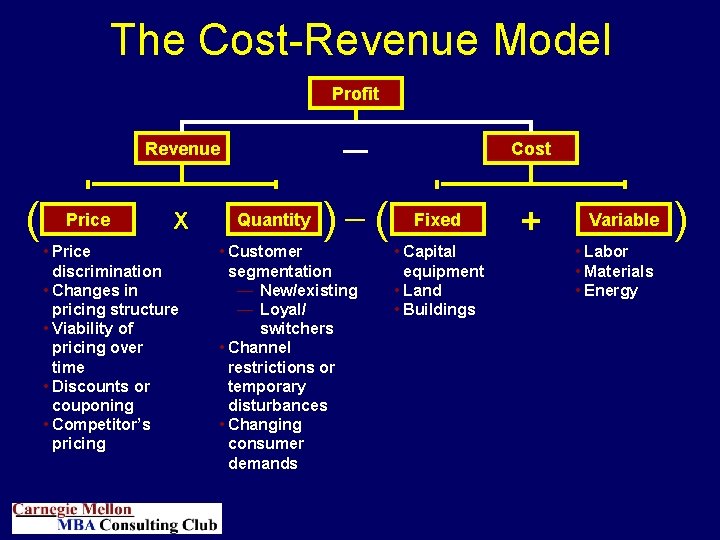
The Cost-Revenue Model Profit Revenue ( Price X • Price discrimination • Changes in pricing structure • Viability of pricing over time • Discounts or couponing • Competitor’s pricing Cost Quantity )—( • Customer segmentation — New/existing — Loyal/ switchers • Channel restrictions or temporary disturbances • Changing consumer demands Fixed • Capital equipment • Land • Buildings + Variable • Labor • Materials • Energy )
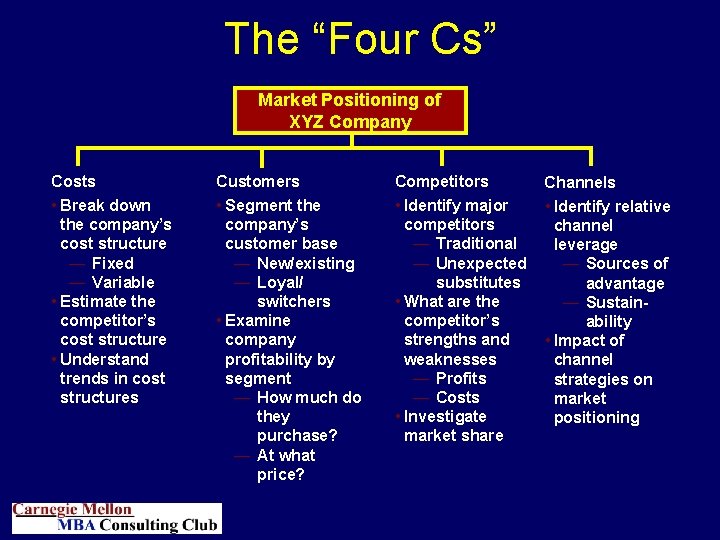
The “Four Cs” Market Positioning of XYZ Company Costs • Break down the company’s cost structure — Fixed — Variable • Estimate the competitor’s cost structure • Understand trends in cost structures Customers • Segment the company’s customer base — New/existing — Loyal/ switchers • Examine company profitability by segment — How much do they purchase? — At what price? Competitors Channels • Identify major • Identify relative competitors channel — Traditional leverage — Unexpected — Sources of substitutes advantage • What are the — Sustaincompetitor’s ability strengths and • Impact of weaknesses channel — Profits strategies on — Costs market • Investigate positioning market share
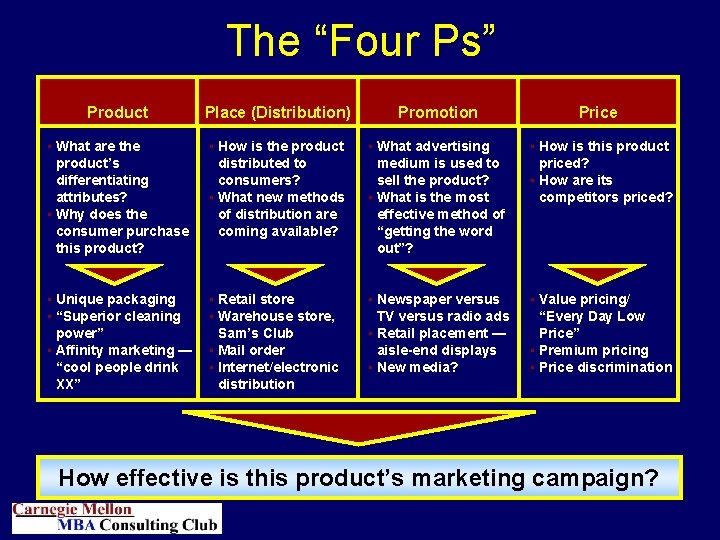
The “Four Ps” Product Place (Distribution) Promotion Price • What are the product’s differentiating attributes? • Why does the consumer purchase this product? • How is the product distributed to consumers? • What new methods of distribution are coming available? • What advertising medium is used to sell the product? • What is the most effective method of “getting the word out”? • How is this product priced? • How are its competitors priced? • Unique packaging • “Superior cleaning power” • Affinity marketing — “cool people drink XX” • Retail store • Warehouse store, Sam’s Club • Mail order • Internet/electronic distribution • Newspaper versus TV versus radio ads • Retail placement — aisle-end displays • New media? • Value pricing/ “Every Day Low Price” • Premium pricing • Price discrimination How effective is this product’s marketing campaign?
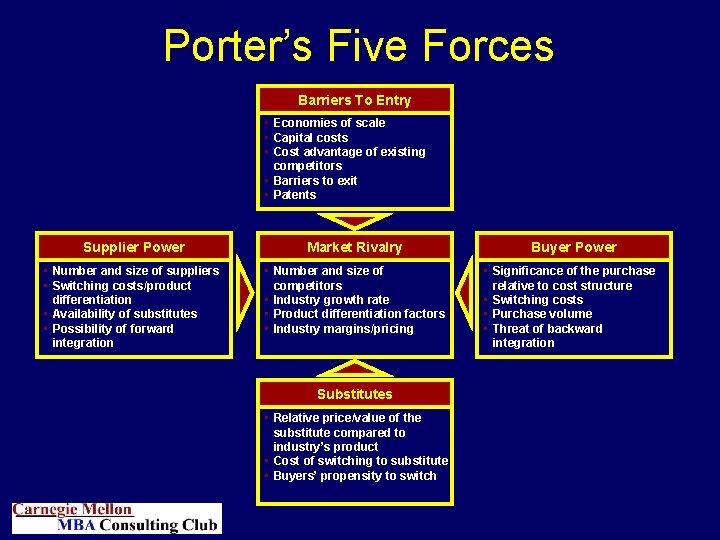
Porter’s Five Forces Barriers To Entry • Economies of scale • Capital costs • Cost advantage of existing competitors • Barriers to exit • Patents Supplier Power Market Rivalry Buyer Power • Number and size of suppliers • Switching costs/product differentiation • Availability of substitutes • Possibility of forward integration • Number and size of competitors • Industry growth rate • Product differentiation factors • Industry margins/pricing • Significance of the purchase relative to cost structure • Switching costs • Purchase volume • Threat of backward integration Substitutes • Relative price/value of the substitute compared to industry’s product • Cost of switching to substitute • Buyers’ propensity to switch
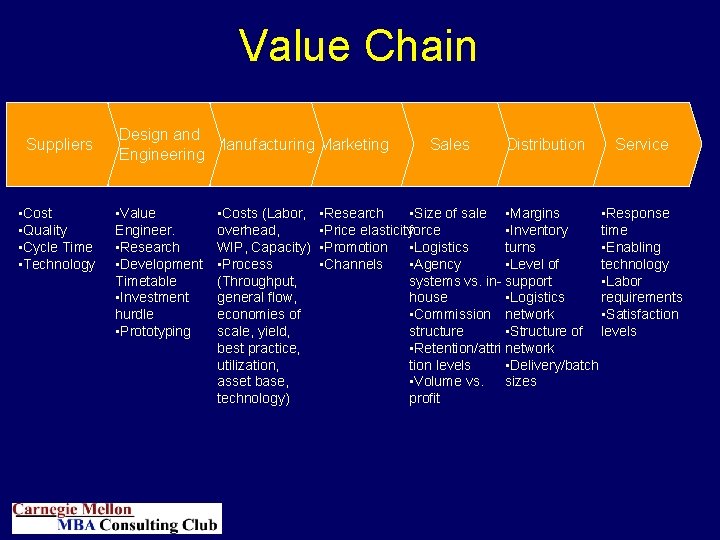
Value Chain Suppliers • Cost • Quality • Cycle Time • Technology Design and Manufacturing Marketing Engineering • Value Engineer. • Research • Development Timetable • Investment hurdle • Prototyping • Costs (Labor, overhead, WIP, Capacity) • Process (Throughput, general flow, economies of scale, yield, best practice, utilization, asset base, technology) Sales Distribution Service • Research • Size of sale • Margins • Response • Price elasticityforce • Inventory time • Promotion • Logistics turns • Enabling • Channels • Agency • Level of technology systems vs. in- support • Labor house • Logistics requirements • Commission network • Satisfaction structure • Structure of levels • Retention/attri network tion levels • Delivery/batch • Volume vs. sizes profit
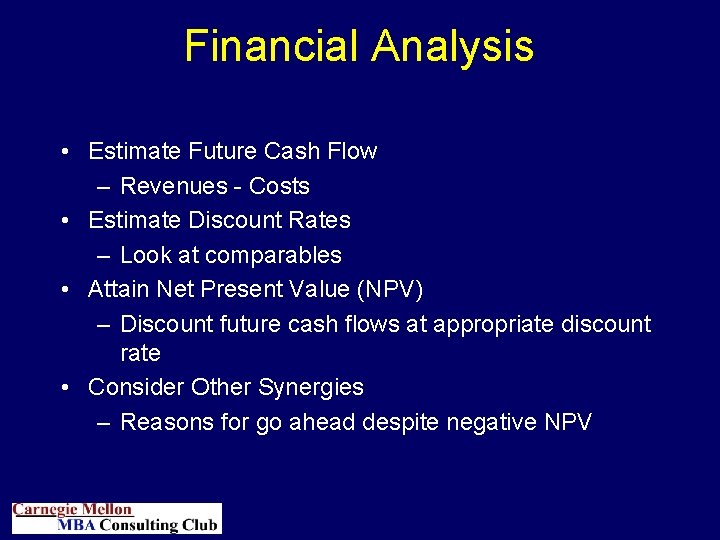
Financial Analysis • Estimate Future Cash Flow – Revenues - Costs • Estimate Discount Rates – Look at comparables • Attain Net Present Value (NPV) – Discount future cash flows at appropriate discount rate • Consider Other Synergies – Reasons for go ahead despite negative NPV
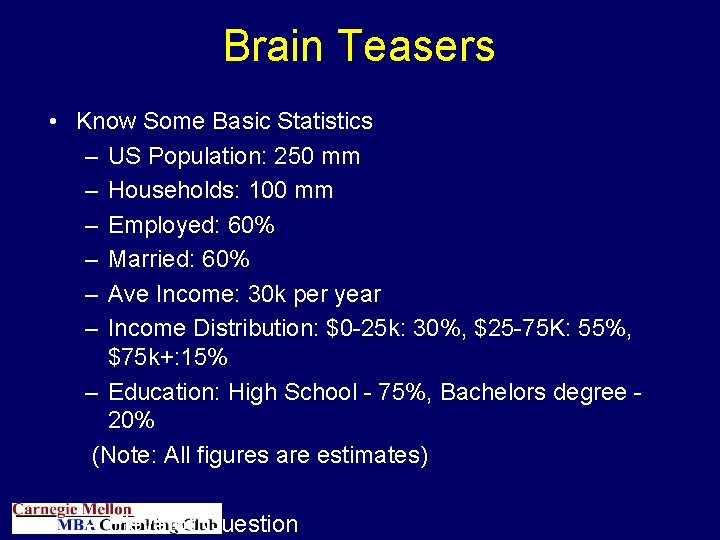
Brain Teasers • Know Some Basic Statistics – US Population: 250 mm – Households: 100 mm – Employed: 60% – Married: 60% – Ave Income: 30 k per year – Income Distribution: $0 -25 k: 30%, $25 -75 K: 55%, $75 k+: 15% – Education: High School - 75%, Bachelors degree 20% (Note: All figures are estimates) – Elevator Question
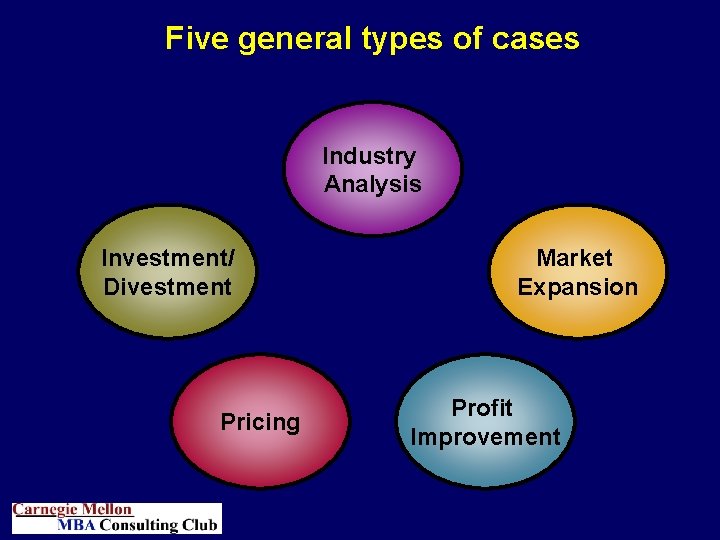
Five general types of cases Industry Analysis Investment/ Divestment Pricing Market Expansion Profit Improvement
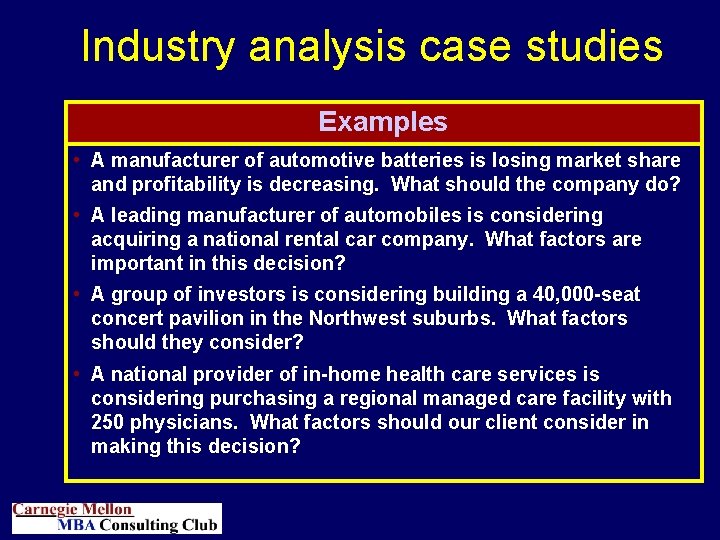
Industry analysis case studies Examples • A manufacturer of automotive batteries is losing market share and profitability is decreasing. What should the company do? • A leading manufacturer of automobiles is considering acquiring a national rental car company. What factors are important in this decision? • A group of investors is considering building a 40, 000 -seat concert pavilion in the Northwest suburbs. What factors should they consider? • A national provider of in-home health care services is considering purchasing a regional managed care facility with 250 physicians. What factors should our client consider in making this decision?
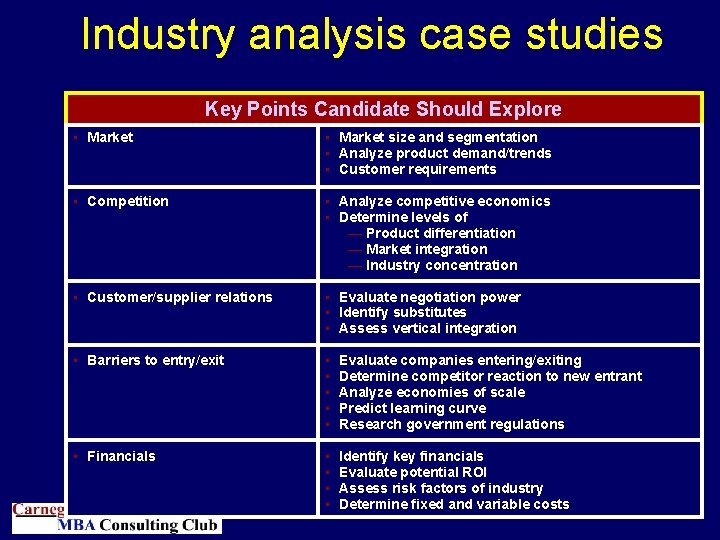
Industry analysis case studies Key Points Candidate Should Explore • Market • Competition • Customer/supplier relations • Barriers to entry/exit • Financials • Market size and segmentation • Analyze product demand/trends • Customer requirements • Analyze competitive economics • Determine levels of — Product differentiation — Market integration — Industry concentration • Evaluate negotiation power • Identify substitutes • Assess vertical integration • • • Evaluate companies entering/exiting Determine competitor reaction to new entrant Analyze economies of scale Predict learning curve Research government regulations • • Identify key financials Evaluate potential ROI Assess risk factors of industry Determine fixed and variable costs
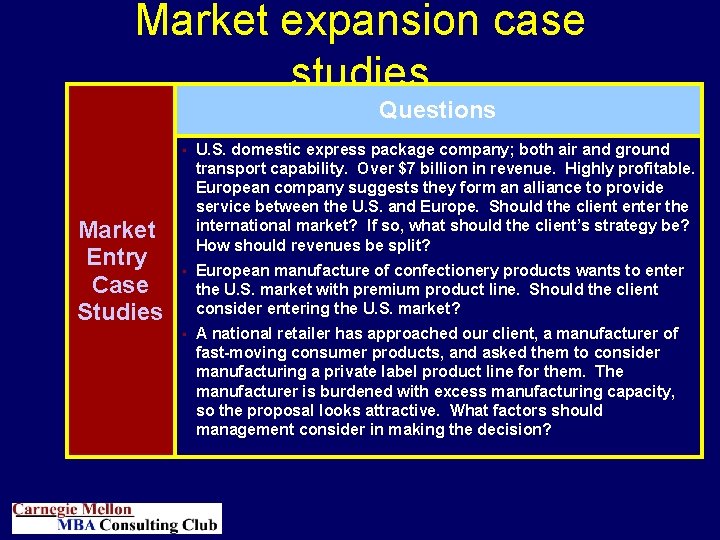
Market expansion case studies Questions Market Entry Case Studies • U. S. domestic express package company; both air and ground transport capability. Over $7 billion in revenue. Highly profitable. European company suggests they form an alliance to provide service between the U. S. and Europe. Should the client enter the international market? If so, what should the client’s strategy be? How should revenues be split? • European manufacture of confectionery products wants to enter the U. S. market with premium product line. Should the client consider entering the U. S. market? • A national retailer has approached our client, a manufacturer of fast-moving consumer products, and asked them to consider manufacturing a private label product line for them. The manufacturer is burdened with excess manufacturing capacity, so the proposal looks attractive. What factors should management consider in making the decision?
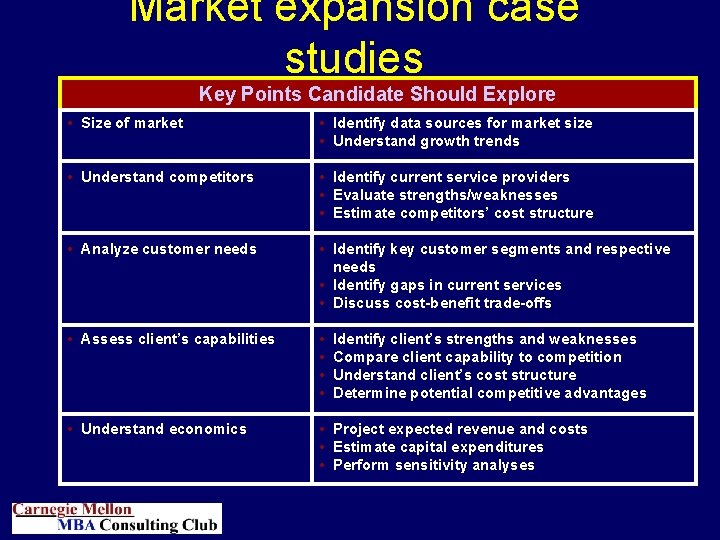
Market expansion case studies Key Points Candidate Should Explore • Size of market • Understand competitors • Analyze customer needs • Assess client’s capabilities • Understand economics • Identify data sources for market size • Understand growth trends • Identify current service providers • Evaluate strengths/weaknesses • Estimate competitors’ cost structure • Identify key customer segments and respective needs • Identify gaps in current services • Discuss cost-benefit trade-offs • • Identify client’s strengths and weaknesses Compare client capability to competition Understand client’s cost structure Determine potential competitive advantages • Project expected revenue and costs • Estimate capital expenditures • Perform sensitivity analyses
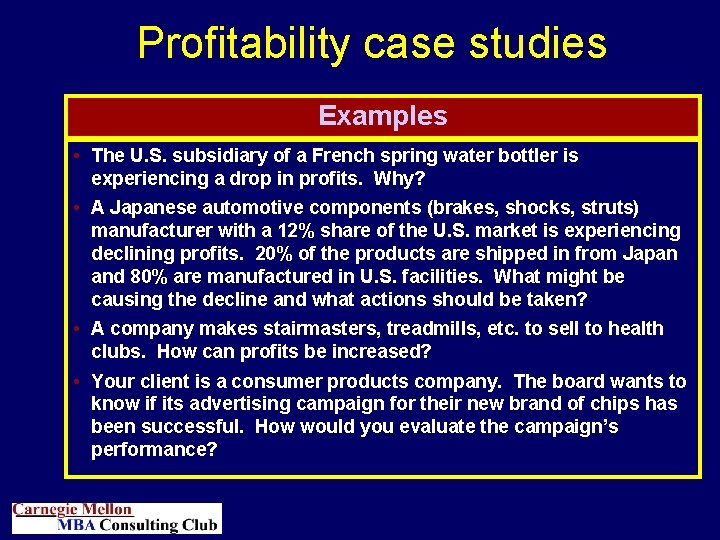
Profitability case studies Examples • The U. S. subsidiary of a French spring water bottler is experiencing a drop in profits. Why? • A Japanese automotive components (brakes, shocks, struts) manufacturer with a 12% share of the U. S. market is experiencing declining profits. 20% of the products are shipped in from Japan and 80% are manufactured in U. S. facilities. What might be causing the decline and what actions should be taken? • A company makes stairmasters, treadmills, etc. to sell to health clubs. How can profits be increased? • Your client is a consumer products company. The board wants to know if its advertising campaign for their new brand of chips has been successful. How would you evaluate the campaign’s performance?
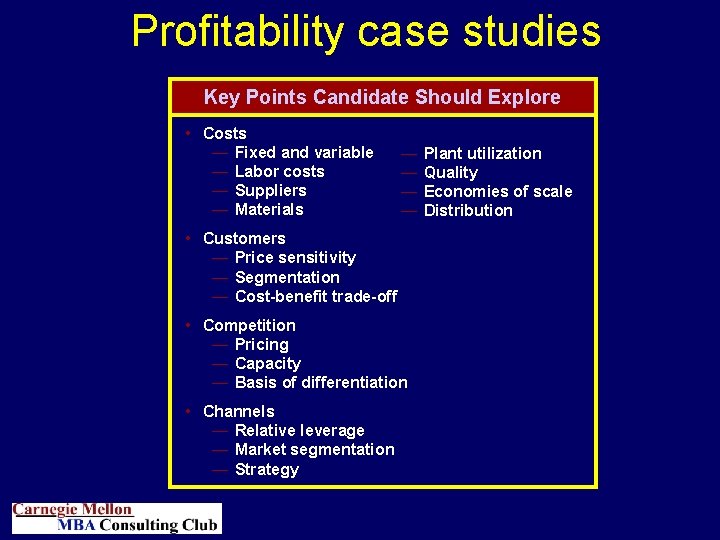
Profitability case studies Key Points Candidate Should Explore • Costs — Fixed and variable — Labor costs — Suppliers — Materials — — • Customers — Price sensitivity — Segmentation — Cost-benefit trade-off • Competition — Pricing — Capacity — Basis of differentiation • Channels — Relative leverage — Market segmentation — Strategy Plant utilization Quality Economies of scale Distribution
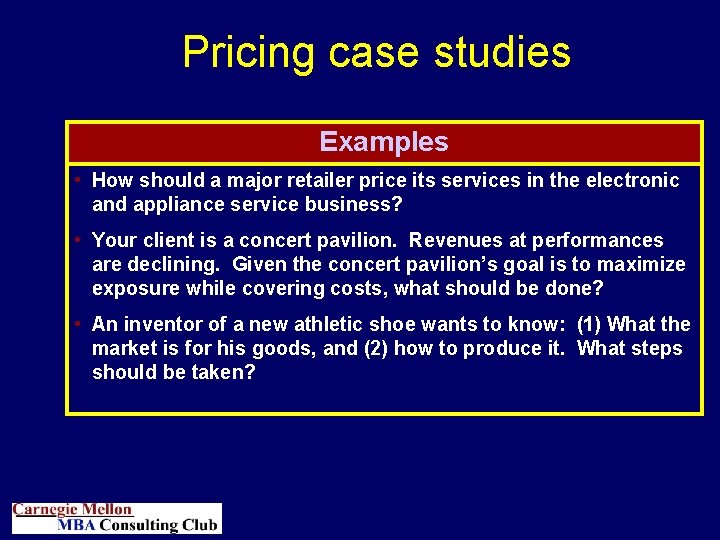
Pricing case studies Examples • How should a major retailer price its services in the electronic and appliance service business? • Your client is a concert pavilion. Revenues at performances are declining. Given the concert pavilion’s goal is to maximize exposure while covering costs, what should be done? • An inventor of a new athletic shoe wants to know: (1) What the market is for his goods, and (2) how to produce it. What steps should be taken?
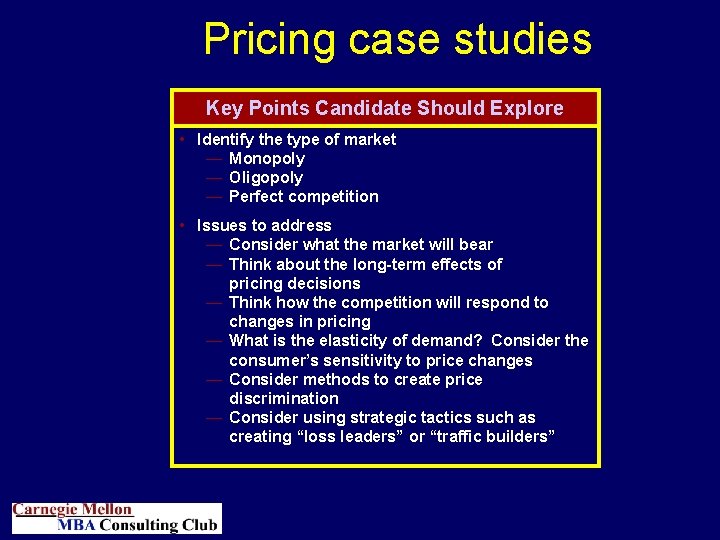
Pricing case studies Key Points Candidate Should Explore • Identify the type of market — Monopoly — Oligopoly — Perfect competition • Issues to address — Consider what the market will bear — Think about the long-term effects of pricing decisions — Think how the competition will respond to changes in pricing — What is the elasticity of demand? Consider the consumer’s sensitivity to price changes — Consider methods to create price discrimination — Consider using strategic tactics such as creating “loss leaders” or “traffic builders”
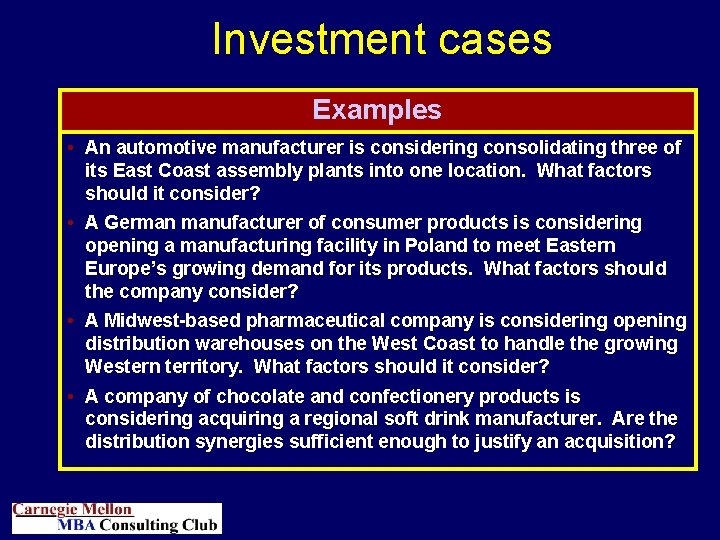
Investment cases Examples • An automotive manufacturer is considering consolidating three of its East Coast assembly plants into one location. What factors should it consider? • A German manufacturer of consumer products is considering opening a manufacturing facility in Poland to meet Eastern Europe’s growing demand for its products. What factors should the company consider? • A Midwest-based pharmaceutical company is considering opening distribution warehouses on the West Coast to handle the growing Western territory. What factors should it consider? • A company of chocolate and confectionery products is considering acquiring a regional soft drink manufacturer. Are the distribution synergies sufficient enough to justify an acquisition?
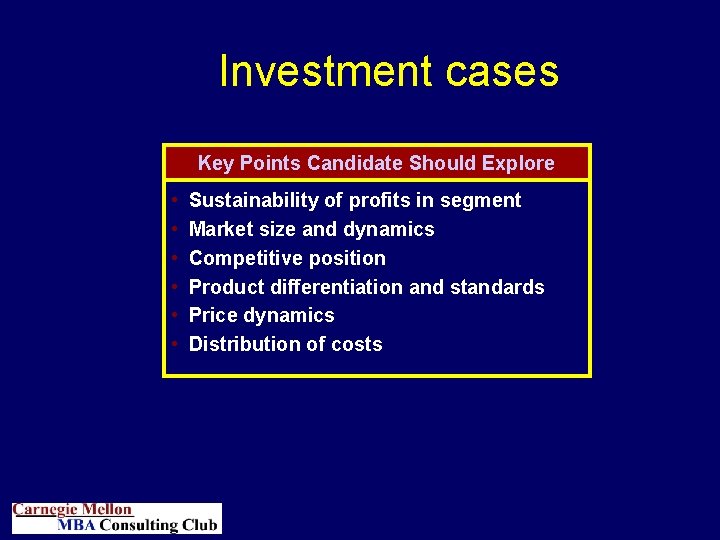
Investment cases Key Points Candidate Should Explore • • • Sustainability of profits in segment Market size and dynamics Competitive position Product differentiation and standards Price dynamics Distribution of costs
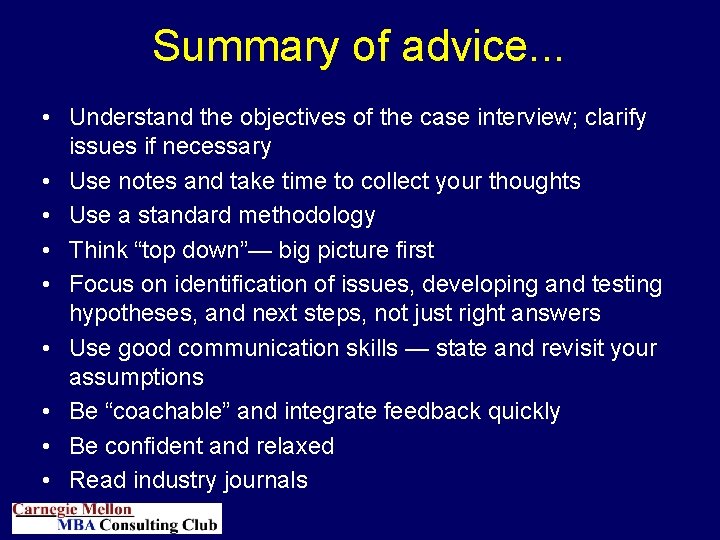
Summary of advice. . . • Understand the objectives of the case interview; clarify issues if necessary • Use notes and take time to collect your thoughts • Use a standard methodology • Think “top down”— big picture first • Focus on identification of issues, developing and testing hypotheses, and next steps, not just right answers • Use good communication skills — state and revisit your assumptions • Be “coachable” and integrate feedback quickly • Be confident and relaxed • Read industry journals

Q&A
- Slides: 33