
Consultants in Human Health Toxicology Regulatory Affairs Chemicals


- Slides: 34
Consultants in Human Health, Toxicology & Regulatory Affairs Chemicals in the Environment and Risk of Cancer Lois Haighton, B. Sc. , DABT November 6, 2007 Mississauga, ON www. cantox. com
Consultants in Human Health, Toxicology & Regulatory Affairs Google Search Engine Results • Generated November 3, 2007 • Cancer causing chemicals in the environment – ~1, 660, 000 results • “Cancer causing chemicals in the environment” – ~597 results • Carcinogens in the environment – ~1, 820, 000 results • “Carcinogens in the environment” – ~12, 900 results www. cantox. com
Consultants in Human Health, Toxicology & Regulatory Affairs Who is offering advice? • Cancer advocacy groups • Medical professionals • Media • Environmentalists • Educators • Scientists/Researchers • Companies that want to sell you stuff (supplements, organic foods) (… and all of their grandmothers) www. cantox. com
Consultants in Human Health, Toxicology & Regulatory Affairs Who should be giving advice? • Scientists/Researchers who are toxicologists and epidemiologists • Agencies that employ toxicologists and epidemiologists • Assistance from statisticians and risk assessors www. cantox. com
Consultants in Human Health, Toxicology & Regulatory Affairs What is Toxicology? • The study of adverse effects of chemicals or physical agents on living organisms • Toxicology, which began as the study of poisons, is now a multidisciplinary field. The development of modern research tools has allowed the science of toxicology to evolve as it has drawn on knowledge gains in biology, chemistry, pharmacology, biochemistry, mathematics and physics. The field of toxicology has also come to include the application of a disciplined approach to safety evaluation and risk assessment. www. cantox. com
Consultants in Human Health, Toxicology & Regulatory Affairs Toxicology Data • Lifetime carcinogenicity studies in animals, usually in rats and mice, to assess ability of a chemical to cause cancer • Genotoxicity assays to assess ability of a chemical to damage DNA Standard test battery – In vitro mutagenicity (Ames Assay) – In vitro clastogenicity in mammalian cells – In vivo clastogenicity • Mechanistic studies to determine mechanism or mode by which chemicals cause cancer www. cantox. com
Consultants in Human Health, Toxicology & Regulatory Affairs Not all Rodent Carcinogens are Human Carcinogens • Some cancer mechanisms occur only in certain species – Alpha 2 u-globulin accumulation (male rats); d-limonene – Forestomach tumors (rodents); propionic acid – Thyroid tumors due to differences in T 3/T 4 metabolism (rodents); some fungicides – Liver tumors due to peroxisome proliferation (rodents); phthalates – Bladder tumours from hyperplasia due to precipitated chemicals – high exposure exceeds solubility (rodents); saccharin www. cantox. com
Consultants in Human Health, Toxicology & Regulatory Affairs What is Epidemiology? • The study of the distribution and determinants of disease or health status in a population; the study of the occurrence and causes of health effects in humans. www. cantox. com
Consultants in Human Health, Toxicology & Regulatory Affairs Epidemiology Studies • Case/Control Studies – compares individuals with disease to controls without disease • Cohort Studies – study of the occurrence of disease in a group of individuals with similar jobs, exposures, etc. • Retrospective Study – identifies subjects that already have diseases and looks back in time to determine potential causality • Prospective Study – subjects are identified and then followed forward in time to see what diseases they develop • Meta-Analysis – combines results of studies with same research objective and similar methodologies to increase statistical power www. cantox. com
Consultants in Human Health, Toxicology & Regulatory Affairs Agencies Involved in Cancer Research • National Toxicology Program (NTP) – U. S. Department of Health and Human Services – Mission: “to evaluate agents of public health concern by developing and applying tools of modern toxicology and molecular biology. ” • International Agency For Research on Cancer (IARC) – Agency of the World Health Organization – Mission: “to coordinate and conduct research on the causes of human cancer, the mechanisms of carcinogenesis, and to develop scientific strategies for cancer control. The Agency is involved in both epidemiological and laboratory research and disseminates scientific information through publications, meetings, courses, and fellowships. ” www. cantox. com
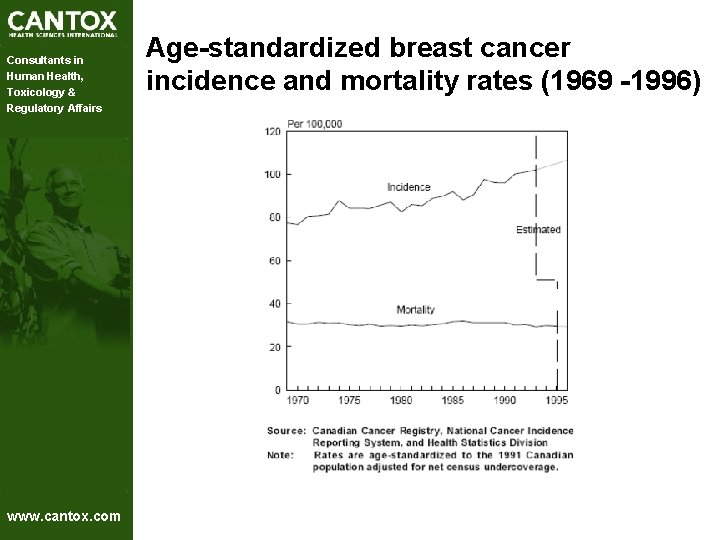
Consultants in Human Health, Toxicology & Regulatory Affairs Incidence vs. Mortality • Incidence is the number of individuals with cancer in a specified time period (e. g. , new cases per year) • Mortality is the number of individuals that die from cancer over a specified time period (e. g. , number of deaths per year) • In determining cancer trends, it is necessary to distinguish between cancer incidence and mortality • Important to standardize data to age www. cantox. com
Consultants in Human Health, Toxicology & Regulatory Affairs www. cantox. com Age-standardized breast cancer incidence and mortality rates (1969 -1996)
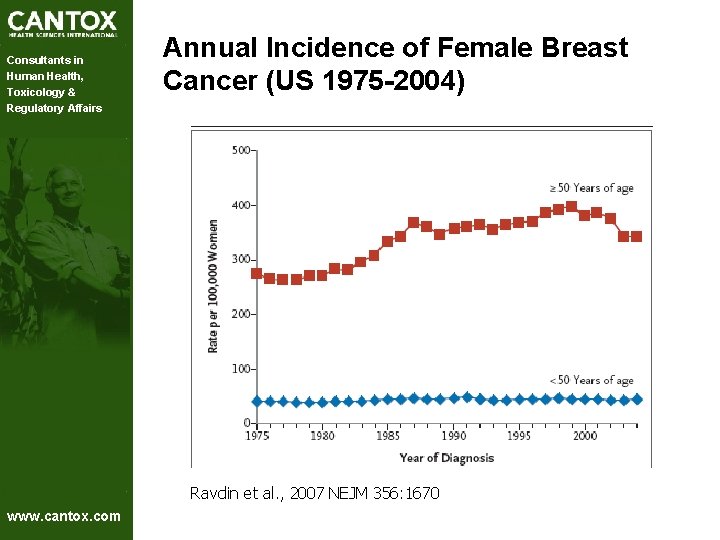
Consultants in Human Health, Toxicology & Regulatory Affairs Annual Incidence of Female Breast Cancer (US 1975 -2004) Ravdin et al. , 2007 NEJM 356: 1670 www. cantox. com
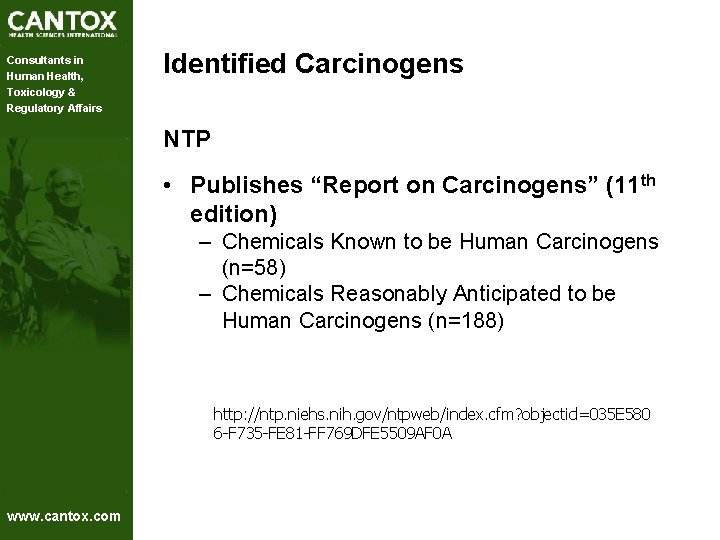
Consultants in Human Health, Toxicology & Regulatory Affairs Identified Carcinogens NTP • Publishes “Report on Carcinogens” (11 th edition) – Chemicals Known to be Human Carcinogens (n=58) – Chemicals Reasonably Anticipated to be Human Carcinogens (n=188) http: //ntp. niehs. nih. gov/ntpweb/index. cfm? objectid=035 E 580 6 -F 735 -FE 81 -FF 769 DFE 5509 AF 0 A www. cantox. com
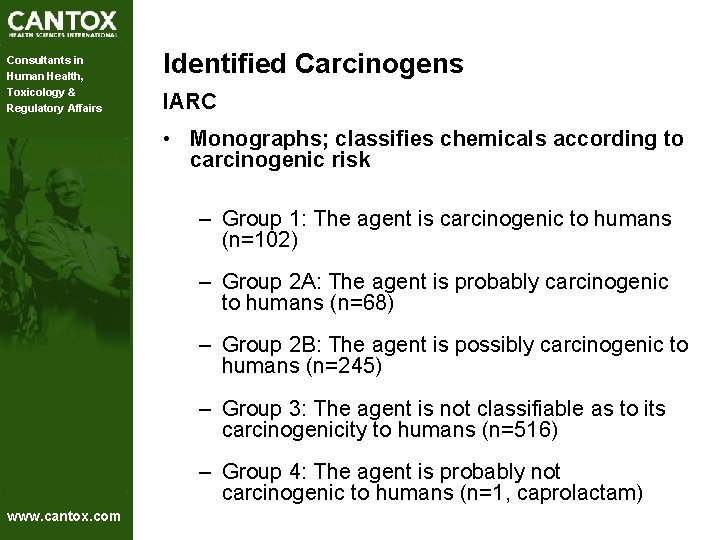
Consultants in Human Health, Toxicology & Regulatory Affairs Identified Carcinogens IARC • Monographs; classifies chemicals according to carcinogenic risk – Group 1: The agent is carcinogenic to humans (n=102) – Group 2 A: The agent is probably carcinogenic to humans (n=68) – Group 2 B: The agent is possibly carcinogenic to humans (n=245) – Group 3: The agent is not classifiable as to its carcinogenicity to humans (n=516) – Group 4: The agent is probably not carcinogenic to humans (n=1, caprolactam) www. cantox. com
Consultants in Human Health, Toxicology & Regulatory Affairs Evidence Supporting that a Chemical is likely a Carcinogen • Increases incidence of tumours in experimental animals • Induces genotoxic responses (although not all carcinogens cause cancer by affecting DNA) • Relative risks or odd ratio is clearly >1 in epidemiology studies (i. e. , strong association) • Epidemiology studies consistently find same association • Cancer is confirmed to occur after exposure with sufficient latency period • Cancer incidence is higher with greater exposure www. cantox. com • Cancer association can be explained mechanistically
Consultants in Human Health, Toxicology & Regulatory Affairs How are you exposed to chemicals in the environment? • Inhalation - air pollution, exhaust • Ingestion – water, food, soil • Skin contact – contaminated soils www. cantox. com
Consultants in Human Health, Toxicology & Regulatory Affairs Carcinogens in the Environment Group 1 Carcinogens • Arsenic, Beryllium, Cadmium, Chromium VI, Nickel • Benzene • Polycyclic Aromatic Hydrocarbons (benzo[a]pyrene) • Formaldehyde • Radium, Radionuclides, Radiation (including solar) • 2, 3, 7, 8 -Tetrachlorodibenzo-p-dioxin www. cantox. com • Chemicals in industrial emissions (e. g. , vinyl chloride, ethylene oxide)
Consultants in Human Health, Toxicology & Regulatory Affairs Drugs listed as Group 1 Carcinogens (Known Human Carcinogens) • Azathioprine • Chlorambucil • Cyclophosphamide • Cyclosporin • Diethylstilboestrol • Estrogen-progestogen menopausal therapy • Etoposide • Melphalan • Methoxypsoralen • Tamoxifen www. cantox. com
Consultants in Human Health, Toxicology & Regulatory Affairs Other Group 1 Carcinogens • Tobacco smoke • Aflatoxins (found in peanut butter) • Coal-tars • Wood dust • Herbal remedies containing plant species of genus Aristolochia • Secondhand or “environmental” tobacco smoke • Various occupations (e. g. , boot and shoe manufacture and repair, chimney sweeping, paving and roofing with coal-tar pitch) www. cantox. com
Consultants in Human Health, Toxicology & Regulatory Affairs What’s in the water? • Trihalomethanes including chloroform (group 2 B); formed during chlorination • Metals • Organic chemicals detected in streams near urban sites (U. S. Geological Survey) – Steroids including estrogen – Nonprescription drugs – Insect Repellants – Detergent metabolites – Disinfectants – Plasticizers – Fire Retardants – Antibiotics • Group 1 carcinogens: PAHs and estrogen www. cantox. com
Consultants in Human Health, Toxicology & Regulatory Affairs What’s in the air? • Nitrogen oxides • Sulfur oxides • Carbon dioxide • Carbon monoxide • Volatile Organic Carbons • Particulate Matter • Chemicals from industrial emissions www. cantox. com
Consultants in Human Health, Toxicology & Regulatory Affairs What’s in diesel exhaust (Group 2 A)? • Polycyclic aromatic hydrocarbons • Nitrous oxide • Nitrogen dioxide • Formaldehyde (Group 1) • Benzene (Group 1) • Sulfur dioxide • Hydrogen sulfide • Carbon dioxide • Carbon monoxide www. cantox. com
Consultants in Human Health, Toxicology & Regulatory Affairs Environmental Exposure to Benzene • A typical nonsmoker inhales about 0. 2 mg benzene/day mostly from auto exhaust or gasoline vapor emissions; other sources include environmental tobacco smoke, petrochemical plants or refineries. • In comparison a typical smoker inhales roughly 2 mg benzene/day (1. 8 mg from cigarettes) (10 x as much) www. cantox. com Environmental Health Perspectives, Vol 104, Suppl 6, Dec 1996
Consultants in Human Health, Toxicology & Regulatory Affairs Example: Risk of Cancer from Benzene in the Environment • A range of 2. 2 x 10 -6 to 7. 8 x 10 -6 is the increase in the lifetime cancer risk of an individual who is exposed for a lifetime to 1 µg/m 3 benzene in air (U. S. EPA; estimated from epidemiology studies). – ~ 1 additional cancer above background per 450, 000 or 130, 000 exposed individuals • Nonsmokers 0. 2 mg/day = 10 µg/m 3 (0. 2 mg/day/20 m 3/day x 1000 µg/mg = 10 µg/m 3 ) – ~ 1 cancer per 45, 000 or 13, 000 • Smokers 2 mg/day = 100 µg/m 3 – ~1 cancer per 4, 500 or 1, 300 individuals www. cantox. com
Consultants in Human Health, Toxicology & Regulatory Affairs Leukemia • Estimated new cases of leukemia in Canada in 2007 – 4200 total (Canadian Cancer Statistics 2007) – Population as of July (32, 976, 026) (16. 5% smokers) – ~1 new case of leukemia per 7, 850 Canadians – 0. 2 mg/day ~ 612 to 2118 new cases – 2 mg/day ~ 1209 to 4185 new cases • Other risk factors besides environmental benzene exposures – Ionizing radiation – Employment in rubber or petroleum industries (1, 3 butadiene) • Leukemia accounts for ~2. 6% of new cancers – Lung 14. 6%; breast 14%; prostate 14%; colorectal 13% www. cantox. com
Consultants in Human Health, Toxicology & Regulatory Affairs Cancer Risk Factors • Genetics (family history) • Lifestyle choices (smoking, alcohol consumption, diet) • Age • Some occupations • Sun exposure • Exposure to chemicals www. cantox. com
Consultants in Human Health, Toxicology & Regulatory Affairs Cancer Risk Factors • Need to distinguish between Environmental Risk and Risk from Chemicals in the Environment • “Environmental” risks are often referring to your “personal environment” (environment vs. genetics) and may include tobacco use, diet, physical activity, and infectious diseases. • About one-third of all cancer deaths are now considered to be related to dietary factors and lack of physical activity in adulthood. • In comparison, carcinogens in the environment are estimated to cause less than 5% of cancer deaths. www. cantox. com
Consultants in Human Health, Toxicology & Regulatory Affairs What protects you from developing cancer? • Metabolism and excretion processes • Detoxification mechanisms (e. g. , superoxide anion scavenging activity by superoxide dismutases and catalase deactivation of reactive oxygen species) • DNA repair mechanisms • Immunosurveillance of DNA-damaged cells • Programmed cell death (apoptosis) of cells carrying damaged DNA • Antioxidants from the diet www. cantox. com
Consultants in Human Health, Toxicology & Regulatory Affairs Why do these mechanisms fail? • Typically cancer may occur when the concentration of the chemical and length of exposure are sufficient to overwhelm protective or detoxification mechanisms • Age – weakening of body’s immune system • Genetic mutation – predisposing individuals to certain cancers www. cantox. com
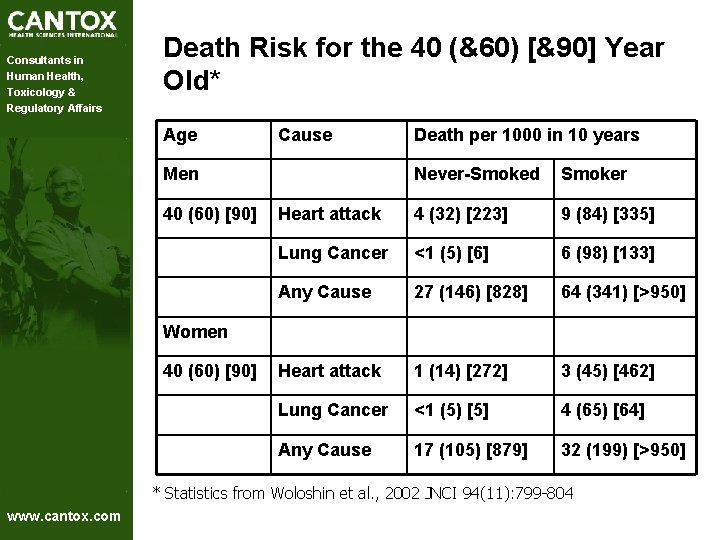
Consultants in Human Health, Toxicology & Regulatory Affairs Death Risk for the 40 (&60) [&90] Year Old* Age Cause Men 40 (60) [90] Death per 1000 in 10 years Never-Smoked Smoker Heart attack 4 (32) [223] 9 (84) [335] Lung Cancer <1 (5) [6] 6 (98) [133] Any Cause 27 (146) [828] 64 (341) [>950] Heart attack 1 (14) [272] 3 (45) [462] Lung Cancer <1 (5) [5] 4 (65) [64] Any Cause 17 (105) [879] 32 (199) [>950] Women 40 (60) [90] * Statistics from Woloshin et al. , 2002 JNCI 94(11): 799 -804 www. cantox. com
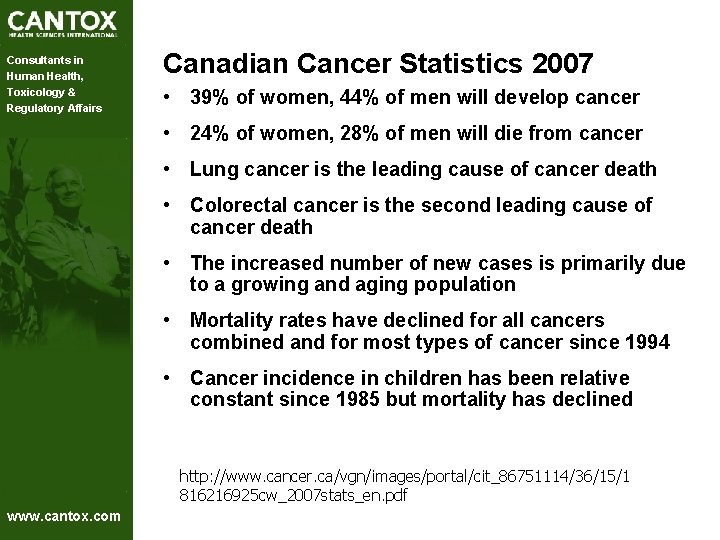
Consultants in Human Health, Toxicology & Regulatory Affairs Canadian Cancer Statistics 2007 • 39% of women, 44% of men will develop cancer • 24% of women, 28% of men will die from cancer • Lung cancer is the leading cause of cancer death • Colorectal cancer is the second leading cause of cancer death • The increased number of new cases is primarily due to a growing and aging population • Mortality rates have declined for all cancers combined and for most types of cancer since 1994 • Cancer incidence in children has been relative constant since 1985 but mortality has declined http: //www. cancer. ca/vgn/images/portal/cit_86751114/36/15/1 816216925 cw_2007 stats_en. pdf www. cantox. com
Consultants in Human Health, Toxicology & Regulatory Affairs Preventative Measures • Quit Smoking (or kick smokers out of house) • Avoid excessive alcohol consumption • Eat diet high in fruits and vegetables and low in fat • Exercise • Get screened for common cancers (prostate, breast, colorectal) • Vitamin D? • Be aware of protective measures at your place of employment www. cantox. com
Consultants in Human Health, Toxicology & Regulatory Affairs Thank you lhaighton@cantox. com 905 542 2900 ext 245 905 542 1011 www. cantox. com