
Consultant Learning A Model for Student Directed Learning
- Slides: 26
Consultant Learning: A Model for Student Directed Learning in Management Education Scott W. Kunkel University of San Diego © 2002 Scott W. Kunkel
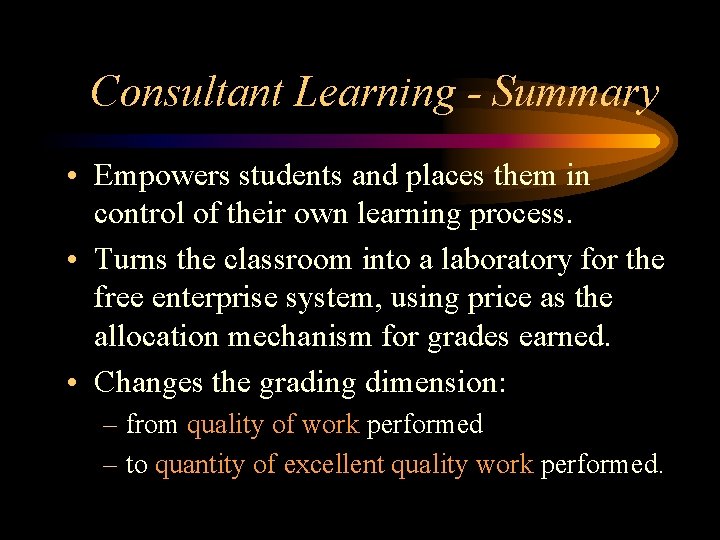
Consultant Learning • Empowers students and places them in control of their own learning process. • Turns the classroom into a laboratory for the free enterprise system, using price as the allocation mechanism for grades earned. • Changes the grading dimension: – from quality of work performed – to quantity of excellent quality work performed.
In the Traditional Course • All students do the same quantity of work. • Grading based on quality: – excellent quality = “A” – mediocre quality = “B” – poor quality = “C” • Poor quality work is accepted and the grade is reduced.
In Consultant Learning • All accepted work is excellent quality. • Work that is not excellent quality is redone until it is excellent quality. • Grading is based on the quantity of excellent quality work the student performs. • Every student produces work of which he/she can be proud.
In Consultant Learning • • Students redo unprofessional work. Students compile the work in a portfolio. Portfolio can be used for job search. Completed portfolio is submitted at end of the semester. • Amount earned determines course grade: – Turns classroom into mini-economy. – Mimics real-world consulting environment.
Theoretical Foundation • “Mastery Learning” by Bloom (‘ 71, ‘ 81). • Bloom said education should no longer be about “weeding out” students. • The normal curve is a valid predictor of random events, not purposeful events. • Learning is a purposeful event.
Theoretical Foundation • “Mastery Learning” is a model that must be implemented across an entire curriculum. • Consultant Learning can be implemented in a single class without changing the assessment and grading standards of an entire institution.
Theoretical Foundation • “Problem-Based Learning” (Bridges, ‘ 92). • Builds educational objectives into projects • Students complete the projects that require fulfillment of the learning objectives. • “Problem-based learning. . . fits exceptionally well in multidisciplinary and interdisciplinary learning and teaching styles” (Glasgow, ‘ 97).
The Consultant Learning Process • Students design projects based on their own interests. • For each project, students submit a proposal explaining what they wish to do. • Students assign a consulting fee to each project using a designated formula. • If the proposal and the fee are approved, the student is authorized to do the project.
The Proposal • Proposal includes 8 items: – 1. Topic – 2. Rationale – 3. Research Method – 4. Output/Report Method – 5. Perspective and Audience – 6. Consulting Hours – 7. Consulting Fee – 8. Due Date
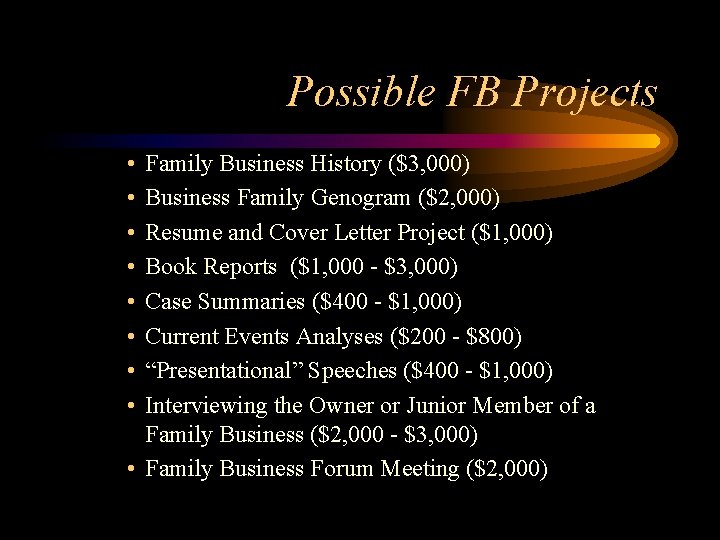
Possible FB Projects • • Family Business History ($3, 000) Business Family Genogram ($2, 000) Resume and Cover Letter Project ($1, 000) Book Reports ($1, 000 - $3, 000) Case Summaries ($400 - $1, 000) Current Events Analyses ($200 - $800) “Presentational” Speeches ($400 - $1, 000) Interviewing the Owner or Junior Member of a Family Business ($2, 000 - $3, 000) • Family Business Forum Meeting ($2, 000)
The Project • When the project is submitted, it is either approved or returned to be redone. • If project is returned, the student must rewrite the project and resubmit it. • This process continues until the project is judged to be of “professional quality” and, therefore, acceptable.
The Project • When the project is accepted, the agreed-upon fee is marked Paid (for example, “PAID $2, 000”) and given back to the student. • There are no partial fees - the project is either professional quality or it is not - it is either paid or returned to the student to be rewritten and resubmitted.
The Project • When a project is paid, it is returned to the student. (I keep no records. ) • The student puts the paid project in his/her portfolio.
Pay for In-Class Work • Students are “paid” for attending class. • Students are “paid” for being prepared to discuss the readings - “Call-On-Me” list.
The Portfolio • At the end of semester, the student puts two accounting sheets on top of the portfolio showing what he/she has earned. • S/he submits the portfolio to the instructor. • The instructor “audits” the portfolio to make sure that the accounting sheet is accurate. • A grade is assigned based on how much the student has earned during the semester.
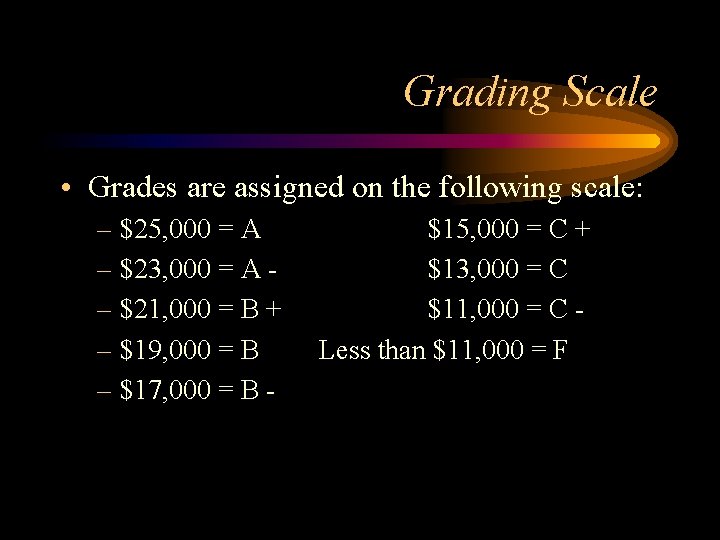
Grading Scale • Grades are assigned on the following scale: – $25, 000 = A – $23, 000 = A – $21, 000 = B + – $19, 000 = B – $17, 000 = B - $15, 000 = C + $13, 000 = C $11, 000 = C Less than $11, 000 = F
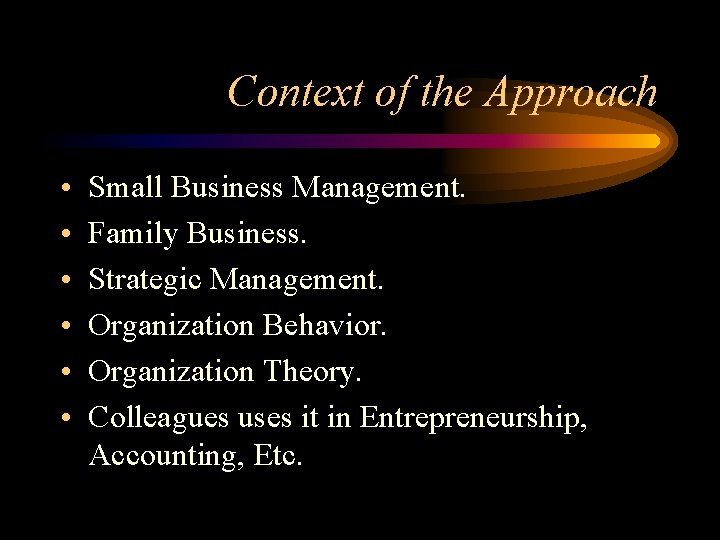
Context of the Approach • • • Small Business Management. Family Business. Strategic Management. Organization Behavior. Organization Theory. Colleagues uses it in Entrepreneurship, Accounting, Etc.
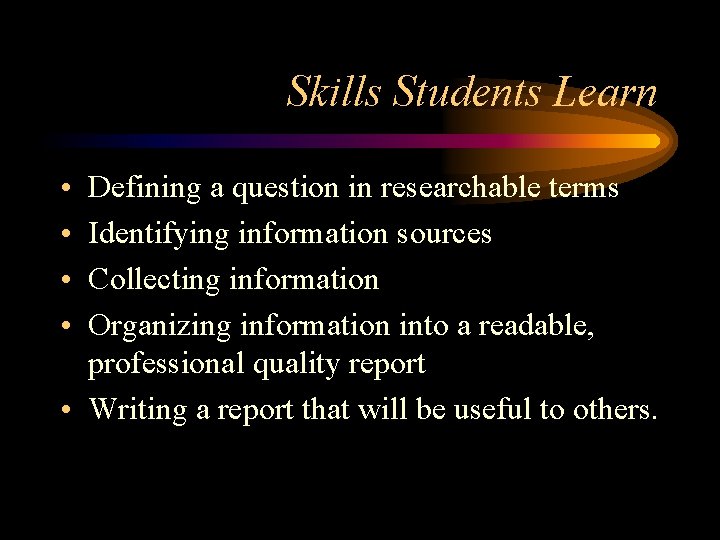
Skills Students Learn • • Defining a question in researchable terms Identifying information sources Collecting information Organizing information into a readable, professional quality report • Writing a report that will be useful to others.
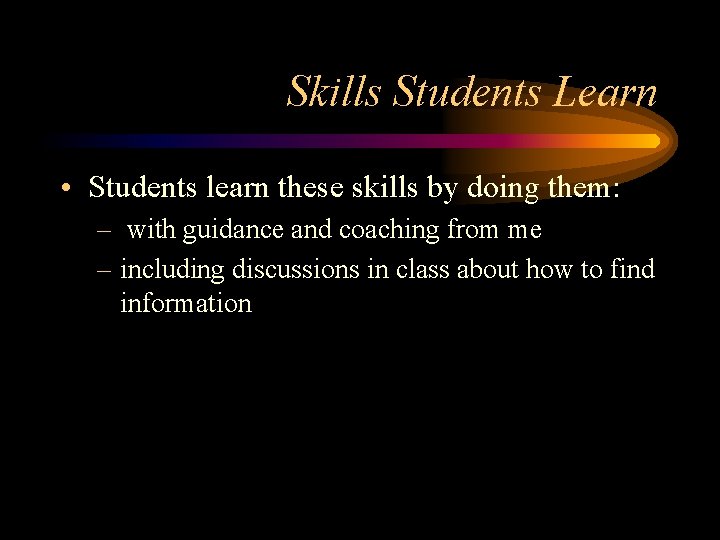
Skills Students Learn • Students learn these skills by doing them: – with guidance and coaching from me – including discussions in class about how to find information
Student Reactions - Positive • High teacher evaluations because students see their work as relevant. • Majority of students make positive comments on unstructured evaluations. • Classes always fill to capacity. • Many students come back after graduation having done things they wrote projects on.
Examples of Student Projects Undertaken • Reviewed franchises then bought MBE. • Proposal to start an R & R band’s fan club, and they hired him. • Proposal to manage a country band, and they hired him. • “Sno. Ads, ” ecologically sensitive advertising in the snow at 2002 Olympics. • Proposal for family to expand farm, they did.
Pros • Student centered - highly motivating to students. • Uses money/economics concepts to motivate behavior - it’s “real world. ” • Students benefit from rewriting. • Course design is extremely flexible. • Motivates students to work for high grades.
Student Reactions - Negative • The Consultant Learning approach places too much responsibility on students. • It is too easy to procrastinate.
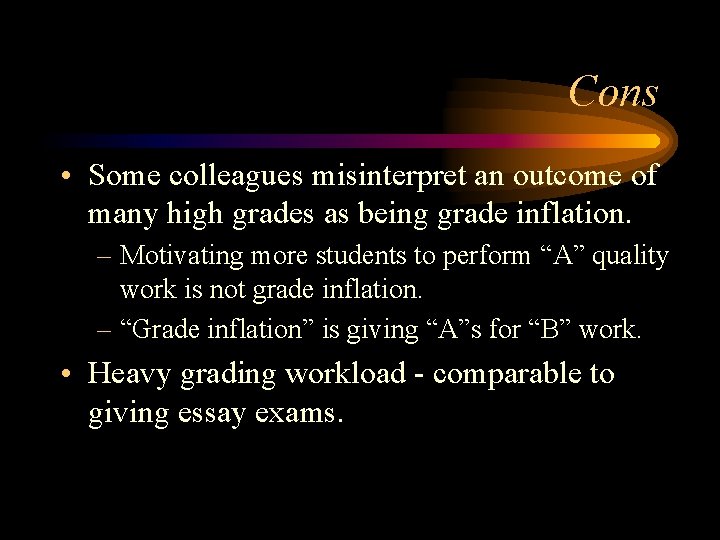
Cons • Some colleagues misinterpret an outcome of many high grades as being grade inflation. – Motivating more students to perform “A” quality work is not grade inflation. – “Grade inflation” is giving “A”s for “B” work. • Heavy grading workload - comparable to giving essay exams.
Consultant Learning - Summary • Empowers students and places them in control of their own learning process. • Turns the classroom into a laboratory for the free enterprise system, using price as the allocation mechanism for grades earned. • Changes the grading dimension: – from quality of work performed – to quantity of excellent quality work performed.