
Constructivist Activity Developing Empathy for Struggling Readers By
Constructivist Activity Developing Empathy for Struggling Readers By Niki Briggs Special Education Teacher Edu 650 Summer 2013
For Who? • Grade Levels: 3 -5 at Grayside Elementary • Timeline: 7 -8 days during morning meeting. • Possibly on-going lunch bunch
Goals and Objectives: • To develop student understanding of what some common struggles are and how they affect someone • To develop empathy for students in their classrooms that struggle academically • To foster friendships between students with disabilities and students without extra challenges • To decrease teasing/bullying • To deepen comprehension strategies for students
INTASC Standards • Standard 2: The teacher understands how children learn and develop, and can provide learning opportunities that support a child’s intellectual, social and personal development. • Standard 3: The teacher understands how students differ in their approaches to learning and barriers that impede learning. The teacher can adapt instruction to meet the diverse needs of students, including those with disabilities.
INTASC Standards Continued… • Standard 5: The teacher uses an understanding of individual and group motivation to create a learning environment that encourages positive social interaction, active engagement in learning and selfmotivation.
Materials • Book: Thank You, Mr. Falker by Patricia Polacco • Construction paper, markers and crayons to create a poster for the class. • Response books • Parent Letter explaining the purpose and activities
RAFT • Role: your job as students is to perform the tasks to the best of your ability. • Audience: You will write a “quick write “ in your journal after you experience what it felt like to struggle with reading. You will collaborate with a small group to discuss your experiences. • Format: whole class, small group, and individual handson activities with some teacher led discussion • Topics: believing in yourself, bullying, how important people shape how we feel about ourselves.
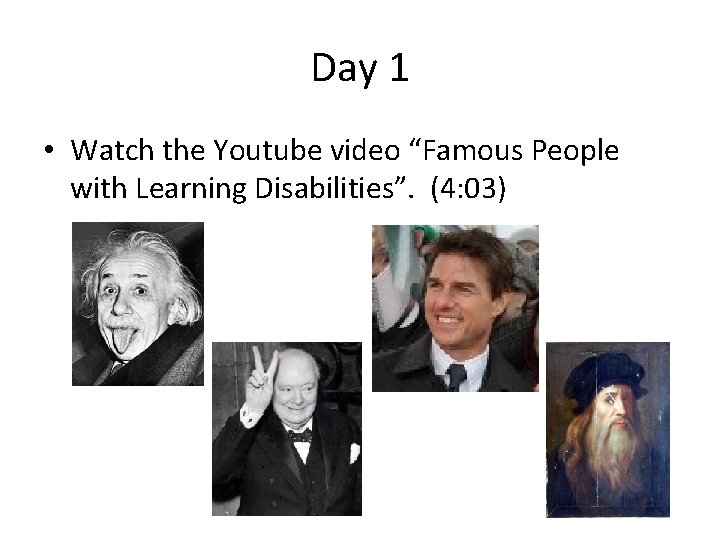
Day 1 • Watch the Youtube video “Famous People with Learning Disabilities”. (4: 03)
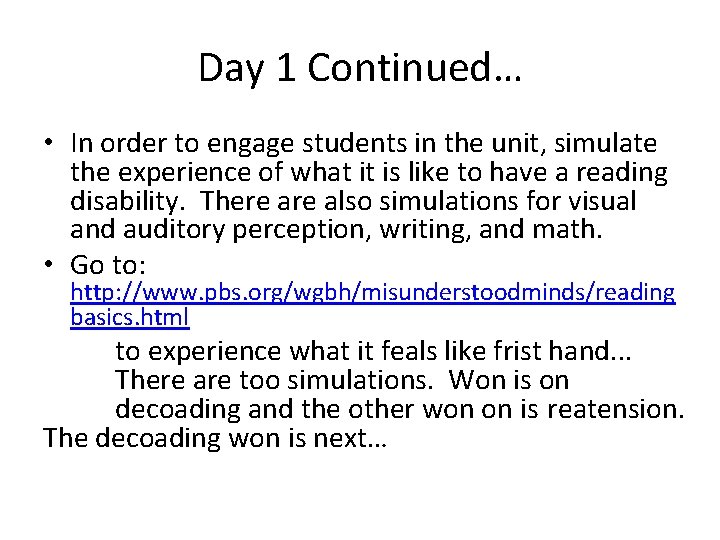
Day 1 Continued… • In order to engage students in the unit, simulate the experience of what it is like to have a reading disability. There also simulations for visual and auditory perception, writing, and math. • Go to: http: //www. pbs. org/wgbh/misunderstoodminds/reading basics. html to experience what it feals like frist hand. . . There are too simulations. Won is on decoading and the other won on is reatension. The decoading won is next…
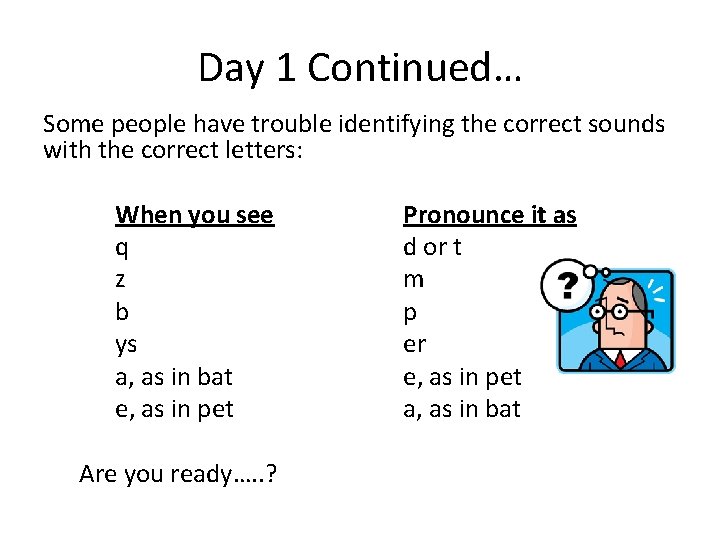
Day 1 Continued… Some people have trouble identifying the correct sounds with the correct letters: When you see q z b ys a, as in bat e, as in pet Are you ready…. . ? Pronounce it as d or t m p er e, as in pet a, as in bat
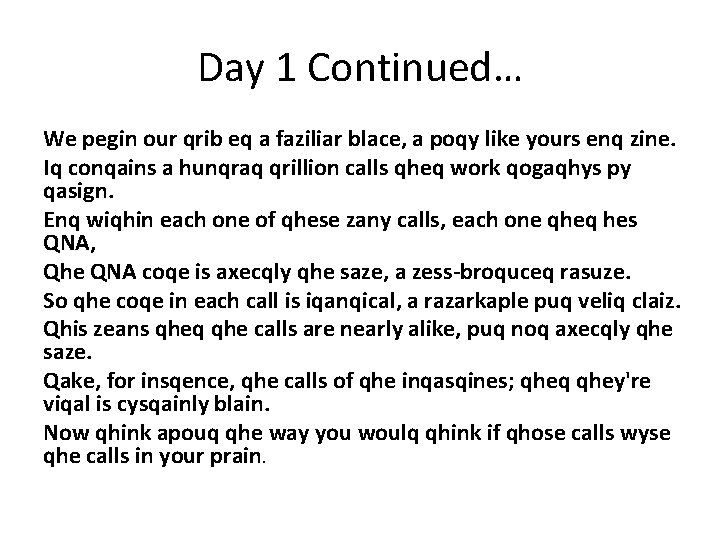
Day 1 Continued… We pegin our qrib eq a faziliar blace, a poqy like yours enq zine. Iq conqains a hunqraq qrillion calls qheq work qogaqhys py qasign. Enq wiqhin each one of qhese zany calls, each one qheq hes QNA, Qhe QNA coqe is axecqly qhe saze, a zess-broquceq rasuze. So qhe coqe in each call is iqanqical, a razarkaple puq veliq claiz. Qhis zeans qheq qhe calls are nearly alike, puq noq axecqly qhe saze. Qake, for insqence, qhe calls of qhe inqasqines; qheq qhey're viqal is cysqainly blain. Now qhink apouq qhe way you woulq qhink if qhose calls wyse qhe calls in your prain.
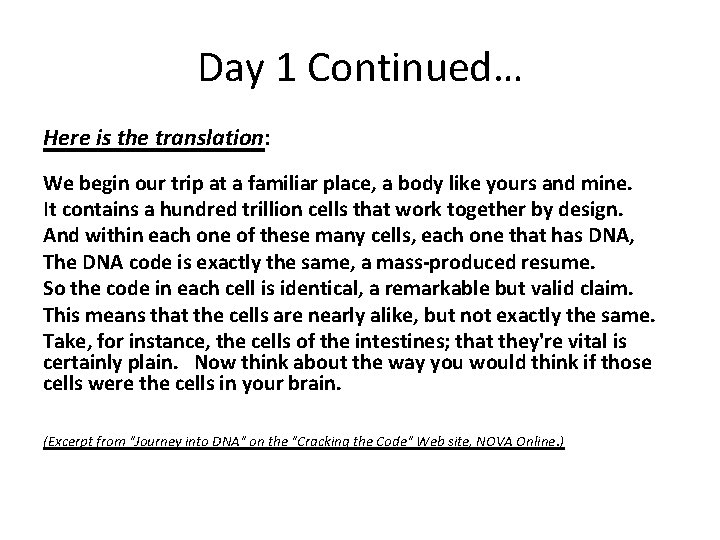
Day 1 Continued… Here is the translation: We begin our trip at a familiar place, a body like yours and mine. It contains a hundred trillion cells that work together by design. And within each one of these many cells, each one that has DNA, The DNA code is exactly the same, a mass-produced resume. So the code in each cell is identical, a remarkable but valid claim. This means that the cells are nearly alike, but not exactly the same. Take, for instance, the cells of the intestines; that they're vital is certainly plain. Now think about the way you would think if those cells were the cells in your brain. (Excerpt from "Journey into DNA" on the "Cracking the Code" Web site, NOVA Online. )
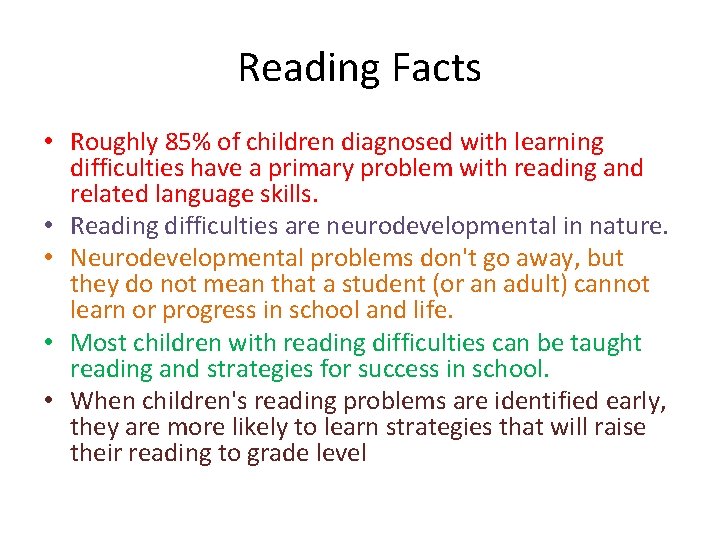
Reading Facts • Roughly 85% of children diagnosed with learning difficulties have a primary problem with reading and related language skills. • Reading difficulties are neurodevelopmental in nature. • Neurodevelopmental problems don't go away, but they do not mean that a student (or an adult) cannot learn or progress in school and life. • Most children with reading difficulties can be taught reading and strategies for success in school. • When children's reading problems are identified early, they are more likely to learn strategies that will raise their reading to grade level
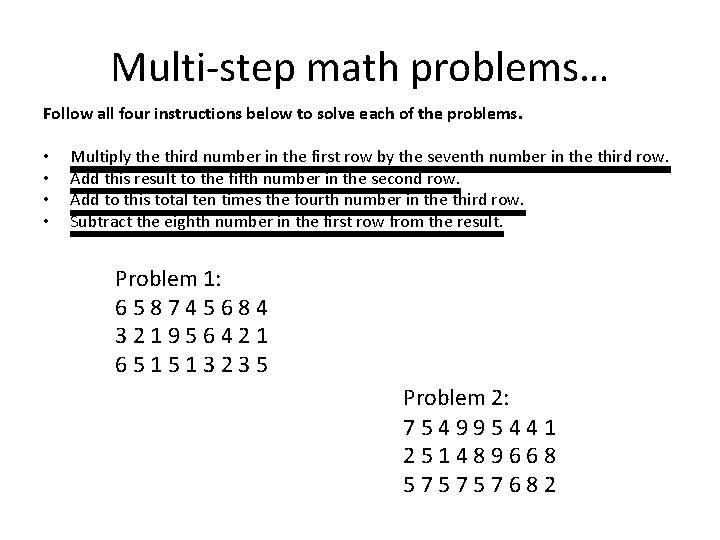
Multi-step math problems… Follow all four instructions below to solve each of the problems. • • Multiply the third number in the first row by the seventh number in the third row. Add this result to the fifth number in the second row. Add to this total ten times the fourth number in the third row. Subtract the eighth number in the first row from the result. Problem 1: 658745684 321956421 651513235 Problem 2: 754995441 251489668 575757682
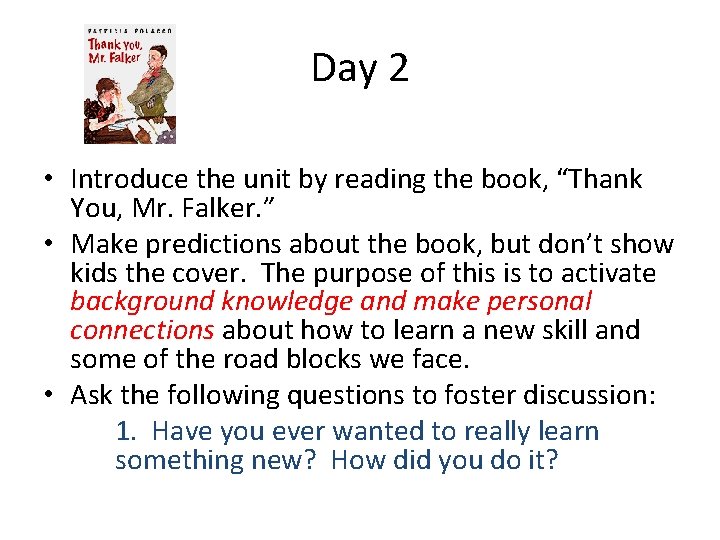
Day 2 • Introduce the unit by reading the book, “Thank You, Mr. Falker. ” • Make predictions about the book, but don’t show kids the cover. The purpose of this is to activate background knowledge and make personal connections about how to learn a new skill and some of the road blocks we face. • Ask the following questions to foster discussion: 1. Have you ever wanted to really learn something new? How did you do it?
Day 2 Continued… 2. Was it easy or difficult? 3. If it was hard, how did you feel? Who or what helped? Who or what didn’t help? Show students the cover of the book and ask for predictions. 4. What do you think my questions had to do with this book? Copyright 2005 IRA/NCTE. All rights reserved. Read. Write. Think materials may be reproduced for educational purposes
Day 2 Continued… • 5. Continue reading the book, and then ask, • 6. “Did any of your predictions come true? ” “How does the book make you feel? ” Continue Reading, thinking aloud as you go • 7. “Does this story remind you of anything that has happened to you or a friend? ” • 8. “Have you ever felt good or bad about yourself because of what someone said or did? ”
Day 2 Continued… • Have students write or draw their reaction (favorite or least favorite part) in a response journal.
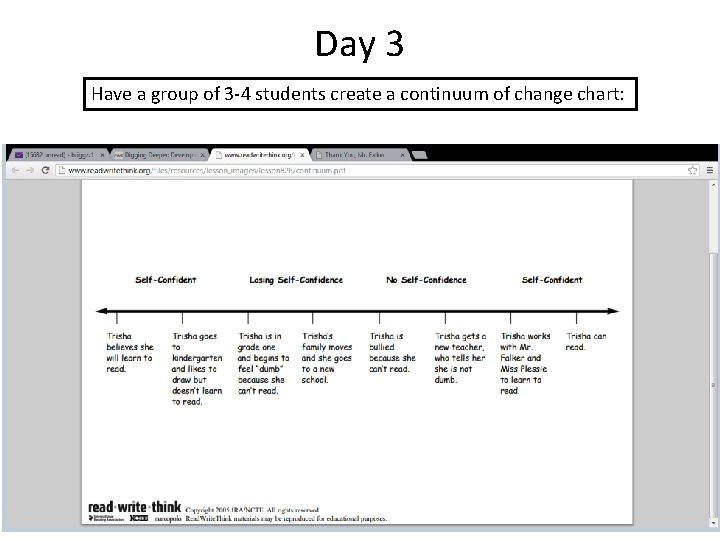
Day 3 Have a group of 3 -4 students create a continuum of change chart: • Have students form a group of 3 -4 and create a continuum of change chart based on the story. See example below:
Day 3 Continued… • After students have created their chart, ask them to give examples from the story of why they thought that way. • To build vocabulary, ask each group to come up with 3 words that describe the author at the beginning of the story, in the middle of the story and at the end of the story.
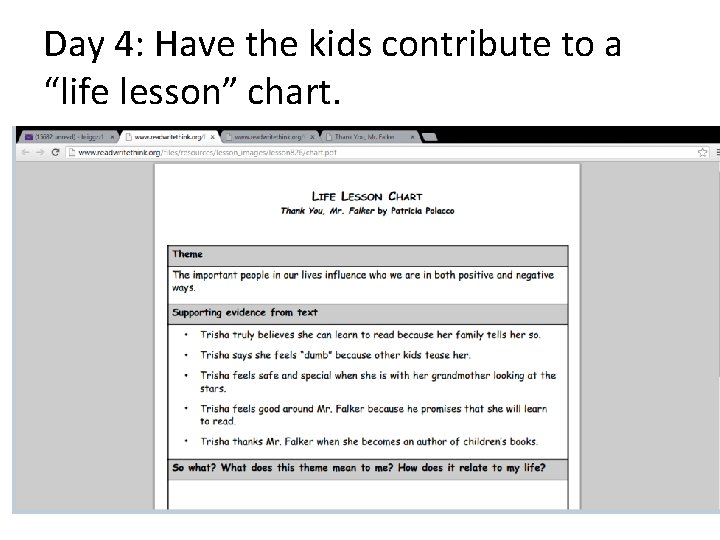
Day 4: Have the kids contribute to a “life lesson” chart. • Show the kids a blank “life lesson” chart.
Day 4 • Talk about themes in the book (believe in yourself, bullying, important people in our lives shape how we feel about ourselves). • Do a picture walk through the story (but not rereading) and have the students summarize what is happening on each page. • Tell the students that although there are several themes, however today we are going to focus on one theme— "important people in our lives shape how we feel about ourselves. " Write this theme on the Life Lesson Chart you are developing.
Day 4 Continued… • Help students identify supporting evidence from the text to show evidence for this theme. • Share a personal example from your own life, and then ask the following questions: • Who are the important people in your life? • How do the important people in your life make you feel good about yourself? How do they do that? • What do they say? Have students record this information on their “So What? ” sheets for later.
Day 5 Ask students to get into a small group of 3 -4 students and talk about the following: 1. How the story would change if Trisha's family did not move? 2. Would Trisha learn to read? 3. What would the other characters then have to do to make her feel good about herself? 4. Would anything happen to the bully?
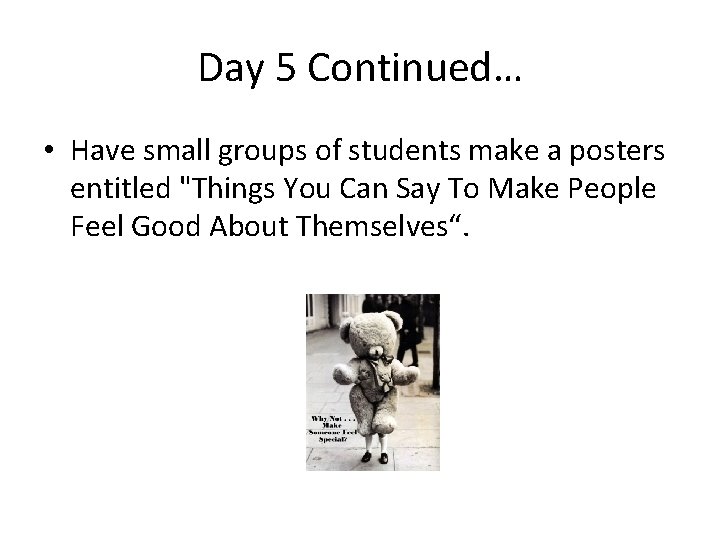
Day 5 Continued… • Have small groups of students make a posters entitled "Things You Can Say To Make People Feel Good About Themselves“.
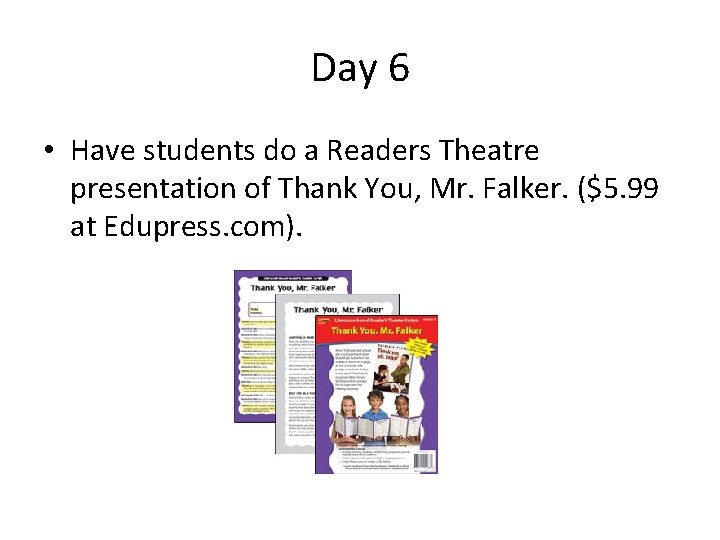
Day 6 • Have students do a Readers Theatre presentation of Thank You, Mr. Falker. ($5. 99 at Edupress. com).
Day 7 • Have a student from the high school or an adult from the community come and talk to the kids about how it felt to be a struggling reader at school and who made a difference in their lives. Ask them to share what people said that was helpful. Another possibility: Youtube- My Learning Disability by Joey Graceffa. (8: 12)
Day 8 Wrap Up • Ask the kids to share what they learned. • Groups will present their “Things I can say to make others feel good about themselves” poster.
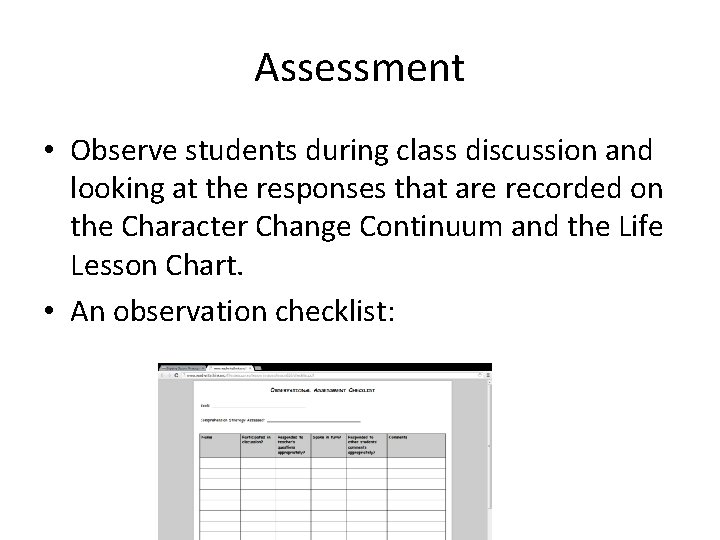
Assessment • Observe students during class discussion and looking at the responses that are recorded on the Character Change Continuum and the Life Lesson Chart. • An observation checklist:
Assessment • Ask for interested students to join an ongoing group to foster friendship like lunch bunch with a student who has a disability.
Language Arts Areas • Reading: Book by Patricia Polacco called, “Thank You, Mr. Falker. • Writing: Students will journal their experiences and create a group poster • Speaking: Students will be collaborating with group members. At the end of the unit, students will be sharing their “Things you can say to make people feel good about themselves” posters with the rest of the class. • Listening: Students will listen to a member of the community who has a disability tell about their experiences and ask questions.
Constructivist Activity Qualities • 1. Allows for personal perception of the world • 3. Provides for active involvement in the learning process • 4. Creates opportunities for transferring learning • 5. Creates meaning from experiences • 6. Allows for individual and social construction in the learning process
Constructivist Activity Qualities 1 8. Knowledge is constructed, not transmitted 9. Emphasizes process over product 10. Is self-motivating 11. Makes learners problem solvers 12. The teacher a facilitator, not director 13. More focus on the learner than the subject • 14 Allows students to see the “big picture” • • •
Constructivist Activity Qualities 2 • • 15. 16. 17. 18. 19. 20. 21. Is a “hands on” activity Does not require extensive memorization Involves students in authentic tasks Encourages use of dialogue Cooperation and collaboration are valued Requires patience Provides multiple perspectives on reality
Constructivist Activity Qualities 3 • 22. Can be an on-going process (book buddies or lunch bunch) • 31. Prior knowledge is evaluated • 35. Requires connections to real world activities • 36. Emphasizes the importance of social and cultural contexts. • 37 Technology is useful
Constructivist Activity Qualities 4 • 38. Unique experiences aid in the learning process. • 40. Allows for self-reflection • 41. Involves students in language-rich activities
Bibliography • • www. readwritethink. org www. pbs. org/misunderstoodminds www. edupress. com www. famousquotes. com • Youtube: Learning Disabilities by Joey Graceffa • Youtube: Famous People with Learning Disabilities
Last Thoughts… “Success is almost totally dependent upon drive and persistence. The extra energy required to make another effort or try another approach is the secret of winning. ” -Denis Waitley
- Slides: 38