
Constructivism v Realism Is knowledge a reflection of
- Slides: 32
Constructivism -v- Realism Is knowledge a reflection of an outside reality or constructed by us? Doctoral Training Philosophy of Knowledge: (slides available at http: //cfpm. org/doctrain)
Some Questions! • Does a jury find out the truth of someone’s guilt or is it only a social process that determines a socially acceptable outcome? • Can it be determined objectively whether a certain person is a fashion leader? • Will everyone within a given society agree 100% on what general human rights hold? – If not, does this make human rights an entirely subjective matter? – If so, does this make human rights an objective fact? • Can I be mistaken about what group memberships I have? • Is my self-identity real? Constructivism -v- Realism. MMUBS Doctoral Training, PKRD, http: //cfpm. org/doctrain slide-2
The Central Issues in this Debate • To what extent do we make/construct our knowledge? • To what extent does our knowledge reflect an exterior reality? • If knowledge is constructed who does it and how? • How much do we rely on social processes of consensus to determine truth? • Are different kinds of knowledge different with respect to these questions? Constructivism -v- Realism. MMUBS Doctoral Training, PKRD, http: //cfpm. org/doctrain slide-3
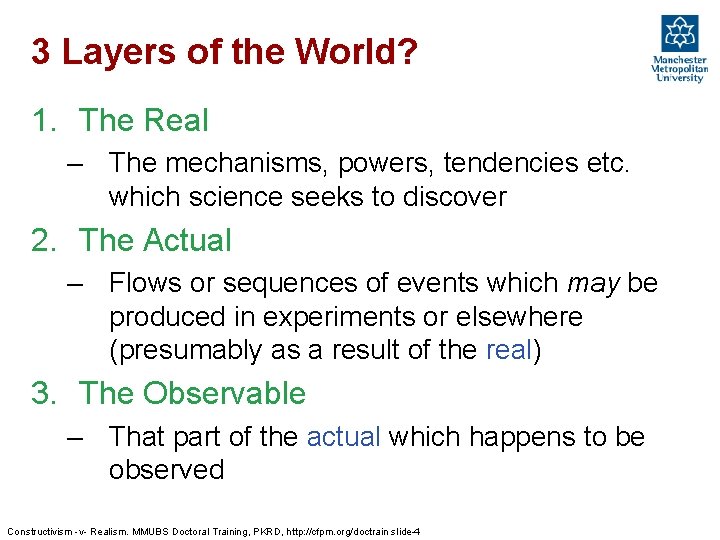
3 Layers of the World? 1. The Real – The mechanisms, powers, tendencies etc. which science seeks to discover 2. The Actual – Flows or sequences of events which may be produced in experiments or elsewhere (presumably as a result of the real) 3. The Observable – That part of the actual which happens to be observed Constructivism -v- Realism. MMUBS Doctoral Training, PKRD, http: //cfpm. org/doctrain slide-4
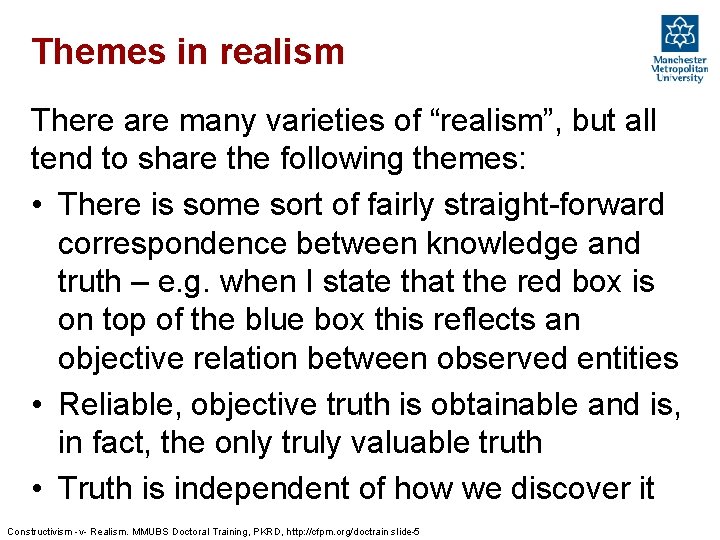
Themes in realism There are many varieties of “realism”, but all tend to share the following themes: • There is some sort of fairly straight-forward correspondence between knowledge and truth – e. g. when I state that the red box is on top of the blue box this reflects an objective relation between observed entities • Reliable, objective truth is obtainable and is, in fact, the only truly valuable truth • Truth is independent of how we discover it Constructivism -v- Realism. MMUBS Doctoral Training, PKRD, http: //cfpm. org/doctrain slide-5
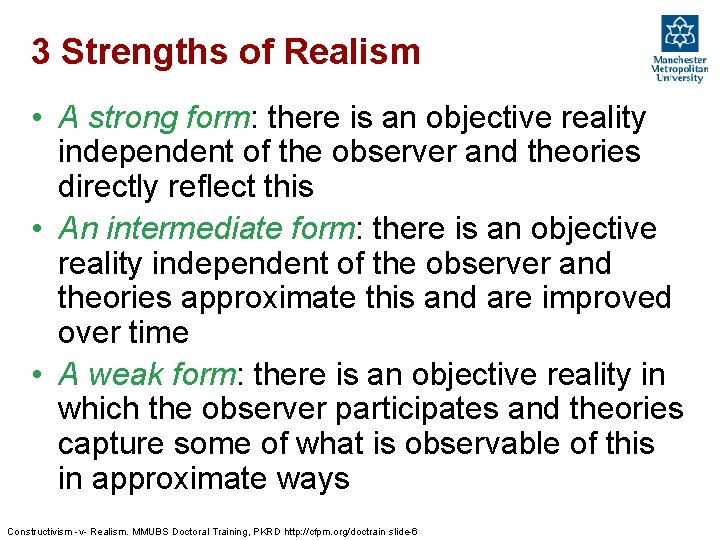
3 Strengths of Realism • A strong form: there is an objective reality independent of the observer and theories directly reflect this • An intermediate form: there is an objective reality independent of the observer and theories approximate this and are improved over time • A weak form: there is an objective reality in which the observer participates and theories capture some of what is observable of this in approximate ways Constructivism -v- Realism. MMUBS Doctoral Training, PKRD http: //cfpm. org/doctrain slide-6
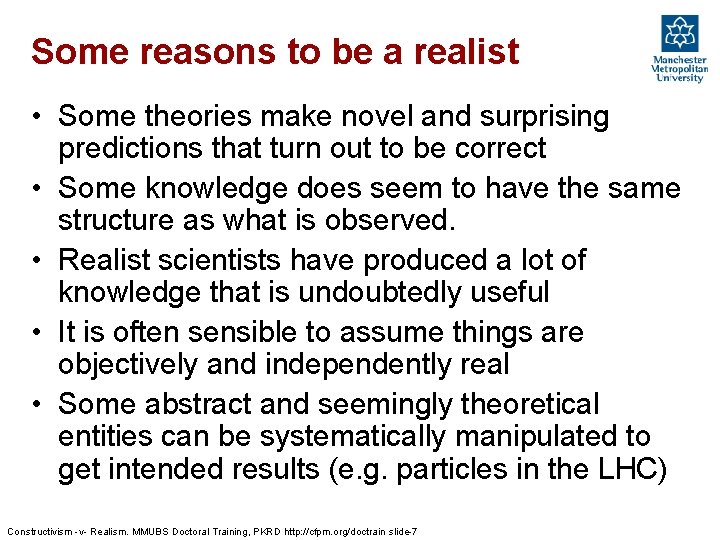
Some reasons to be a realist • Some theories make novel and surprising predictions that turn out to be correct • Some knowledge does seem to have the same structure as what is observed. • Realist scientists have produced a lot of knowledge that is undoubtedly useful • It is often sensible to assume things are objectively and independently real • Some abstract and seemingly theoretical entities can be systematically manipulated to get intended results (e. g. particles in the LHC) Constructivism -v- Realism. MMUBS Doctoral Training, PKRD http: //cfpm. org/doctrain slide-7
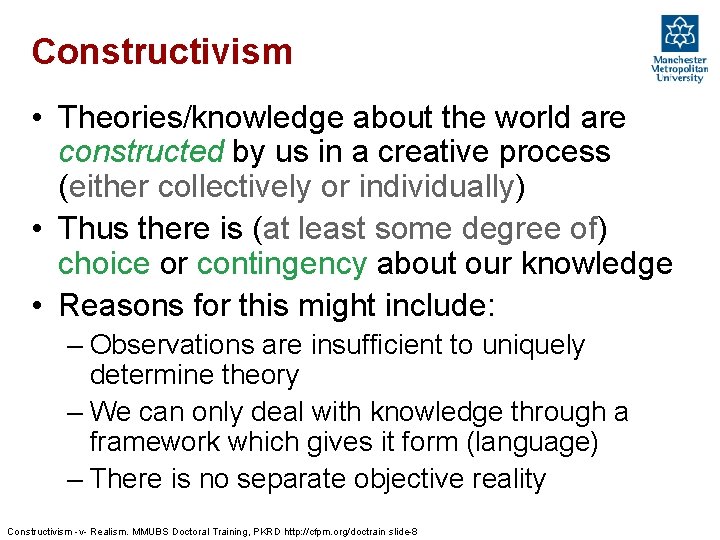
Constructivism • Theories/knowledge about the world are constructed by us in a creative process (either collectively or individually) • Thus there is (at least some degree of) choice or contingency about our knowledge • Reasons for this might include: – Observations are insufficient to uniquely determine theory – We can only deal with knowledge through a framework which gives it form (language) – There is no separate objective reality Constructivism -v- Realism. MMUBS Doctoral Training, PKRD http: //cfpm. org/doctrain slide-8
Some reasons to be a constructivist • Many theoretical entities have turned out to be incorrect (even though the models are approximately correct in many aspects) • In retrospect we can see the biasing effect of culture, assumptions, language etc. • Theories are rarely constrained down to uniqueness by the evidence • Doing science involves being creative • Reformulating is often a useful thing to do Constructivism -v- Realism. MMUBS Doctoral Training, PKRD http: //cfpm. org/doctrain slide-9
Constructivist/Realist Examples For each of the examples to the right: • To what extent is it constructed (compared to being a reflection of some external reality)? • If constructed how was it constructed? • Is it knowledge about it that is constructed or the terms we use about it? • How reliable is it? • How objective is it? • Is it falsifiable? • Can you reformulate it to make it more realist? • This item is art • This is a table • It’s a fashionable to dress as a goth • I am in debt • This is a log • This is money • This is a £ 5 note • I have -£ 345. 45 in my bank account today • An entrepreneur is creative Constructivism -v- Realism. MMUBS Doctoral Training, PKRD http: //cfpm. org/doctrain slide-10
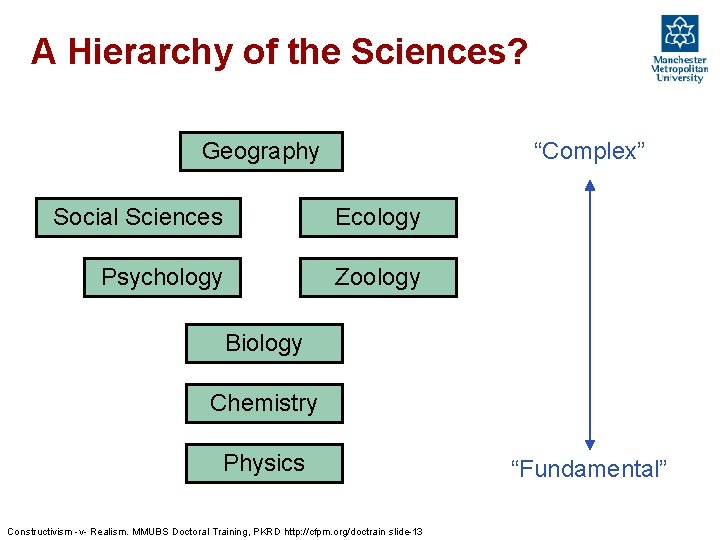
Reductionism • That knowledge in the more complex sciences (e. g. social sciences) can (or will) be shown to be consequences of knowledge in the more “basic” sciences (e. g. biology). • For example: some of the properties of a cell (and hence an organism) have been successfully explained by the action of biochemical processes (e. g. DNA) Constructivism -v- Realism. MMUBS Doctoral Training, PKRD http: //cfpm. org/doctrain slide-11
Holism • That (some) phenomena are not reducible to the behaviour/properties of its parts • “The whole is more than the sum of its parts” • For example: that culture is not reducible to the psychology of individuals or evolution • Results in different kinds of phenomena • Difference between in principle holism and in practice holism Constructivism -v- Realism. MMUBS Doctoral Training, PKRD http: //cfpm. org/doctrain slide-12
A Hierarchy of the Sciences? Geography “Complex” Social Sciences Ecology Psychology Zoology Biology Chemistry Physics Constructivism -v- Realism. MMUBS Doctoral Training, PKRD http: //cfpm. org/doctrain slide-13 “Fundamental”
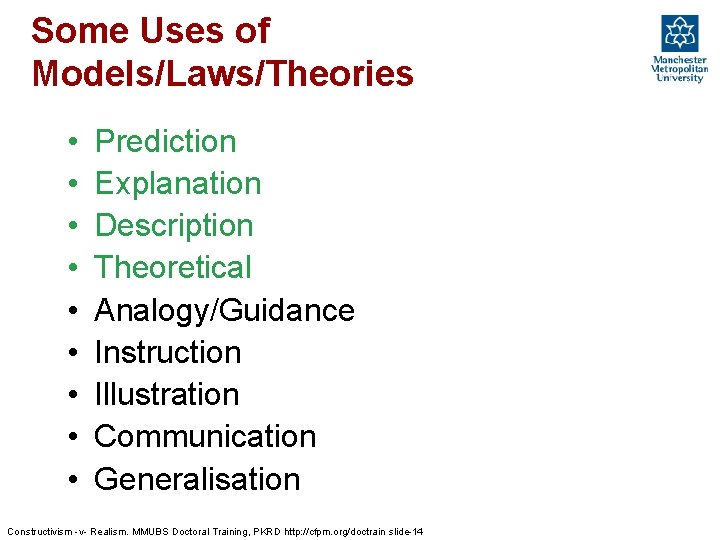
Some Uses of Models/Laws/Theories • • • Prediction Explanation Description Theoretical Analogy/Guidance Instruction Illustration Communication Generalisation Constructivism -v- Realism. MMUBS Doctoral Training, PKRD http: //cfpm. org/doctrain slide-14
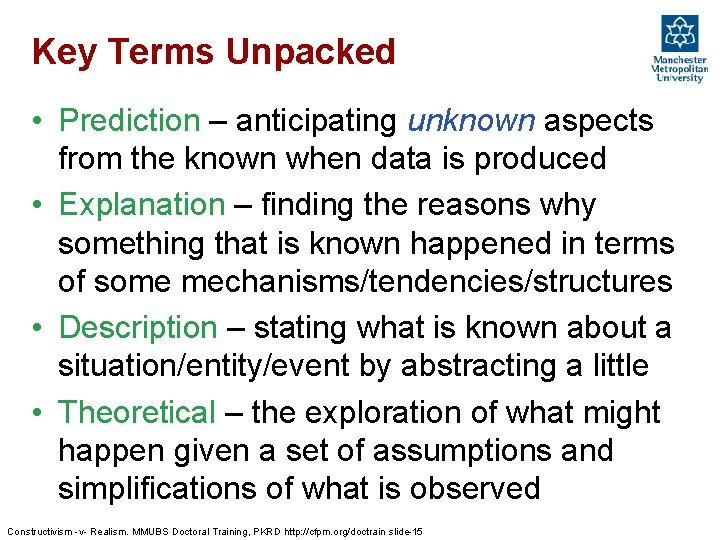
Key Terms Unpacked • Prediction – anticipating unknown aspects from the known when data is produced • Explanation – finding the reasons why something that is known happened in terms of some mechanisms/tendencies/structures • Description – stating what is known about a situation/entity/event by abstracting a little • Theoretical – the exploration of what might happen given a set of assumptions and simplifications of what is observed Constructivism -v- Realism. MMUBS Doctoral Training, PKRD http: //cfpm. org/doctrain slide-15
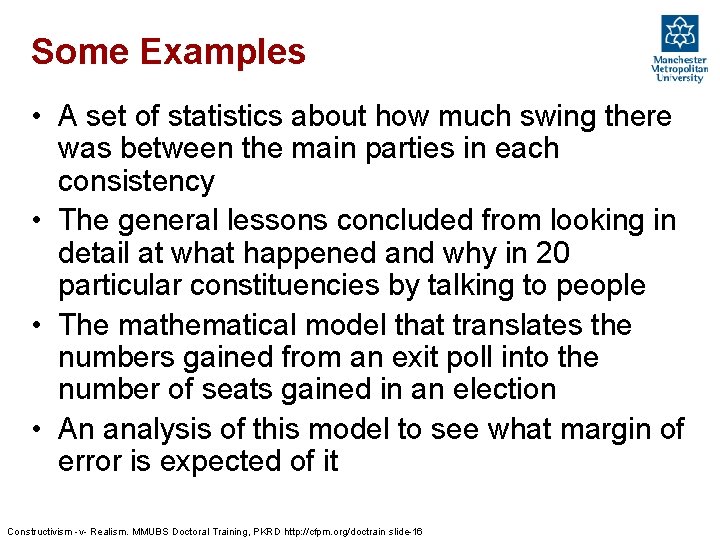
Some Examples • A set of statistics about how much swing there was between the main parties in each consistency • The general lessons concluded from looking in detail at what happened and why in 20 particular constituencies by talking to people • The mathematical model that translates the numbers gained from an exit poll into the number of seats gained in an election • An analysis of this model to see what margin of error is expected of it Constructivism -v- Realism. MMUBS Doctoral Training, PKRD http: //cfpm. org/doctrain slide-16
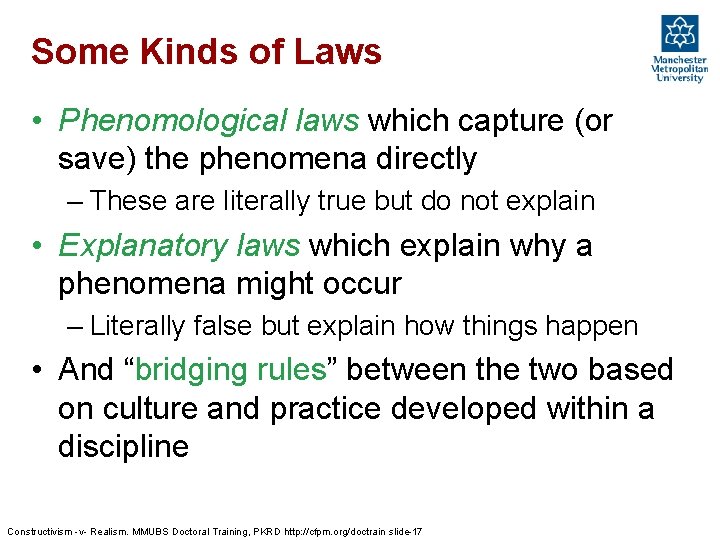
Some Kinds of Laws • Phenomological laws which capture (or save) the phenomena directly – These are literally true but do not explain • Explanatory laws which explain why a phenomena might occur – Literally false but explain how things happen • And “bridging rules” between the two based on culture and practice developed within a discipline Constructivism -v- Realism. MMUBS Doctoral Training, PKRD http: //cfpm. org/doctrain slide-17
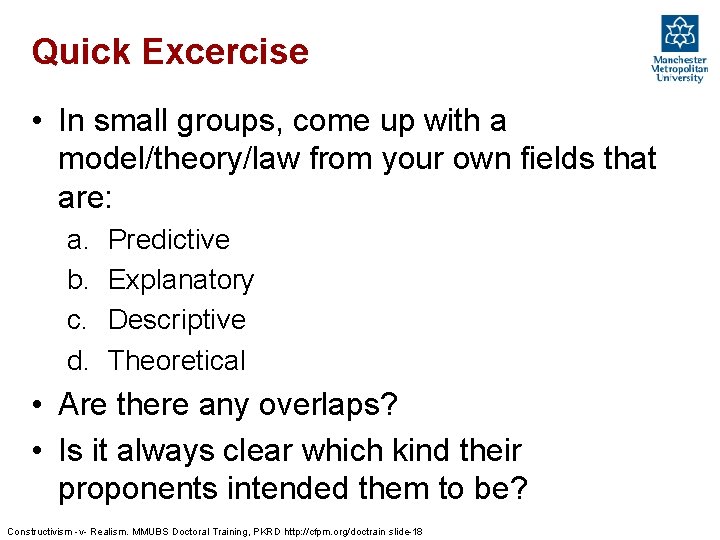
Quick Excercise • In small groups, come up with a model/theory/law from your own fields that are: a. b. c. d. Predictive Explanatory Descriptive Theoretical • Are there any overlaps? • Is it always clear which kind their proponents intended them to be? Constructivism -v- Realism. MMUBS Doctoral Training, PKRD http: //cfpm. org/doctrain slide-18
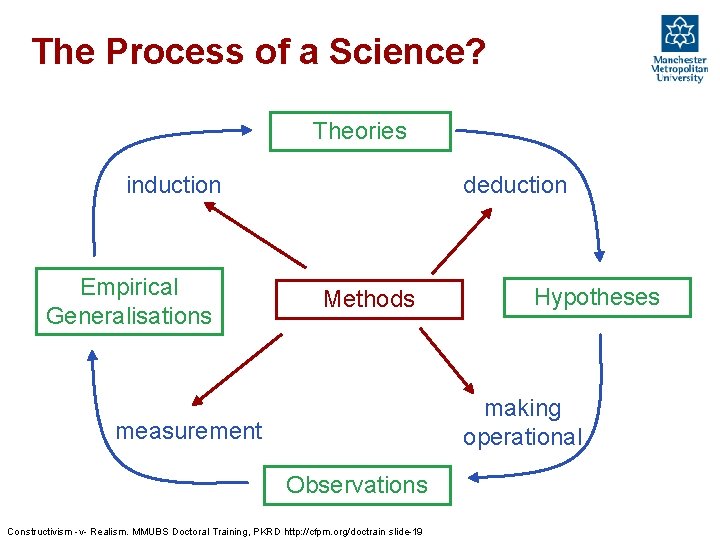
The Process of a Science? Theories induction Empirical Generalisations deduction Methods Hypotheses making operational measurement Observations Constructivism -v- Realism. MMUBS Doctoral Training, PKRD http: //cfpm. org/doctrain slide-19
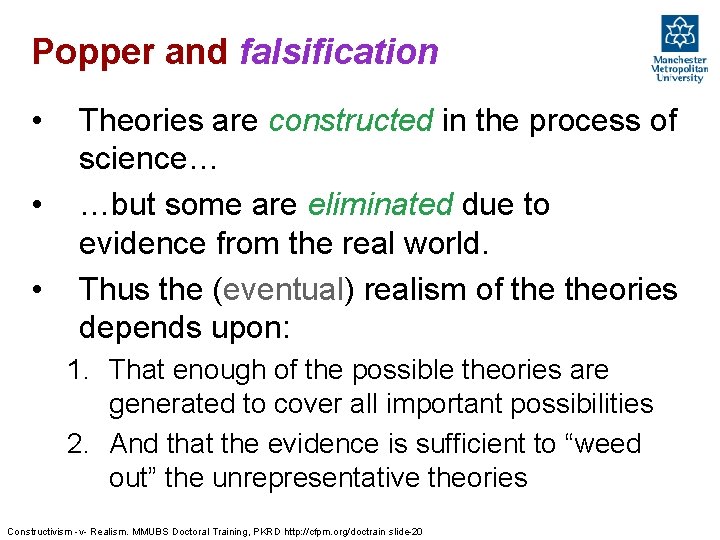
Popper and falsification • • • Theories are constructed in the process of science… …but some are eliminated due to evidence from the real world. Thus the (eventual) realism of theories depends upon: 1. That enough of the possible theories are generated to cover all important possibilities 2. And that the evidence is sufficient to “weed out” the unrepresentative theories Constructivism -v- Realism. MMUBS Doctoral Training, PKRD http: //cfpm. org/doctrain slide-20
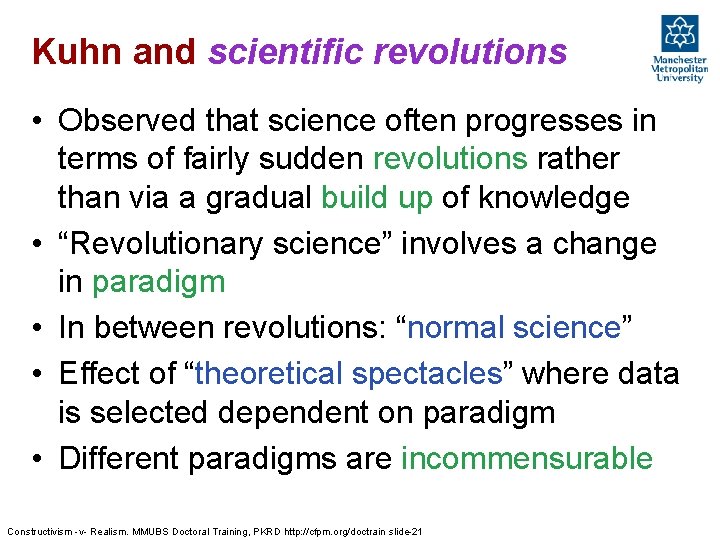
Kuhn and scientific revolutions • Observed that science often progresses in terms of fairly sudden revolutions rather than via a gradual build up of knowledge • “Revolutionary science” involves a change in paradigm • In between revolutions: “normal science” • Effect of “theoretical spectacles” where data is selected dependent on paradigm • Different paradigms are incommensurable Constructivism -v- Realism. MMUBS Doctoral Training, PKRD http: //cfpm. org/doctrain slide-21
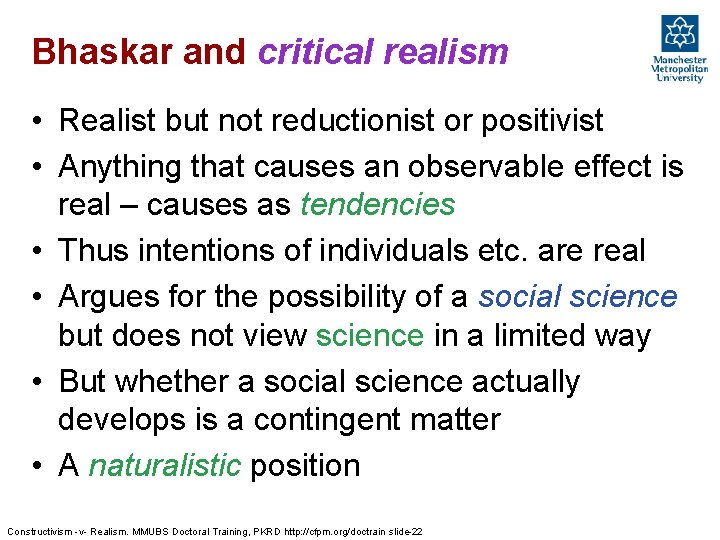
Bhaskar and critical realism • Realist but not reductionist or positivist • Anything that causes an observable effect is real – causes as tendencies • Thus intentions of individuals etc. are real • Argues for the possibility of a social science but does not view science in a limited way • But whether a social science actually develops is a contingent matter • A naturalistic position Constructivism -v- Realism. MMUBS Doctoral Training, PKRD http: //cfpm. org/doctrain slide-22
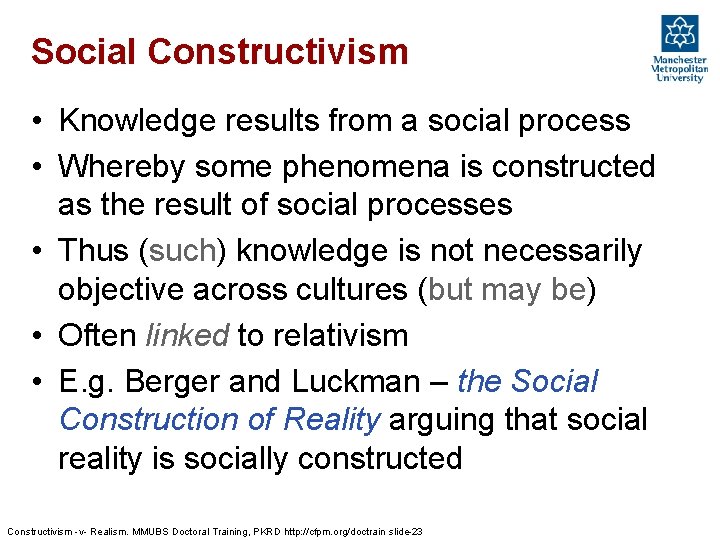
Social Constructivism • Knowledge results from a social process • Whereby some phenomena is constructed as the result of social processes • Thus (such) knowledge is not necessarily objective across cultures (but may be) • Often linked to relativism • E. g. Berger and Luckman – the Social Construction of Reality arguing that social reality is socially constructed Constructivism -v- Realism. MMUBS Doctoral Training, PKRD http: //cfpm. org/doctrain slide-23
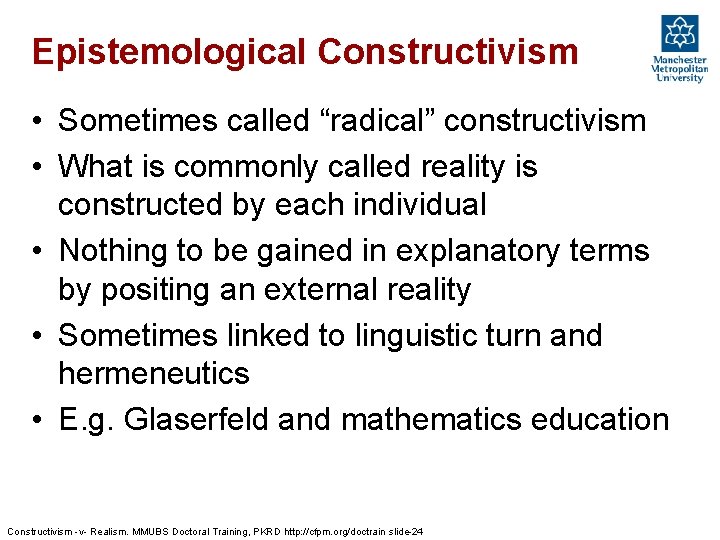
Epistemological Constructivism • Sometimes called “radical” constructivism • What is commonly called reality is constructed by each individual • Nothing to be gained in explanatory terms by positing an external reality • Sometimes linked to linguistic turn and hermeneutics • E. g. Glaserfeld and mathematics education Constructivism -v- Realism. MMUBS Doctoral Training, PKRD http: //cfpm. org/doctrain slide-24
Example: Realism/constructivism in housing research • In 3 groups: (the papers are just to supply you with some ideas/issues if you want to use them) • Decide what you guess are the main issues in this area • What knowledge is being argued about here do you think? • Why do you think it’s such a hot issue in housing research? • Is the knowledge in these examples constructed or a reflection of reality? Constructivism -v- Realism. MMUBS Doctoral Training, PKRD http: //cfpm. org/doctrain slide-25
An Analogy with Biological Evolution • Theories ‘evolve’ in the environment of human society and the world • Variations are being continually produced • Theories survive and are propagated depending on their attractiveness to humans (including how useful they are) • There is a mutual ‘lock-in’ effect due to the formation of knowledge ‘ecologies’ • Theories only reflect reality to the extent that organisms reflect their environment Constructivism -v- Realism. MMUBS Doctoral Training, PKRD http: //cfpm. org/doctrain slide-26
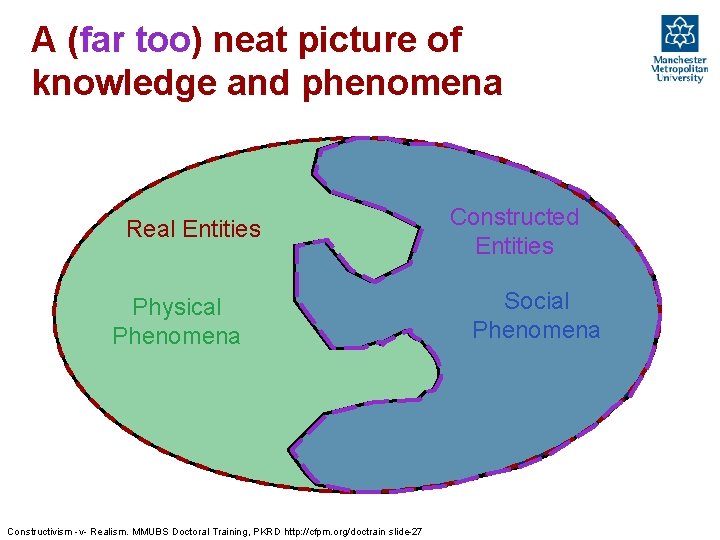
A (far too) neat picture of knowledge and phenomena Real Entities Physical Phenomena Constructivism -v- Realism. MMUBS Doctoral Training, PKRD http: //cfpm. org/doctrain slide-27 Constructed Entities Social Phenomena
Paradigm Hairballs? • • Qualitative Constructivist Holist Interpretative Linguistic Collective research Sociological Descriptive & Explanatory • • Quantitative Realist Reductionist Objective Mathematical Individual research Individualistic Theoretical & Predictive Constructivism -v- Realism. MMUBS Doctoral Training, PKRD http: //cfpm. org/doctrain slide-28
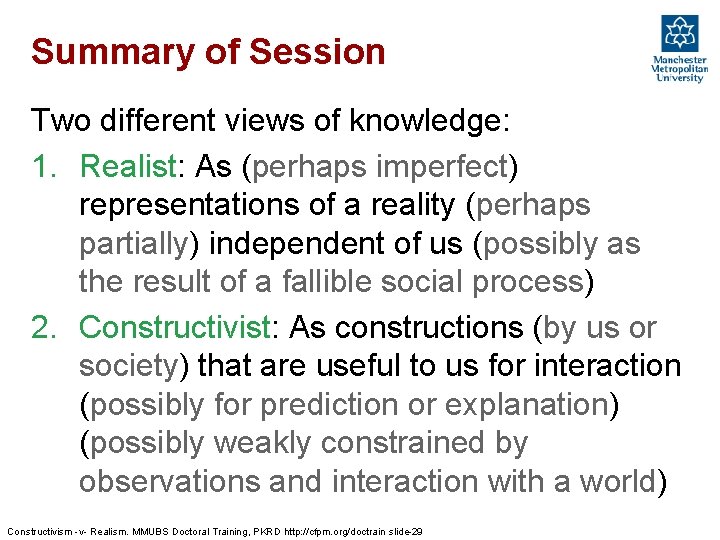
Summary of Session Two different views of knowledge: 1. Realist: As (perhaps imperfect) representations of a reality (perhaps partially) independent of us (possibly as the result of a fallible social process) 2. Constructivist: As constructions (by us or society) that are useful to us for interaction (possibly for prediction or explanation) (possibly weakly constrained by observations and interaction with a world) Constructivism -v- Realism. MMUBS Doctoral Training, PKRD http: //cfpm. org/doctrain slide-29
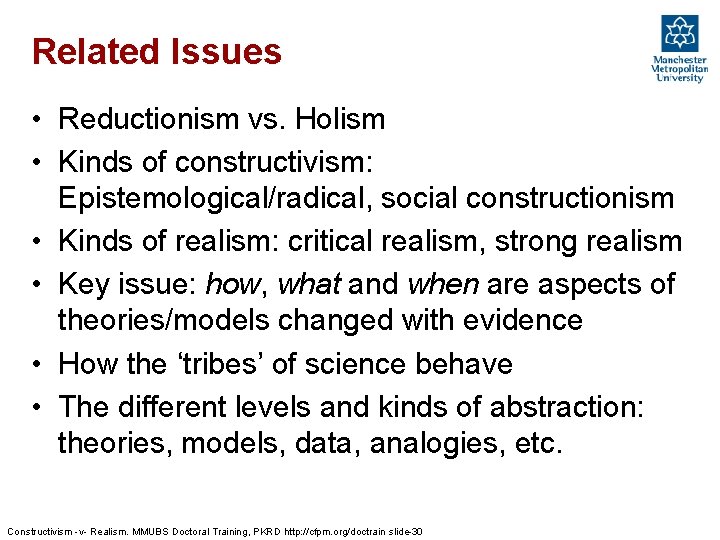
Related Issues • Reductionism vs. Holism • Kinds of constructivism: Epistemological/radical, social constructionism • Kinds of realism: critical realism, strong realism • Key issue: how, what and when are aspects of theories/models changed with evidence • How the ‘tribes’ of science behave • The different levels and kinds of abstraction: theories, models, data, analogies, etc. Constructivism -v- Realism. MMUBS Doctoral Training, PKRD http: //cfpm. org/doctrain slide-30
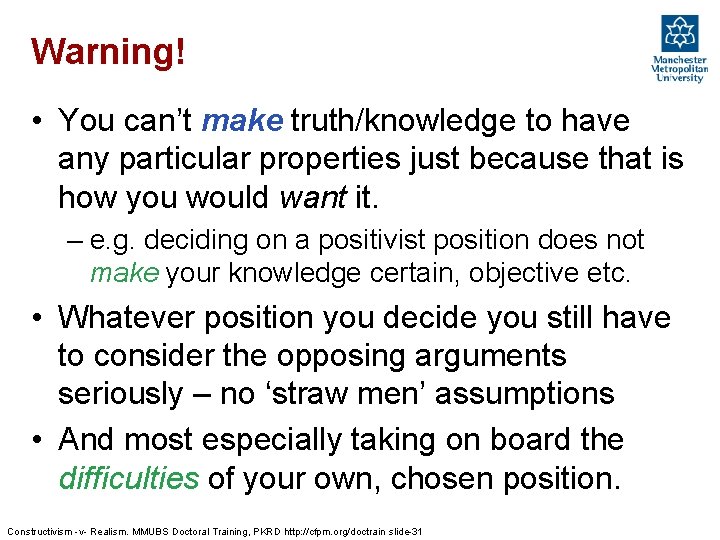
Warning! • You can’t make truth/knowledge to have any particular properties just because that is how you would want it. – e. g. deciding on a positivist position does not make your knowledge certain, objective etc. • Whatever position you decide you still have to consider the opposing arguments seriously – no ‘straw men’ assumptions • And most especially taking on board the difficulties of your own, chosen position. Constructivism -v- Realism. MMUBS Doctoral Training, PKRD http: //cfpm. org/doctrain slide-31
The End (as usual slides etc. on Moodle and: http: //cfpm. org/doctrain)