
CONSTRUCTIVISM 1915 1935 History Following the Communist revolution
- Slides: 22
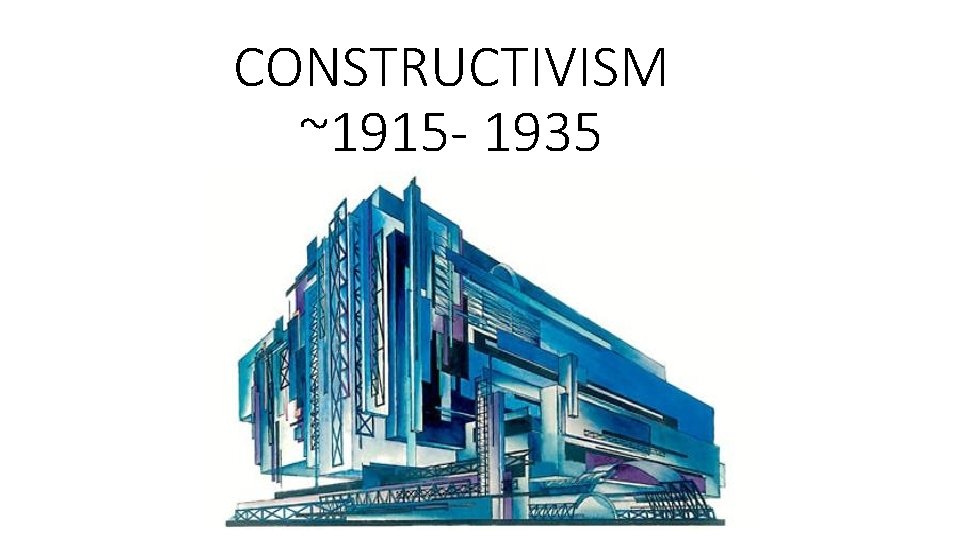
CONSTRUCTIVISM ~1915 - 1935
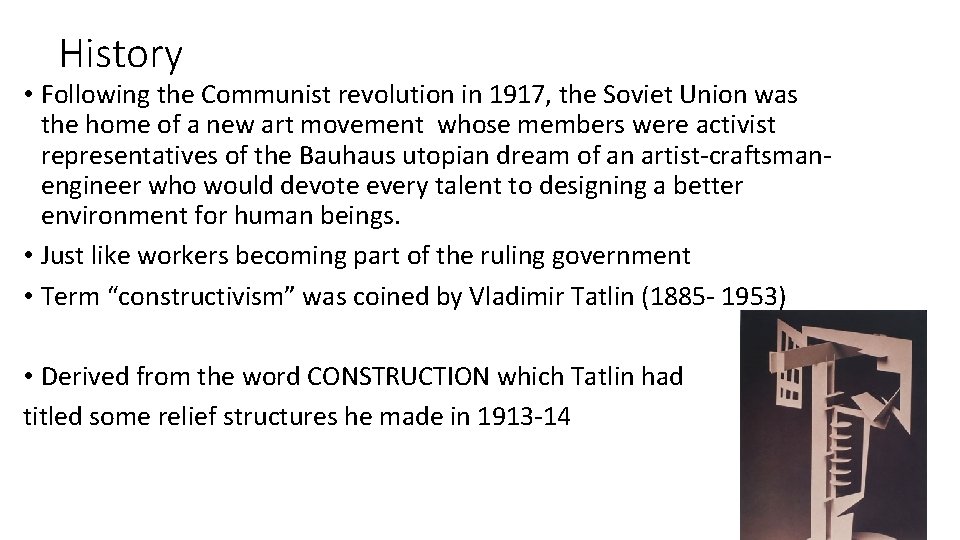
History • Following the Communist revolution in 1917, the Soviet Union was the home of a new art movement whose members were activist representatives of the Bauhaus utopian dream of an artist-craftsmanengineer who would devote every talent to designing a better environment for human beings. • Just like workers becoming part of the ruling government • Term “constructivism” was coined by Vladimir Tatlin (1885 - 1953) • Derived from the word CONSTRUCTION which Tatlin had titled some relief structures he made in 1913 -14
Constructivism (APPROX. 1915 - 1935) • translated the 'spirit' of the machine age and the new society into a practical visual form • shifted its emphasis toward designing functional constructions which could benefit the emerging soviet state • ventured into the production of items beneficial to the new Russia, the materials used were appropriate to the product and process whether ceramics, clothing, posters or architecture • interested in an immediate application to create a new civilization in the Soviet Union, with art becoming the motor of the propaganda machine
The Style • a purely non-objective approach in the making of artwork, • without reference to the real world • was essentially geometric, precise and almost mathematical; in fact a number of Rodchenko drawings were executed with compass and ruler • used squares, rectangles, circles and triangles as the predominant shapes in carefully composed artworks, whether drawing, painting, design or sculpture • emphasized the dominance of the world of machines and structures over nature
Methods and Materials • dealt with such a wide range of materials that anything was possible; wood, celluloid, nylon, Plexiglas, tin, cardboard and early forms of plastic were used through a variety of constructing methods from glue through to welding • lacked the more engineered approach developed by International Constructivism • employed new materials, construction, and joining methods, including aluminum, electronic components and chrome-plating
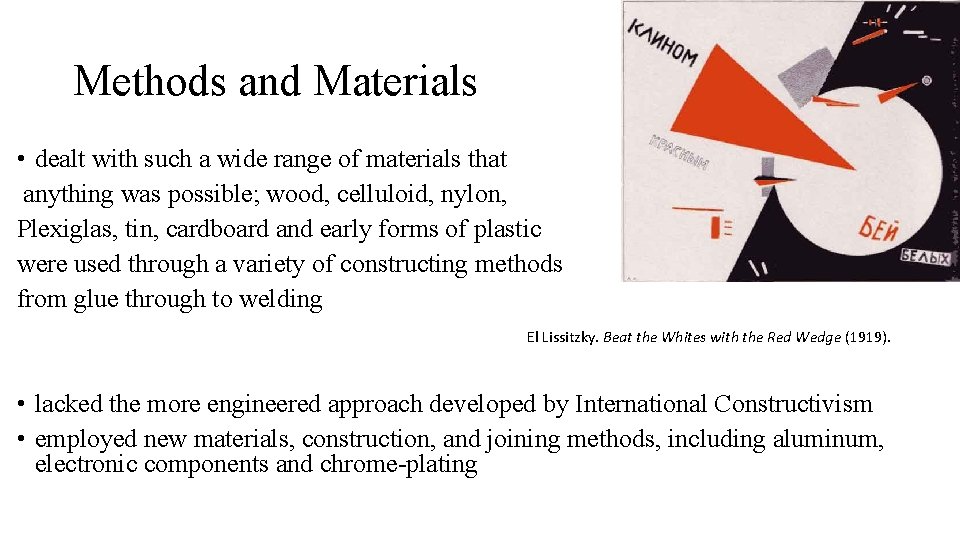
Methods and Materials • dealt with such a wide range of materials that anything was possible; wood, celluloid, nylon, Plexiglas, tin, cardboard and early forms of plastic were used through a variety of constructing methods from glue through to welding El Lissitzky. Beat the Whites with the Red Wedge (1919). • lacked the more engineered approach developed by International Constructivism • employed new materials, construction, and joining methods, including aluminum, electronic components and chrome-plating
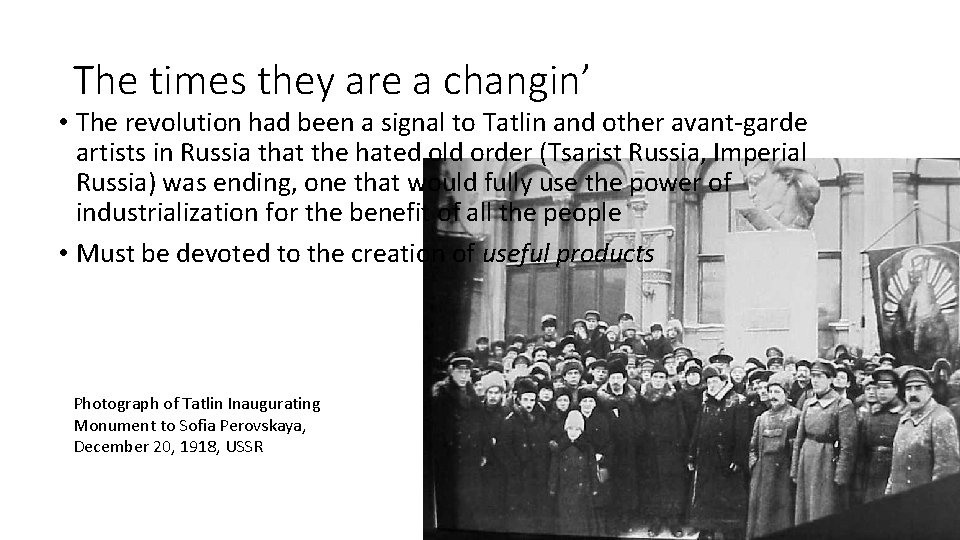
The times they are a changin’ • The revolution had been a signal to Tatlin and other avant-garde artists in Russia that the hated old order (Tsarist Russia, Imperial Russia) was ending, one that would fully use the power of industrialization for the benefit of all the people • Must be devoted to the creation of useful products Photograph of Tatlin Inaugurating Monument to Sofia Perovskaya, December 20, 1918, USSR
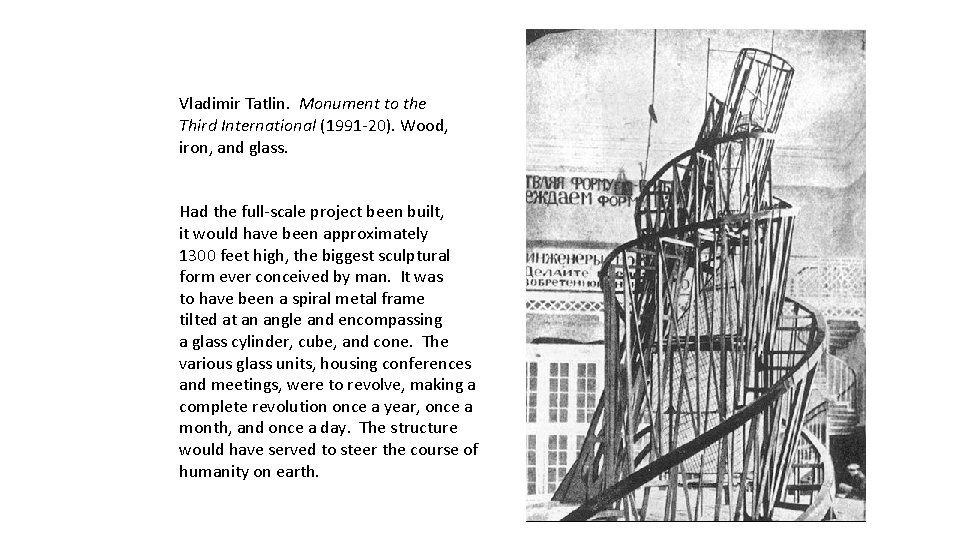
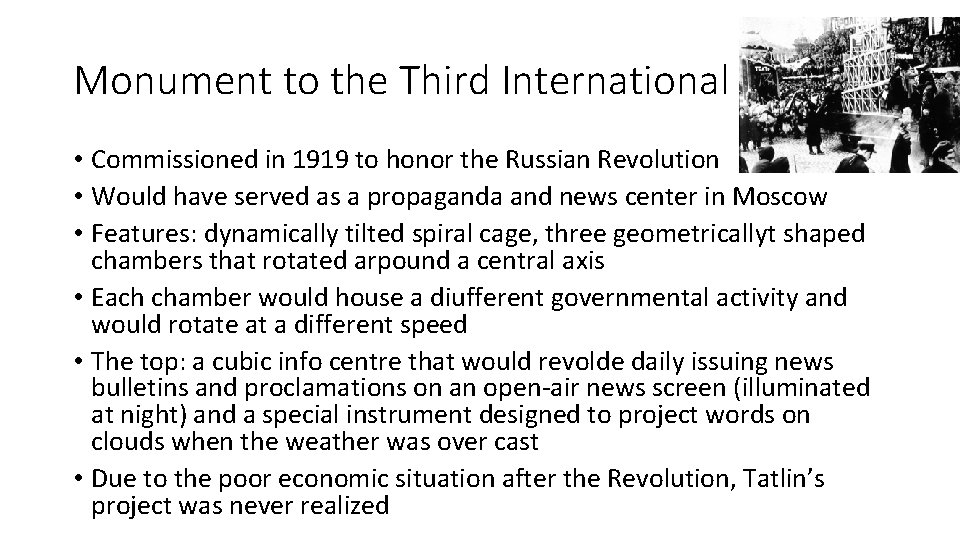
Vladimir Tatlin. Monument to the Third International (1991 -20). Wood, iron, and glass. Had the full-scale project been built, it would have been approximately 1300 feet high, the biggest sculptural form ever conceived by man. It was to have been a spiral metal frame tilted at an angle and encompassing a glass cylinder, cube, and cone. The various glass units, housing conferences and meetings, were to revolve, making a complete revolution once a year, once a month, and once a day. The structure would have served to steer the course of humanity on earth.
Monument to the Third International • Commissioned in 1919 to honor the Russian Revolution • Would have served as a propaganda and news center in Moscow • Features: dynamically tilted spiral cage, three geometricallyt shaped chambers that rotated arpound a central axis • Each chamber would house a diufferent governmental activity and would rotate at a different speed • The top: a cubic info centre that would revolde daily issuing news bulletins and proclamations on an open-air news screen (illuminated at night) and a special instrument designed to project words on clouds when the weather was over cast • Due to the poor economic situation after the Revolution, Tatlin’s project was never realized
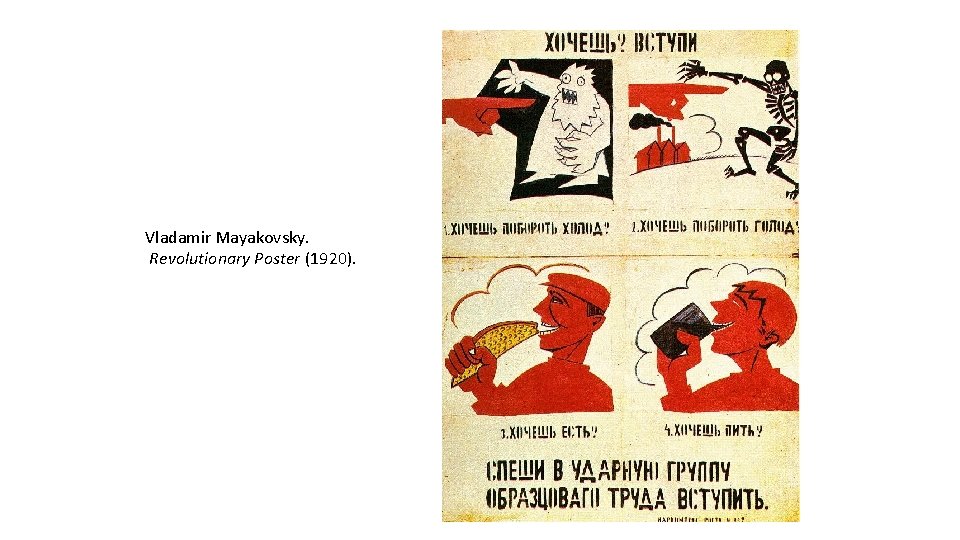
Vladamir Mayakovsky. Revolutionary Poster (1920).
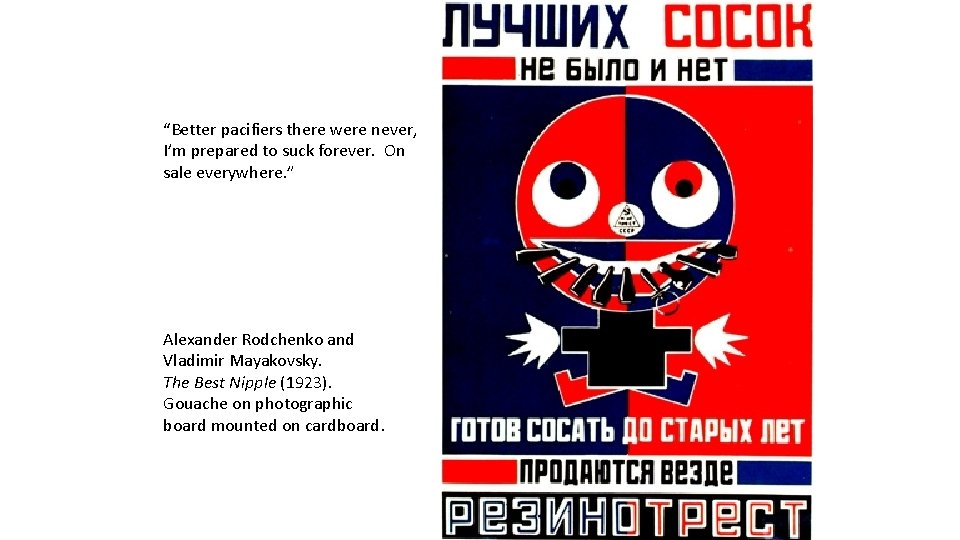
“Better pacifiers there were never, I’m prepared to suck forever. On sale everywhere. ” Alexander Rodchenko and Vladimir Mayakovsky. The Best Nipple (1923). Gouache on photographic board mounted on cardboard.
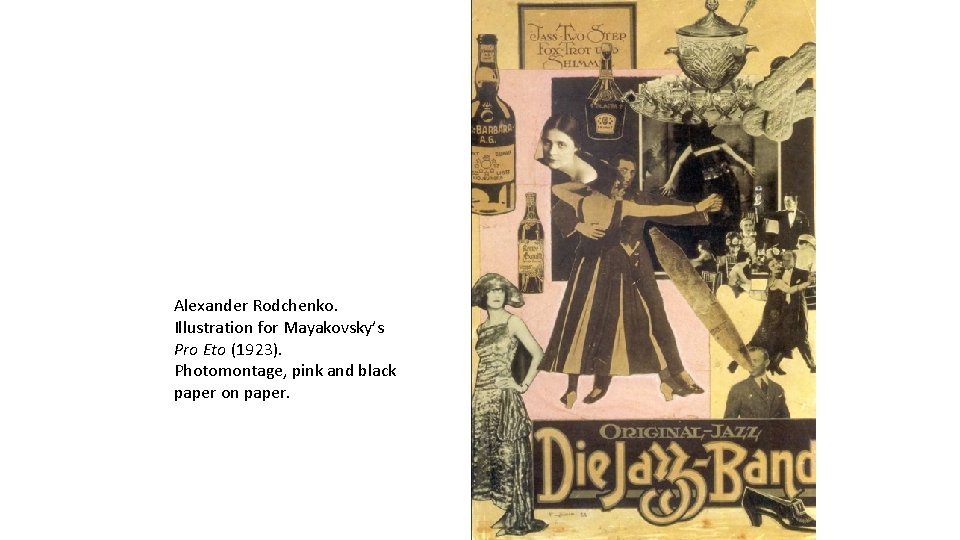
Alexander Rodchenko. Illustration for Mayakovsky’s Pro Eto (1923). Photomontage, pink and black paper on paper.
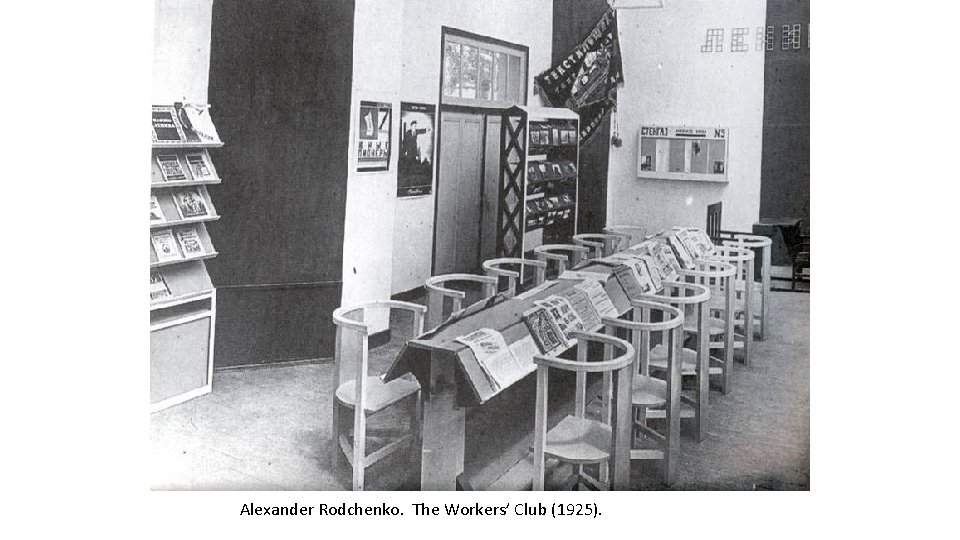
Alexander Rodchenko. The Workers’ Club (1925).
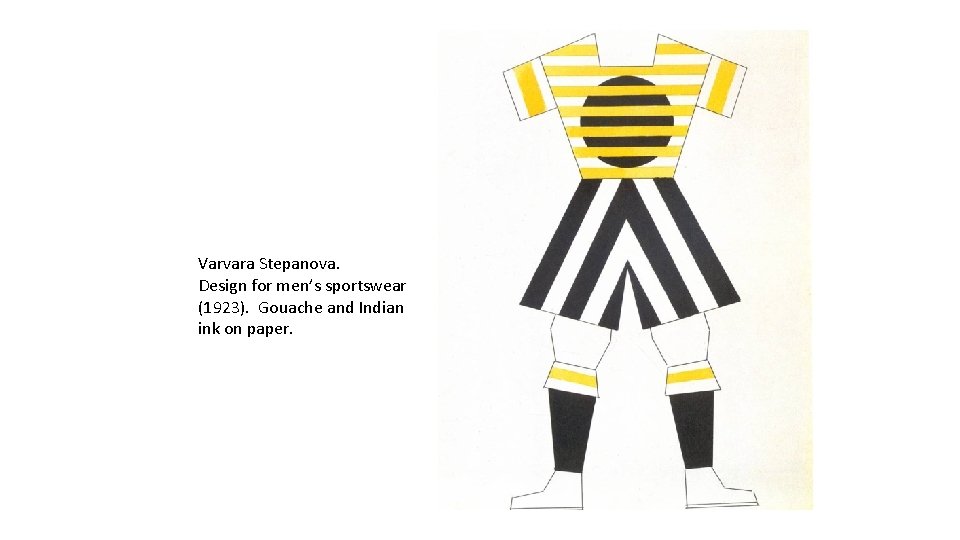
Varvara Stepanova. Design for men’s sportswear (1923). Gouache and Indian ink on paper.
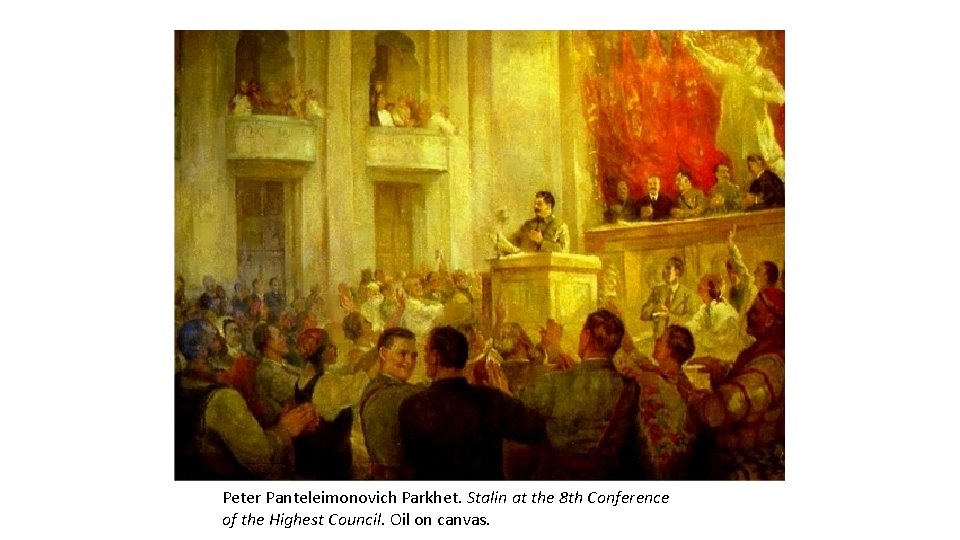
Peter Panteleimonovich Parkhet. Stalin at the 8 th Conference of the Highest Council. Oil on canvas.
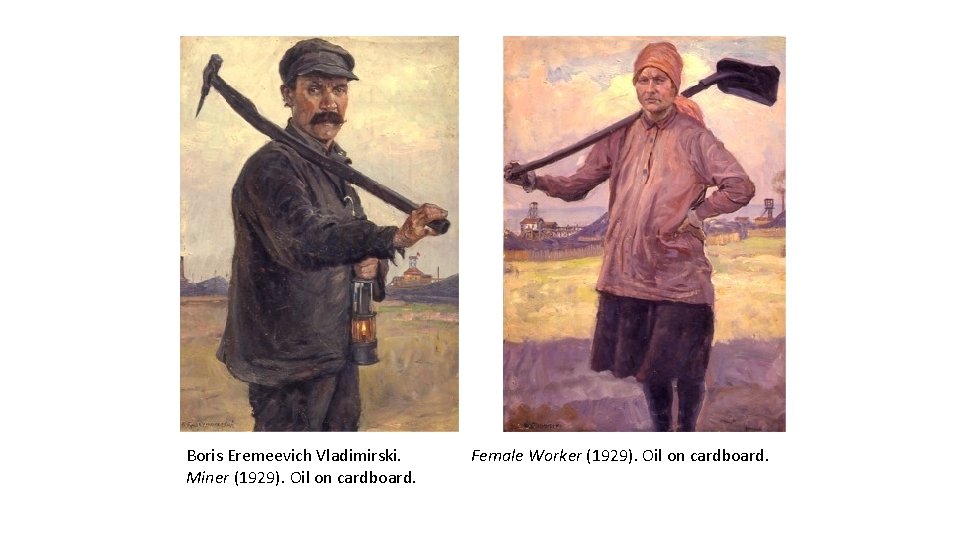
Boris Eremeevich Vladimirski. Miner (1929). Oil on cardboard. Female Worker (1929). Oil on cardboard.
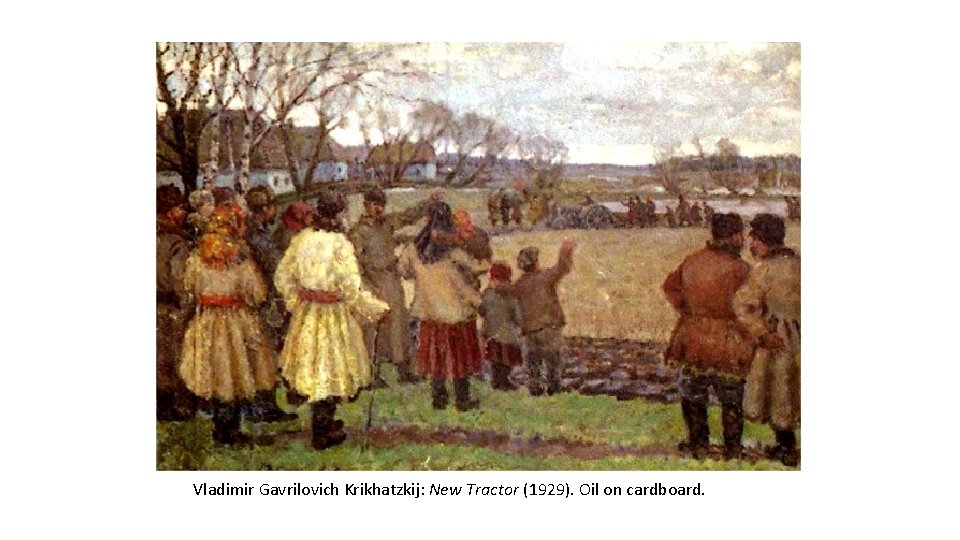
Vladimir Gavrilovich Krikhatzkij: New Tractor (1929). Oil on cardboard.
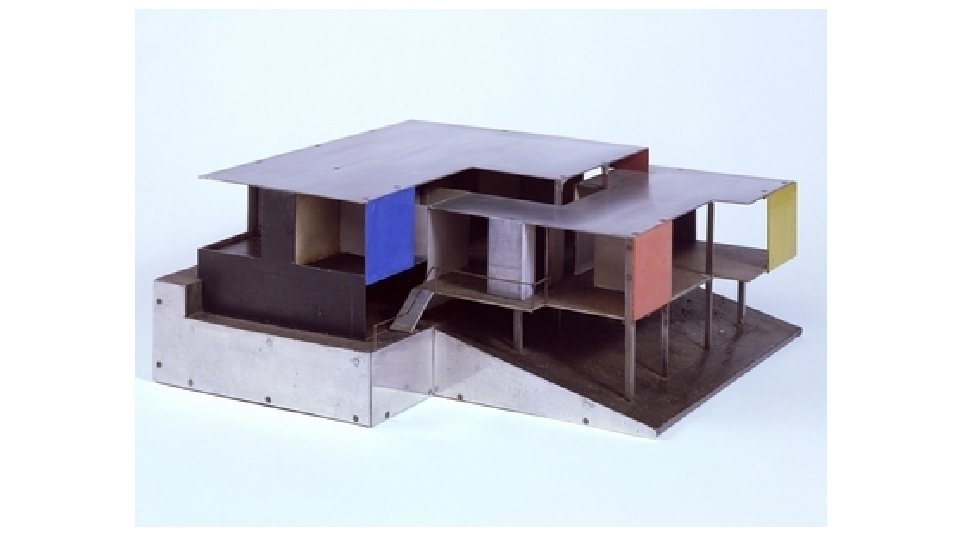
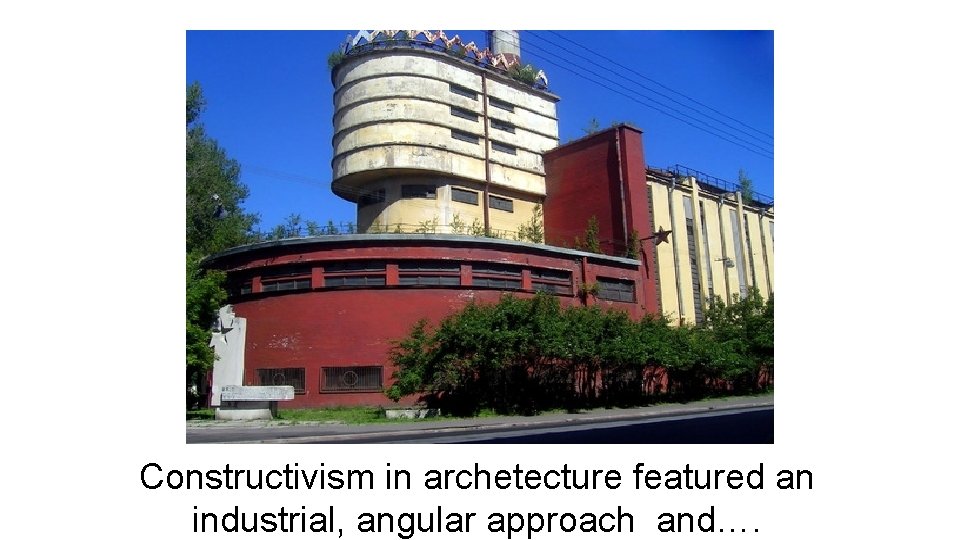
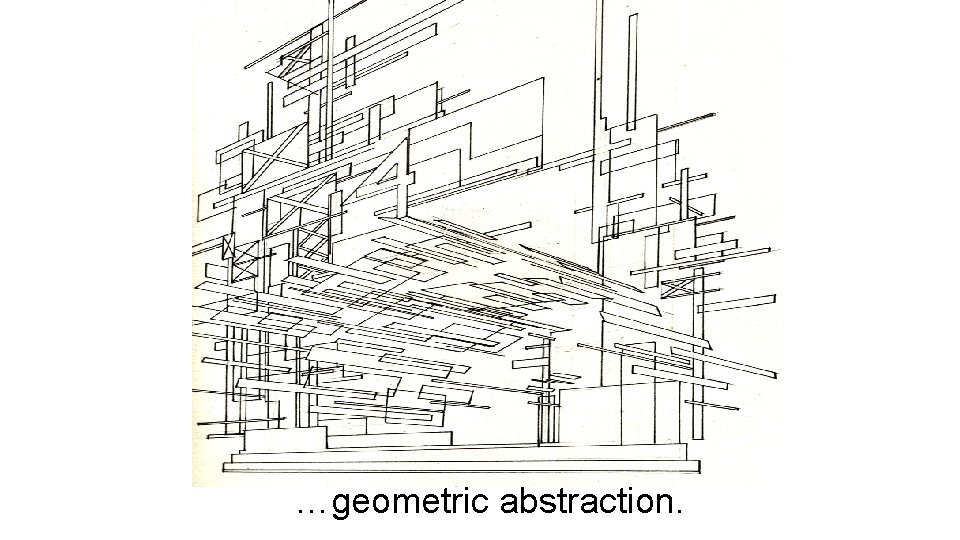
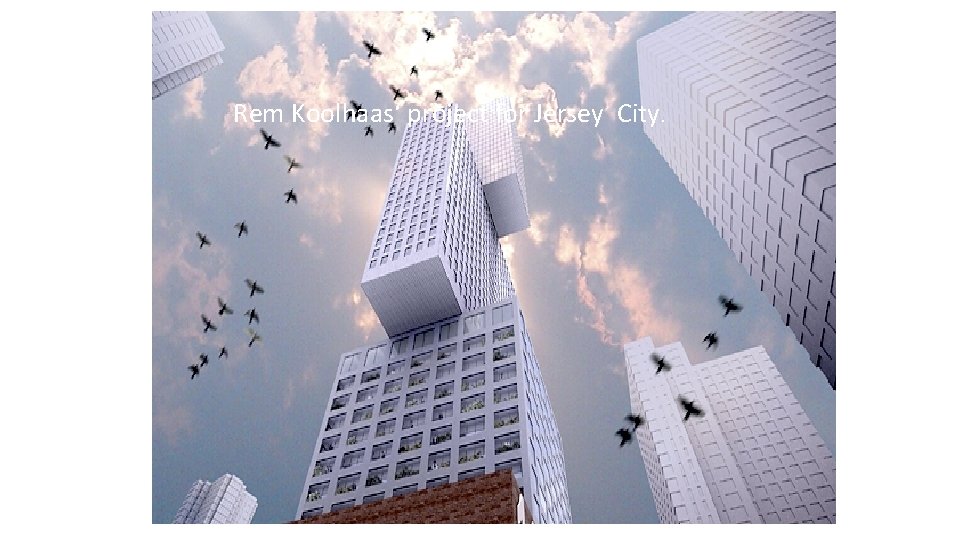
Constructivism in archetecture featured an industrial, angular approach and….
…geometric abstraction.
Rem Koolhaas‘ project for Jersey City.
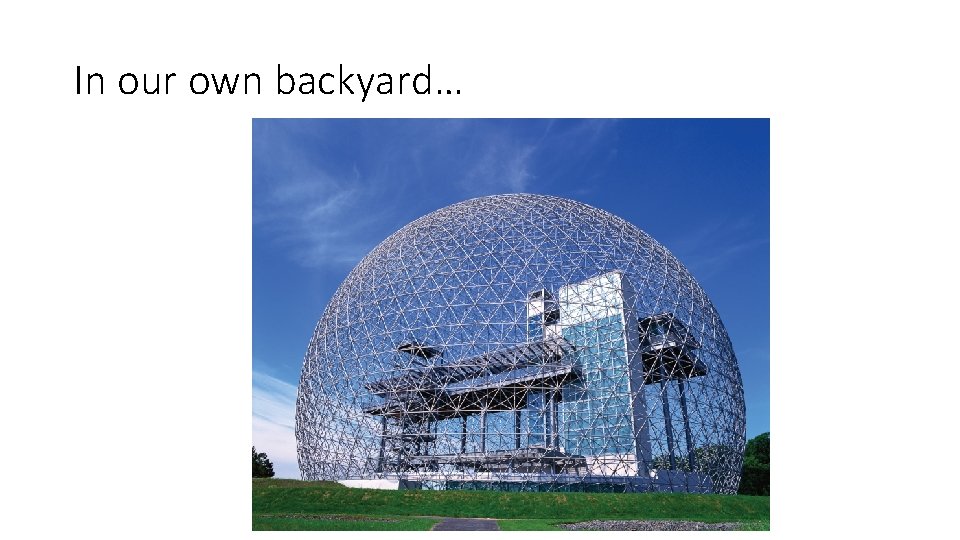
In our own backyard…