
Constructive Computer Architecture Tutorial 5 Programming SMIPS SingleCore
- Slides: 30
Constructive Computer Architecture Tutorial 5: Programming SMIPS: Single-Core Assembly Andy Wright 6. 175 TA October 10, 2014 http: //csg. csail. mit. edu/6. 175 T 04 -1
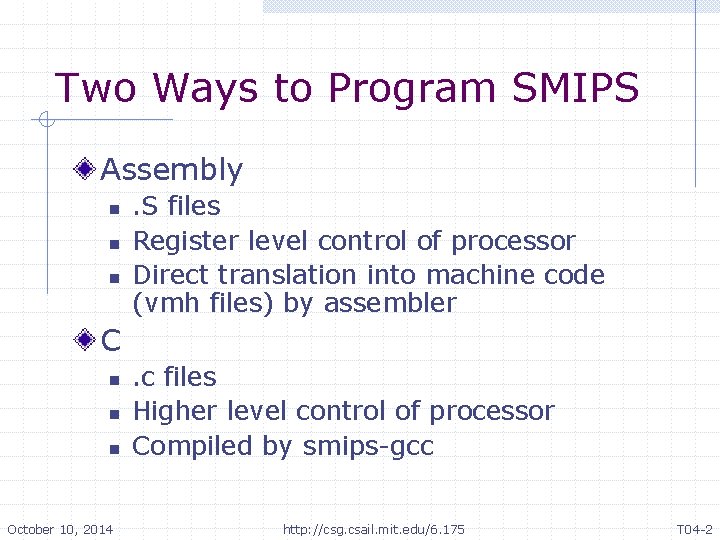
Two Ways to Program SMIPS Assembly n n n . S files Register level control of processor Direct translation into machine code (vmh files) by assembler C n n n October 10, 2014 . c files Higher level control of processor Compiled by smips-gcc http: //csg. csail. mit. edu/6. 175 T 04 -2
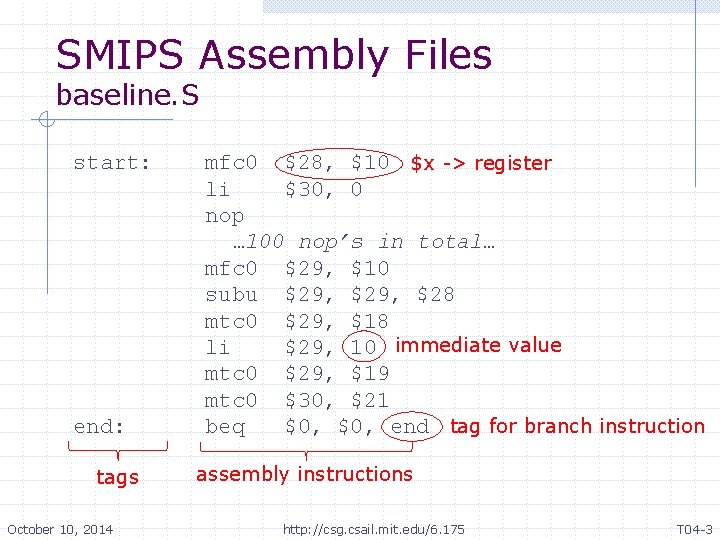
SMIPS Assembly Files baseline. S start: end: tags October 10, 2014 mfc 0 $28, $10 $x -> register li $30, 0 nop … 100 nop’s in total… mfc 0 $29, $10 subu $29, $28 mtc 0 $29, $18 li $29, 10 immediate value mtc 0 $29, $19 mtc 0 $30, $21 beq $0, end tag for branch instruction assembly instructions http: //csg. csail. mit. edu/6. 175 T 04 -3
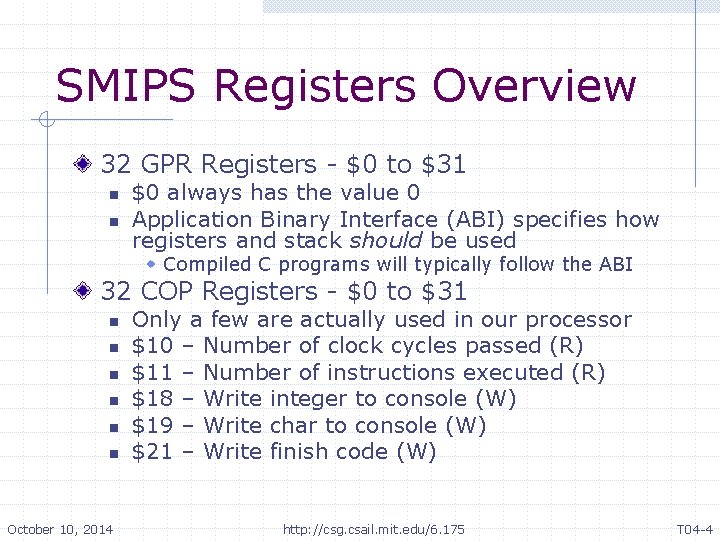
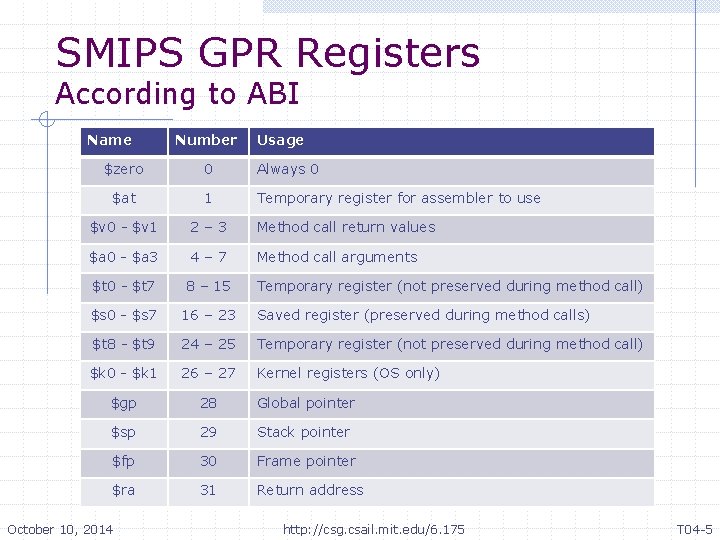
SMIPS Registers Overview 32 GPR Registers - $0 to $31 n n $0 always has the value 0 Application Binary Interface (ABI) specifies how registers and stack should be used w Compiled C programs will typically follow the ABI 32 COP Registers - $0 to $31 n n n October 10, 2014 Only a few are actually used in our processor $10 – Number of clock cycles passed (R) $11 – Number of instructions executed (R) $18 – Write integer to console (W) $19 – Write char to console (W) $21 – Write finish code (W) http: //csg. csail. mit. edu/6. 175 T 04 -4
SMIPS GPR Registers According to ABI Name Number Usage $zero 0 Always 0 $at 1 Temporary register for assembler to use $v 0 - $v 1 2– 3 Method call return values $a 0 - $a 3 4– 7 Method call arguments $t 0 - $t 7 8 – 15 $s 0 - $s 7 16 – 23 Saved register (preserved during method calls) $t 8 - $t 9 24 – 25 Temporary register (not preserved during method call) $k 0 - $k 1 26 – 27 Kernel registers (OS only) $gp 28 Global pointer $sp 29 Stack pointer $fp 30 Frame pointer $ra 31 Return address October 10, 2014 Temporary register (not preserved during method call) http: //csg. csail. mit. edu/6. 175 T 04 -5
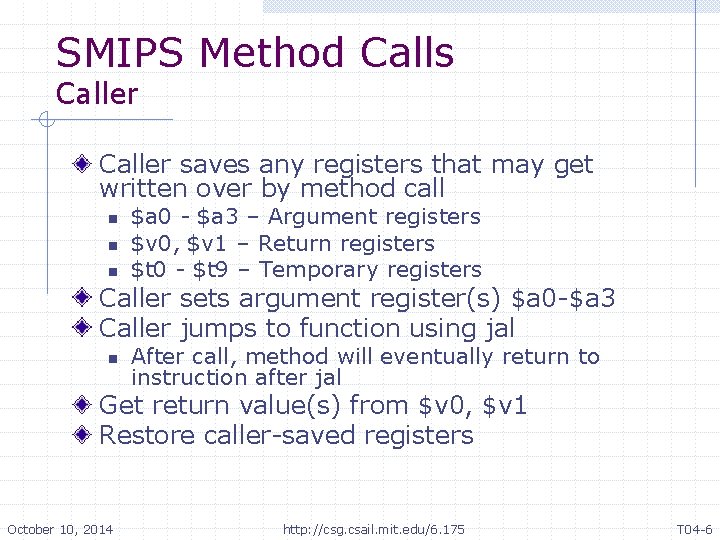
SMIPS Method Calls Caller saves any registers that may get written over by method call n n n $a 0 - $a 3 – Argument registers $v 0, $v 1 – Return registers $t 0 - $t 9 – Temporary registers Caller sets argument register(s) $a 0 -$a 3 Caller jumps to function using jal n After call, method will eventually return to instruction after jal Get return value(s) from $v 0, $v 1 Restore caller-saved registers October 10, 2014 http: //csg. csail. mit. edu/6. 175 T 04 -6
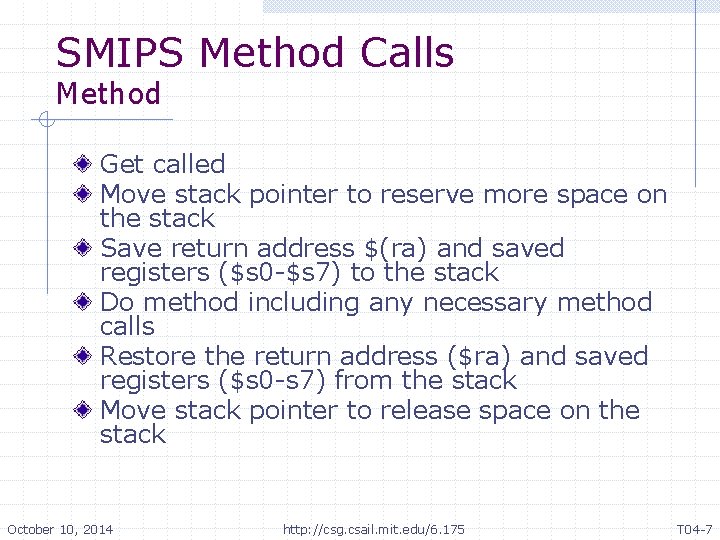
SMIPS Method Calls Method Get called Move stack pointer to reserve more space on the stack Save return address $(ra) and saved registers ($s 0 -$s 7) to the stack Do method including any necessary method calls Restore the return address ($ra) and saved registers ($s 0 -s 7) from the stack Move stack pointer to release space on the stack October 10, 2014 http: //csg. csail. mit. edu/6. 175 T 04 -7
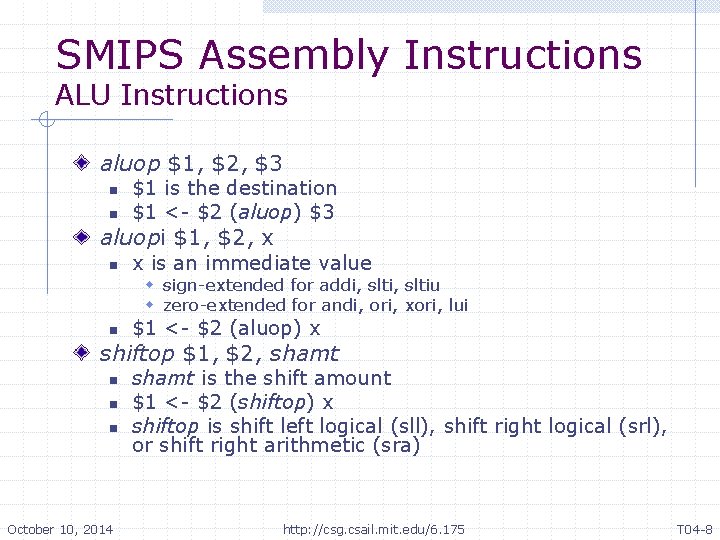
SMIPS Assembly Instructions ALU Instructions aluop $1, $2, $3 n n $1 is the destination $1 <- $2 (aluop) $3 aluopi $1, $2, x n x is an immediate value w sign-extended for addi, sltiu w zero-extended for andi, ori, xori, lui n $1 <- $2 (aluop) x shiftop $1, $2, shamt n n n October 10, 2014 shamt is the shift amount $1 <- $2 (shiftop) x shiftop is shift left logical (sll), shift right logical (srl), or shift right arithmetic (sra) http: //csg. csail. mit. edu/6. 175 T 04 -8
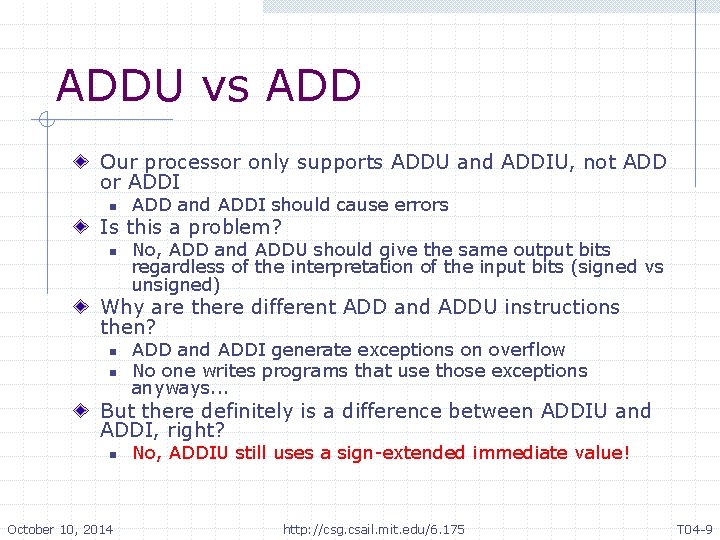
ADDU vs ADD Our processor only supports ADDU and ADDIU, not ADD or ADDI n ADD and ADDI should cause errors Is this a problem? n No, ADD and ADDU should give the same output bits regardless of the interpretation of the input bits (signed vs unsigned) Why are there different ADD and ADDU instructions then? n n ADD and ADDI generate exceptions on overflow No one writes programs that use those exceptions anyways. . . But there definitely is a difference between ADDIU and ADDI, right? n October 10, 2014 No, ADDIU still uses a sign-extended immediate value! http: //csg. csail. mit. edu/6. 175 T 04 -9
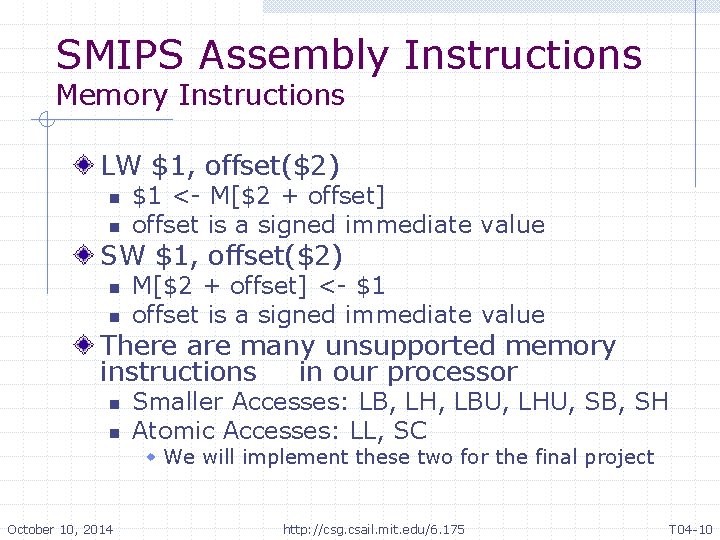
SMIPS Assembly Instructions Memory Instructions LW $1, offset($2) n n $1 <- M[$2 + offset] offset is a signed immediate value SW $1, offset($2) n n M[$2 + offset] <- $1 offset is a signed immediate value There are many unsupported memory instructions in our processor n n Smaller Accesses: LB, LH, LBU, LHU, SB, SH Atomic Accesses: LL, SC w We will implement these two for the final project October 10, 2014 http: //csg. csail. mit. edu/6. 175 T 04 -10
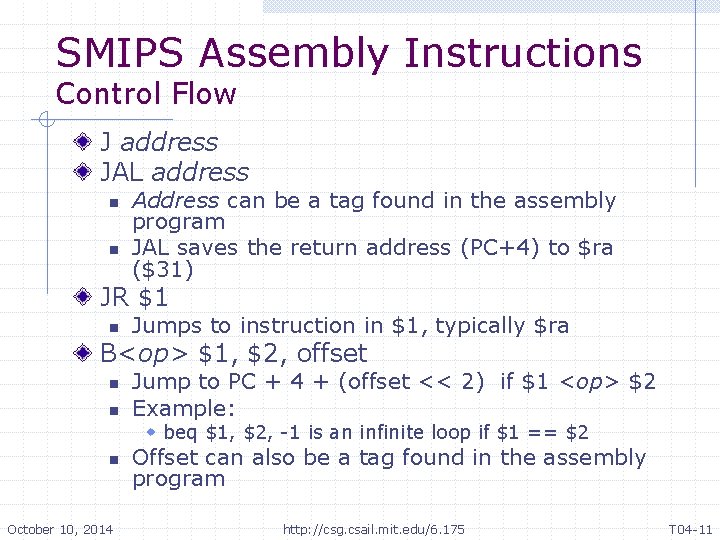
SMIPS Assembly Instructions Control Flow J address JAL address n n Address can be a tag found in the assembly program JAL saves the return address (PC+4) to $ra ($31) JR $1 n Jumps to instruction in $1, typically $ra B<op> $1, $2, offset n n Jump to PC + 4 + (offset << 2) if $1 <op> $2 Example: w beq $1, $2, -1 is an infinite loop if $1 == $2 n October 10, 2014 Offset can also be a tag found in the assembly program http: //csg. csail. mit. edu/6. 175 T 04 -11
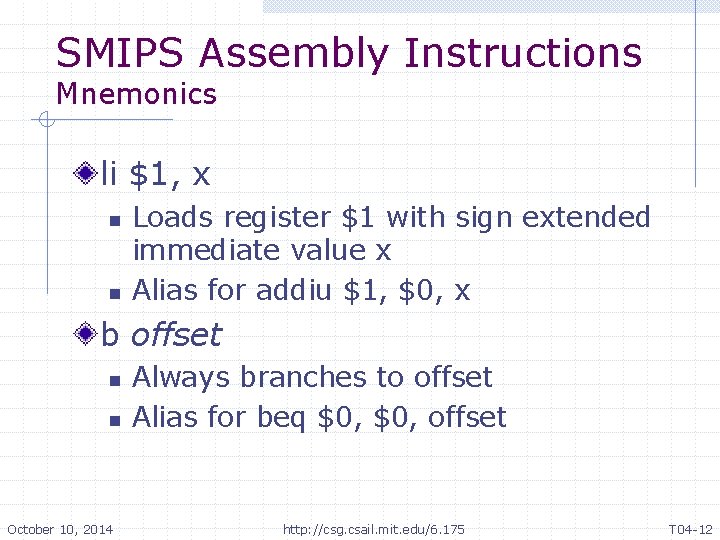
SMIPS Assembly Instructions Mnemonics li $1, x n n Loads register $1 with sign extended immediate value x Alias for addiu $1, $0, x b offset n n October 10, 2014 Always branches to offset Alias for beq $0, offset http: //csg. csail. mit. edu/6. 175 T 04 -12
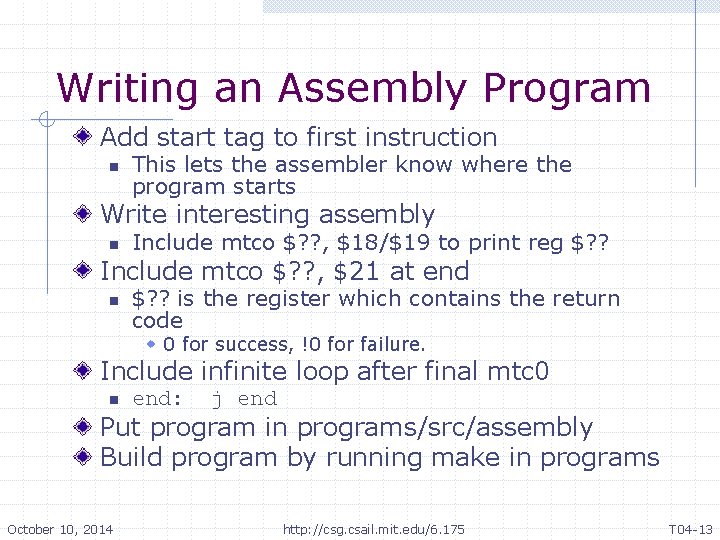
Writing an Assembly Program Add start tag to first instruction n This lets the assembler know where the program starts Write interesting assembly n Include mtco $? ? , $18/$19 to print reg $? ? Include mtco $? ? , $21 at end n $? ? is the register which contains the return code w 0 for success, !0 for failure. Include infinite loop after final mtc 0 n end: j end Put program in programs/src/assembly Build program by running make in programs October 10, 2014 http: //csg. csail. mit. edu/6. 175 T 04 -13
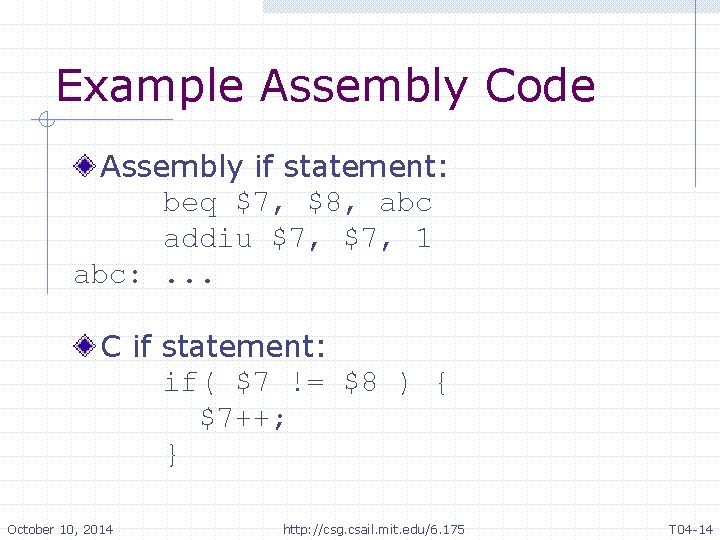
Example Assembly Code Assembly if statement: beq $7, $8, abc addiu $7, 1 abc: . . . C if statement: if( $7 != $8 ) { $7++; } October 10, 2014 http: //csg. csail. mit. edu/6. 175 T 04 -14
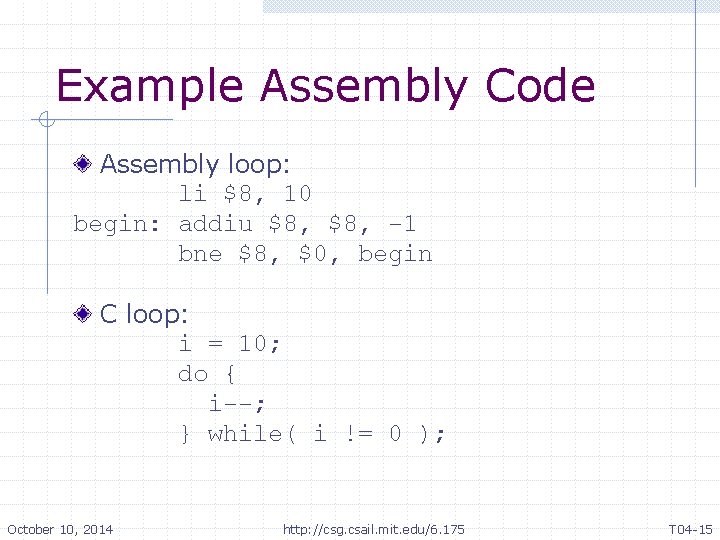
Example Assembly Code Assembly loop: li $8, 10 begin: addiu $8, -1 bne $8, $0, begin C loop: i = 10; do { i--; } while( i != 0 ); October 10, 2014 http: //csg. csail. mit. edu/6. 175 T 04 -15
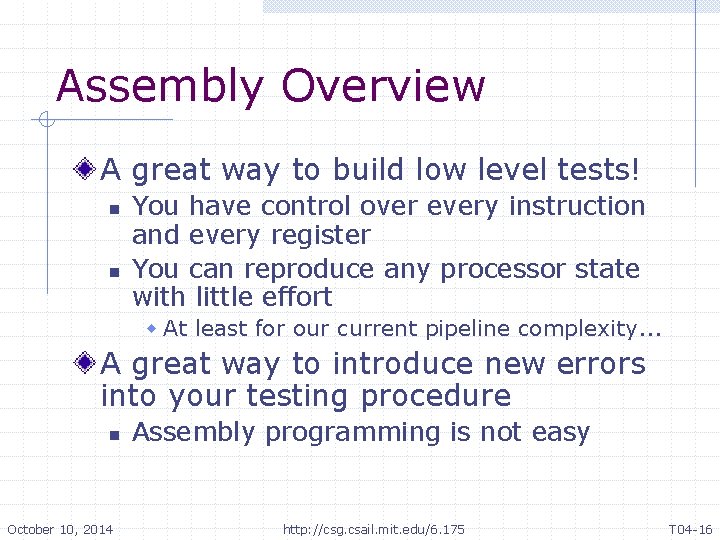
Assembly Overview A great way to build low level tests! n n You have control over every instruction and every register You can reproduce any processor state with little effort w At least for our current pipeline complexity. . . A great way to introduce new errors into your testing procedure n October 10, 2014 Assembly programming is not easy http: //csg. csail. mit. edu/6. 175 T 04 -16
C Programs We have a compiler to turn C programs into SMIPS programs You can create larger tests and performance benchmarks with ease October 10, 2014 http: //csg. csail. mit. edu/6. 175 T 04 -17
C Programs What’s missing smips-gcc sometimes produces unsupported instructions n n Using types smaller than int (such as char) causes unsupported loads and stores to be implemented Mul and div instructions are unsupported so using * and / causes problems No standard libraries n October 10, 2014 Can’t use malloc, printf, etc. http: //csg. csail. mit. edu/6. 175 T 04 -18
C Programs What we have Start code n Jumps to main and sends return value to COP Print library n Can print chars, ints, and strings Cop library n October 10, 2014 Can read number of instructions and things like that. http: //csg. csail. mit. edu/6. 175 T 04 -19
C Programs We are going to talk about details in a later tutorial (when we talk about multicore programming) n n October 10, 2014 If you want to do it on your own, start with an existing example and modify it Also add the necessary lines to the makefile http: //csg. csail. mit. edu/6. 175 T 04 -20
Searchable FIFO October 10, 2014 http: //csg. csail. mit. edu/6. 175 T 04 -21
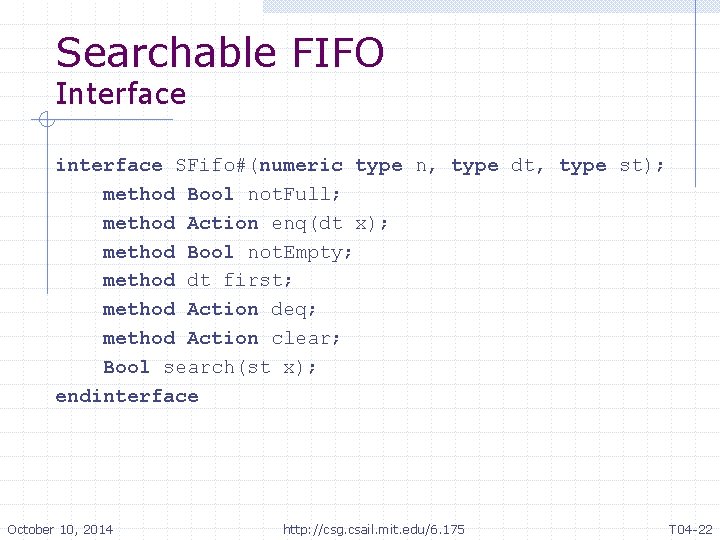
Searchable FIFO Interface interface SFifo#(numeric type n, type dt, type st); method Bool not. Full; method Action enq(dt x); method Bool not. Empty; method dt first; method Action deq; method Action clear; Bool search(st x); endinterface October 10, 2014 http: //csg. csail. mit. edu/6. 175 T 04 -22
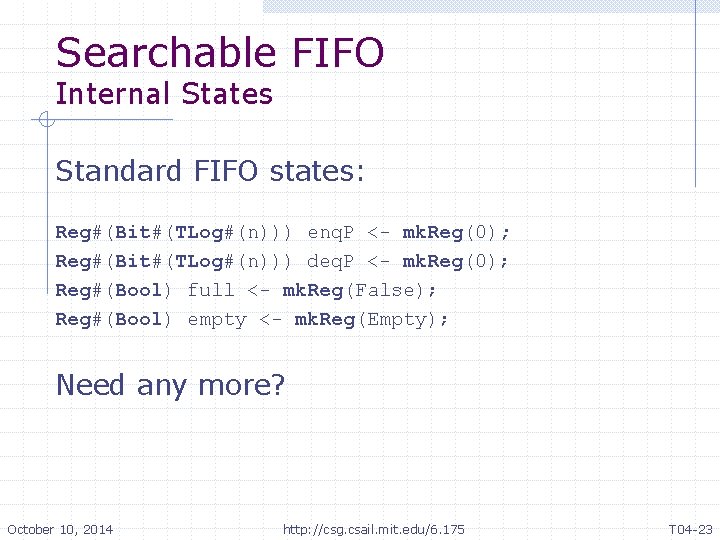
Searchable FIFO Internal States Standard FIFO states: Reg#(Bit#(TLog#(n))) enq. P <- mk. Reg(0); Reg#(Bit#(TLog#(n))) deq. P <- mk. Reg(0); Reg#(Bool) full <- mk. Reg(False); Reg#(Bool) empty <- mk. Reg(Empty); Need any more? October 10, 2014 http: //csg. csail. mit. edu/6. 175 T 04 -23
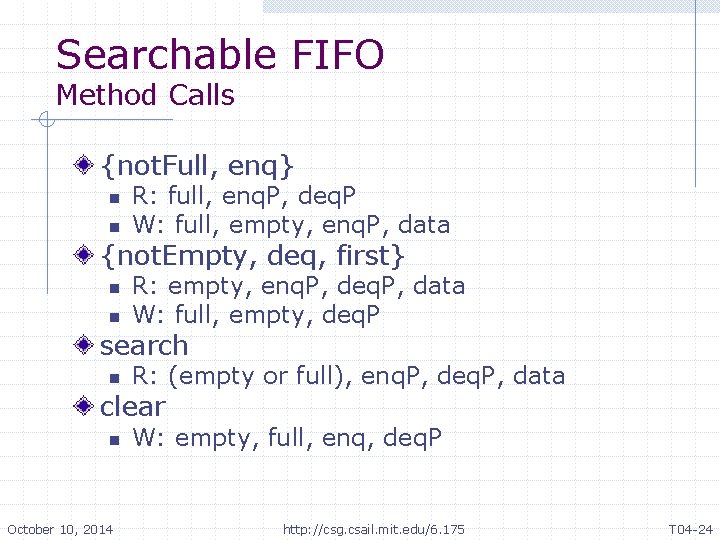
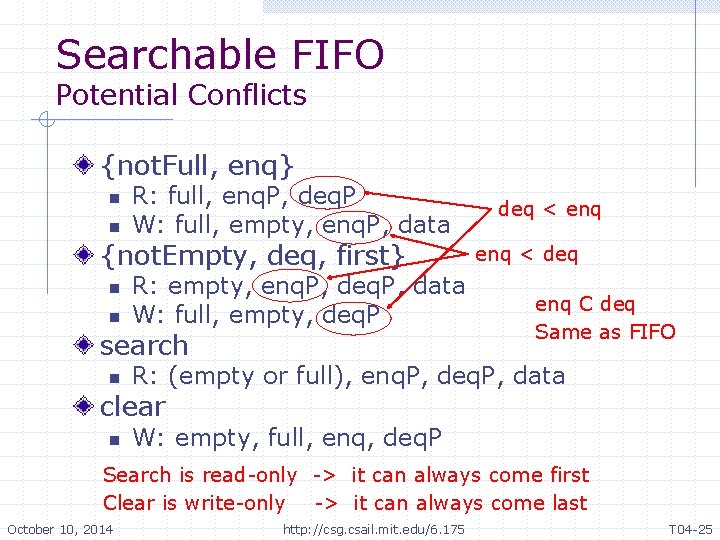
Searchable FIFO Method Calls {not. Full, enq} n n R: full, enq. P, deq. P W: full, empty, enq. P, data {not. Empty, deq, first} n n R: empty, enq. P, deq. P, data W: full, empty, deq. P search n R: (empty or full), enq. P, deq. P, data clear n October 10, 2014 W: empty, full, enq, deq. P http: //csg. csail. mit. edu/6. 175 T 04 -24
Searchable FIFO Potential Conflicts {not. Full, enq} n n R: full, enq. P, deq. P W: full, empty, enq. P, data {not. Empty, deq, first} n n R: empty, enq. P, deq. P, data W: full, empty, deq. P search n deq < enq < deq enq C deq Same as FIFO R: (empty or full), enq. P, deq. P, data clear n W: empty, full, enq, deq. P Search is read-only -> it can always come first Clear is write-only -> it can always come last October 10, 2014 http: //csg. csail. mit. edu/6. 175 T 04 -25
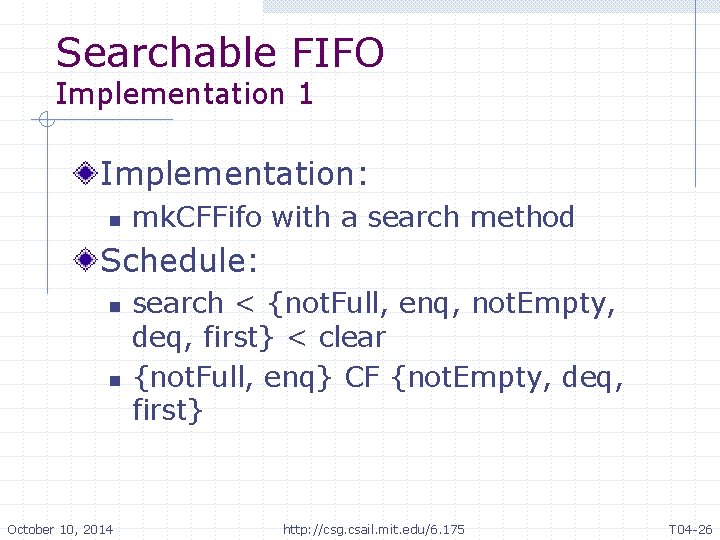
Searchable FIFO Implementation 1 Implementation: n mk. CFFifo with a search method Schedule: n n October 10, 2014 search < {not. Full, enq, not. Empty, deq, first} < clear {not. Full, enq} CF {not. Empty, deq, first} http: //csg. csail. mit. edu/6. 175 T 04 -26
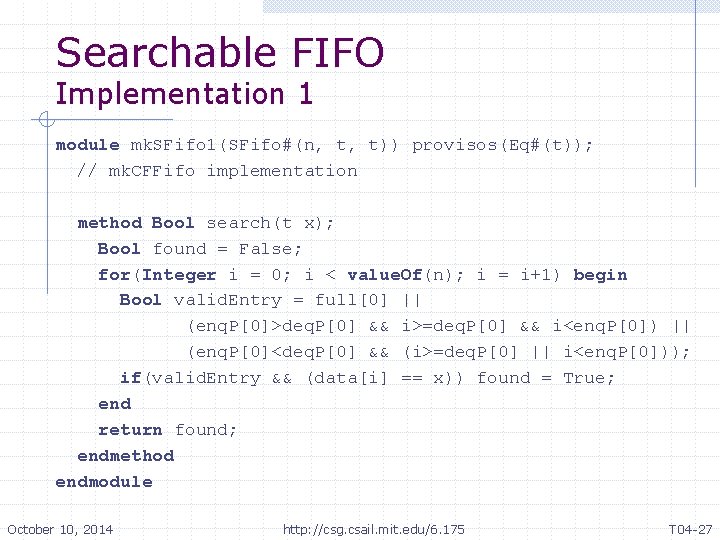
Searchable FIFO Implementation 1 module mk. SFifo 1(SFifo#(n, t, t)) provisos(Eq#(t)); // mk. CFFifo implementation method Bool search(t x); Bool found = False; for(Integer i = 0; i < value. Of(n); i = i+1) begin Bool valid. Entry = full[0] || (enq. P[0]>deq. P[0] && i>=deq. P[0] && i<enq. P[0]) || (enq. P[0]<deq. P[0] && (i>=deq. P[0] || i<enq. P[0])); if(valid. Entry && (data[i] == x)) found = True; end return found; endmethod endmodule October 10, 2014 http: //csg. csail. mit. edu/6. 175 T 04 -27
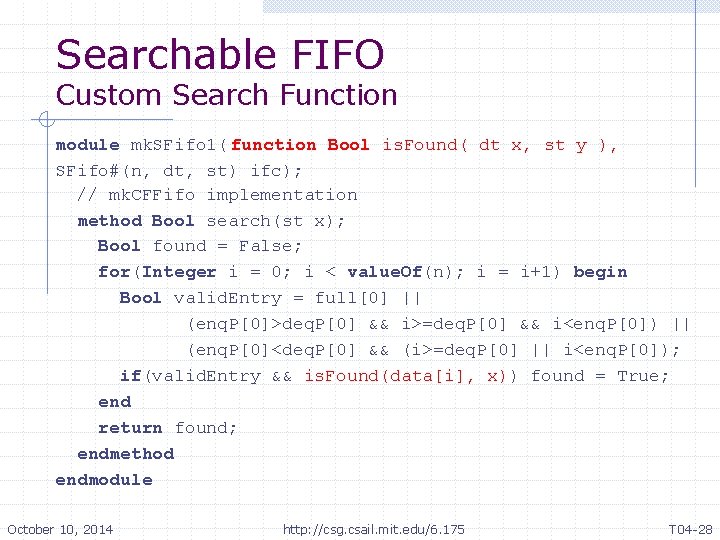
Searchable FIFO Custom Search Function module mk. SFifo 1( function Bool is. Found( dt x, st y ), SFifo#(n, dt, st) ifc); // mk. CFFifo implementation method Bool search(st x); Bool found = False; for(Integer i = 0; i < value. Of(n); i = i+1) begin Bool valid. Entry = full[0] || (enq. P[0]>deq. P[0] && i>=deq. P[0] && i<enq. P[0]) || (enq. P[0]<deq. P[0] && (i>=deq. P[0] || i<enq. P[0]); if(valid. Entry && is. Found(data[i], x)) found = True; end return found; endmethod endmodule October 10, 2014 http: //csg. csail. mit. edu/6. 175 T 04 -28
Scoreboard When using a SFifo for a scoreboard, the following functions are used together: n n {search, not. Full, enq} {not. Empty, deq} Are enq and deq still commutative like in the CFFifo case? n October 10, 2014 No! Search has to be able to be done with enq, and search is not commutative with deq http: //csg. csail. mit. edu/6. 175 T 04 -29
Two SFifo Implementations for a Scoreboard Implementation 1: n n {search, not. Full, enq} < {deq, not. Empty} “Conflict Free” Scoreboard w Can be implemented with previously shown SFifo Implementation 2: n n {deq, not. Empty} < {search, not. Full, enq} “Pipeline” Scoreboard w Design is straight forward using technique from Lab 4 October 10, 2014 http: //csg. csail. mit. edu/6. 175 T 04 -30