
Constructive Computer Architecture Multirule systems and Concurrent Execution
- Slides: 22
Constructive Computer Architecture: Multirule systems and Concurrent Execution of Rules Arvind Computer Science & Artificial Intelligence Lab. Massachusetts Institute of Technology September 28, 2015 http: //csg. csail. mit. edu/6. 175 L 08 -1
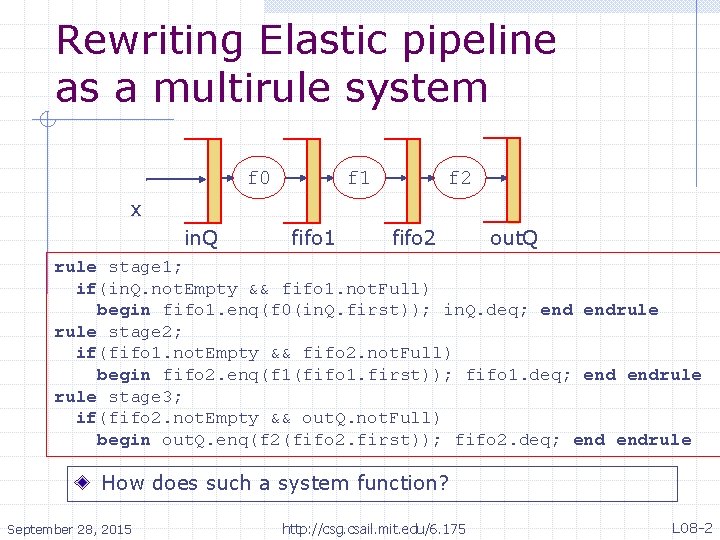
Rewriting Elastic pipeline as a multirule system f 0 f 1 f 2 x in. Q fifo 1 fifo 2 out. Q rule stage 1; if(in. Q. not. Empty && fifo 1. not. Full) begin fifo 1. enq(f 0(in. Q. first)); in. Q. deq; endrule stage 2; if(fifo 1. not. Empty && fifo 2. not. Full) begin fifo 2. enq(f 1(fifo 1. first)); fifo 1. deq; endrule stage 3; if(fifo 2. not. Empty && out. Q. not. Full) begin out. Q. enq(f 2(fifo 2. first)); fifo 2. deq; endrule How does such a system function? September 28, 2015 http: //csg. csail. mit. edu/6. 175 L 08 -2
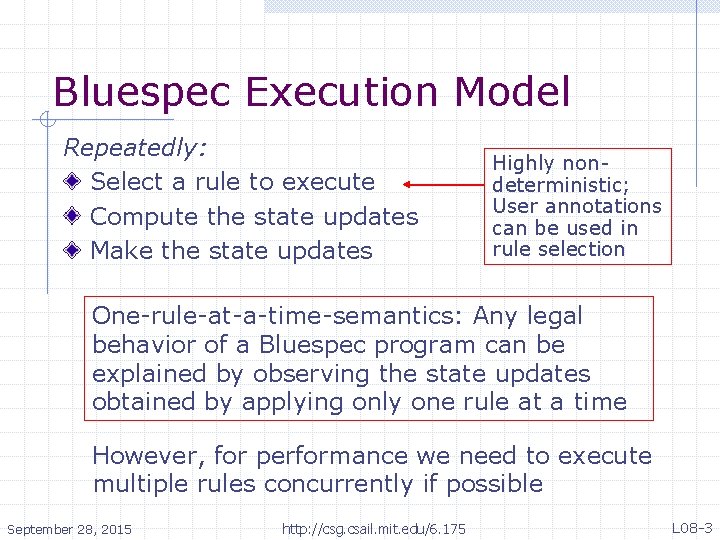
Bluespec Execution Model Repeatedly: Select a rule to execute Compute the state updates Make the state updates Highly nondeterministic; User annotations can be used in rule selection One-rule-at-a-time-semantics: Any legal behavior of a Bluespec program can be explained by observing the state updates obtained by applying only one rule at a time However, for performance we need to execute multiple rules concurrently if possible September 28, 2015 http: //csg. csail. mit. edu/6. 175 L 08 -3
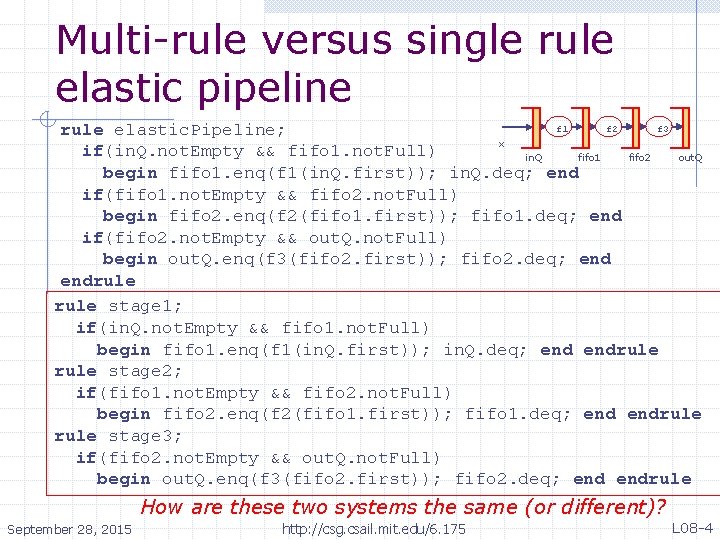
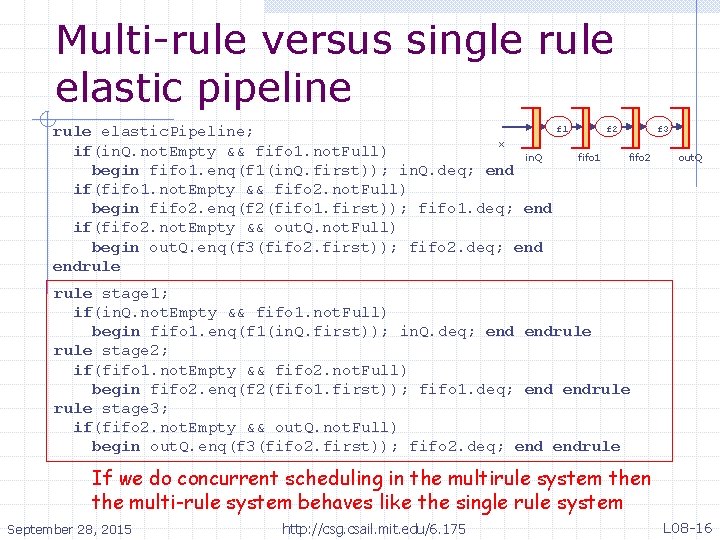
Multi-rule versus single rule elastic pipeline f 1 f 2 f 3 rule elastic. Pipeline; x if(in. Q. not. Empty && fifo 1. not. Full) in. Q fifo 1 fifo 2 out. Q begin fifo 1. enq(f 1(in. Q. first)); in. Q. deq; end if(fifo 1. not. Empty && fifo 2. not. Full) begin fifo 2. enq(f 2(fifo 1. first)); fifo 1. deq; end if(fifo 2. not. Empty && out. Q. not. Full) begin out. Q. enq(f 3(fifo 2. first)); fifo 2. deq; endrule stage 1; if(in. Q. not. Empty && fifo 1. not. Full) begin fifo 1. enq(f 1(in. Q. first)); in. Q. deq; endrule stage 2; if(fifo 1. not. Empty && fifo 2. not. Full) begin fifo 2. enq(f 2(fifo 1. first)); fifo 1. deq; endrule stage 3; if(fifo 2. not. Empty && out. Q. not. Full) begin out. Q. enq(f 3(fifo 2. first)); fifo 2. deq; endrule How are these two systems the same (or different)? September 28, 2015 http: //csg. csail. mit. edu/6. 175 L 08 -4
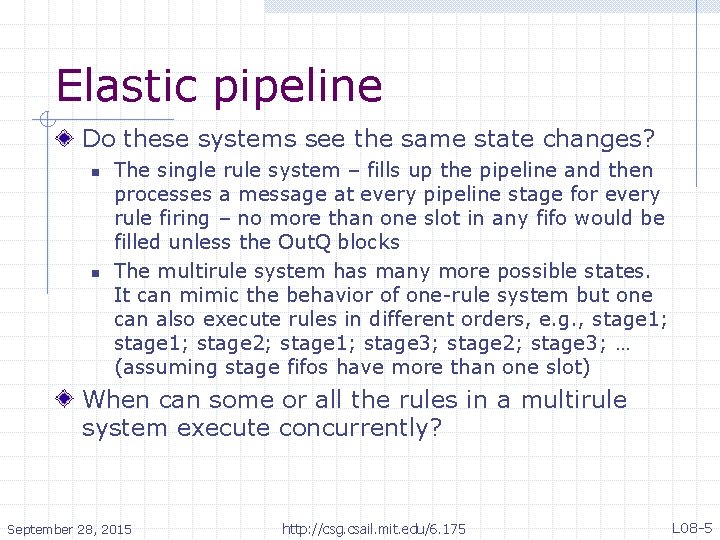
Elastic pipeline Do these systems see the same state changes? n n The single rule system – fills up the pipeline and then processes a message at every pipeline stage for every rule firing – no more than one slot in any fifo would be filled unless the Out. Q blocks The multirule system has many more possible states. It can mimic the behavior of one-rule system but one can also execute rules in different orders, e. g. , stage 1; stage 2; stage 1; stage 3; stage 2; stage 3; … (assuming stage fifos have more than one slot) When can some or all the rules in a multirule system execute concurrently? September 28, 2015 http: //csg. csail. mit. edu/6. 175 L 08 -5
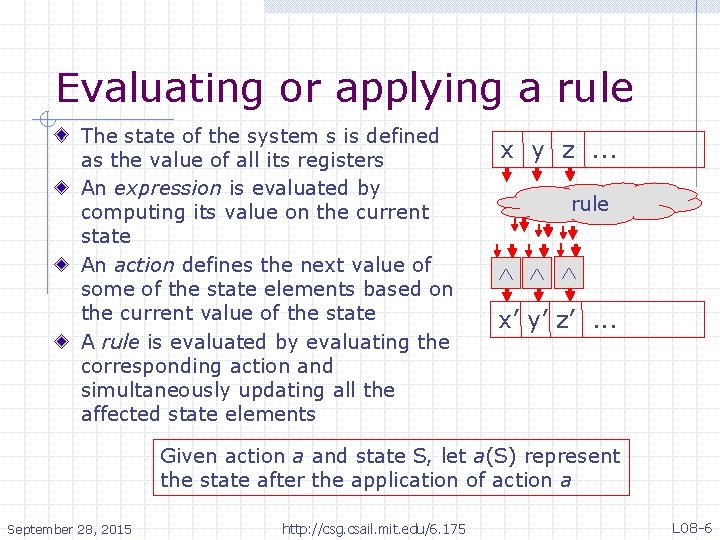
Evaluating or applying a rule The state of the system s is defined as the value of all its registers An expression is evaluated by computing its value on the current state An action defines the next value of some of the state elements based on the current value of the state A rule is evaluated by evaluating the corresponding action and simultaneously updating all the affected state elements x y z. . . rule x’ y’ z’. . . Given action a and state S, let a(S) represent the state after the application of action a September 28, 2015 http: //csg. csail. mit. edu/6. 175 L 08 -6
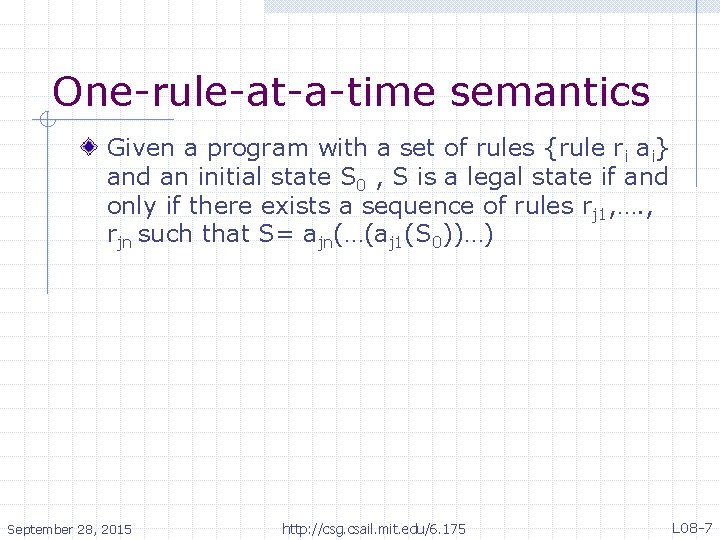
One-rule-at-a-time semantics Given a program with a set of rules {rule ri ai} and an initial state S 0 , S is a legal state if and only if there exists a sequence of rules rj 1, …. , rjn such that S= ajn(…(aj 1(S 0))…) September 28, 2015 http: //csg. csail. mit. edu/6. 175 L 08 -7
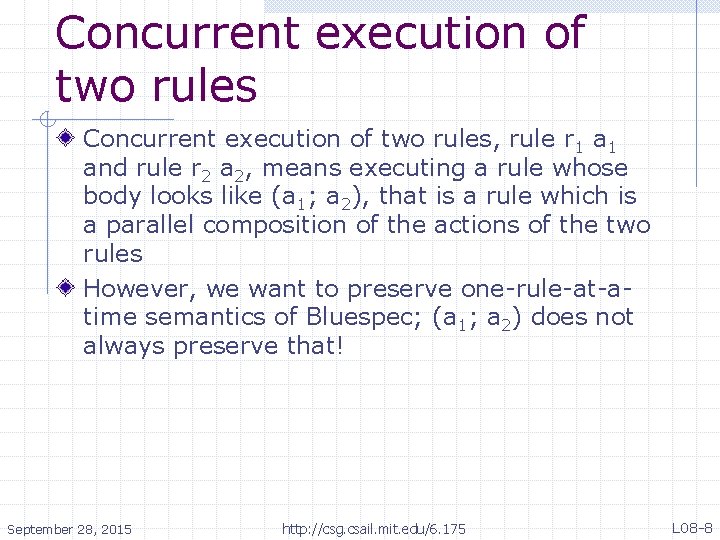
Concurrent execution of two rules, rule r 1 and rule r 2 a 2, means executing a rule whose body looks like (a 1; a 2), that is a rule which is a parallel composition of the actions of the two rules However, we want to preserve one-rule-at-atime semantics of Bluespec; (a 1; a 2) does not always preserve that! September 28, 2015 http: //csg. csail. mit. edu/6. 175 L 08 -8
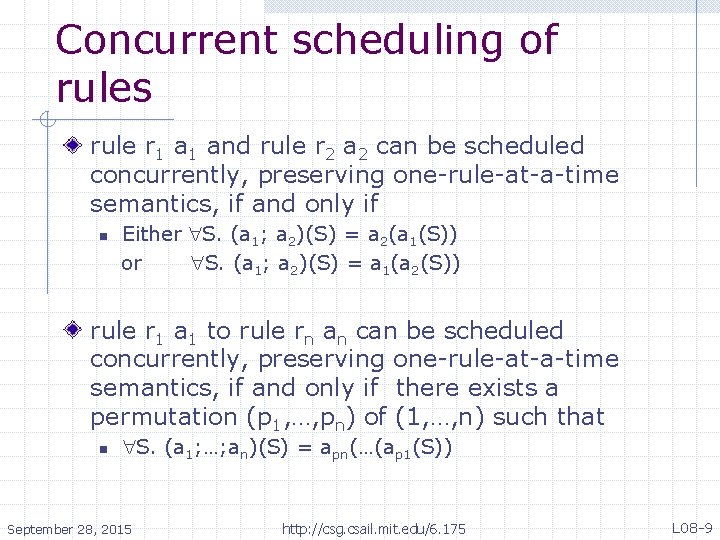
Concurrent scheduling of rules rule r 1 and rule r 2 a 2 can be scheduled concurrently, preserving one-rule-at-a-time semantics, if and only if n Either S. (a 1; a 2)(S) = a 2(a 1(S)) or S. (a 1; a 2)(S) = a 1(a 2(S)) rule r 1 a 1 to rule rn an can be scheduled concurrently, preserving one-rule-at-a-time semantics, if and only if there exists a permutation (p 1, …, pn) of (1, …, n) such that n S. (a 1; …; an)(S) = apn(…(ap 1(S)) September 28, 2015 http: //csg. csail. mit. edu/6. 175 L 08 -9
A compiler can determine if two rules can be executed in parallel without violating the one-rule-at -a-time semantics James Hoe, Ph. D. , 2000 Construct a conflict matrix (CM) for rules September 28, 2015 http: //csg. csail. mit. edu/6. 175 L 08 -10
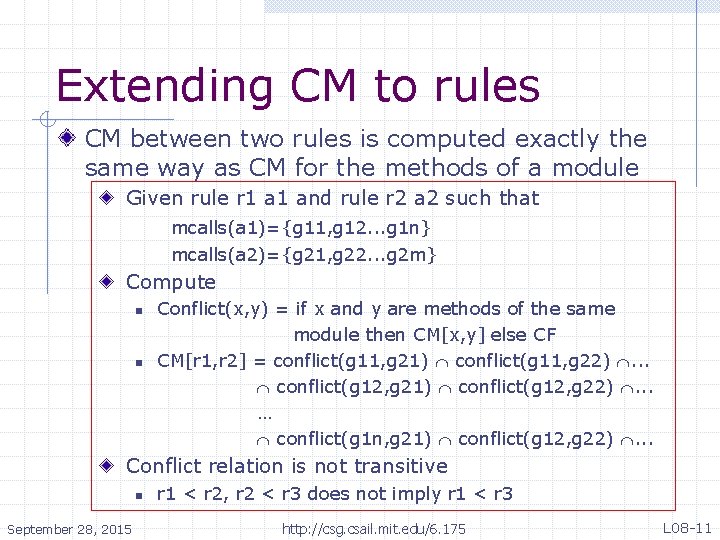
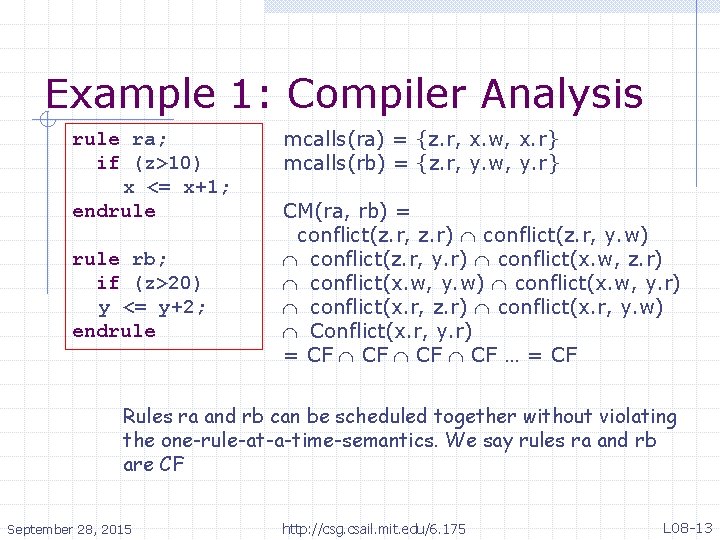
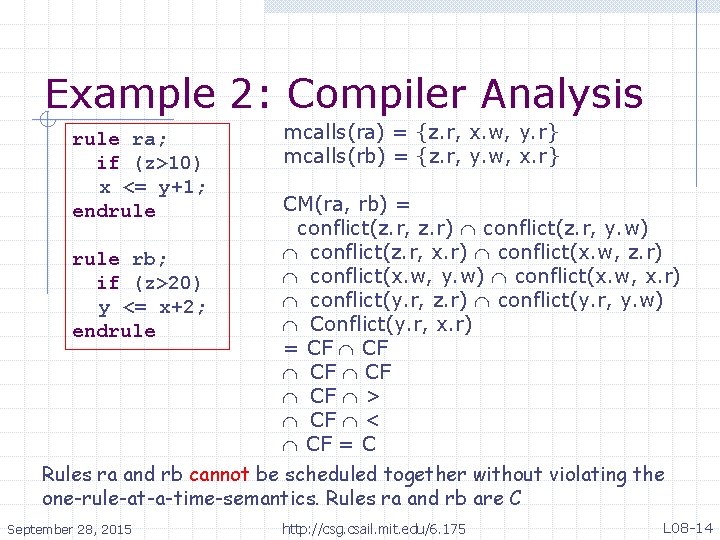
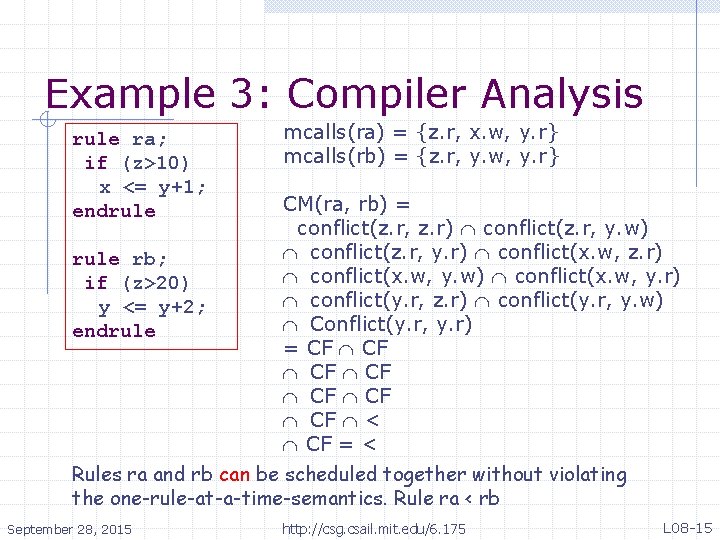
Extending CM to rules CM between two rules is computed exactly the same way as CM for the methods of a module Given rule r 1 and rule r 2 a 2 such that mcalls(a 1)={g 11, g 12. . . g 1 n} mcalls(a 2)={g 21, g 22. . . g 2 m} Compute n n Conflict(x, y) = if x and y are methods of the same module then CM[x, y] else CF CM[r 1, r 2] = conflict(g 11, g 21) conflict(g 11, g 22) . . . conflict(g 12, g 21) conflict(g 12, g 22) . . . … conflict(g 1 n, g 21) conflict(g 12, g 22) . . . Conflict relation is not transitive n September 28, 2015 r 1 < r 2, r 2 < r 3 does not imply r 1 < r 3 http: //csg. csail. mit. edu/6. 175 L 08 -11
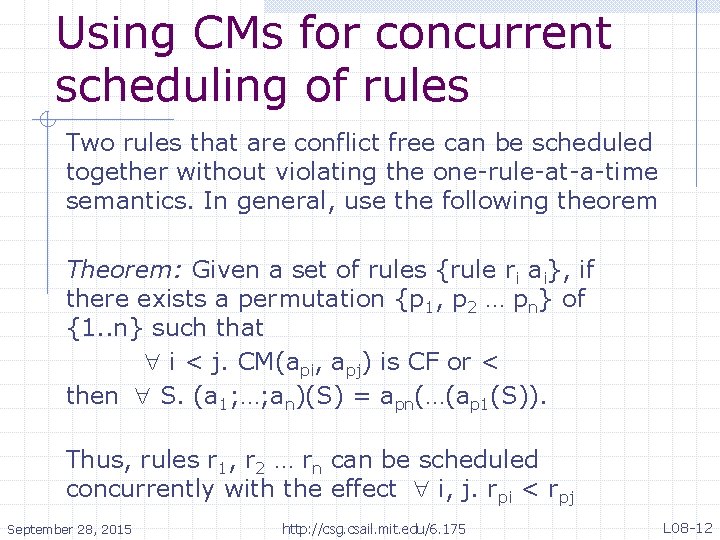
Using CMs for concurrent scheduling of rules Two rules that are conflict free can be scheduled together without violating the one-rule-at-a-time semantics. In general, use the following theorem Theorem: Given a set of rules {rule ri ai}, if there exists a permutation {p 1, p 2 … pn} of {1. . n} such that i < j. CM(api, apj) is CF or < then S. (a 1; …; an)(S) = apn(…(ap 1(S)). Thus, rules r 1, r 2 … rn can be scheduled concurrently with the effect i, j. rpi < rpj September 28, 2015 http: //csg. csail. mit. edu/6. 175 L 08 -12
Example 1: Compiler Analysis rule ra; if (z>10) x <= x+1; endrule rb; if (z>20) y <= y+2; endrule mcalls(ra) = {z. r, x. w, x. r} mcalls(rb) = {z. r, y. w, y. r} CM(ra, rb) = conflict(z. r, z. r) conflict(z. r, y. w) conflict(z. r, y. r) conflict(x. w, z. r) conflict(x. w, y. w) conflict(x. w, y. r) conflict(x. r, z. r) conflict(x. r, y. w) Conflict(x. r, y. r) = CF CF … = CF Rules ra and rb can be scheduled together without violating the one-rule-at-a-time-semantics. We say rules ra and rb are CF September 28, 2015 http: //csg. csail. mit. edu/6. 175 L 08 -13
Example 2: Compiler Analysis rule ra; if (z>10) x <= y+1; endrule rb; if (z>20) y <= x+2; endrule mcalls(ra) = {z. r, x. w, y. r} mcalls(rb) = {z. r, y. w, x. r} CM(ra, rb) = conflict(z. r, z. r) conflict(z. r, y. w) conflict(z. r, x. r) conflict(x. w, z. r) conflict(x. w, y. w) conflict(x. w, x. r) conflict(y. r, z. r) conflict(y. r, y. w) Conflict(y. r, x. r) = CF CF CF > CF < CF = C Rules ra and rb cannot be scheduled together without violating the one-rule-at-a-time-semantics. Rules ra and rb are C September 28, 2015 http: //csg. csail. mit. edu/6. 175 L 08 -14
Example 3: Compiler Analysis rule ra; if (z>10) x <= y+1; endrule rb; if (z>20) y <= y+2; endrule mcalls(ra) = {z. r, x. w, y. r} mcalls(rb) = {z. r, y. w, y. r} CM(ra, rb) = conflict(z. r, z. r) conflict(z. r, y. w) conflict(z. r, y. r) conflict(x. w, z. r) conflict(x. w, y. w) conflict(x. w, y. r) conflict(y. r, z. r) conflict(y. r, y. w) Conflict(y. r, y. r) = CF CF < CF = < Rules ra and rb can be scheduled together without violating the one-rule-at-a-time-semantics. Rule ra < rb September 28, 2015 http: //csg. csail. mit. edu/6. 175 L 08 -15
Multi-rule versus single rule elastic pipeline f 1 rule elastic. Pipeline; x if(in. Q. not. Empty && fifo 1. not. Full) in. Q begin fifo 1. enq(f 1(in. Q. first)); in. Q. deq; end if(fifo 1. not. Empty && fifo 2. not. Full) begin fifo 2. enq(f 2(fifo 1. first)); fifo 1. deq; end if(fifo 2. not. Empty && out. Q. not. Full) begin out. Q. enq(f 3(fifo 2. first)); fifo 2. deq; endrule f 2 fifo 1 f 3 fifo 2 out. Q rule stage 1; if(in. Q. not. Empty && fifo 1. not. Full) begin fifo 1. enq(f 1(in. Q. first)); in. Q. deq; endrule stage 2; if(fifo 1. not. Empty && fifo 2. not. Full) begin fifo 2. enq(f 2(fifo 1. first)); fifo 1. deq; endrule stage 3; if(fifo 2. not. Empty && out. Q. not. Full) begin out. Q. enq(f 3(fifo 2. first)); fifo 2. deq; endrule If we do concurrent scheduling in the multirule system then the multi-rule system behaves like the single rule system September 28, 2015 http: //csg. csail. mit. edu/6. 175 L 08 -16
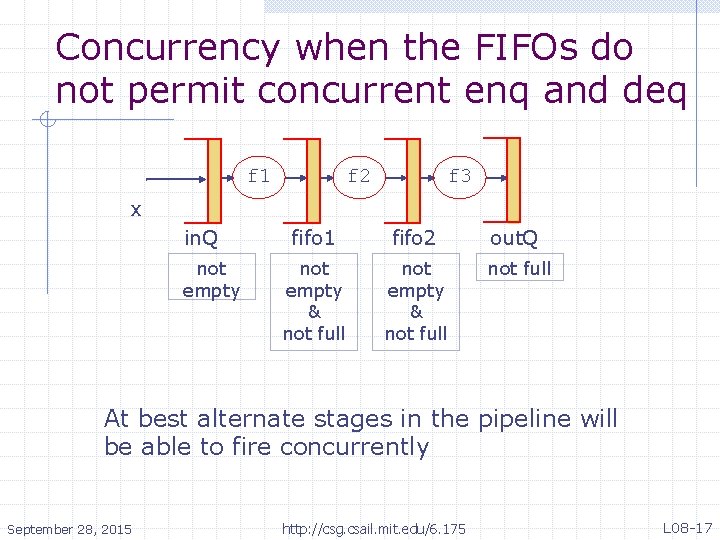
Concurrency when the FIFOs do not permit concurrent enq and deq f 1 f 2 f 3 x in. Q not empty fifo 1 fifo 2 not empty & not full out. Q not full At best alternate stages in the pipeline will be able to fire concurrently September 28, 2015 http: //csg. csail. mit. edu/6. 175 L 08 -17
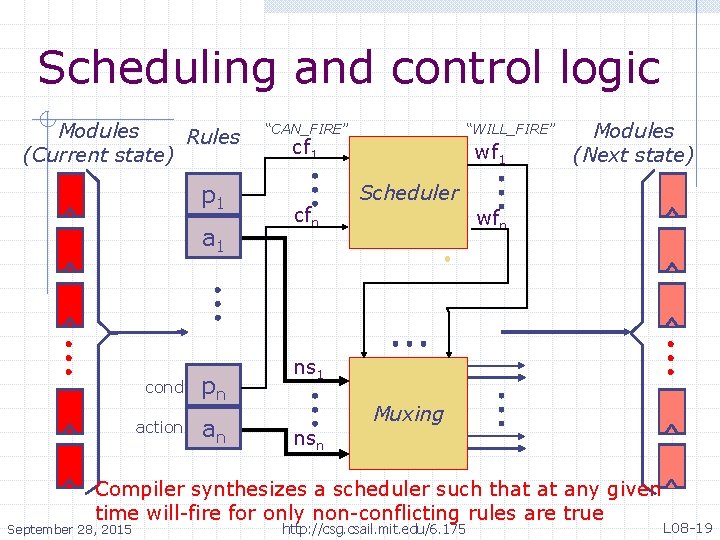
Practical scheduling concerns Rules often have a top level predicate or guard: n rule r 1 if (p 1); a 1 It does make sense to schedule such a rule for execution unless it’s predicate is true We can evaluate the guards of many* rules in parallel every (clock) cycle and then select for parallel execution only among those rules whose guards are true. Of course the selected rules must preserve one-rule-at-a-time semantics. *Not all guards can be evaluated in parallel because of EHRs and method parameters September 28, 2015 http: //csg. csail. mit. edu/6. 175 L 08 -18
Scheduling and control logic Modules Rules (Current state) p 1 a 1 cond action pn an “CAN_FIRE” “WILL_FIRE” cf 1 cfn wf 1 Modules (Next state) Scheduler wfn ns 1 nsn Muxing Compiler synthesizes a scheduler such that at any given time will-fire for only non-conflicting rules are true September 28, 2015 http: //csg. csail. mit. edu/6. 175 L 08 -19
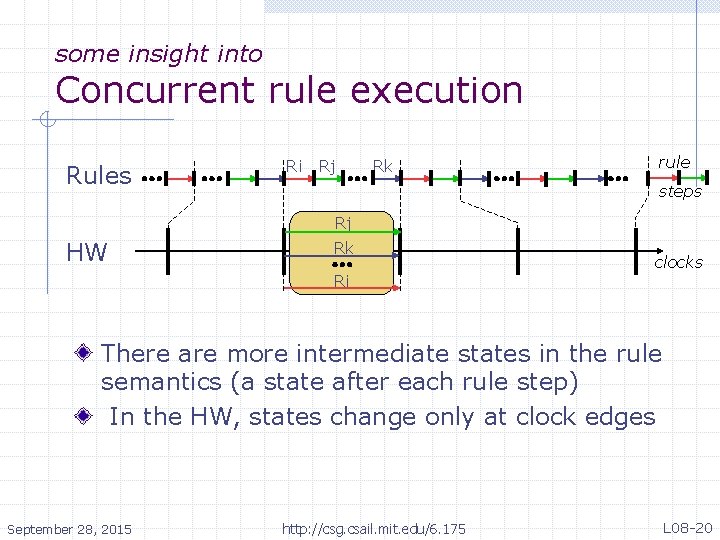
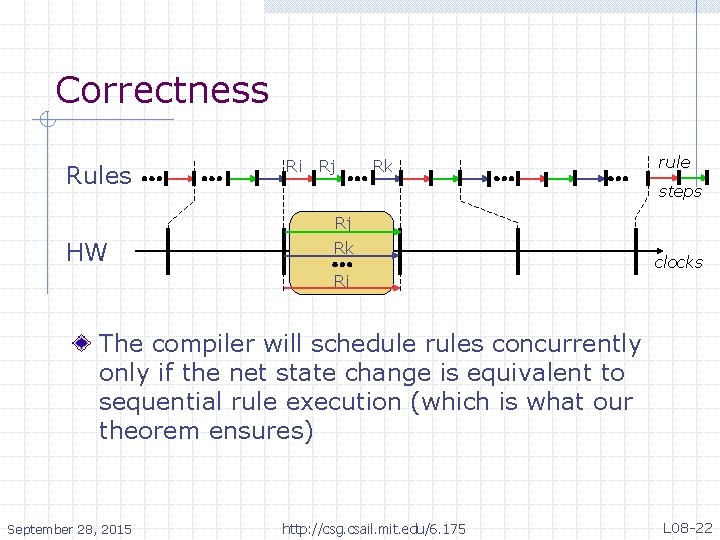
some insight into Concurrent rule execution Rules Ri Rj Rk rule steps Rj HW Rk Ri clocks There are more intermediate states in the rule semantics (a state after each rule step) In the HW, states change only at clock edges September 28, 2015 http: //csg. csail. mit. edu/6. 175 L 08 -20
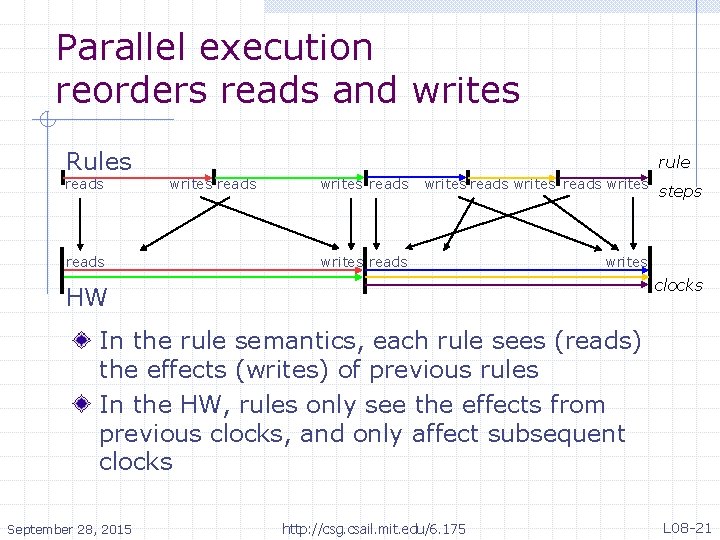
Parallel execution reorders reads and writes Rules reads rule writes reads writes reads writes steps clocks HW In the rule semantics, each rule sees (reads) the effects (writes) of previous rules In the HW, rules only see the effects from previous clocks, and only affect subsequent clocks September 28, 2015 http: //csg. csail. mit. edu/6. 175 L 08 -21
Correctness Rules Ri Rj Rk rule steps Rj HW Rk Ri clocks The compiler will schedule rules concurrently only if the net state change is equivalent to sequential rule execution (which is what our theorem ensures) September 28, 2015 http: //csg. csail. mit. edu/6. 175 L 08 -22