
Constructive Computer Architecture Cache Coherence Arvind Computer Science


![Processor Hit Rules Load-hit rule p 2 m. msg=(Load a) & (c. state[a]>I) p](https://slidetodoc.com/presentation_image_h2/f7811ad8f6a898851f7a73d68054319f/image-15.jpg "Processor Hit Rules Load-hit rule p 2 m. msg=(Load a) & (c. state[a]>I) p")
![Processing a Load miss L 1 to Parent: Upgrade-to-S request (c. state[a]=I) & (c.](https://slidetodoc.com/presentation_image_h2/f7811ad8f6a898851f7a73d68054319f/image-17.jpg "Processing a Load miss L 1 to Parent: Upgrade-to-S request (c. state[a]=I) & (c.")
![Processing Load miss cont. What if ( i≠c, Is. Compatible(m. child[i][a], y)) is false?](https://slidetodoc.com/presentation_image_h2/f7811ad8f6a898851f7a73d68054319f/image-18.jpg "Processing Load miss cont. What if ( i≠c, Is. Compatible(m. child[i][a], y)) is false?")
![Child Requests 1. Child to Parent: Upgrade-to-y Request (c. state[a]<y) & (c. waitp[a]=Nothing) c.](https://slidetodoc.com/presentation_image_h2/f7811ad8f6a898851f7a73d68054319f/image-20.jpg "Child Requests 1. Child to Parent: Upgrade-to-y Request (c. state[a]<y) & (c. waitp[a]=Nothing) c.")
![Parent Responds 2. Parent to Child: Upgrade-to-y response ( j, m. waitc[j][a]=Nothing) & c](https://slidetodoc.com/presentation_image_h2/f7811ad8f6a898851f7a73d68054319f/image-21.jpg "Parent Responds 2. Parent to Child: Upgrade-to-y response ( j, m. waitc[j][a]=Nothing) & c")
![Parent Requests 4. Parent to Child: Downgrade-to-y Request (m. child[i][a]>y) & (m. waitc[i][a]=Nothing) m.](https://slidetodoc.com/presentation_image_h2/f7811ad8f6a898851f7a73d68054319f/image-23.jpg "Parent Requests 4. Parent to Child: Downgrade-to-y Request (m. child[i][a]>y) & (m. waitc[i][a]=Nothing) m.")
![Child Voluntarily downgrades 8. Child to Parent: Downgrade-to-y response (vol) (c. waitp[a]=Nothing) & (c.](https://slidetodoc.com/presentation_image_h2/f7811ad8f6a898851f7a73d68054319f/image-27.jpg "Child Voluntarily downgrades 8. Child to Parent: Downgrade-to-y response (vol) (c. waitp[a]=Nothing) & (c.")
- Slides: 30
Constructive Computer Architecture Cache Coherence Arvind Computer Science & Artificial Intelligence Lab. Massachusetts Institute of Technology November 18, 2013 http: //www. csg. csail. mit. edu/6. s 195 L 21 -1
Contributors to the course material Arvind, Rishiyur S. Nikhil, Joel Emer, Muralidaran Vijayaraghavan Staff and students in 6. 375 (Spring 2013), 6. S 195 (Fall 2012), 6. S 078 (Spring 2012) n Asif Khan, Richard Ruhler, Sang Woo Jun, Abhinav Agarwal, Myron King, Kermin Fleming, Ming Liu, Li. Shiuan Peh External n n Prof November 18, 2013 Amey Karkare & students at IIT Kanpur Jihong Kim & students at Seoul Nation University Derek Chiou, University of Texas at Austin Yoav Etsion & students at Technion http: //www. csg. csail. mit. edu/6. s 195 L 21 -2
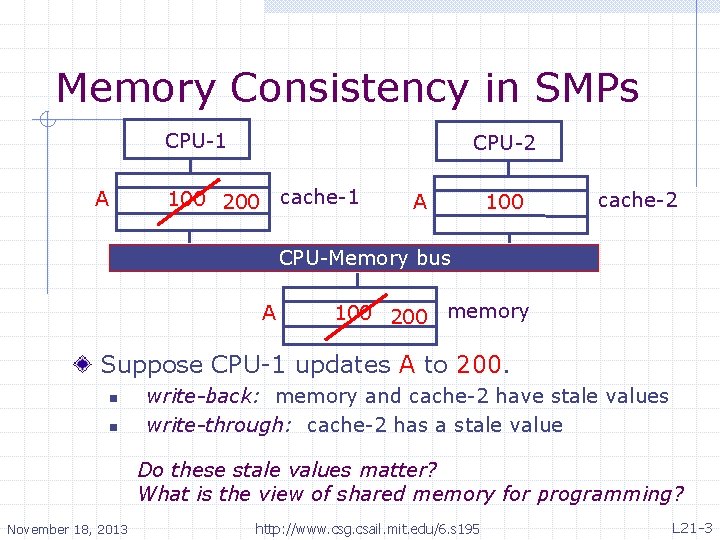
Memory Consistency in SMPs CPU-1 A CPU-2 cache-1 100 200 A 100 cache-2 CPU-Memory bus A 100 200 memory Suppose CPU-1 updates A to 200. n n write-back: memory and cache-2 have stale values write-through: cache-2 has a stale value Do these stale values matter? What is the view of shared memory for programming? November 18, 2013 http: //www. csg. csail. mit. edu/6. s 195 L 21 -3
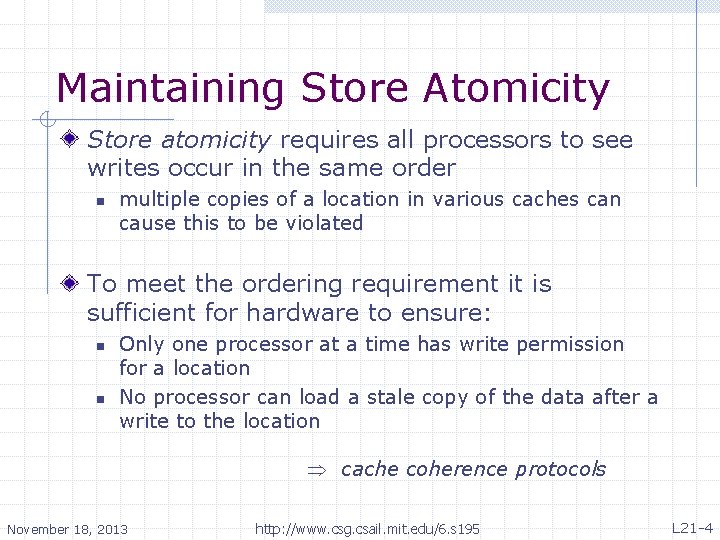
Maintaining Store Atomicity Store atomicity requires all processors to see writes occur in the same order n multiple copies of a location in various caches can cause this to be violated To meet the ordering requirement it is sufficient for hardware to ensure: n n Only one processor at a time has write permission for a location No processor can load a stale copy of the data after a write to the location cache coherence protocols November 18, 2013 http: //www. csg. csail. mit. edu/6. s 195 L 21 -4
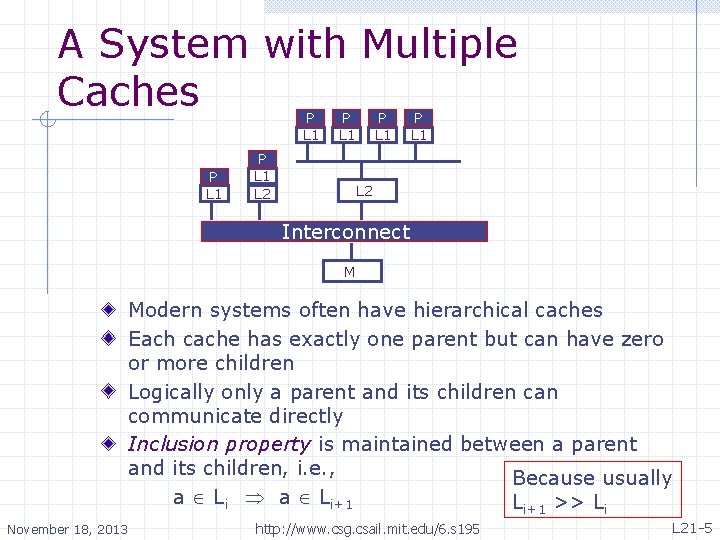
A System with Multiple Caches P L 1 L 2 P L 1 L 2 Interconnect M Modern systems often have hierarchical caches Each cache has exactly one parent but can have zero or more children Logically only a parent and its children can communicate directly Inclusion property is maintained between a parent and its children, i. e. , Because usually a Li+1 >> Li November 18, 2013 http: //www. csg. csail. mit. edu/6. s 195 L 21 -5
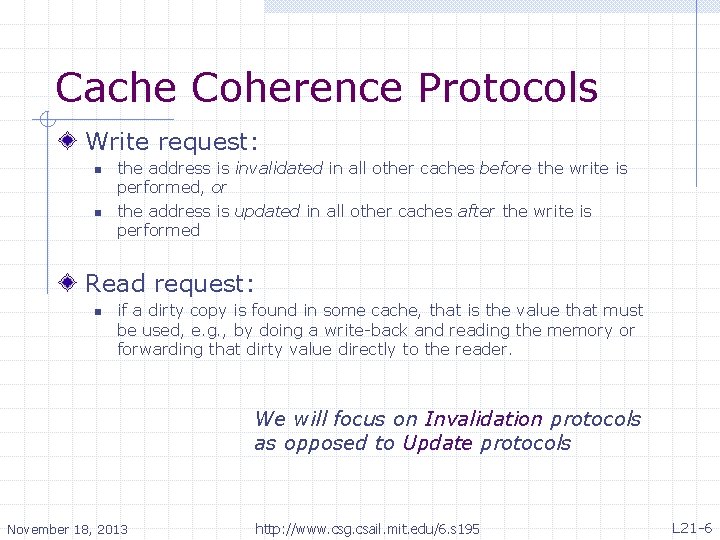
Cache Coherence Protocols Write request: n n the address is invalidated in all other caches before the write is performed, or the address is updated in all other caches after the write is performed Read request: n if a dirty copy is found in some cache, that is the value that must be used, e. g. , by doing a write-back and reading the memory or forwarding that dirty value directly to the reader. We will focus on Invalidation protocols as opposed to Update protocols November 18, 2013 http: //www. csg. csail. mit. edu/6. s 195 L 21 -6
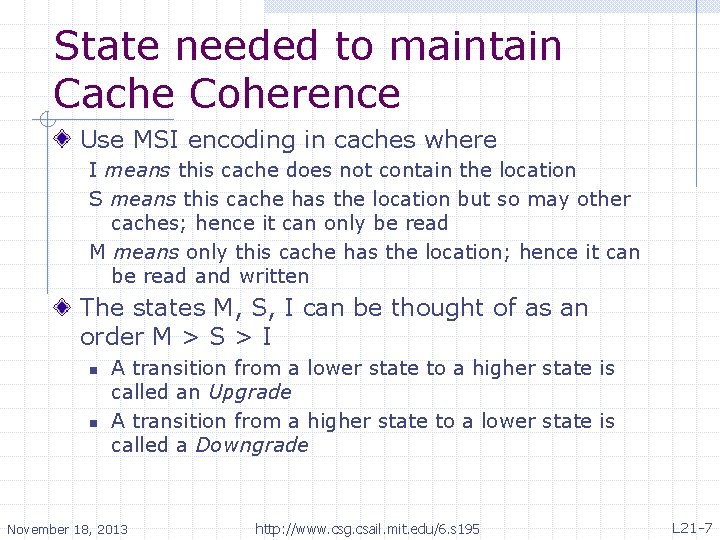
State needed to maintain Cache Coherence Use MSI encoding in caches where I means this cache does not contain the location S means this cache has the location but so may other caches; hence it can only be read M means only this cache has the location; hence it can be read and written The states M, S, I can be thought of as an order M > S > I n n A transition from a lower state to a higher state is called an Upgrade A transition from a higher state to a lower state is called a Downgrade November 18, 2013 http: //www. csg. csail. mit. edu/6. s 195 L 21 -7
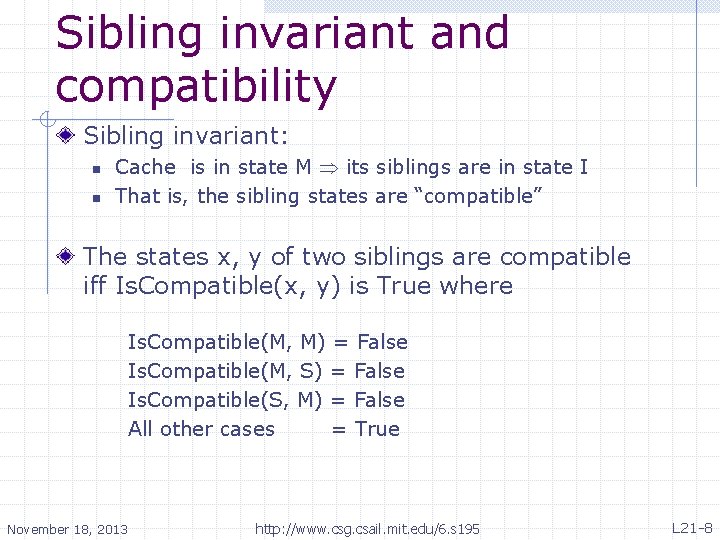
Sibling invariant and compatibility Sibling invariant: n n Cache is in state M its siblings are in state I That is, the sibling states are “compatible” The states x, y of two siblings are compatible iff Is. Compatible(x, y) is True where Is. Compatible(M, M) = False Is. Compatible(M, S) = False Is. Compatible(S, M) = False All other cases = True November 18, 2013 http: //www. csg. csail. mit. edu/6. s 195 L 21 -8
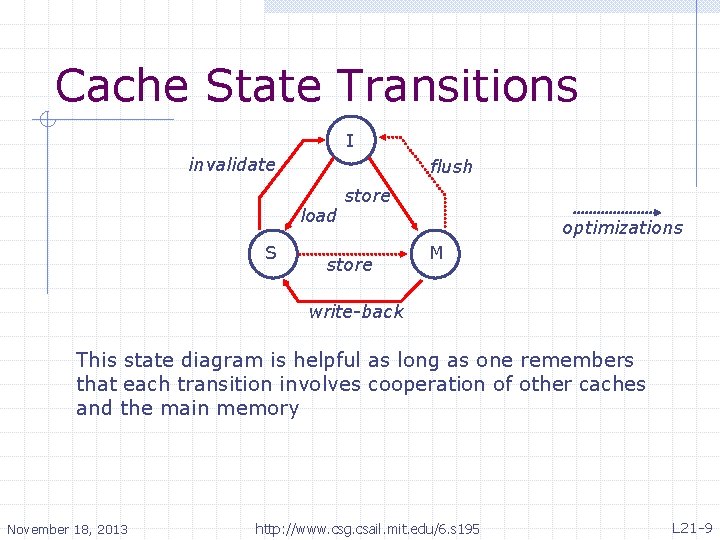
Cache State Transitions I invalidate flush load S store optimizations M write-back This state diagram is helpful as long as one remembers that each transition involves cooperation of other caches and the main memory November 18, 2013 http: //www. csg. csail. mit. edu/6. s 195 L 21 -9
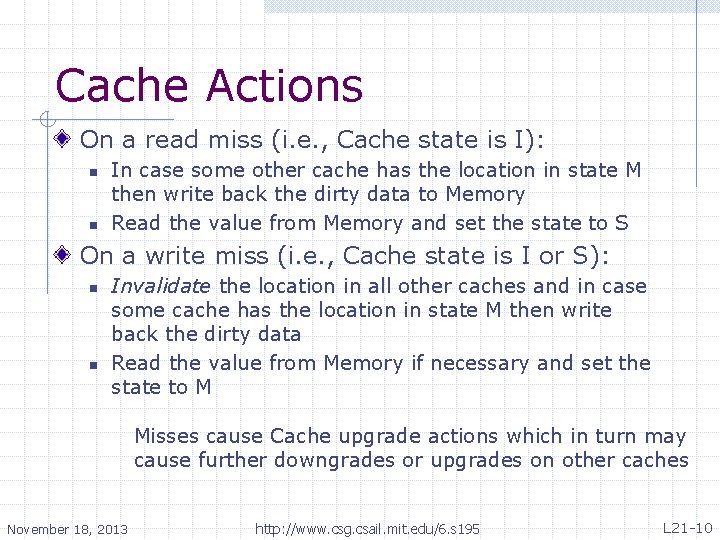
Cache Actions On a read miss (i. e. , Cache state is I): n n In case some other cache has the location in state M then write back the dirty data to Memory Read the value from Memory and set the state to S On a write miss (i. e. , Cache state is I or S): n n Invalidate the location in all other caches and in case some cache has the location in state M then write back the dirty data Read the value from Memory if necessary and set the state to M Misses cause Cache upgrade actions which in turn may cause further downgrades or upgrades on other caches November 18, 2013 http: //www. csg. csail. mit. edu/6. s 195 L 21 -10
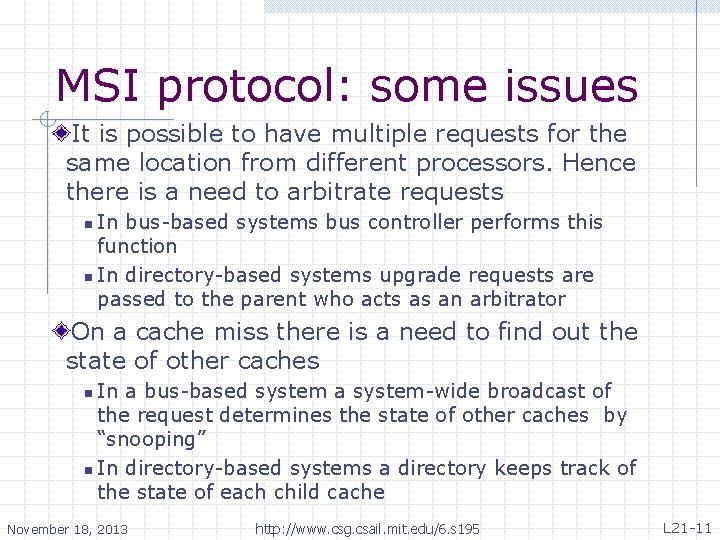
MSI protocol: some issues It is possible to have multiple requests for the same location from different processors. Hence there is a need to arbitrate requests In bus-based systems bus controller performs this function n In directory-based systems upgrade requests are passed to the parent who acts as an arbitrator n On a cache miss there is a need to find out the state of other caches In a bus-based system a system-wide broadcast of the request determines the state of other caches by “snooping” n In directory-based systems a directory keeps track of the state of each child cache n November 18, 2013 http: //www. csg. csail. mit. edu/6. s 195 L 21 -11
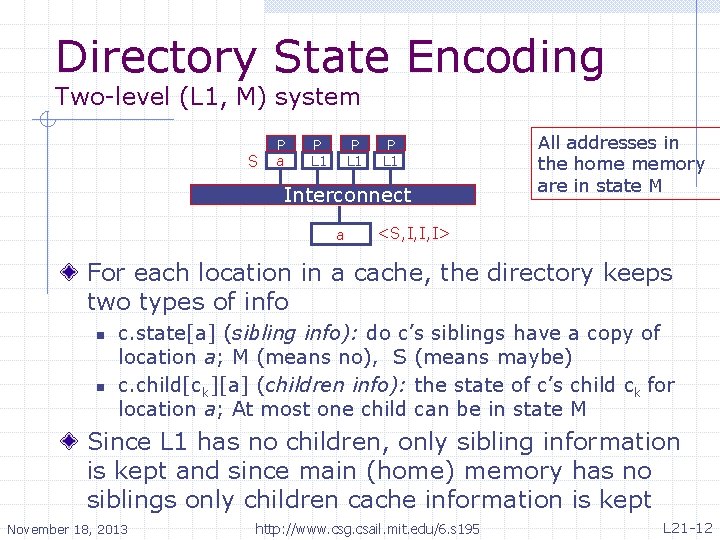
Directory State Encoding Two-level (L 1, M) system S P a P L 1 Interconnect a All addresses in the home memory are in state M <S, I, I, I> For each location in a cache, the directory keeps two types of info n n c. state[a] (sibling info): do c’s siblings have a copy of location a; M (means no), S (means maybe) c. child[ck][a] (children info): the state of c’s child ck for location a; At most one child can be in state M Since L 1 has no children, only sibling information is kept and since main (home) memory has no siblings only children cache information is kept November 18, 2013 http: //www. csg. csail. mit. edu/6. s 195 L 21 -12
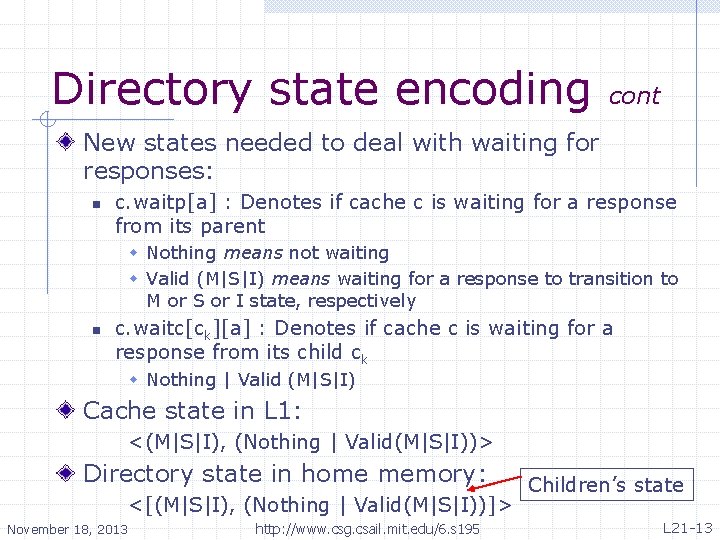
Directory state encoding cont New states needed to deal with waiting for responses: n c. waitp[a] : Denotes if cache c is waiting for a response from its parent w Nothing means not waiting w Valid (M|S|I) means waiting for a response to transition to M or S or I state, respectively n c. waitc[ck][a] : Denotes if cache c is waiting for a response from its child ck w Nothing | Valid (M|S|I) Cache state in L 1: <(M|S|I), (Nothing | Valid(M|S|I))> Directory state in home memory: <[(M|S|I), (Nothing | Valid(M|S|I))]> November 18, 2013 http: //www. csg. csail. mit. edu/6. s 195 Children’s state L 21 -13
A Directory-based Protocol an abstract view P p 2 m PP L 1 P m 2 p c 2 m interconnect m 2 p c 2 m m 2 c in p 2 m PP out PP m Each cache has 2 pairs of queues n (c 2 m, m 2 c) to communicate with the memory n (p 2 m, m 2 p) to communicate with the processor Message format: <cmd, src dst, a, s, data> Req/Resp address state FIFO message passing between each (src dst) pair except a Resp cannot block a Req November 18, 2013 L 1 http: //www. csg. csail. mit. edu/6. s 195 L 21 -14
Processor Hit Rules Load-hit rule p 2 m. msg=(Load a) & (c. state[a]>I) p 2 m. deq; m 2 p. enq(c. data[a]); Store-hit rule p 2 m. msg=(Store a v) & c. state[a]=M p 2 m. deq; m 2 p. enq(Ack); c. data[a]: =v; November 18, 2013 P p 2 m L 1 PP m 2 p c 2 m m 2 c The miss rules are taken care of by the general cache rules to be presented http: //www. csg. csail. mit. edu/6. s 195 L 21 -15
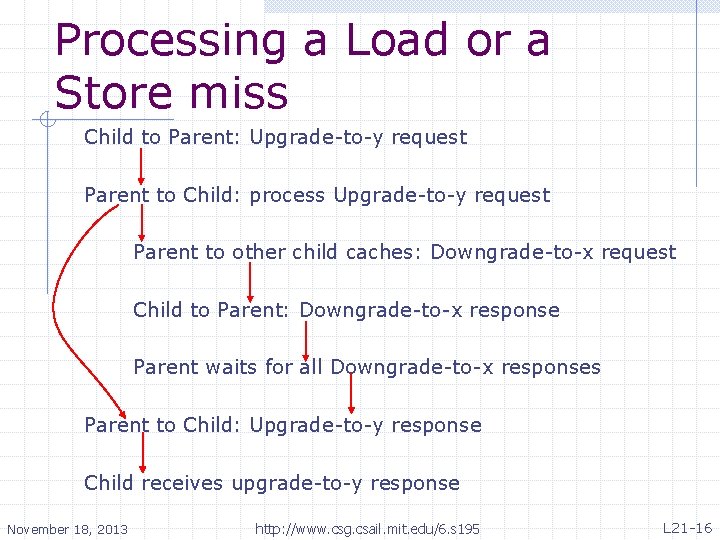
Processing a Load or a Store miss Child to Parent: Upgrade-to-y request Parent to Child: process Upgrade-to-y request Parent to other child caches: Downgrade-to-x request Child to Parent: Downgrade-to-x response Parent waits for all Downgrade-to-x responses Parent to Child: Upgrade-to-y response Child receives upgrade-to-y response November 18, 2013 http: //www. csg. csail. mit. edu/6. s 195 L 21 -16
Processing a Load miss L 1 to Parent: Upgrade-to-S request (c. state[a]=I) & (c. waitp[a]=Nothing) c. waitp[a]: =Valid S; c 2 m. enq(<Req, c m, a, S, - >); Parent to L 1: Upgrade-to-S response ( j, m. waitc[j][a]=Nothing) & c 2 m. msg=<Req, c m, a, S, -> & ( i≠c, Is. Compatible(m. child[i][a], S)) m 2 c. enq(<Resp, m c, a, S, m. data[a]>); m. child[c][a]: =S; c 2 m. deq L 1 receiving upgrade-to-S response m 2 c. msg=<Resp, m c, a, S, data> m 2 c. deq; c. data[a]: =data; c. state[a]: =S; c. waitp[a]: =Nothing; November 18, 2013 http: //www. csg. csail. mit. edu/6. s 195 L 21 -17
Processing Load miss cont. What if ( i≠c, Is. Compatible(m. child[i][a], y)) is false? Downgrade other child caches Parent to L 1: Upgrade-to-S response ( j, m. waitc[j][a]=Nothing) & c 2 m. msg=<Req, c m, a, S, -> & ( i≠c, Is. Compatible(m. child[i][a], S)) m 2 c. enq(<Resp, m c, a, S, m. data[a]>); m. child[c][a]: =S; c 2 m. deq Parent to Child: Downgrade to S request c 2 m. msg=<Req, c m, a, S, -> & (m. child[i][a]>S) & (m. waitc[i][a]=Nothing) m. waitc[i][a]: =Valid S; m 2 c. enq(<Req, m i, a, S, - >); November 18, 2013 http: //www. csg. csail. mit. edu/6. s 195 L 21 -18
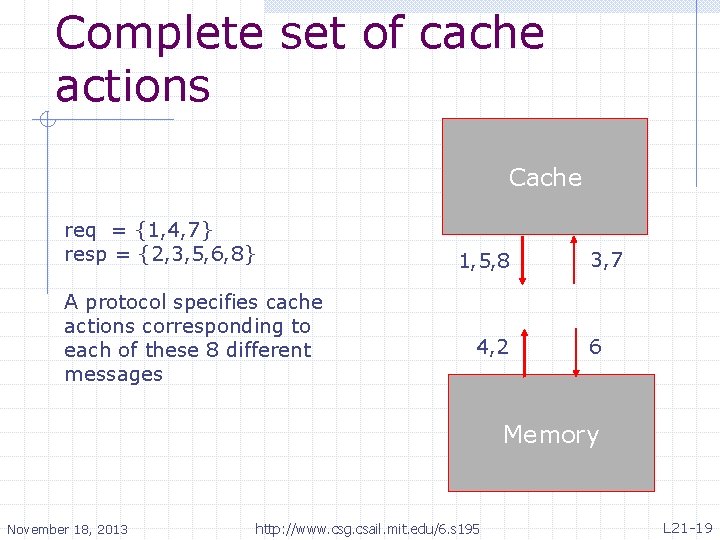
Complete set of cache actions Cache req = {1, 4, 7} resp = {2, 3, 5, 6, 8} A protocol specifies cache actions corresponding to each of these 8 different messages 1, 5, 8 4, 2 3, 7 6 Memory November 18, 2013 http: //www. csg. csail. mit. edu/6. s 195 L 21 -19
Child Requests 1. Child to Parent: Upgrade-to-y Request (c. state[a]<y) & (c. waitp[a]=Nothing) c. waitp[a]: =Valid y; c 2 m. enq(<Req, c m, a, y, - >); November 18, 2013 http: //www. csg. csail. mit. edu/6. s 195 L 21 -20
Parent Responds 2. Parent to Child: Upgrade-to-y response ( j, m. waitc[j][a]=Nothing) & c 2 m. msg=<Req, c m, a, y, -> & (m. child[c][a]<y) & ( i≠c, Is. Compatible(m. child[i][a], y)) m 2 c. enq(<Resp, m c, a, y, (if (m. child[c][a]=I) then m. data[a] else -)>); m. child[c][a]: =y; c 2 m. deq; November 18, 2013 http: //www. csg. csail. mit. edu/6. s 195 L 21 -21
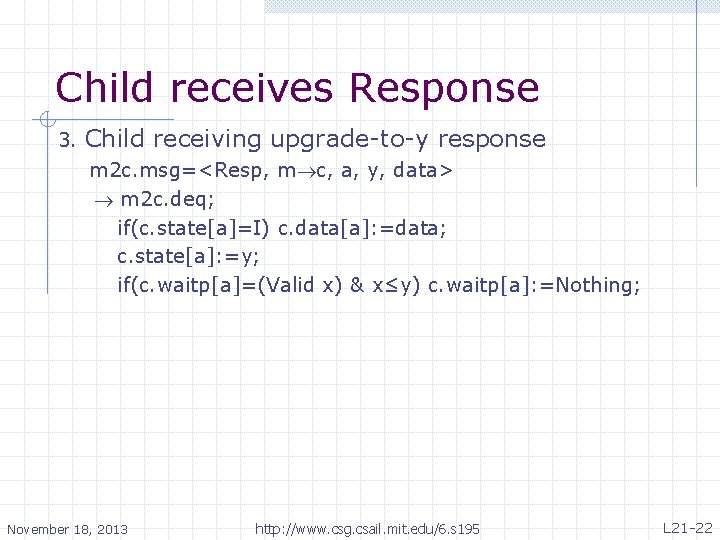
Child receives Response 3. Child receiving upgrade-to-y response m 2 c. msg=<Resp, m c, a, y, data> m 2 c. deq; if(c. state[a]=I) c. data[a]: =data; c. state[a]: =y; if(c. waitp[a]=(Valid x) & x≤y) c. waitp[a]: =Nothing; November 18, 2013 http: //www. csg. csail. mit. edu/6. s 195 L 21 -22
Parent Requests 4. Parent to Child: Downgrade-to-y Request (m. child[i][a]>y) & (m. waitc[i][a]=Nothing) m. waitc[i][a]: =Valid y; m 2 c. enq(<Req, m c, a, y, - >); November 18, 2013 http: //www. csg. csail. mit. edu/6. s 195 L 21 -23
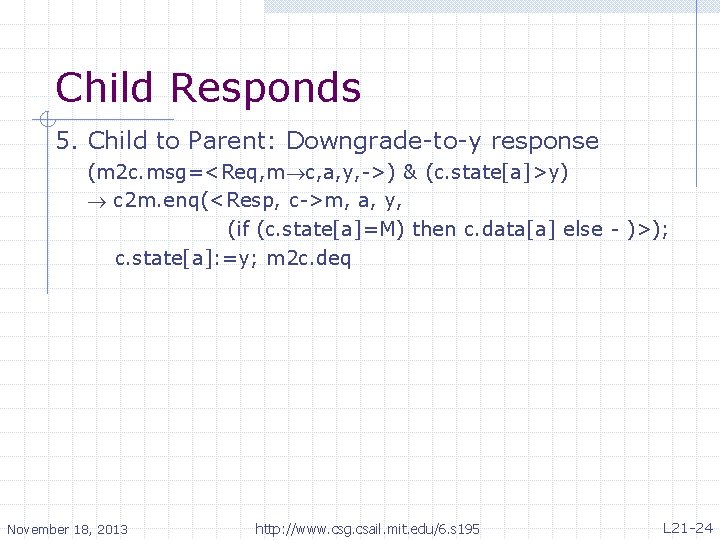
Child Responds 5. Child to Parent: Downgrade-to-y response (m 2 c. msg=<Req, m c, a, y, ->) & (c. state[a]>y) c 2 m. enq(<Resp, c->m, a, y, (if (c. state[a]=M) then c. data[a] else - )>); c. state[a]: =y; m 2 c. deq November 18, 2013 http: //www. csg. csail. mit. edu/6. s 195 L 21 -24
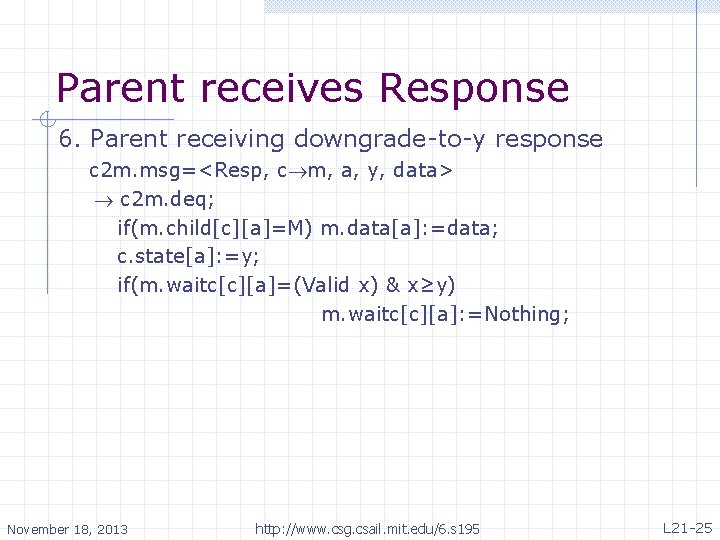
Parent receives Response 6. Parent receiving downgrade-to-y response c 2 m. msg=<Resp, c m, a, y, data> c 2 m. deq; if(m. child[c][a]=M) m. data[a]: =data; c. state[a]: =y; if(m. waitc[c][a]=(Valid x) & x≥y) m. waitc[c][a]: =Nothing; November 18, 2013 http: //www. csg. csail. mit. edu/6. s 195 L 21 -25
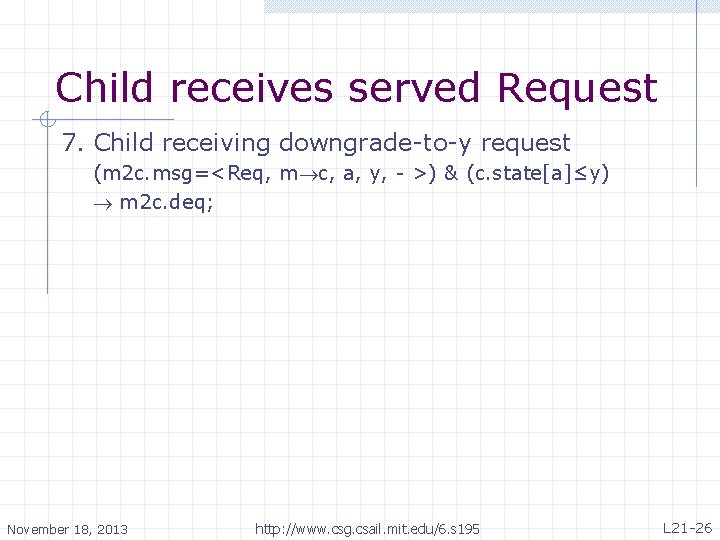
Child receives served Request 7. Child receiving downgrade-to-y request (m 2 c. msg=<Req, m c, a, y, - >) & (c. state[a]≤y) m 2 c. deq; November 18, 2013 http: //www. csg. csail. mit. edu/6. s 195 L 21 -26
Child Voluntarily downgrades 8. Child to Parent: Downgrade-to-y response (vol) (c. waitp[a]=Nothing) & (c. state[a]>y) c 2 m. enq(<Resp, c->m, a, y, (if (c. state[a]=M) then c. data[a] else - )>); c. state[a]: =y; November 18, 2013 http: //www. csg. csail. mit. edu/6. s 195 L 21 -27
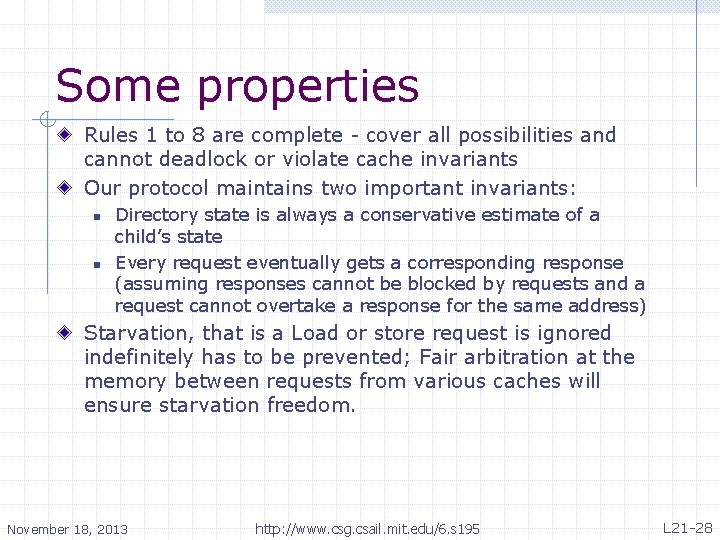
Some properties Rules 1 to 8 are complete - cover all possibilities and cannot deadlock or violate cache invariants Our protocol maintains two important invariants: n n Directory state is always a conservative estimate of a child’s state Every request eventually gets a corresponding response (assuming responses cannot be blocked by requests and a request cannot overtake a response for the same address) Starvation, that is a Load or store request is ignored indefinitely has to be prevented; Fair arbitration at the memory between requests from various caches will ensure starvation freedom. November 18, 2013 http: //www. csg. csail. mit. edu/6. s 195 L 21 -28
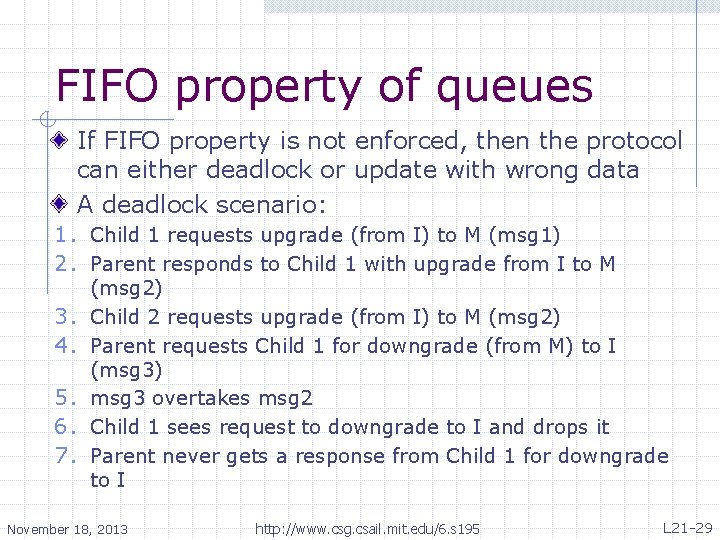
FIFO property of queues If FIFO property is not enforced, then the protocol can either deadlock or update with wrong data A deadlock scenario: 1. Child 1 requests upgrade (from I) to M (msg 1) 2. Parent responds to Child 1 with upgrade from I to M 3. 4. 5. 6. 7. (msg 2) Child 2 requests upgrade (from I) to M (msg 2) Parent requests Child 1 for downgrade (from M) to I (msg 3) msg 3 overtakes msg 2 Child 1 sees request to downgrade to I and drops it Parent never gets a response from Child 1 for downgrade to I November 18, 2013 http: //www. csg. csail. mit. edu/6. s 195 L 21 -29
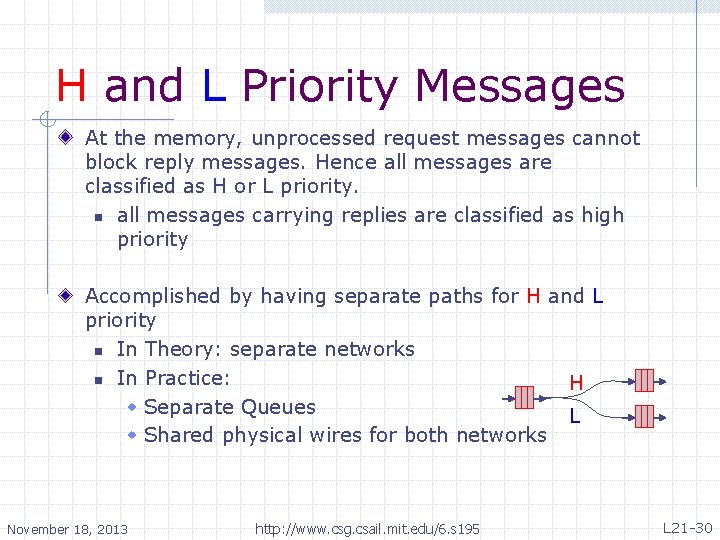
H and L Priority Messages At the memory, unprocessed request messages cannot block reply messages. Hence all messages are classified as H or L priority. n all messages carrying replies are classified as high priority Accomplished by having separate paths for H and L priority n In Theory: separate networks n In Practice: H w Separate Queues L w Shared physical wires for both networks November 18, 2013 http: //www. csg. csail. mit. edu/6. s 195 L 21 -30