
CONSTRUCTIVE ALIGNMENT TEACHING APPROACHES STRATEGIES METHODS ACTIVITIES A

![Student-Centered Instruction [SCI] • is an instructional approach in which students influence the content,](https://slidetodoc.com/presentation_image_h2/86ae6c10f0a9918bd2ee2b02821bdf61/image-4.jpg "Student-Centered Instruction [SCI] • is an instructional approach in which students influence the content,")
![Student-Centered Instruction [SCI] • The SCI approach includes assigning open-ended problems and problems requiring](https://slidetodoc.com/presentation_image_h2/86ae6c10f0a9918bd2ee2b02821bdf61/image-5.jpg "Student-Centered Instruction [SCI] • The SCI approach includes assigning open-ended problems and problems requiring")
- Slides: 20
CONSTRUCTIVE ALIGNMENT
TEACHING APPROACHES, STRATEGIES, METHODS, ACTIVITIES ‘A THOUSAND TEACHERS A THOUSAND METHODS’ CHINESE PROVERB
Student-Centered Instruction [SCI] • is an instructional approach in which students influence the content, activities, materials, and pace of learning. • This learning model places the student (learner) in the center of the learning process. • The instructor provides students with opportunities to learn independently and from one another and coaches them in the skills they need to do so effectively.
Student-Centered Instruction [SCI] • The SCI approach includes assigning open-ended problems and problems requiring critical or creative thinking that cannot be solved by following text examples, involving students in simulations and role plays, and using self-paced and/or cooperative (teambased) learning. Properly implemented SCI can lead to increased motivation to learn, greater retention of knowledge, deeper understanding, and more positive attitudes towards the subject being taught (Collins & O'Brien, 2003).
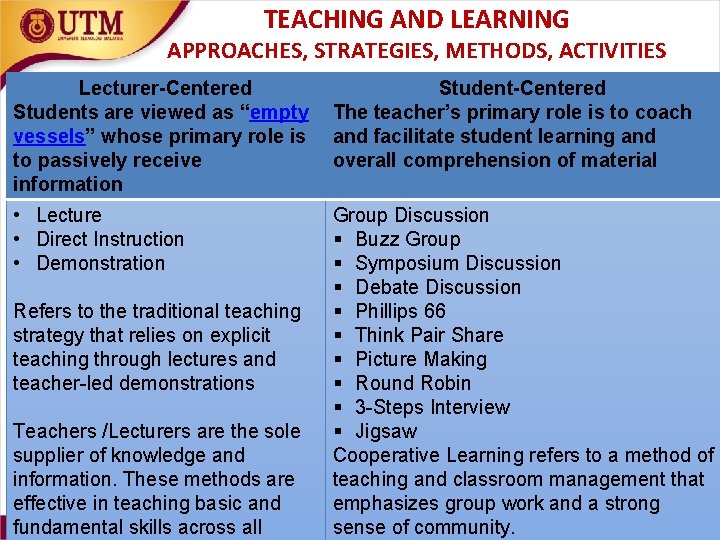
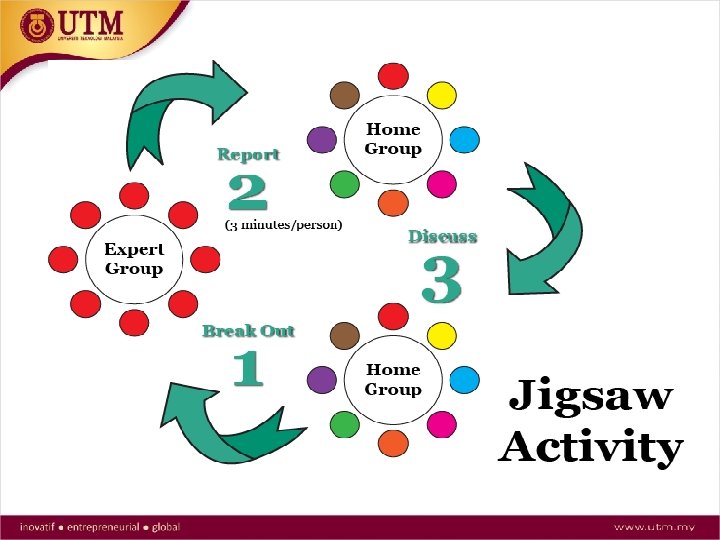
TEACHING AND LEARNING APPROACHES, STRATEGIES, METHODS, ACTIVITIES Lecturer-Centered Students are viewed as “empty vessels” whose primary role is to passively receive information Student-Centered The teacher’s primary role is to coach and facilitate student learning and overall comprehension of material • Lecture • Direct Instruction • Demonstration Group Discussion § Buzz Group § Symposium Discussion § Debate Discussion § Phillips 66 § Think Pair Share § Picture Making § Round Robin § 3 -Steps Interview § Jigsaw Cooperative Learning refers to a method of teaching and classroom management that emphasizes group work and a strong sense of community. Refers to the traditional teaching strategy that relies on explicit teaching through lectures and teacher-led demonstrations Teachers /Lecturers are the sole supplier of knowledge and information. These methods are effective in teaching basic and fundamental skills across all
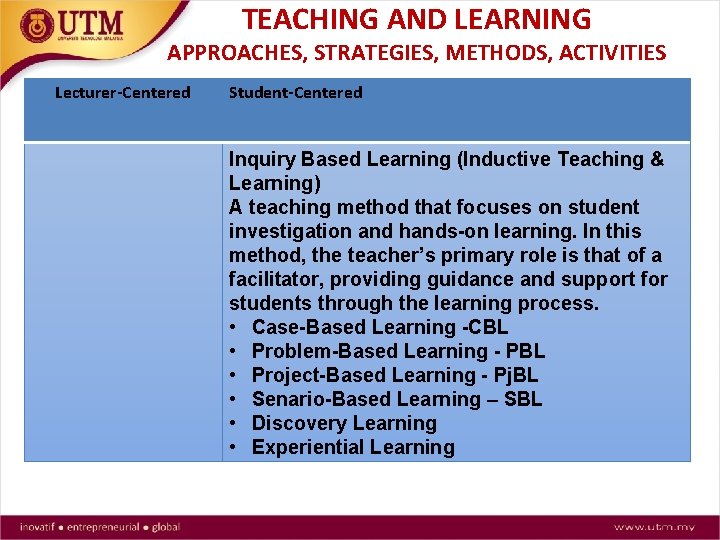
TEACHING AND LEARNING APPROACHES, STRATEGIES, METHODS, ACTIVITIES Lecturer-Centered Student-Centered Inquiry Based Learning (Inductive Teaching & Learning) A teaching method that focuses on student investigation and hands-on learning. In this method, the teacher’s primary role is that of a facilitator, providing guidance and support for students through the learning process. • Case-Based Learning -CBL • Problem-Based Learning - PBL • Project-Based Learning - Pj. BL • Senario-Based Learning – SBL • Discovery Learning • Experiential Learning
Lecture • Students concentration during presentations often declines after 15 minutes. • Break for : – – – A Think Pair Share activities Buzz Group 3 step interview Phillips 66 A concept test
Group Discussion Factors Affecting Group Discussion • • • Size of the group Cliques Within a Group Personal Goals of Members: Physical Environment Seating Arrangement Time for Discussion
Group Discussion Six attributes of effective small group activities : • • • Interesting topic Clearly defined Sequenced Well paced Flexible Participative
Group Discussion Preparing A Group Discussion • Choose A Topic: A topic for group discussion should be interesting, significant, and manageable. • Decide What Type of Question to Discuss: Topic chosen should be worded in the form of a question. • Word the Question Carefully: Once the question is formed, then narrow it down by wording it in clear, concise, and unbiased language. • Prepare an Outline: To keep the group moving toward its goal. • Research A Topic: All members doing research on the topic before the discussion takes place
Buzz Group • A buzz group is a small group, consisting of three to six people who are given an assignment to complete in a short time period. Generally, each buzz group records their output then reports to the larger group. Can be used : • Build an agenda. • Serve as an icebreaker • Solve problems • Share ideas • Generate lists. • Reflect and review. Evaluate an activity or process. Warm up a group to a new topic. Address a topic from a new perspective. Generate ideas Gather feedback
Think Pair Share • Pose the problem and have students work on it individually for a short time • Then have them form pairs and reconcile and improve their solutions • and finally call on several individuals or pairs to share their responses. Note : This structure takes a bit more time than a simple group activity, but it includes individual thinking and so leads to greater learning.
Symposium Discussion • A discussion in which the topic is broken its various phases. • Each part is presented by an expert / person well informed on their particular phase in a brief and consice speech [The group consist of 3 -4 members, discuss and plan the outline] • Audience direct questions to proper symposium members • The leader summarizes
Phillips 66 • • It’s a spontaneous method Where 6 students view their opinions on a topic For 6 minutes Randomly call any students to share their ideas / solutions
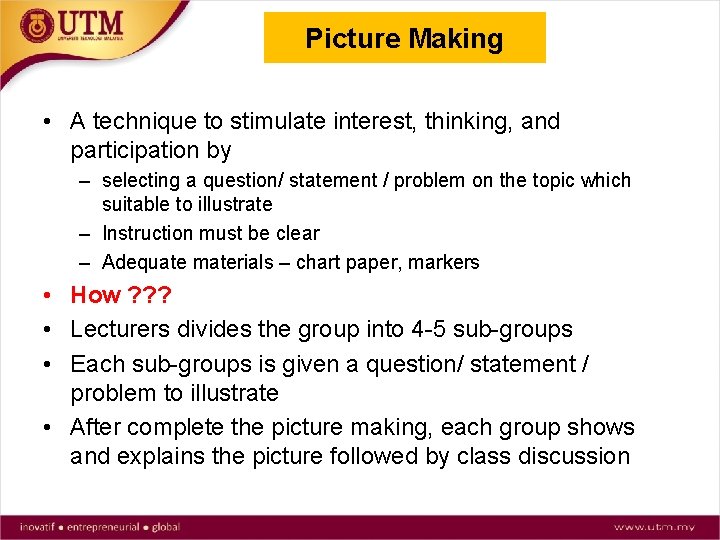
Picture Making • A technique to stimulate interest, thinking, and participation by – selecting a question/ statement / problem on the topic which suitable to illustrate – Instruction must be clear – Adequate materials – chart paper, markers • How ? ? ? • Lecturers divides the group into 4 -5 sub-groups • Each sub-groups is given a question/ statement / problem to illustrate • After complete the picture making, each group shows and explains the picture followed by class discussion
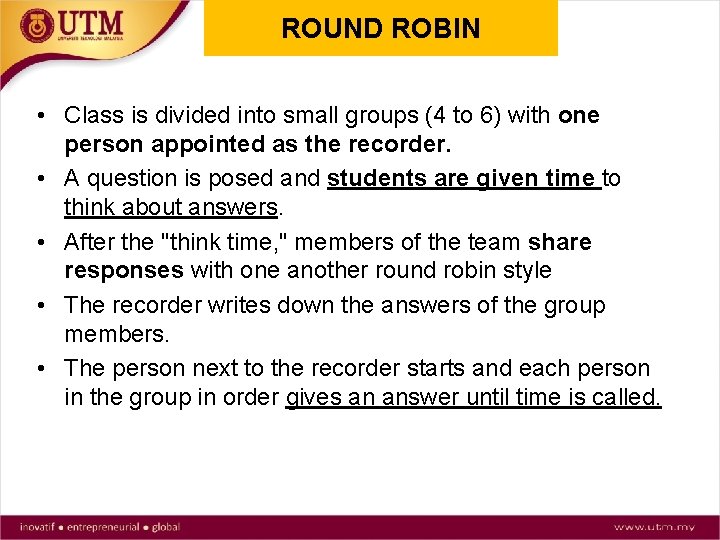
ROUND ROBIN • Class is divided into small groups (4 to 6) with one person appointed as the recorder. • A question is posed and students are given time to think about answers. • After the "think time, " members of the team share responses with one another round robin style • The recorder writes down the answers of the group members. • The person next to the recorder starts and each person in the group in order gives an answer until time is called.
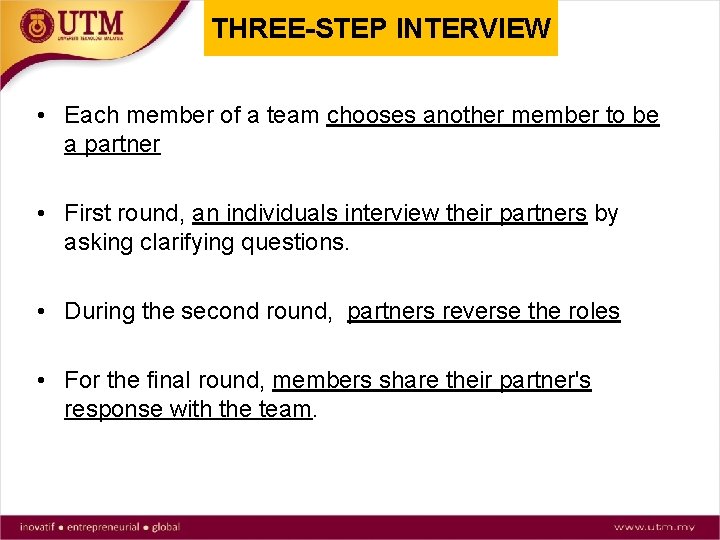
THREE-STEP INTERVIEW • Each member of a team chooses another member to be a partner • First round, an individuals interview their partners by asking clarifying questions. • During the second round, partners reverse the roles • For the final round, members share their partner's response with the team.