
Construction Studies Project Guidelines for students Introduction Project


- Slides: 17
Construction Studies Project Guidelines for students
Introduction ® Project is 25% of the leaving cert exam. ® 150 marks allocated ® There is no “brief” given by the exam commission. Instead a project which is related to the syllabus is selected by the student.
Instructions to Candidates ® Given to students each year ® Contains rules and regulations for project work ® Gives closing date ® May vary slightly from year to year.
PROJEC T TYPES
Project Types ® Three main categories: ® Practical craft ® Building science ® Written/drawn with scale model
Project Types ® Practical craft Articles of furniture ® Construction trade/skills ® l ® Plumbing, joinery, plastering, electrical, etc Heritage l Restoration, reproduction and traditional craft skills
Practical Craft ® Full- scale project work ® Full scale trade skills, ie. Bricklaying, plastering etc. are difficult to achieve here due to lack of space & facilities. ® More emphasis on the artefact than the folio.
Project Types ® Building Science ® Construction models ® New technologies ® Investigative
Building Science ® Construction ® models: Analysing any area or building construction: l l l l l Groundwork Foundations Walls Floors Roofs Windows & doors Heating & plumbing Electrical Drainage & waste treatment Any combination of areas
Building Science ® New Technologies ® Projects looking at new methods of building construction: Timber frame ® Solar power ® Underfloor heating ®
Building Science ® Investigative ® Projects analysing materials or components involved in building construction: Concrete production ® Heat loss & insulation ® Lighting ® Sound and sound insulation ® Soil mechanics ®
Project Types ® Written drawn ® Architectural: ® Projects looking at the design of buildings: l l l ® domestic, industrial, commercial Famous landmarks Architectural styles (e. g. georgian) Civil engineering: ® ® ® with scale model Bridges, roads, canals railways Specific engineering projects (e. g. channel tunnel) Interior design: ® Architecture and design of interior spaces l l Kitchen design Disabled access
PROJECT SELECTION
Project Selection ® How to decide on what to do…. . List your areas of interest ® Look for advice: ® ® ® Past students Teachers Family & friends Set yourself goals to achieve: ® ® ® Grade/points needed for college. Experience in an area of construction. Personal achievement
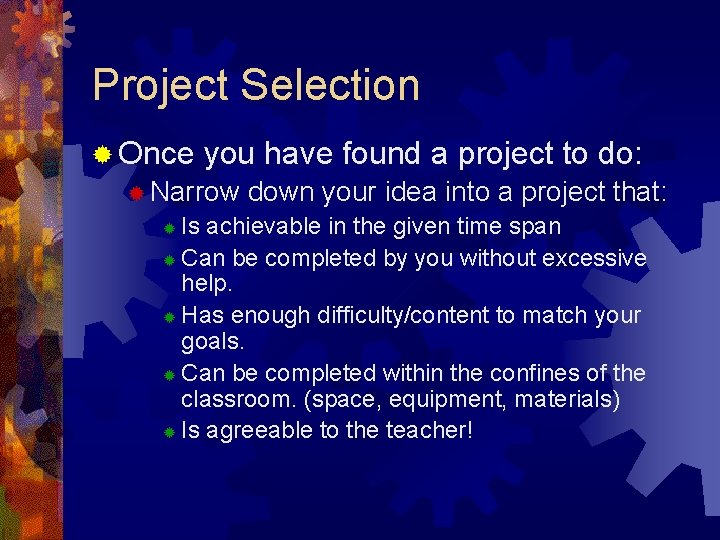
Project Selection ® Once you have found a project to do: ® Narrow down your idea into a project that: Is achievable in the given time span ® Can be completed by you without excessive help. ® Has enough difficulty/content to match your goals. ® Can be completed within the confines of the classroom. (space, equipment, materials) ® Is agreeable to the teacher! ®
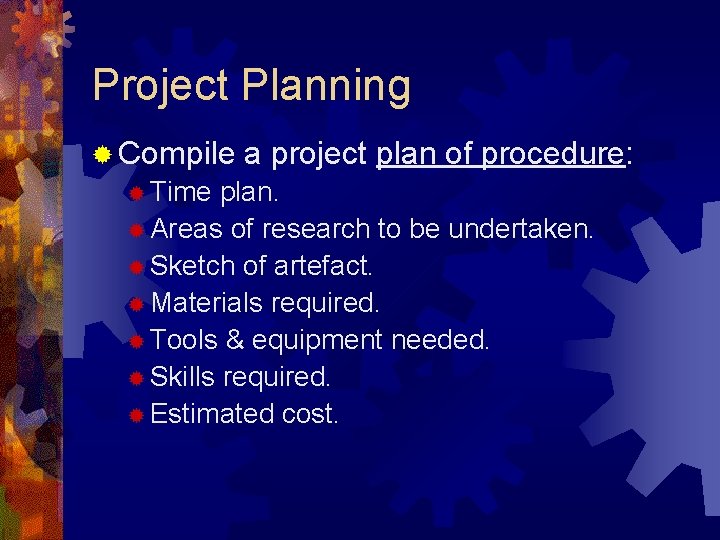
Project Planning ® Compile ® Time a project plan of procedure: plan. ® Areas of research to be undertaken. ® Sketch of artefact. ® Materials required. ® Tools & equipment needed. ® Skills required. ® Estimated cost.
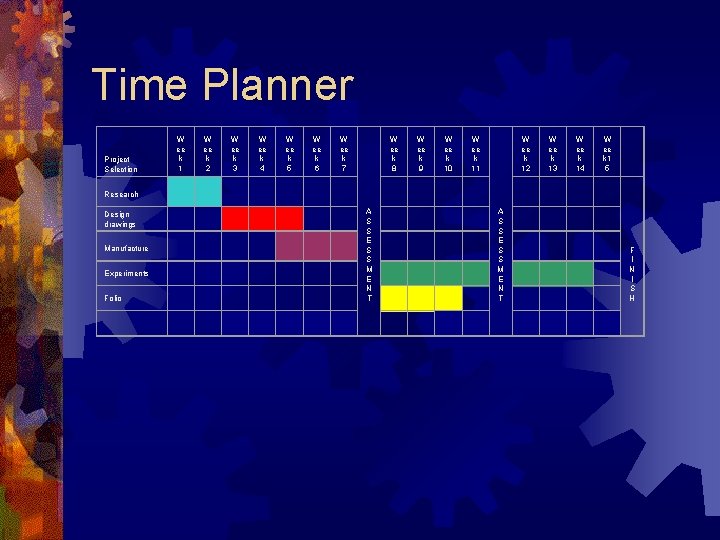
Time Planner Project Selection W ee k 1 W ee k 2 W ee k 3 W ee k 4 W ee k 5 W ee k 6 W ee k 7 W ee k 8 W ee k 9 W ee k 10 W ee k 11 W ee k 12 W ee k 13 W ee k 14 W ee k 1 5 Research Design drawings Manufacture Experiments Folio A S S E S S M E N T F I N I S H