
Construction Standards Working Group Construction Good Practice Standards

- Slides: 19
Construction Standards Working Group Construction Good Practice Standards COMMON STANDARDS FOR THE RESPONSIBLE DELIVERY OF BUILDING CONSTRUCTION IN HUMANITARIAN SETTINGS 2020 ACHIEVEMENTS AND 2021 OUTLOOK
Thank you for joining We will begin the webinar soon. . ﺳﻨﺒﺪﺃ ﻓﻲ ﻧﺪﻭﺓ ﺍﻟﻮﻳﺐ ﻗﺮﻳﺒﺎ Nous allons commencer le webinaire bientôt. Comenzaremos el seminario web pronto Please set your microphone to ‘mute’. Por favor, ajuste el micrófono a 'silencio’. S’il vous plaît définir votre microphone pour « mute » . “ ﺍﻟﺮﺟﺎﺀ ﺿﺒﻂ ﺍﻟﻤﻴﻜﺮﻭﻓﻮﻥ ﻋﻠﻰ "ﻛﺘﻢ ﺍﻟﺼﻮﺕ We are recording this webinar. Estamos grabando este webinar. Nous allons enregistrer ce webinaire. . ﻧﺤﻦ ﻧﺴﺠﻞ ﻫﺬﺍ ﺍﻟﻨﺪﻭﺓ Type your name and office in the chat box ﺍﻛﺘﺐ ﺍﺳﻤﻚ ﻭﻣﻜﺘﺒﻚ ﻓﻲ ﻣﺮﺑﻊ ﺍﻟﺪﺭﺩﺷﺔ. Tapez votre nom et votre bureau dans la boîte de chat. Escriba su nombre y oficina en el cuadro de chat Construction Policy Introduction and Update
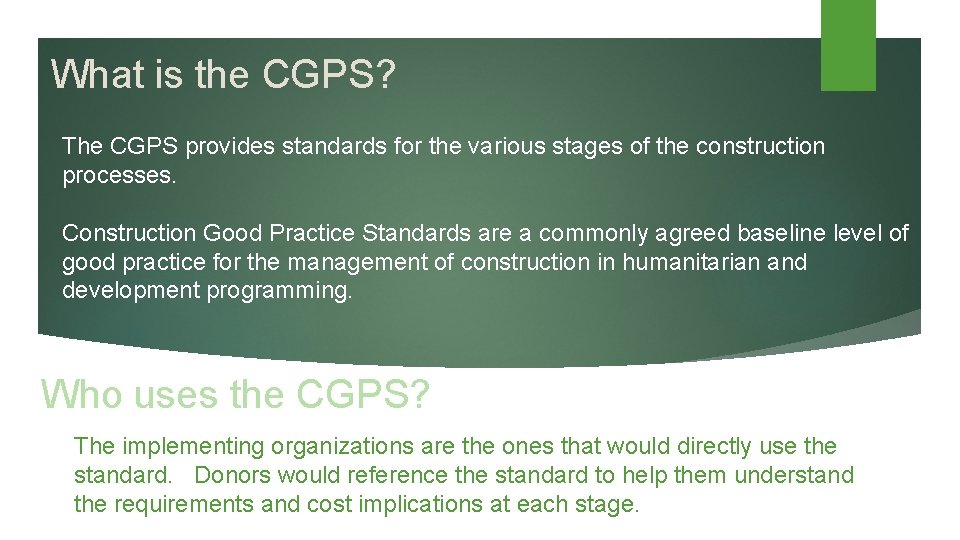
What is the CGPS? The CGPS provides standards for the various stages of the construction processes. Construction Good Practice Standards are a commonly agreed baseline level of good practice for the management of construction in humanitarian and development programming. Who uses the CGPS? The implementing organizations are the ones that would directly use the standard. Donors would reference the standard to help them understand the requirements and cost implications at each stage.
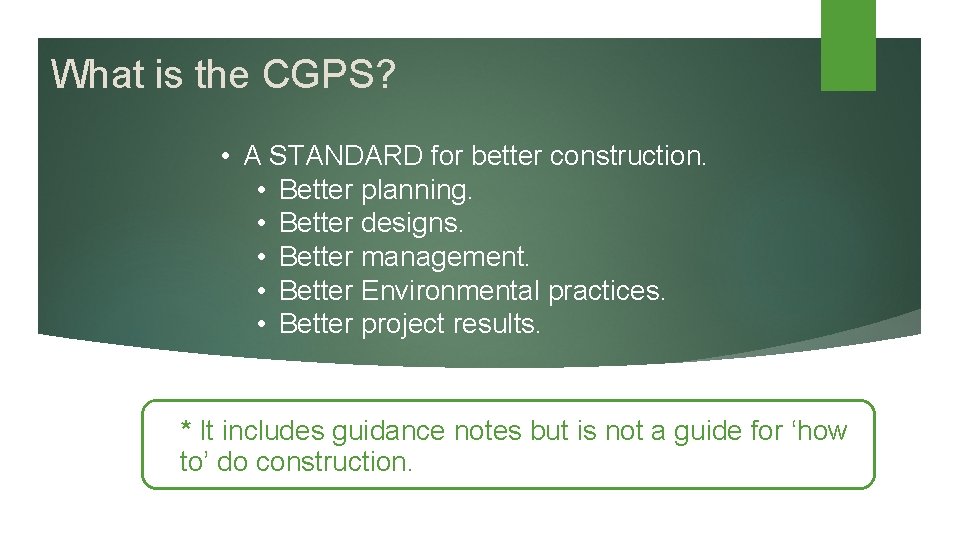
What is the CGPS? • A STANDARD for better construction. • Better planning. • Better designs. • Better management. • Better Environmental practices. • Better project results. * It includes guidance notes but is not a guide for ‘how to’ do construction.
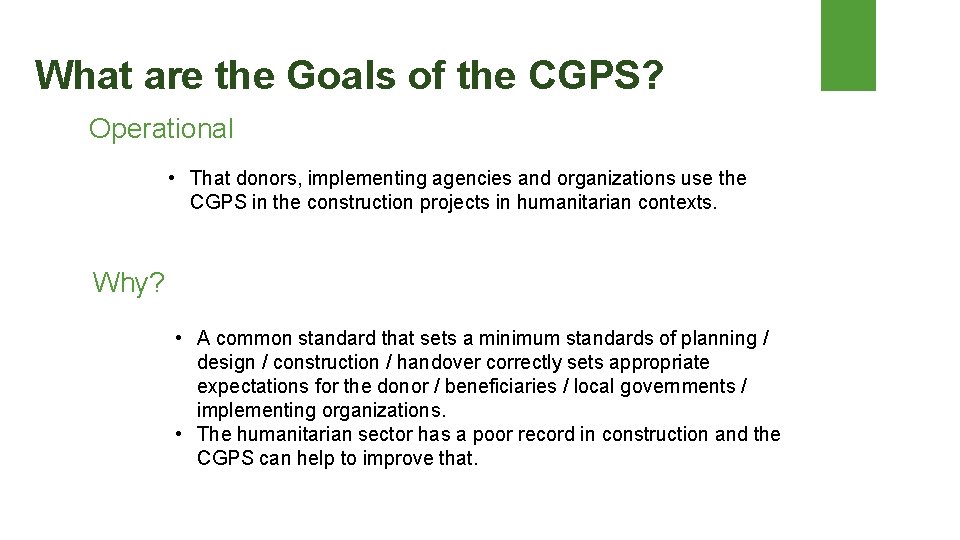
What are the Goals of the CGPS? Operational • That donors, implementing agencies and organizations use the CGPS in the construction projects in humanitarian contexts. Why? • A common standard that sets a minimum standards of planning / design / construction / handover correctly sets appropriate expectations for the donor / beneficiaries / local governments / implementing organizations. • The humanitarian sector has a poor record in construction and the CGPS can help to improve that.
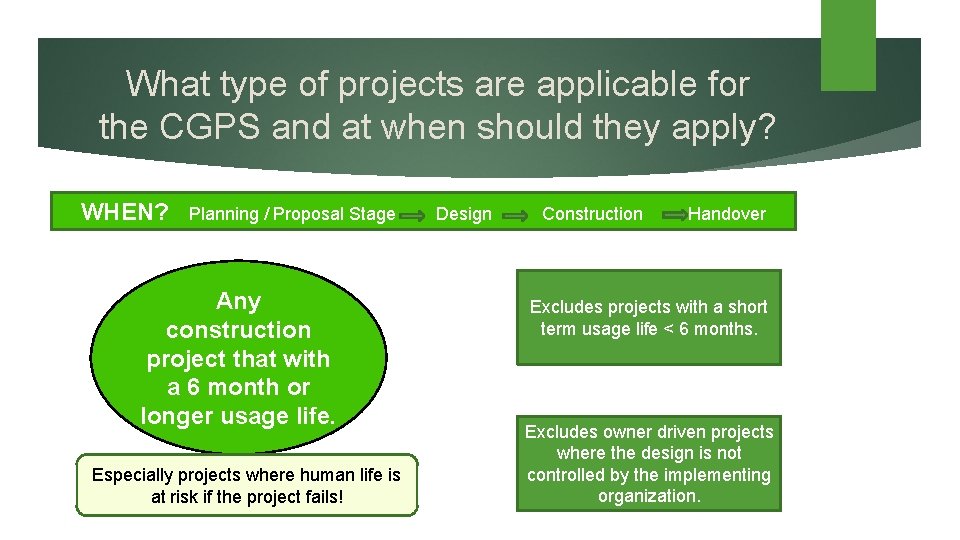
What type of projects are applicable for the CGPS and at when should they apply? WHEN? Planning / Proposal Stage Any construction project that with a 6 month or longer usage life. Especially projects where human life is at risk if the project fails! Design Construction Handover Excludes projects with a short term usage life < 6 months. Excludes owner driven projects where the design is not controlled by the implementing organization.
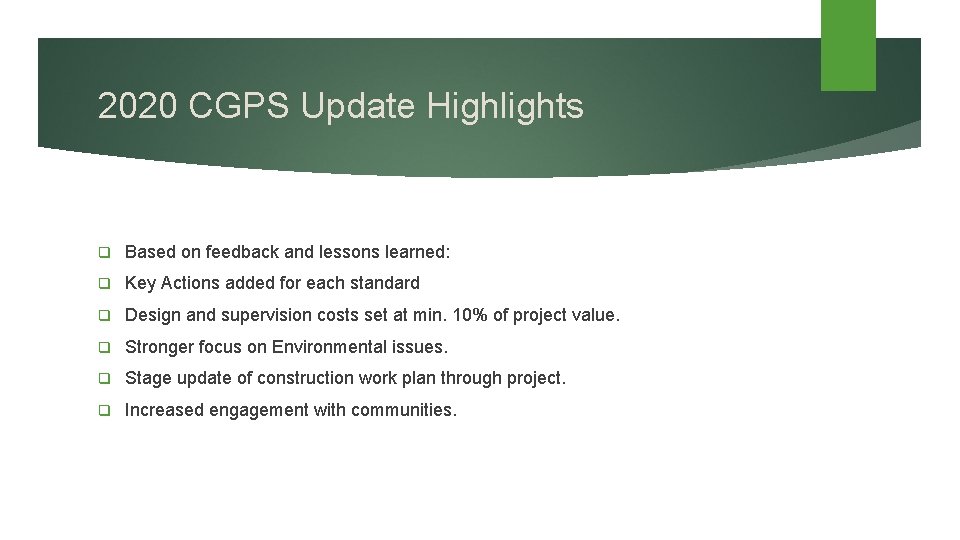
2020 CGPS Update Highlights q Based on feedback and lessons learned: q Key Actions added for each standard q Design and supervision costs set at min. 10% of project value. q Stronger focus on Environmental issues. q Stage update of construction work plan through project. q Increased engagement with communities.
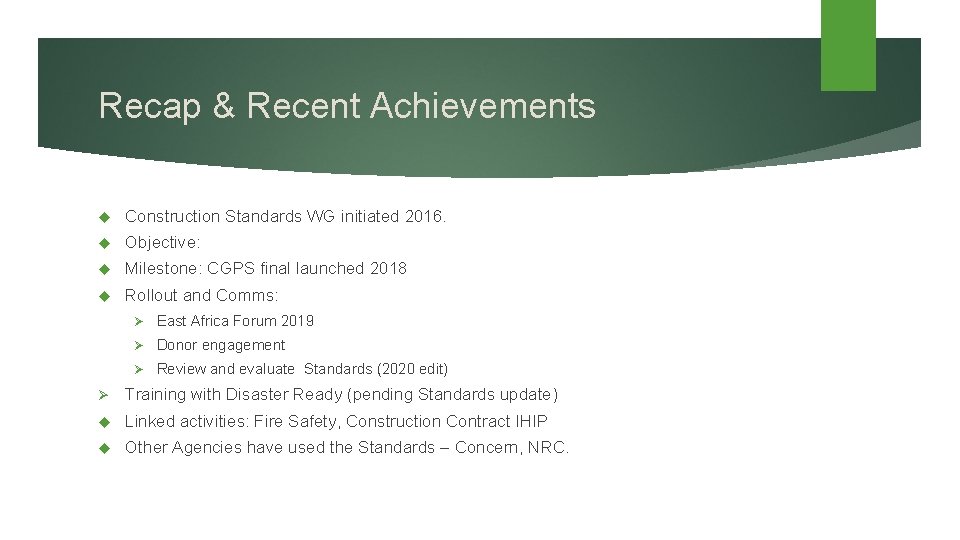
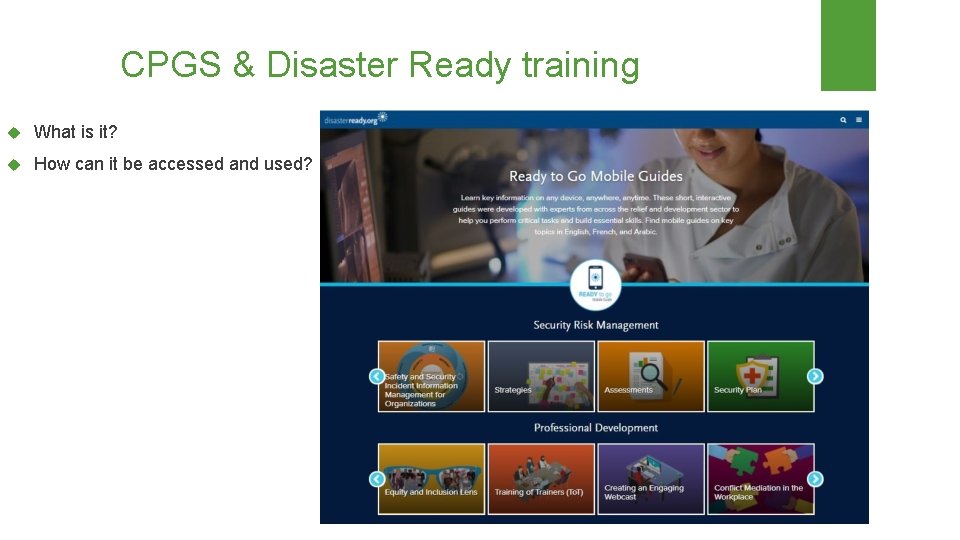
Recap & Recent Achievements Construction Standards WG initiated 2016. Objective: Milestone: CGPS final launched 2018 Rollout and Comms: Ø East Africa Forum 2019 Ø Donor engagement Ø Review and evaluate Standards (2020 edit) Ø Training with Disaster Ready (pending Standards update) Linked activities: Fire Safety, Construction Contract IHIP Other Agencies have used the Standards – Concern, NRC.
CPGS & Disaster Ready training What is it? How can it be accessed and used?
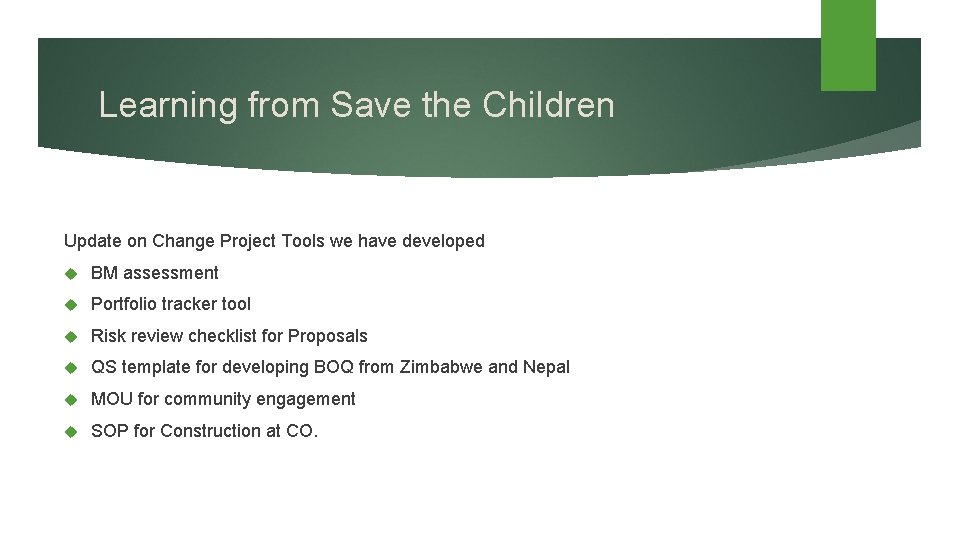
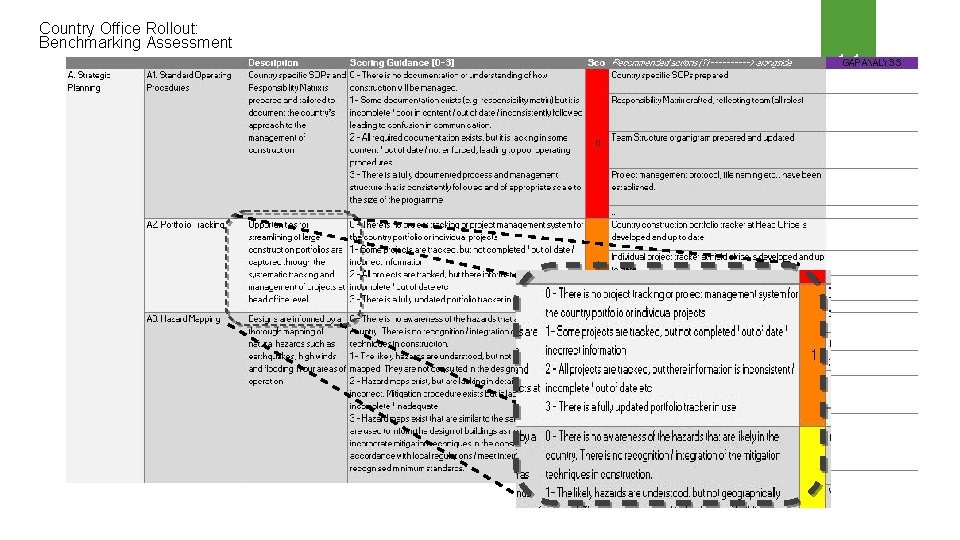
Learning from Save the Children Update on Change Project Tools we have developed BM assessment Portfolio tracker tool Risk review checklist for Proposals QS template for developing BOQ from Zimbabwe and Nepal MOU for community engagement SOP for Construction at CO.
Country Office Rollout: Benchmarking Assessment 11
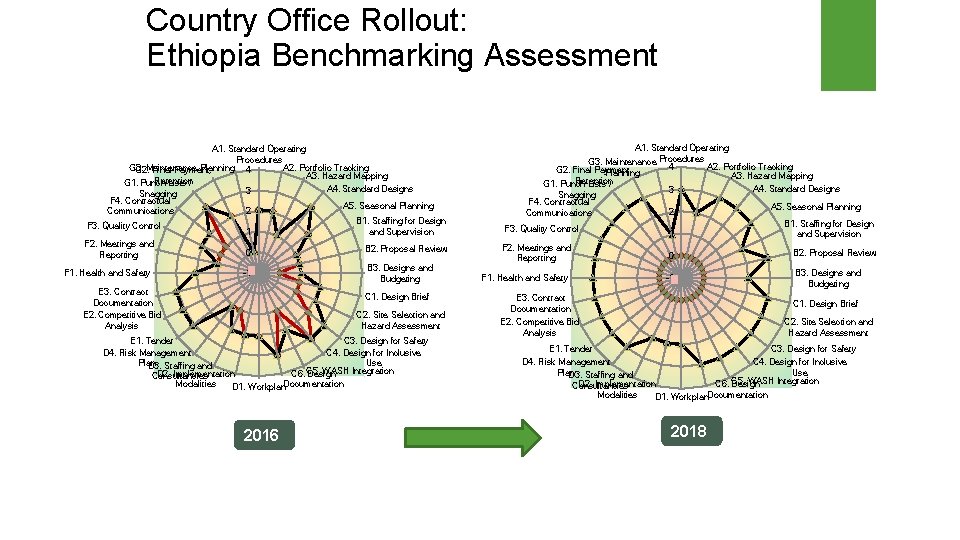
Country Office Rollout: Ethiopia Benchmarking Assessment A 1. Standard Operating Procedures G 3. Planning 4 A 2. Portfolio Tracking G 2. Maintenance Final Payment, A 3. Hazard Mapping Retention G 1. Punch Lists / A 4. Standard Designs 3 Snagging F 4. Contractual A 5. Seasonal Planning Communications 2 B 1. Staffing for Design F 3. Quality Control and Supervision 1 F 2. Meetings and B 2. Proposal Review 0 Reporting B 3. Designs and F 1. Health and Safety -1 Budgeting E 3. Contract C 1. Design Brief Documentation E 2. Competitive Bid C 2. Site Selection and Analysis Hazard Assessment E 1. Tender C 3. Design for Safety D 4. Risk Management C 4. Design for Inclusive Plan Use D 3. Staffing and WASH Integration D 2. Implementation C 6. C 5. Design Consultancies Modalities D 1. Workplan. Documentation 2016 A 1. Standard Operating G 3. Maintenance Procedures 4 A 2. Portfolio Tracking G 2. Final Payment, Planning A 3. Hazard Mapping Retention G 1. Punch Lists / A 4. Standard Designs 3 Snagging F 4. Contractual A 5. Seasonal Planning 2 Communications B 1. Staffing for Design F 3. Quality Control 1 and Supervision F 2. Meetings and B 2. Proposal Review 0 Reporting F 1. Health and Safety -1 E 3. Contract Documentation E 2. Competitive Bid Analysis B 3. Designs and Budgeting C 1. Design Brief C 2. Site Selection and Hazard Assessment E 1. Tender C 3. Design for Safety D 4. Risk Management C 4. Design for Inclusive Plan Use D 3. Staffing and C 5. WASH Integration D 2. Implementation C 6. Design Consultancies Modalities D 1. Workplan. Documentation 2018
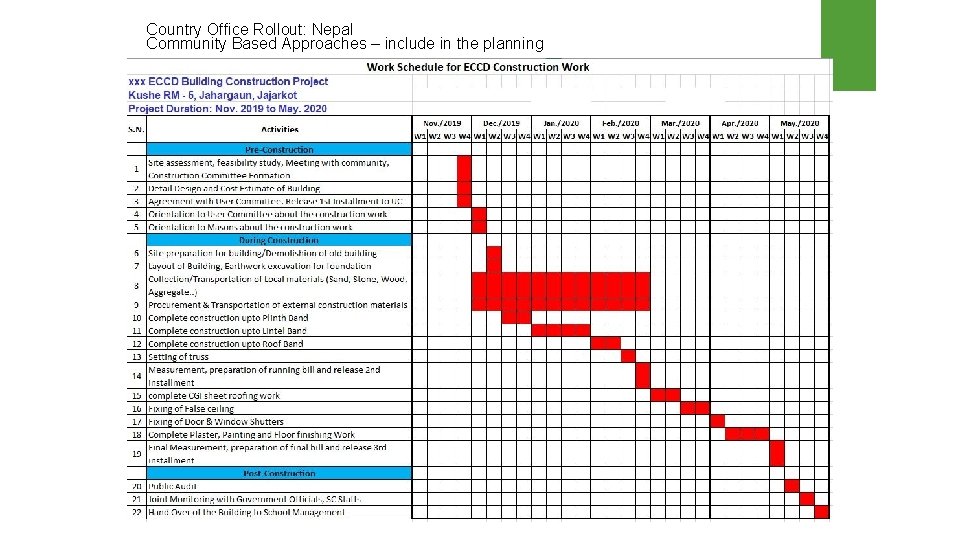
Country Office Rollout: Nepal Community Based Approaches – include in the planning
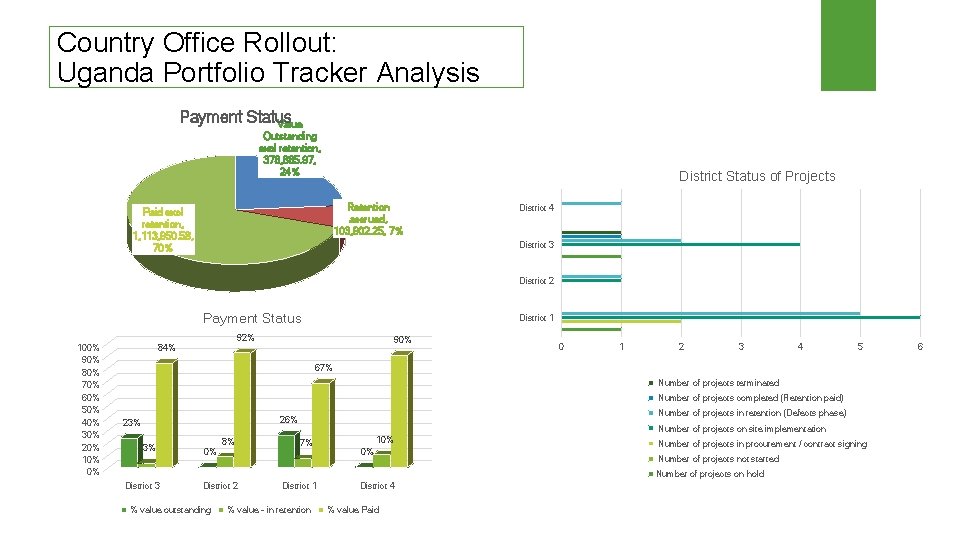
Country Office Rollout: Uganda Portfolio Tracker Analysis Payment Status Value Outstanding excl retention, 378, 885. 97, 24% District Status of Projects Retention accrued, 103, 902. 25, 7% Paid excl retention, 1, 113, 950. 58, 70% District 4 District 3 District 2 Payment Status 100% 90% 80% 70% 60% 50% 40% 30% 20% 10% 0% District 1 92% 84% 90% 0 1 2 3 4 5 67% Number of projects terminated Number of projects completed (Retention paid) Number of projects in retention (Defects phase) 26% 23% 3% 0% 8% Number of projects on site implementation 7% 10% 0% Number of projects in procurement / contract signing Number of projects not started Number of projects on hold District 3 District 2 % value outstanding District 1 % value - in retention District 4 % value Paid 6
Challenges to SCI embedding policy ØLACK OF CONSTRUCTION STAFF IN STRATEGIC ROLES AT RO AND CO > FOCAL POINT ESTABLISHED WITHIN RISK REVIEW PROCESS ØCOVID > REMOTE TRAINING AND ENGAGEMENT
Challenges to Global Standards rollout Other key clusters (WASH, Education, Health) are not engaging, this is seen as a ‘shelter document’ Donors not engaging in endorsing standards or adding conditions for safe construction (staffing, budgets, planning and design) Lack of understanding of the structural deficiencies within construction in the humanitarian world and what is needed to address them.
What next? q Finalise update Standards – seeking peer review volunteers q Launch training on Disaster Ready q Request to Donors for engagement on how to embed the Standards in your proposal guidance q Request to partners - let us know how you are using this q Develop inter-agency training on the different standards, link to modules that are relevant (e. g. Hazard mapping). q Promotion of the CGPS in your work and amongst others doing construction work in humanitarian contexts.
Open to Q & A Menti How to operationalise standards? (Sphere? Donor guidance? Etc) Documenting progress and lessons learned
PLEASE REGISTER YOUR INTEREST BY EMAILING: Join the CGPS mailing list! CONSTRUCTIONPRACTICEWG @GMAIL. COM Tell us a bit about yourself and how you participate in the world of construction in the humanitarian sector. We welcome diverse educational and work backgrounds and look forward to hearing from you!