
CONSTRUCTION ROBOTICS PATHWAY TO IMPLEMENTATION Name Roll no
CONSTRUCTION ROBOTICS ( PATHWAY TO IMPLEMENTATION ) Name : Roll no : AKULA PRAKASH 1005 -14 -741604
CONTENTS ü ü ü ü Introduction Literature review Applications Advantages and Disadvantages Case study Conclusions References
INTRODUCTION Ø Right from the existence of the mankind, the basic needs – food, clothing, and shelter lead to civilization. To satisfy these basic needs, construction of building, development of transportation, irrigation projects etc. , has taken place in the construction field as a part of civilization Ø “Yesterday’s technology is not the exact solution for tomorrow’s problem”. Ø Development of robotic systems for construction applications has advanced dramatically over the past few years
Definition : ü The term robot implies various meanings to different people. ü Technically robot can be defined as a re-programmable, multifunctional manipulator, designed to move materials, parts, tools, specialized devices, through variable programmed motions for the performance of a variety of tasks. ü According to Seward (1992), robot is an advanced automation and remote control devices used on the construction site or prefabrication work which are designed to increase speed and improve accuracy of construction field operations.
LITERATURE REVIEW � Whittaker reported that “Robots were emerging in construction as a way to increase productivity, improve quality and decrease hazard to human activities. The requirement for multiple capabilities at the automated work site must be served by multiple cooperative robot agents. ” � Skibniewski and Russell (1989) states that “with less optimistic estimates for construction robotics due to their complex operational environments, it can be anticipated that their application can result in approximately 1015% increase in overall construction productivity rate. ” � Furthermore, working in the construction industry can be an extremely dangerous occupation. Mac. Collum (1995) describes that the construction worker is five times more likely to be killed on the job than other workers. Bears (1999) states that robots can perform many of the more dangerous work operations without risk
Fabrid (1993) states that to date, however, few robotic applications are in actual field use, and implementation of both academic and commercial and computerized construction engineering and management systems in the industry has been rather slow. Lynch (1993) states that, there is an emphasis in transferring the advanced robotic technology to the civilian sector. Winston (2000) explains that the U. S. construction industry has also recently been concerned about the lack of skilled personnel. Shortages have become so severe that construction firms are using temporary labour agencies to fill the gaps when possible.
Goal of the automation : � Reports of the U. N. are showing a shortage of 600 million dwelling units throughout the world. � India produces 2 million homes as per a leading Indian economist, while United Nations reports that India produces 3. 3 million homes per year, which is far less than the requirement in India’s tenth plan. � We need to discover or invent a system that can produce houses at the desired speed. Next, we need to produce them at affordable costs if we are to address the working classes and others.
Objectives of construction robotics : � Identifying the work places where the robots can be implemented in the construction site, to bring awareness among the people about automation and robotics and to prove the beneficiaries. � Identify the parameters depending on the nature of building including the nature of the tasks to be performed. � Calculate the cost of robot using parameters, and � Develop the robotic system for full scale experimentation for realistic assessment of productivity.
APPLICATIONS Research work done by different scholars proved to be beneficial in various fields. Building robots have been employed in various useful tasks, including material handling, various interior and exterior finishing tasks and quality control • Exterior handling robots, which are employed in handling large loads such as concrete buckets, steel bars etc. , • Horizontal finishers, which are used for finishing floor surfaces like smoothing etc. , • Vertical finishers, which are used for finishing like painting or inspecting exterior walls • Interior finisher, which are used for various finishing and material handling tasks inside the building like painting masonry etc. , • Single task robots are used to complete concrete operations such as building form work, bending rebar, pouring and vibrating concrete, screeding etc. •
Cost elements for Robotic application : � Direct cost � Cost of materials � Cost of auxiliary manual labour � Cost of the robot movement between work stations � Cost of the robot positioning at each work station � Cost of the installation of the robot on the building site
Parameters determining the cost : � Parameters dependent on the robotic system include its cost, its work envelope (and then its covered area), its speed of movement and its mode of operation (extent of human control). � Parameters dependent on the nature of the building site include the nature of the tasks to be performed, their quality, the number of transfers between work sections and the locations / distribution of work in each section. � Parameters dependent on the task to be performed include the output per hour, the materials and the auxiliary works needed.
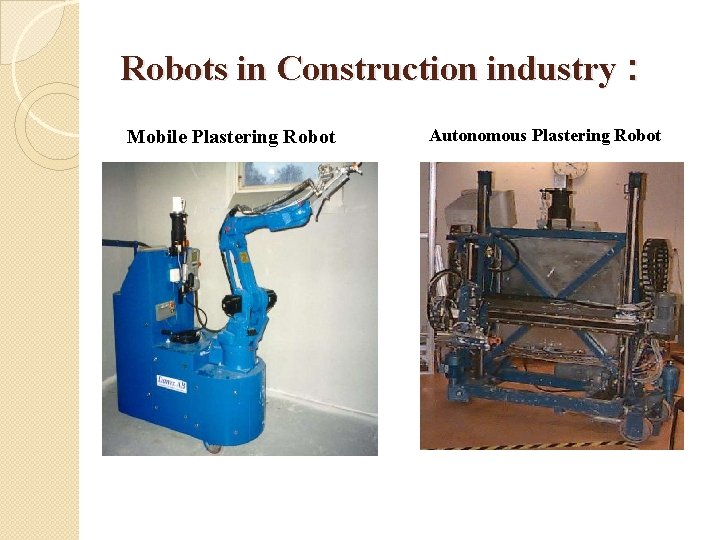
Robots in Construction industry : Mobile Plastering Robot Autonomous Plastering Robot
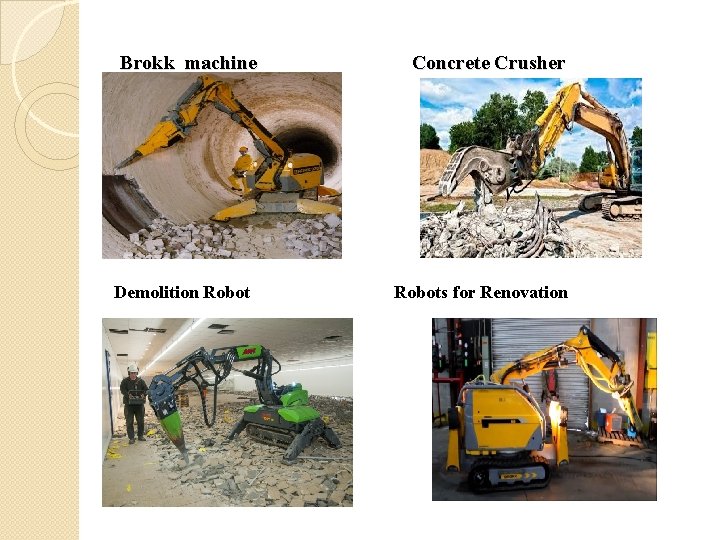
Brokk machine Demolition Robot Concrete Crusher Robots for Renovation
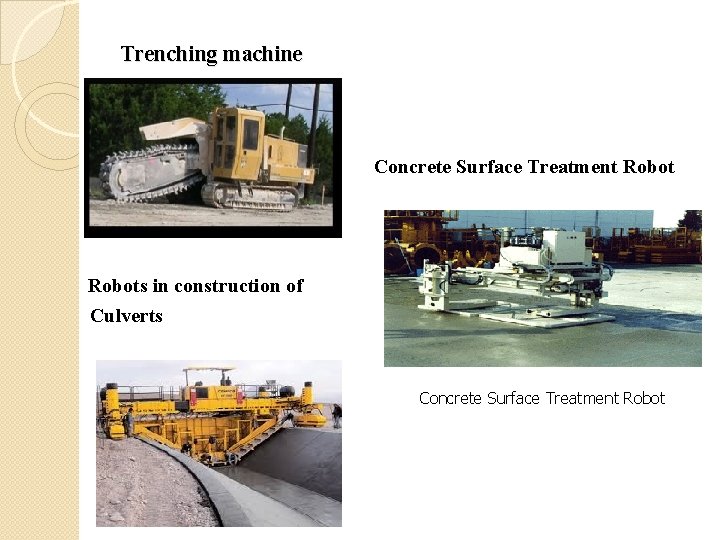
Trenching machine Concrete Surface Treatment Robots in construction of Culverts Concrete Surface Treatment Robot
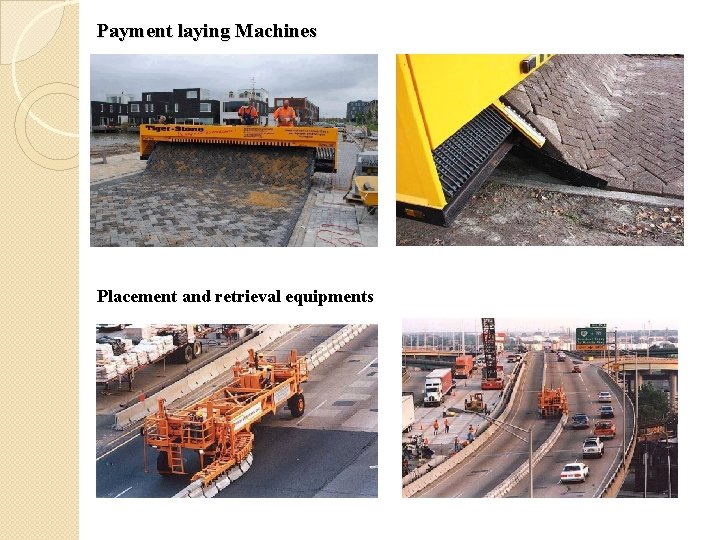
Payment laying Machines Placement and retrieval equipments
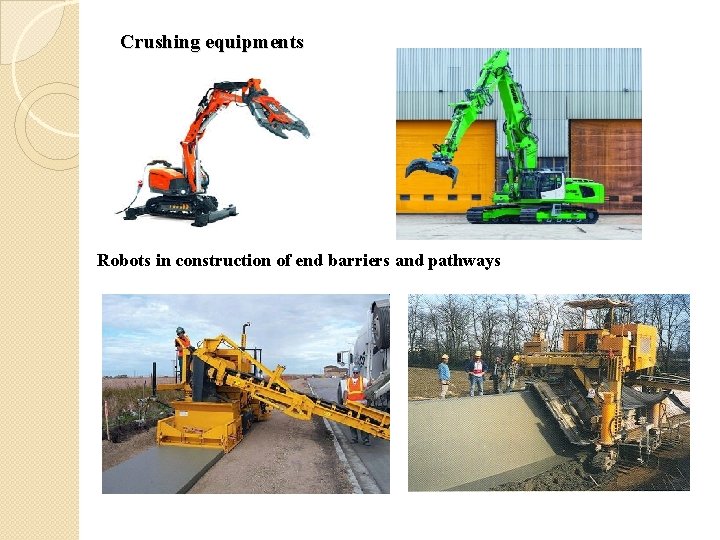
Crushing equipments Robots in construction of end barriers and pathways
CASE STUDY The Chennai shopping mall, Bhaghyanagar colony, Kukatpally, Hyderabad, Telangana. has been considered for the application of robotics in building construction. In this case study the robotics is applied only for plastering. • The study has been done by comparing the cost and time of the work actually done (plastering) by conventional method with the robot projected values of cost and time. the building has the following data regarding plastering. •
For walls : Plastering 20 mm thick in CM (1: 6 proportion) and CM (1: 4 proportion) for 1 st and 2 nd coat respectively with dubara sponge finishing including making 12 mm grooves on either side of the column and beams at the function of panel walls including cost and conveyance of all materials to side curing, scaffolding charges and all incidental and operational charges etc. , complete. For ceiling : Ceiling plastering 12 mm thick in CM (1: 5 proportions) and CM (1: 3 proportions) for 1 st and 2 nd coat respectively with dubara sponge finishing including cost and conveyance of all materials to site, curing, scaffolding charges and all incidental and operational charges etc. , complete.
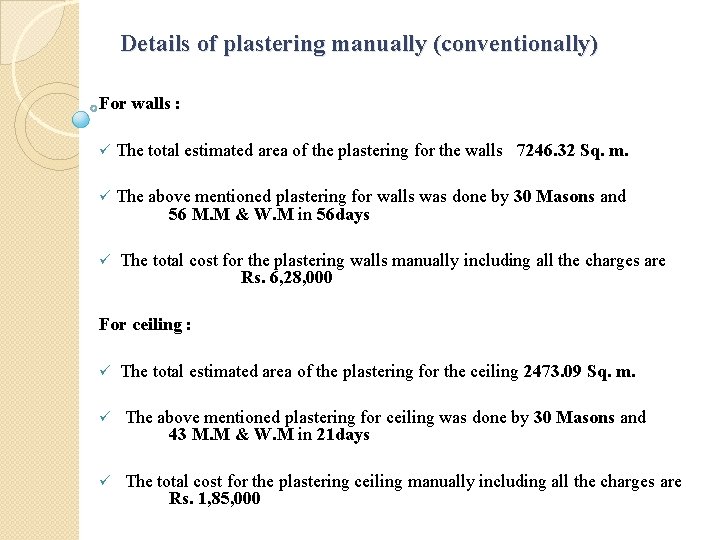
Details of plastering manually (conventionally) For walls : ü The total estimated area of the plastering for the walls 7246. 32 Sq. m. ü The above mentioned plastering for walls was done by 30 Masons and 56 M. M & W. M in 56 days ü The total cost for the plastering walls manually including all the charges are Rs. 6, 28, 000 For ceiling : ü The total estimated area of the plastering for the ceiling 2473. 09 Sq. m. ü The above mentioned plastering for ceiling was done by 30 Masons and 43 M. M & W. M in 21 days ü The total cost for the plastering ceiling manually including all the charges are Rs. 1, 85, 000
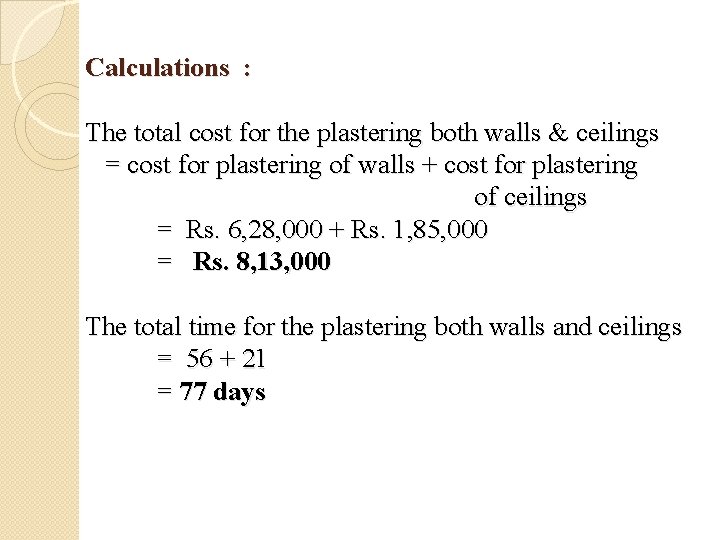
Calculations : The total cost for the plastering both walls & ceilings = cost for plastering of walls + cost for plastering of ceilings = Rs. 6, 28, 000 + Rs. 1, 85, 000 = Rs. 8, 13, 000 The total time for the plastering both walls and ceilings = 56 + 21 = 77 days
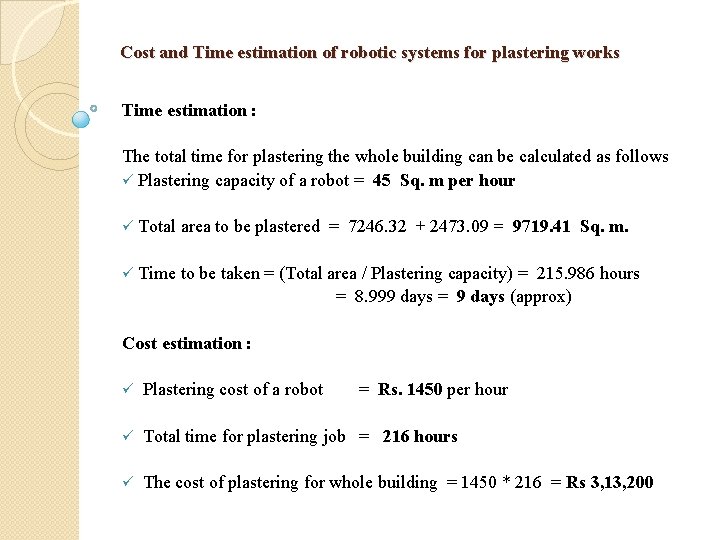
Cost and Time estimation of robotic systems for plastering works Time estimation : The total time for plastering the whole building can be calculated as follows ü Plastering capacity of a robot = 45 Sq. m per hour ü Total area to be plastered = 7246. 32 + 2473. 09 = 9719. 41 Sq. m. ü Time to be taken = (Total area / Plastering capacity) = 215. 986 hours = 8. 999 days = 9 days (approx) Cost estimation : ü Plastering cost of a robot = Rs. 1450 per hour ü Total time for plastering job = 216 hours ü The cost of plastering for whole building = 1450 * 216 = Rs 3, 13, 200
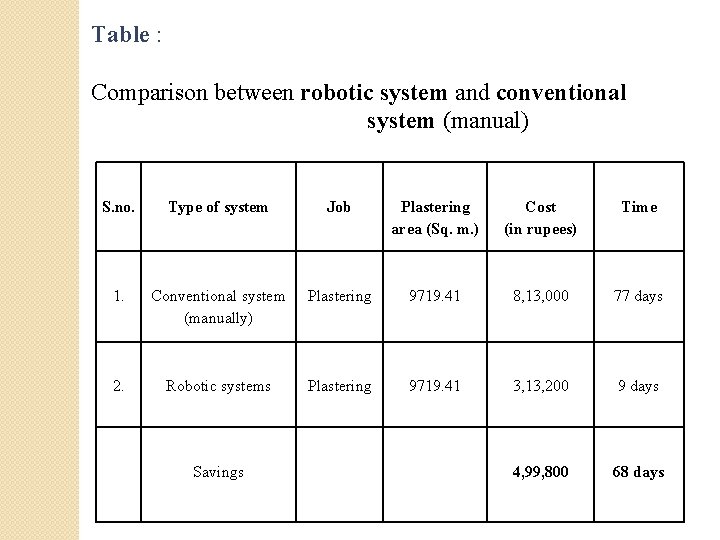
Table : Comparison between robotic system and conventional system (manual) S. no. Type of system Job Plastering area (Sq. m. ) Cost (in rupees) Time 1. Conventional system (manually) Plastering 9719. 41 8, 13, 000 77 days 2. Robotic systems Plastering 9719. 41 3, 13, 200 9 days 4, 99, 800 68 days Savings
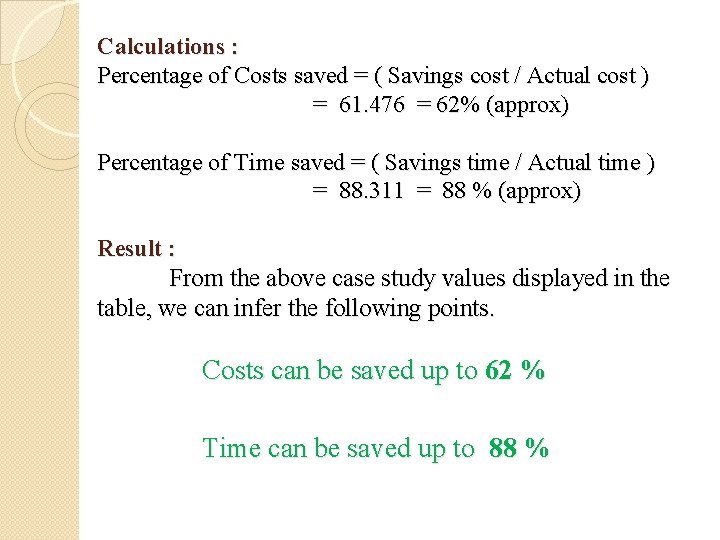
Calculations : Percentage of Costs saved = ( Savings cost / Actual cost ) = 61. 476 = 62% (approx) Percentage of Time saved = ( Savings time / Actual time ) = 88. 311 = 88 % (approx) Result : From the above case study values displayed in the table, we can infer the following points. Costs can be saved up to 62 % Time can be saved up to 88 %
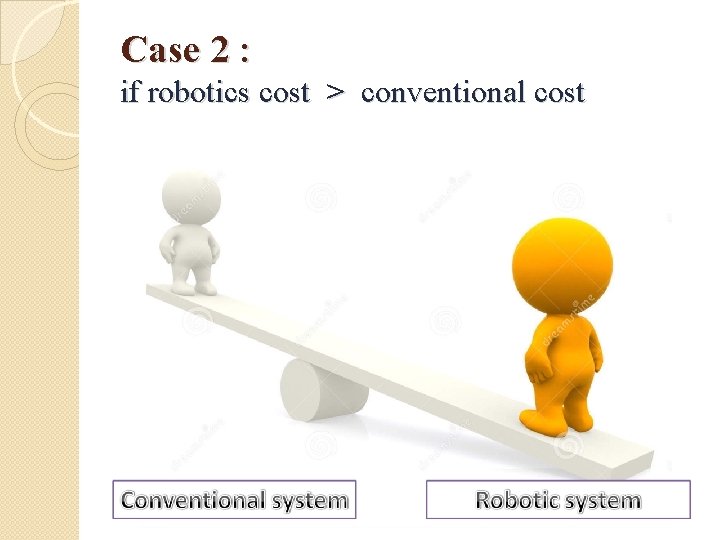
Case 2 : if robotics cost > conventional cost
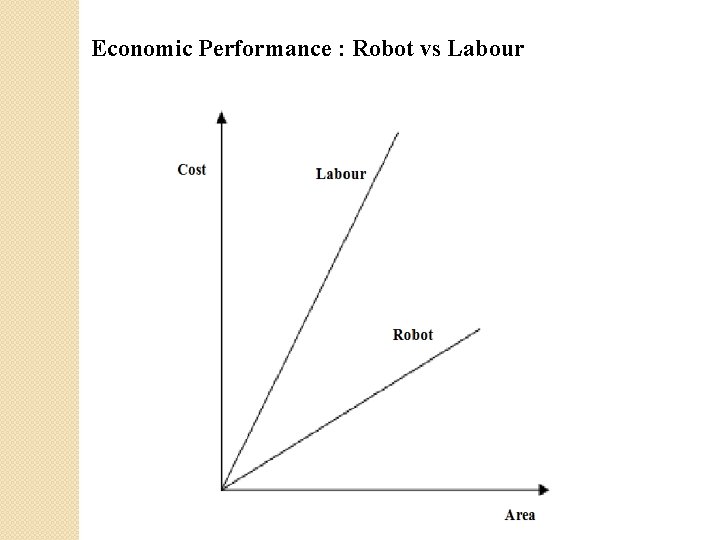
Economic Performance : Robot vs Labour
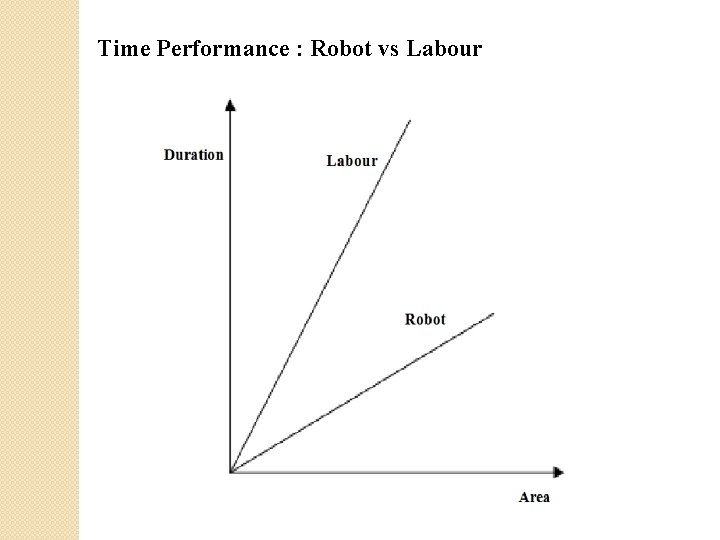
Time Performance : Robot vs Labour
Competitive advantages : ü Reducing the labour requirements greatly improve a contractor’s ability to complete ü Robots typically work faster than humans do Less concern about fluctuating productivity due to the ups and downs life ü of Since these devices are considered faster than humans at work operations, contractors should expect to complete projects sooner ü Properly designed robots may produce a high quality product than humans (Venables, 1994 ). ü Safety is an important aspect to any construction projects. Investing in fall protection, personal protective equipment, and safety management can be costly. Some of these costs can be reduced if robots are utilized in place of humans. ü
HINDRANCES � Many developments are made for specific jobs sites and are not suitable for others. � Each company has to invent all the development costs, making its development must cost effective � Insufficient development of construction robotic prototypes � Existing robots are not well developed to building construction � It is difficult to justify robot employment economically. � Insufficient economic justification for robotics in building. � Difficult managerial environment.
CONCLUSIONS � The construction industry demands a productivity increase by means of automation and robotics � Robot, safety, durability, and qualitative factors should be given priority in the visionary ideas. � Robotization reduces the construction time, cost and efforts. � The case study reveals that an amount of Rs. 4, 99, 800 can be made as saving amount duly using the robot for plastering work, in comparison with the conventional work i. e. , 62% � The time period also can be drastically cut down from 77 days to 9 days, thus contributing or major saving in labour costs with no accidents or injuries to the labour force.
REFERENCES � Cousineau, L& Nobuyasu, M (1998), Construction Robotics : the serach for new building technologies in Japan, Reston, V. A : ASCE press � Crawford, F. S. (1988) “Culvert Whistlers revisited. ” Am. J. Physics, 56 (8), 752 -754 � Cater Pillar (1996), Cater Pillar Computer aided with moving systems, Cater pillar, Peoria ш. � Farid 1993, “Editorial. ” Journal Construction and Management ASCE, 119 (2), 193 -195. � Krom (1997) “Industrialization and robotics in Construction”, Journal Construction Engineering and Management, 111 (3), 44 -50. � Phair, M. (1997) Large Systems seek bigger jobs, ENR, 238 (25), 14. � Seward, D. (1992). Robots in Construction : Conference report, Industrial Robot, 19 (3), 25 -29.


- Slides: 32