
Construction of TwoDimensional Pore with Fluorinated Alkyl Groups
- Slides: 17
Construction of Two-Dimensional Pore with Fluorinated Alkyl Groups Tobe Lab. Keisuke Katayama
Contents Introduction top down approach and bottom up approach 2 D molecular network and guest coadsorption Previous Work about dehydrobenzo[12]annulene (DBA) Purpose of this Work Experiment and discussion Molecular Design Scanning Tunneling Microscopy Experimental Result Conclusion
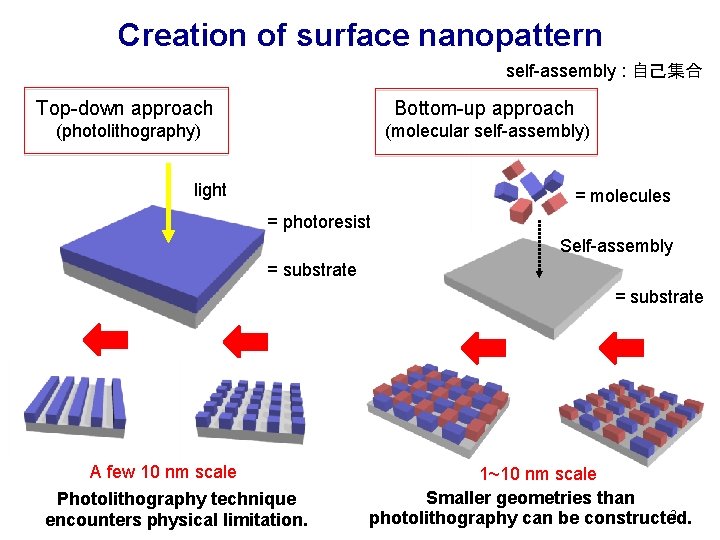
Creation of surface nanopattern self-assembly : 自己集合 Top-down approach Bottom-up approach (photolithography) (molecular self-assembly) light = molecules = photoresist Self-assembly = substrate A few 10 nm scale Photolithography technique encounters physical limitation. 1~10 nm scale Smaller geometries than 3 photolithography can be constructed.
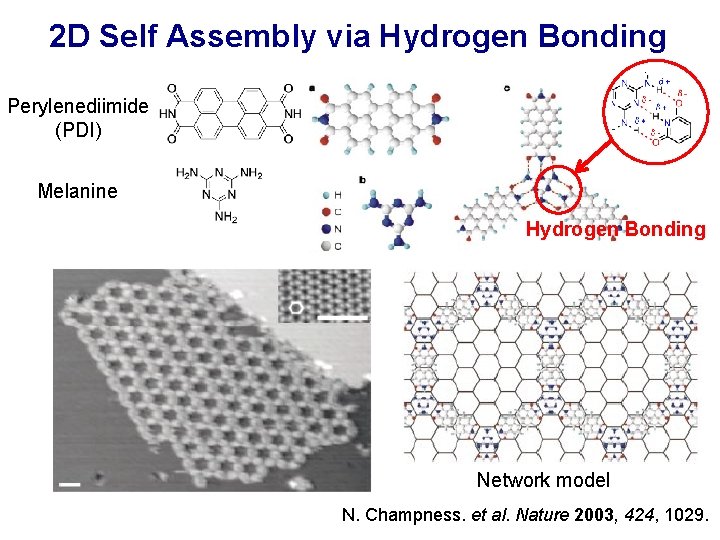
2 D Self Assembly via Hydrogen Bonding Perylenediimide (PDI) Melanine Hydrogen Bonding Network model N. Champness. et al. Nature 2003, 424, 1029.
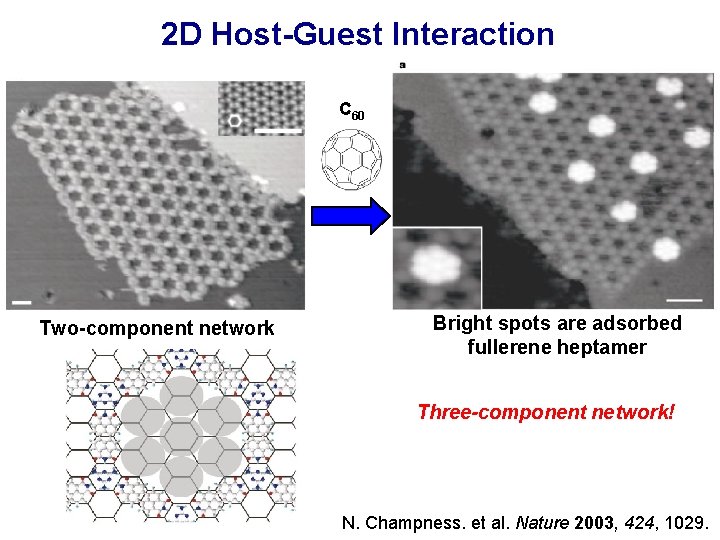
2 D Host-Guest Interaction C 60 Two-component network Bright spots are adsorbed fullerene heptamer Three-component network! N. Champness. et al. Nature 2003, 424, 1029.
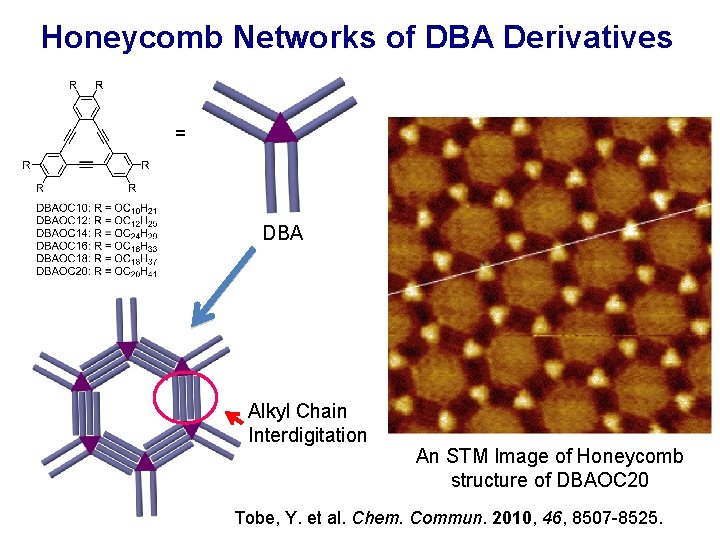
Honeycomb Networks of DBA Derivatives = DBA Alkyl Chain Interdigitation An STM Image of Honeycomb structure of DBAOC 20 Tobe, Y. et al. Chem. Commun. 2010, 46, 8507 -8525.
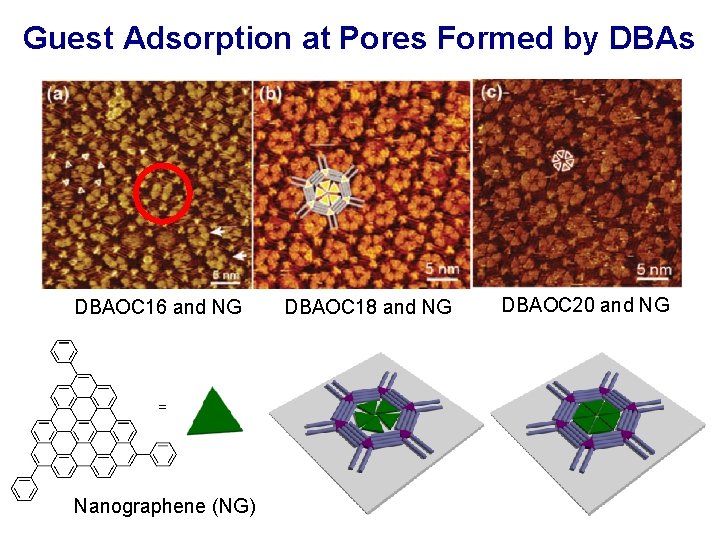
Guest Adsorption at Pores Formed by DBAs DBAOC 16 and NG = Nanographene (NG) DBAOC 18 and NG DBAOC 20 and NG
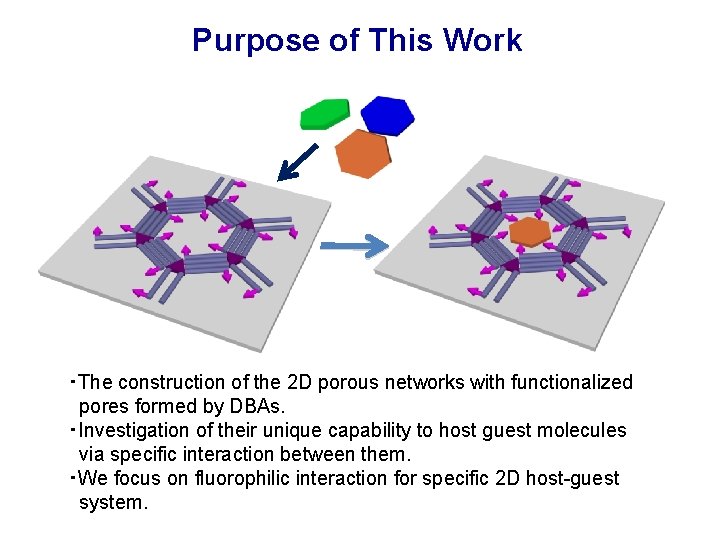
Purpose of This Work ・The construction of the 2 D porous networks with functionalized pores formed by DBAs. ・Investigation of their unique capability to host guest molecules via specific interaction between them. ・We focus on fluorophilic interaction for specific 2 D host-guest system.
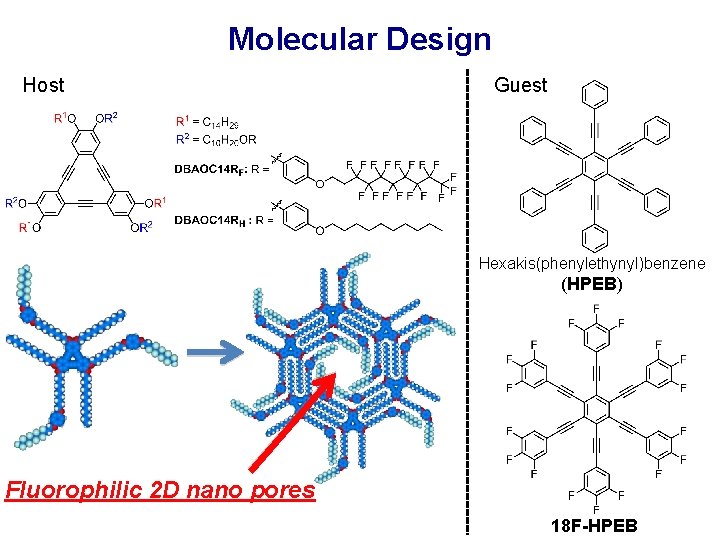
Molecular Design Host Guest Hexakis(phenylethynyl)benzene (HPEB) Fluorophilic 2 D nano pores 18 F-HPEB
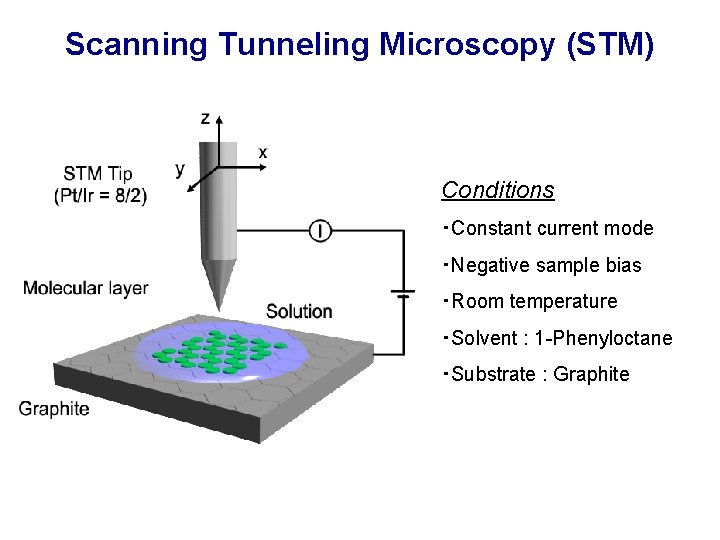
Scanning Tunneling Microscopy (STM) Conditions ・Constant current mode ・Negative sample bias ・Room temperature ・Solvent : 1 -Phenyloctane ・Substrate : Graphite
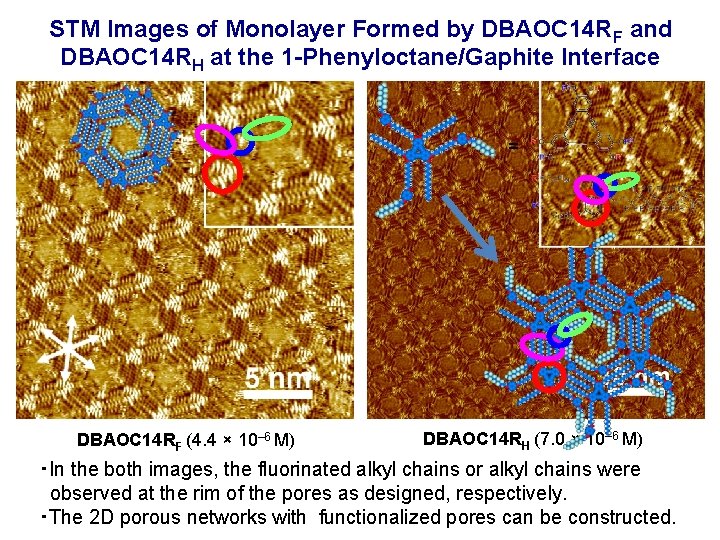
STM Images of Monolayer Formed by DBAOC 14 RF and DBAOC 14 RH at the 1 -Phenyloctane/Gaphite Interface = DBAOC 14 RF (4. 4 × 10– 6 M) DBAOC 14 RH (7. 0 × 10– 6 M) ・In the both images, the fluorinated alkyl chains or alkyl chains were observed at the rim of the pores as designed, respectively. ・The 2 D porous networks with functionalized pores can be constructed.
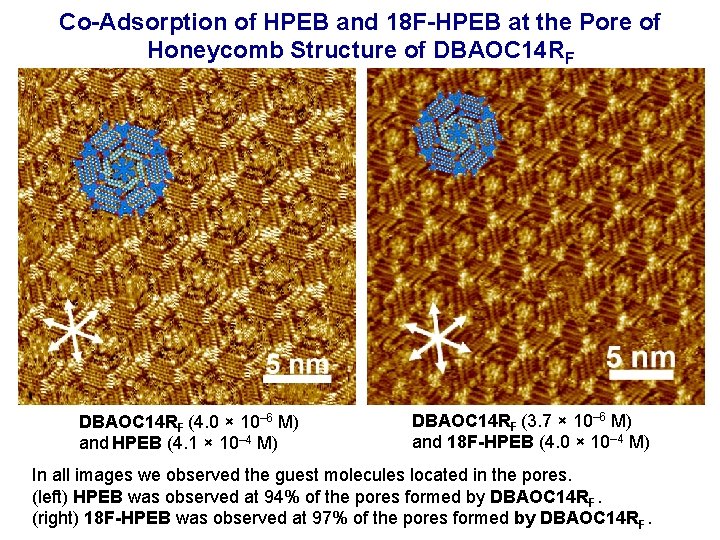
Co-Adsorption of HPEB and 18 F-HPEB at the Pore of Honeycomb Structure of DBAOC 14 RF (4. 0 × 10– 6 M) and HPEB (4. 1 × 10– 4 M) DBAOC 14 RF (3. 7 × 10– 6 M) and 18 F-HPEB (4. 0 × 10– 4 M) In all images we observed the guest molecules located in the pores. (left) HPEB was observed at 94% of the pores formed by DBAOC 14 RF. (right) 18 F-HPEB was observed at 97% of the pores formed by DBAOC 14 RF.
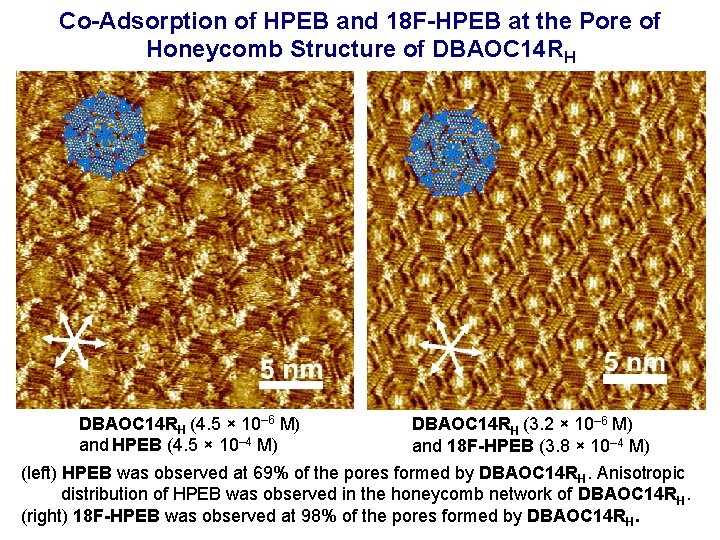
Co-Adsorption of HPEB and 18 F-HPEB at the Pore of Honeycomb Structure of DBAOC 14 RH (4. 5 × 10– 6 M) and HPEB (4. 5 × 10– 4 M) DBAOC 14 RH (3. 2 × 10– 6 M) and 18 F-HPEB (3. 8 × 10– 4 M) (left) HPEB was observed at 69% of the pores formed by DBAOC 14 RH. Anisotropic distribution of HPEB was observed in the honeycomb network of DBAOC 14 RH. (right) 18 F-HPEB was observed at 98% of the pores formed by DBAOC 14 RH.
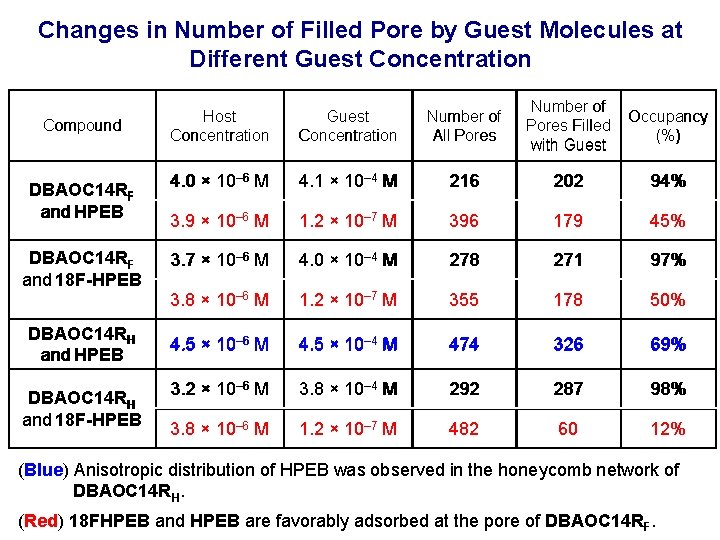
Changes in Number of Filled Pore by Guest Molecules at Different Guest Concentration Host Concentration Guest Concentration Number of All Pores Number of Pores Filled with Guest Occupancy (%) DBAOC 14 RF and HPEB 4. 0 × 10– 6 M 4. 1 × 10– 4 M 216 202 94% 3. 9 × 10– 6 M 1. 2 × 10– 7 M 396 179 45% DBAOC 14 RF and 18 F-HPEB 3. 7 × 10– 6 M 4. 0 × 10– 4 M 278 271 97% 3. 8 × 10– 6 M 1. 2 × 10– 7 M 355 178 50% DBAOC 14 RH and HPEB 4. 5 × 10– 6 M 4. 5 × 10– 4 M 474 326 69% 3. 2 × 10– 6 M 3. 8 × 10– 4 M 292 287 98% 3. 8 × 10– 6 M 1. 2 × 10– 7 M 482 60 12% Compound DBAOC 14 RH and 18 F-HPEB (Blue) Anisotropic distribution of HPEB was observed in the honeycomb network of DBAOC 14 RH. (Red) 18 FHPEB and HPEB are favorably adsorbed at the pore of DBAOC 14 RF.
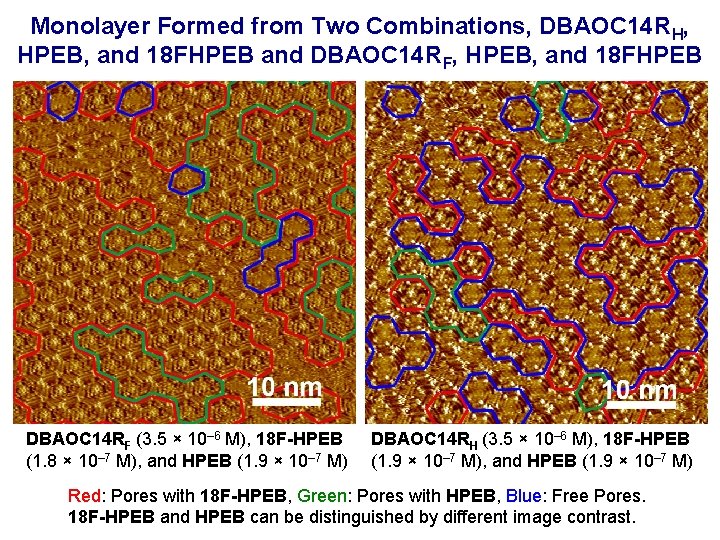
Monolayer Formed from Two Combinations, DBAOC 14 RH, HPEB, and 18 FHPEB and DBAOC 14 RF, HPEB, and 18 FHPEB DBAOC 14 RF (3. 5 × 10– 6 M), 18 F-HPEB (1. 8 × 10– 7 M), and HPEB (1. 9 × 10– 7 M) DBAOC 14 RH (3. 5 × 10– 6 M), 18 F-HPEB (1. 9 × 10– 7 M), and HPEB (1. 9 × 10– 7 M) Red: Pores with 18 F-HPEB, Green: Pores with HPEB, Blue: Free Pores. 18 F-HPEB and HPEB can be distinguished by different image contrast.
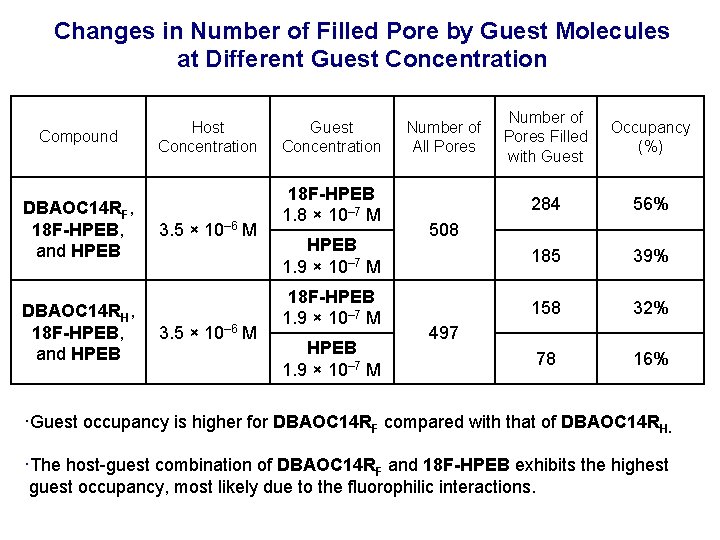
Changes in Number of Filled Pore by Guest Molecules at Different Guest Concentration Compound DBAOC 14 RF, 18 F-HPEB, and HPEB DBAOC 14 RH, 18 F-HPEB, and HPEB Host Concentration 3. 5 × 10– 6 M Guest Concentration 18 F-HPEB 1. 8 × 10– 7 M HPEB 1. 9 × 10– 7 M 18 F-HPEB 1. 9 × 10– 7 M Number of All Pores Number of Pores Filled with Guest Occupancy (%) 284 56% 185 39% 158 32% 78 16% 508 497 ·Guest occupancy is higher for DBAOC 14 RF compared with that of DBAOC 14 RH. ·The host-guest combination of DBAOC 14 RF and 18 F-HPEB exhibits the highest guest occupancy, most likely due to the fluorophilic interactions.
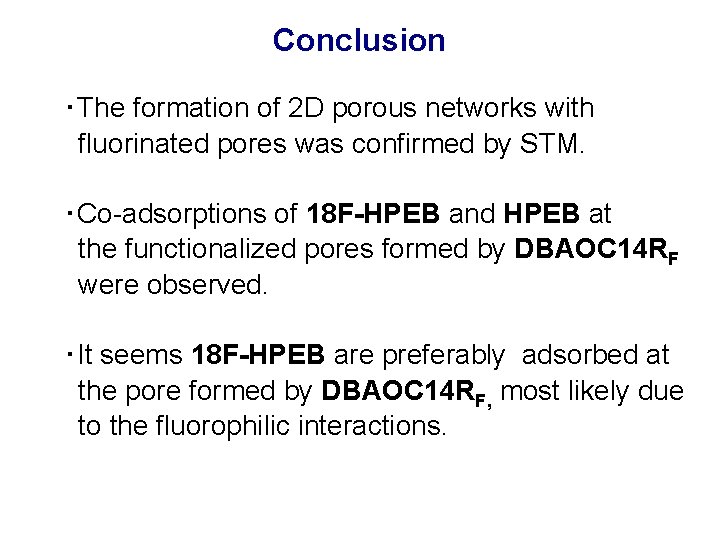
Conclusion ・The formation of 2 D porous networks with fluorinated pores was confirmed by STM. ・Co-adsorptions of 18 F-HPEB and HPEB at the functionalized pores formed by DBAOC 14 RF were observed. ・It seems 18 F-HPEB are preferably adsorbed at the pore formed by DBAOC 14 RF, most likely due to the fluorophilic interactions.