
Construction of Lyapunov functions with linear optimization Sigurur


- Slides: 26
Construction of Lyapunov functions with linear optimization Sigurður F. Hafstein, Reykjavík University
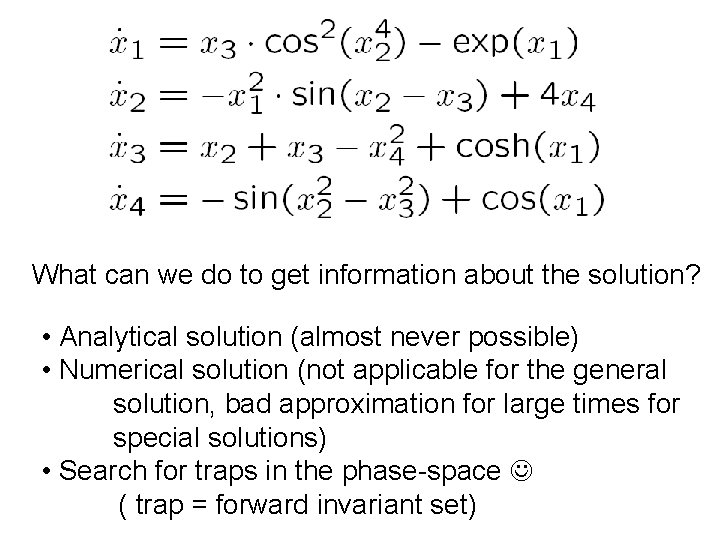
What can we do to get information about the solution? • Analytical solution (almost never possible) • Numerical solution (not applicable for the general solution, bad approximation for large times for special solutions) • Search for traps in the phase-space ( trap = forward invariant set)
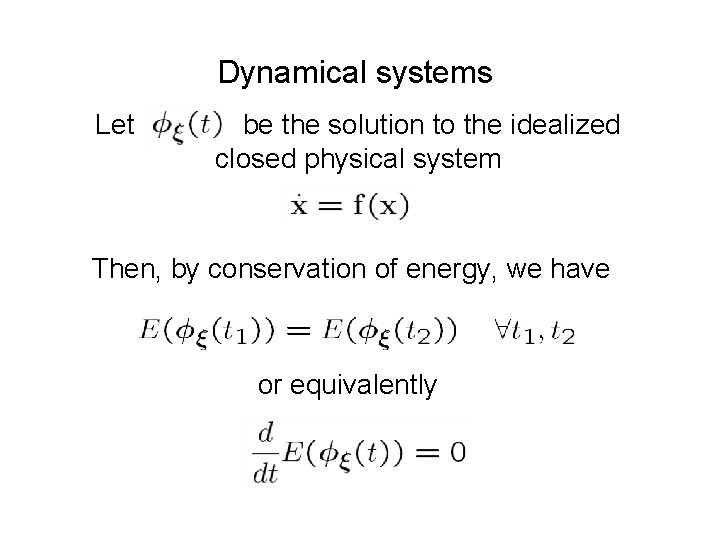
Dynamical systems Let be the solution to the idealized closed physical system Then, by conservation of energy, we have or equivalently
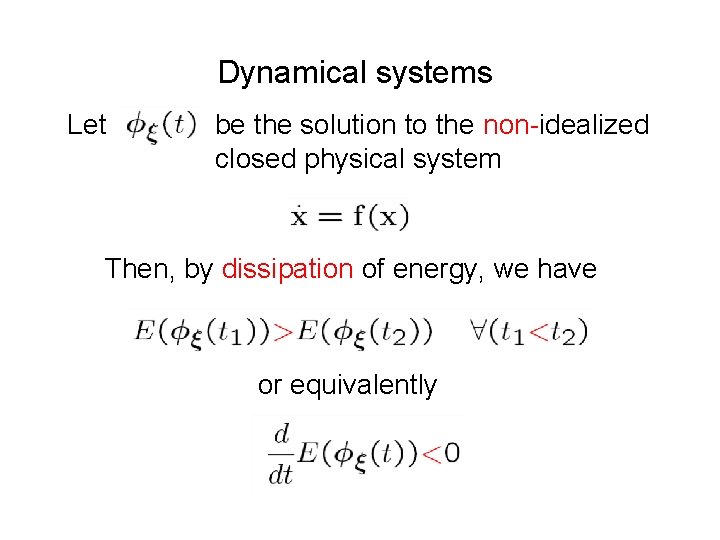
Dynamical systems Let be the solution to the non-idealized closed physical system Then, by dissipation of energy, we have or equivalently
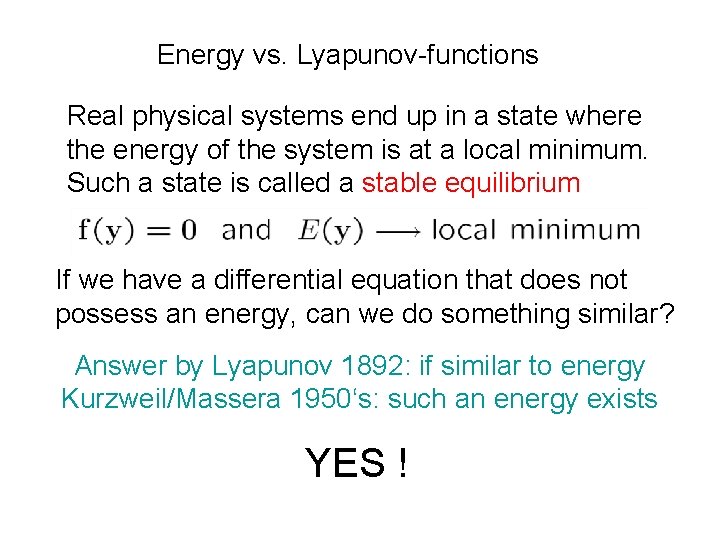
Energy vs. Lyapunov-functions Real physical systems end up in a state where the energy of the system is at a local minimum. Such a state is called a stable equilibrium If we have a differential equation that does not possess an energy, can we do something similar? Answer by Lyapunov 1892: if similar to energy Kurzweil/Massera 1950‘s: such an energy exists YES !
Example: where Partition of the domain of V:
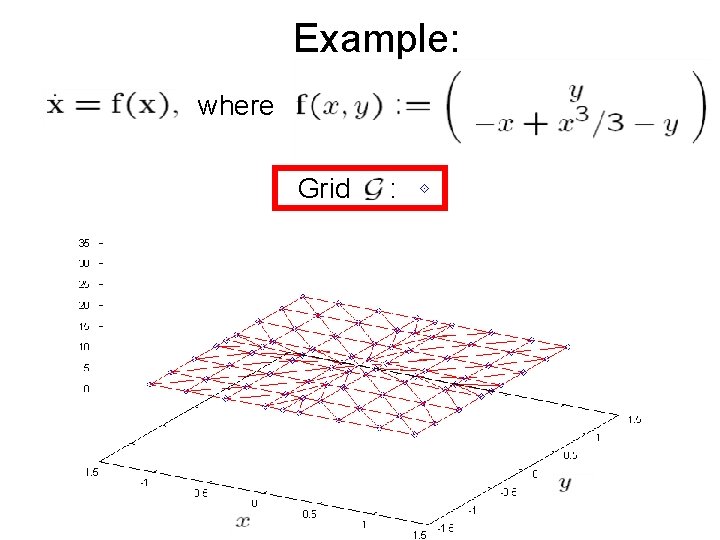
Example: where Grid :
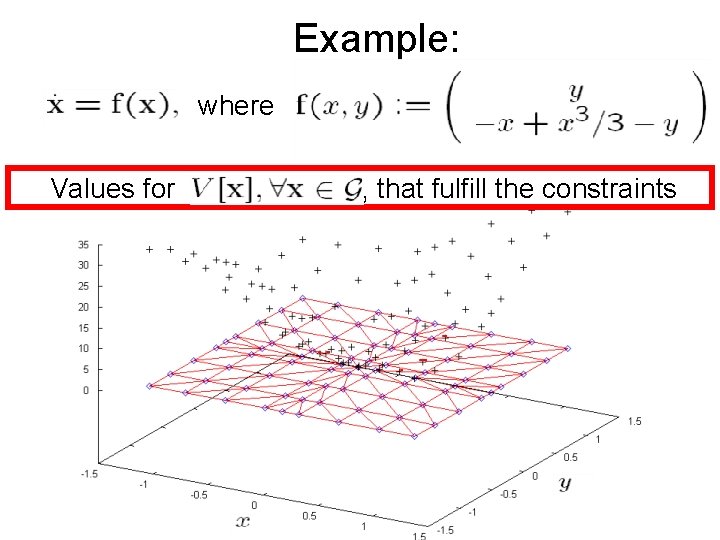
Example: where Values for , that fulfill the constraints
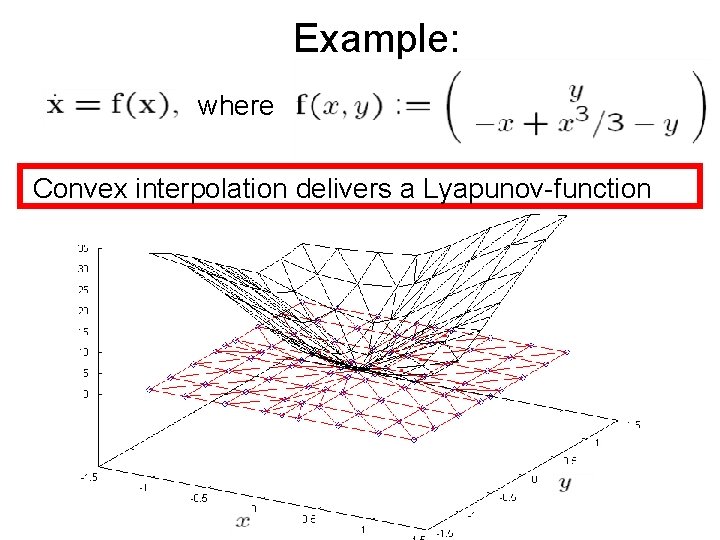
Example: where Convex interpolation delivers a Lyapunov-function
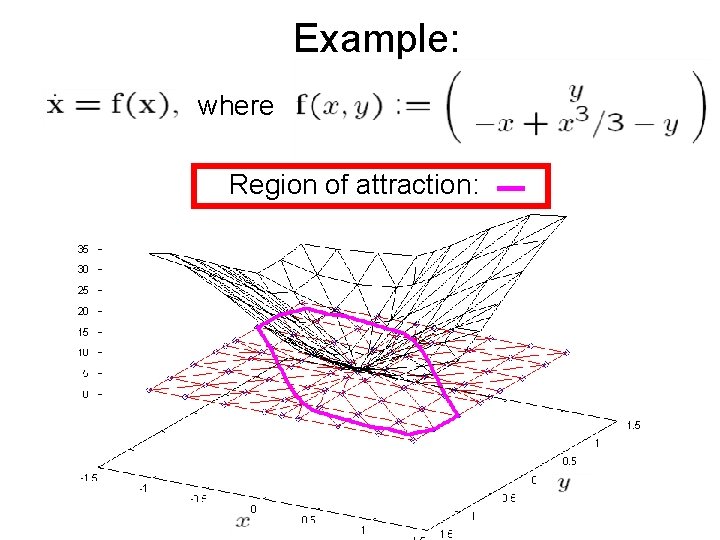
Example: where Region of attraction:
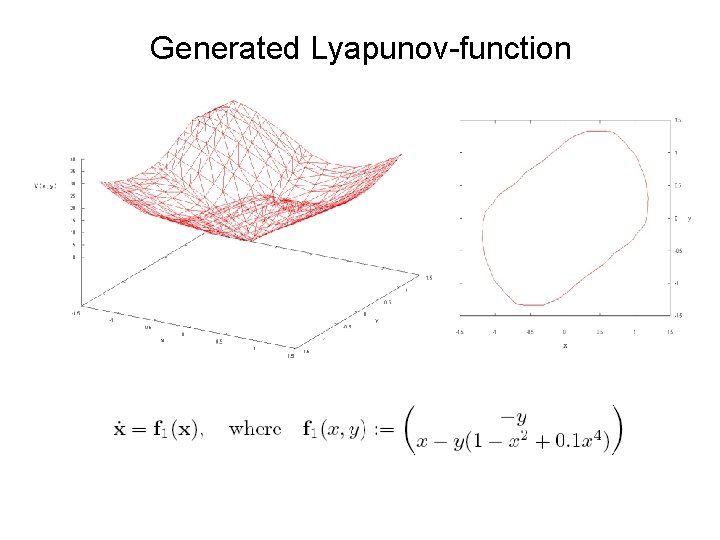
Generated Lyapunov-function
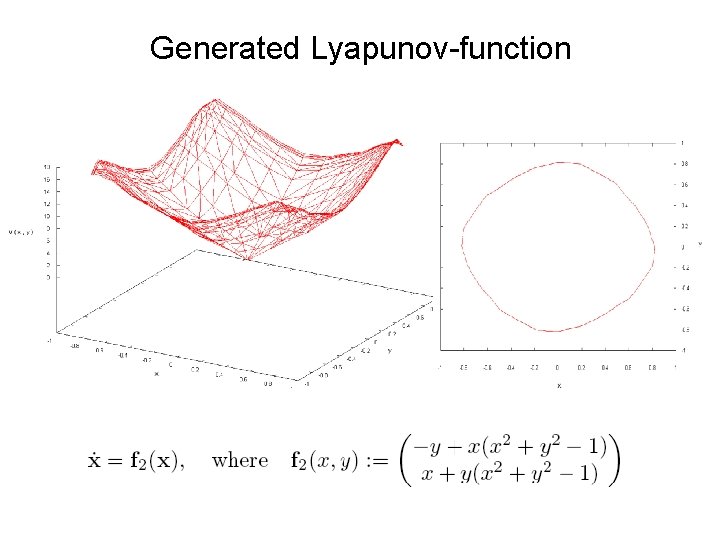
Generated Lyapunov-function
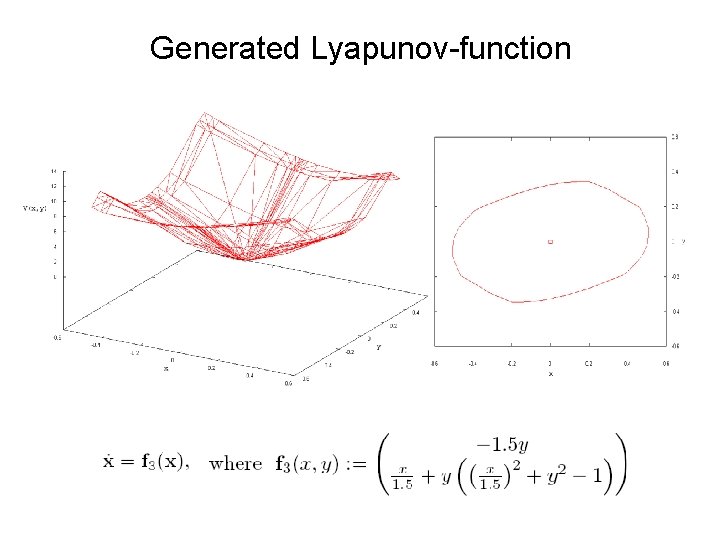
Generated Lyapunov-function
Generated common Lyapunov-function
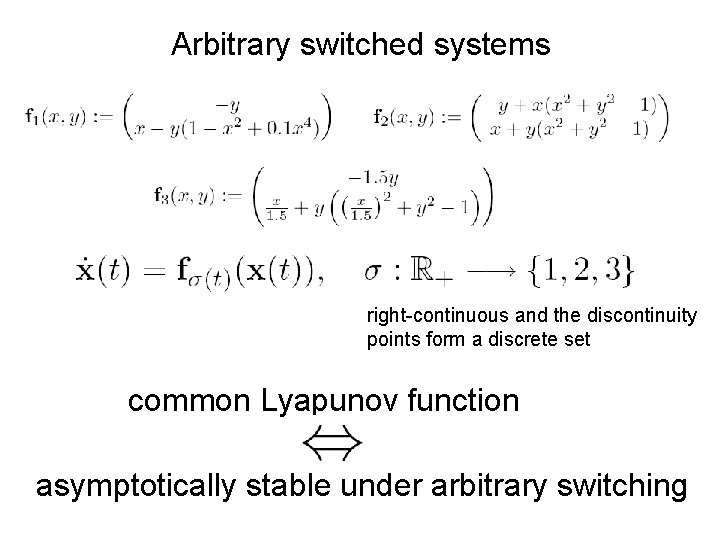
Arbitrary switched systems right-continuous and the discontinuity points form a discrete set common Lyapunov function asymptotically stable under arbitrary switching
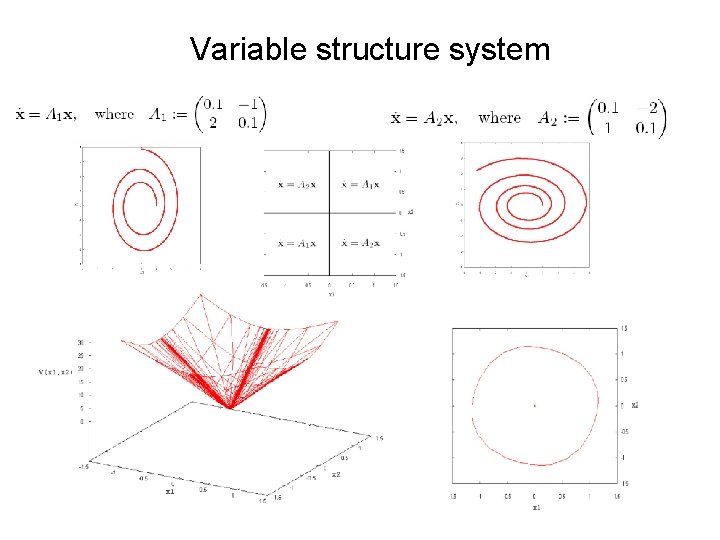
Variable structure system
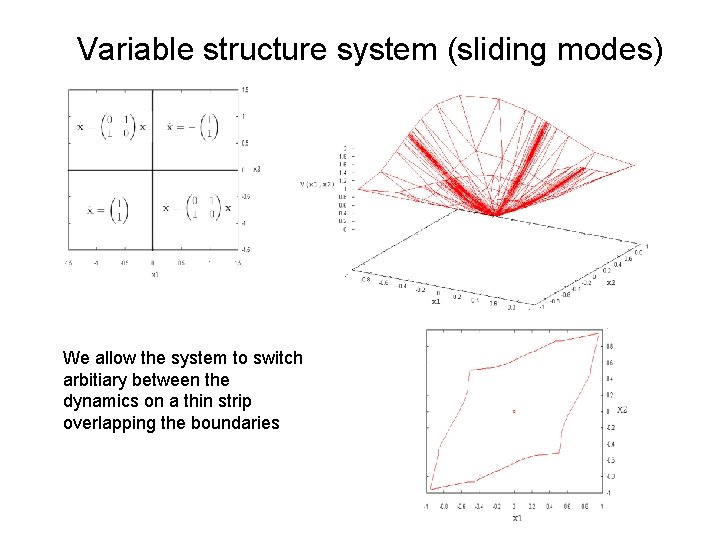
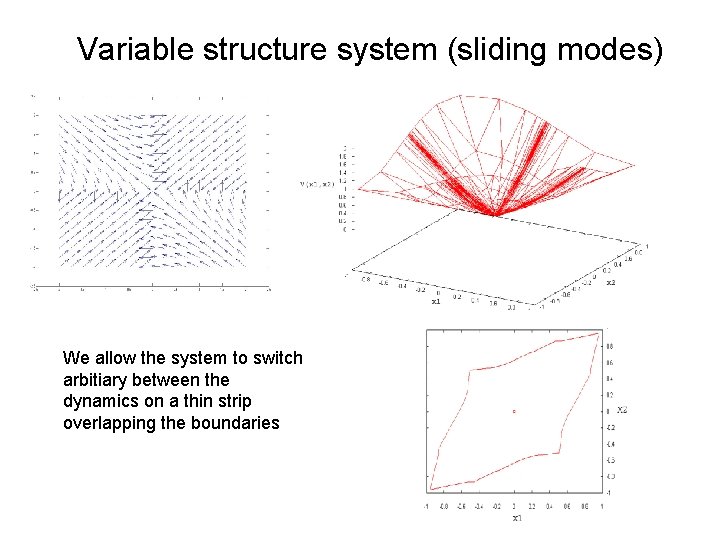
Variable structure system (sliding modes) We allow the system to switch arbitiary between the dynamics on a thin strip overlapping the boundaries
Variable structure system (sliding modes) We allow the system to switch arbitiary between the dynamics on a thin strip overlapping the boundaries
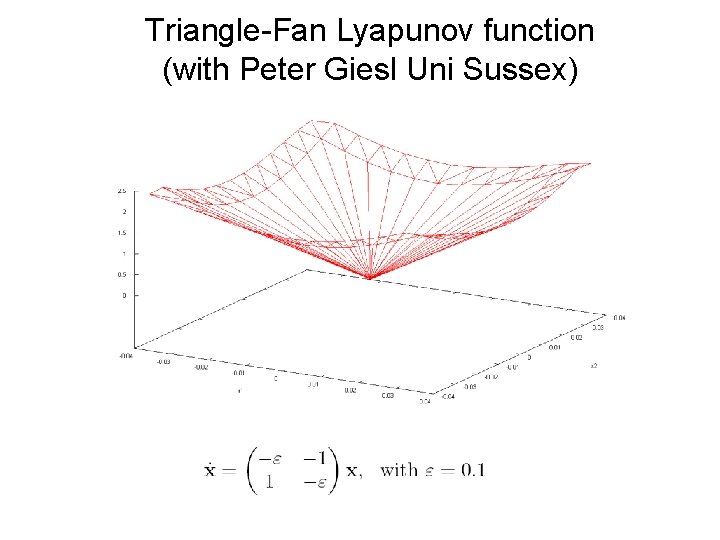
Triangle-Fan Lyapunov function (with Peter Giesl Uni Sussex)
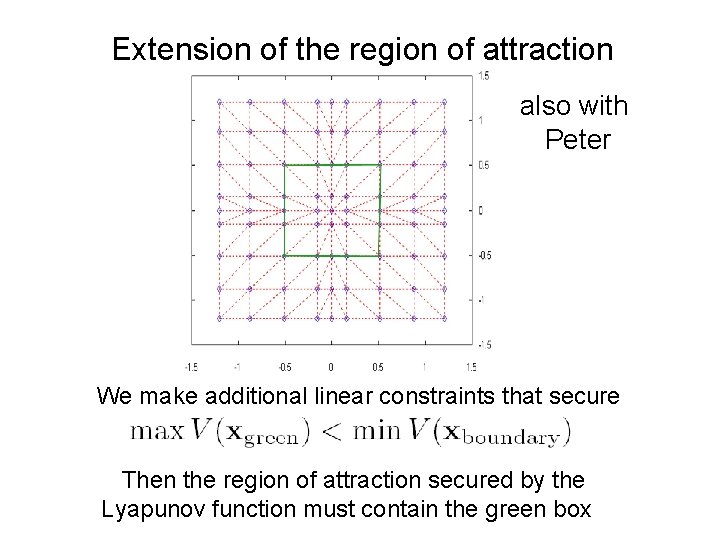
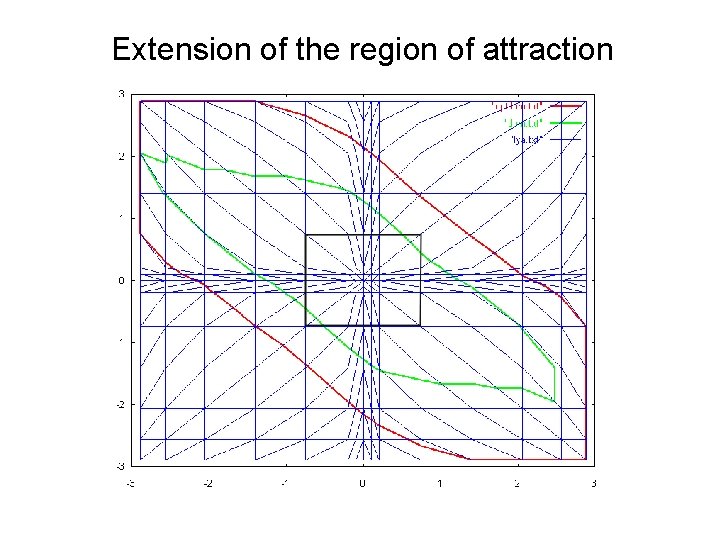
Extension of the region of attraction also with Peter We make additional linear constraints that secure Then the region of attraction secured by the Lyapunov function must contain the green box
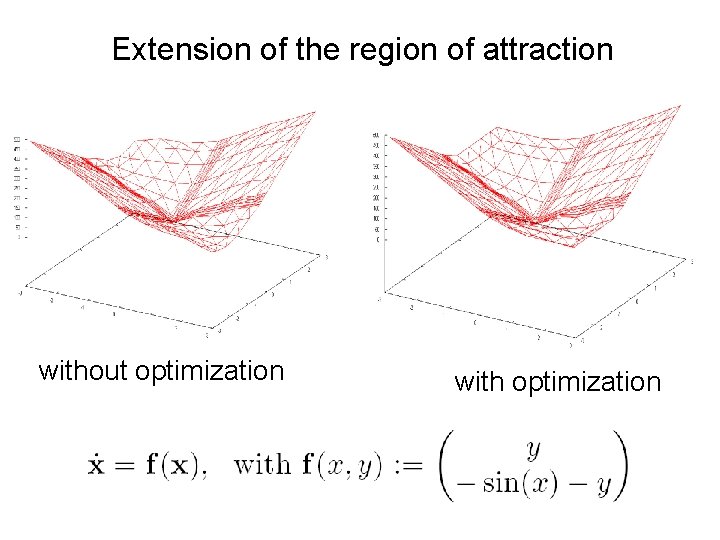
Extension of the region of attraction without optimization with optimization
Extension of the region of attraction
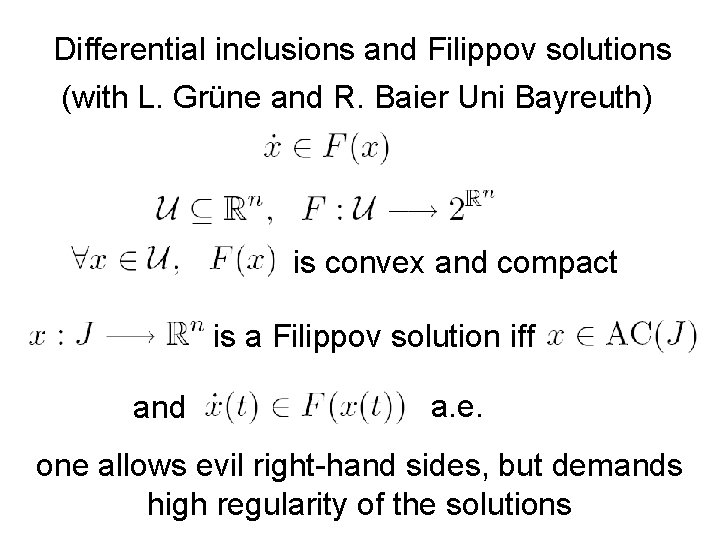
Differential inclusions and Filippov solutions (with L. Grüne and R. Baier Uni Bayreuth) is convex and compact is a Filippov solution iff and a. e. one allows evil right-hand sides, but demands high regularity of the solutions
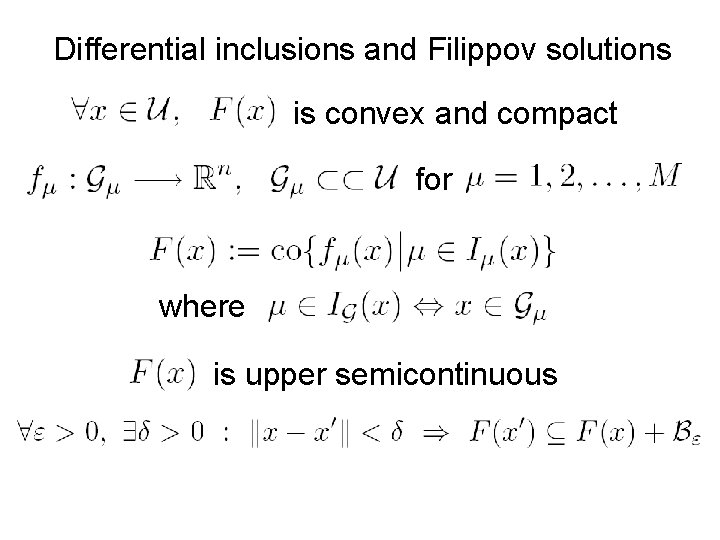
Differential inclusions and Filippov solutions is convex and compact for where is upper semicontinuous
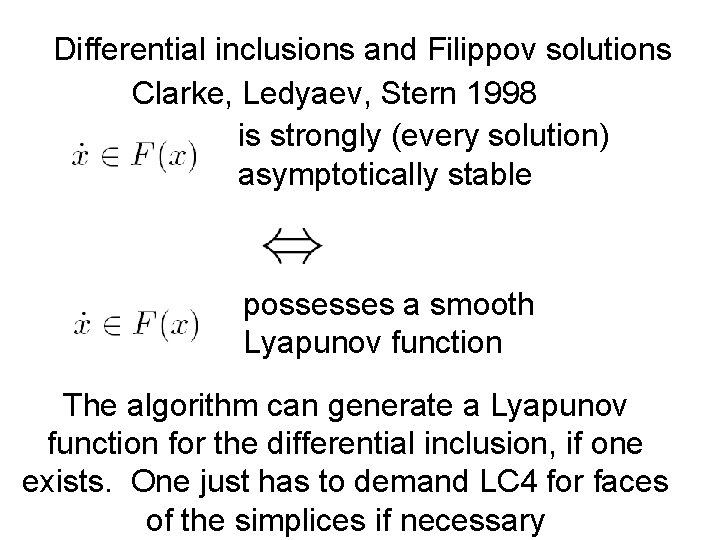
Differential inclusions and Filippov solutions Clarke, Ledyaev, Stern 1998 is strongly (every solution) asymptotically stable possesses a smooth Lyapunov function The algorithm can generate a Lyapunov function for the differential inclusion, if one exists. One just has to demand LC 4 for faces of the simplices if necessary
THANKS FOR LISTENING!