
Construction of a genetic toggle switch in Escherichia


- Slides: 16
Construction of a genetic toggle switch in Escherichia coli Farah and Tom
What is a Toggle Switch? “A synthetic bistable gene regulatory network”
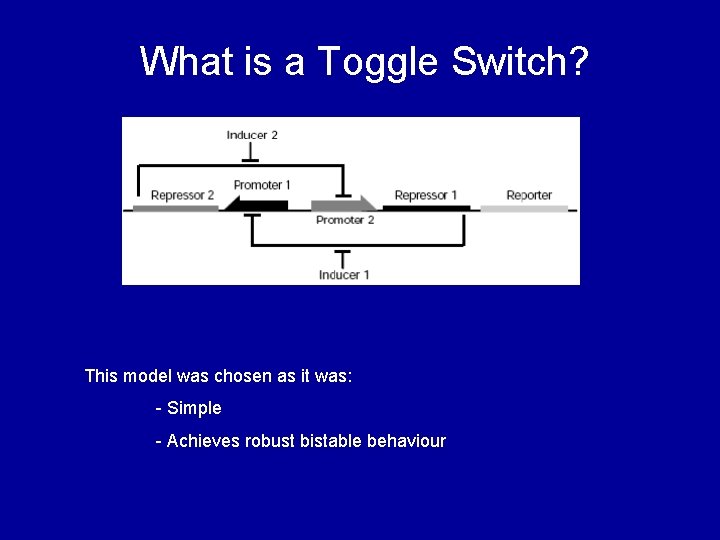
What is a Toggle Switch? The switch consists of: Promoters Repressors Inducers Promoters encourage expression of a gene. Repressors bind to promoters, inhibiting expression of genes. Inducers bind to repressors, preventing repressor binding to promoters and thus encouraging expression. These components are arranged in a mutually inhibitory fashion.
What is a Toggle Switch? This model was chosen as it was: - Simple - Achieves robust bistable behaviour
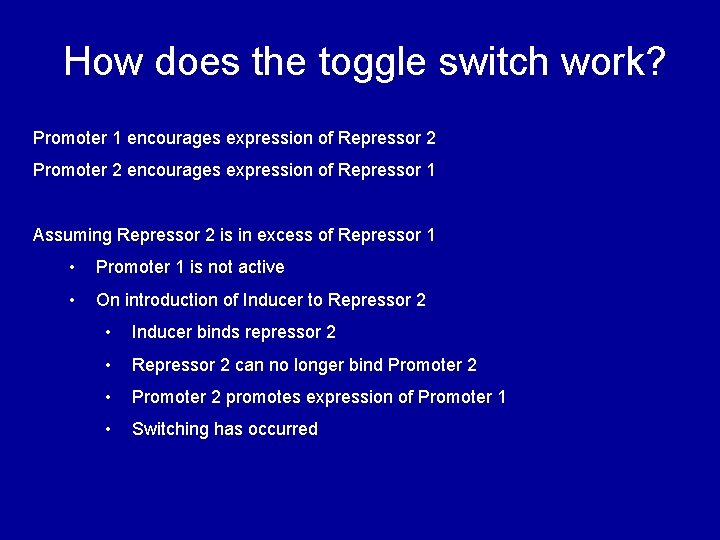
How does the toggle switch work? Promoter 1 encourages expression of Repressor 2 Promoter 2 encourages expression of Repressor 1 Assuming Repressor 2 is in excess of Repressor 1 • Promoter 1 is not active • On introduction of Inducer to Repressor 2 • Inducer binds repressor 2 • Repressor 2 can no longer bind Promoter 2 • Promoter 2 promotes expression of Promoter 1 • Switching has occurred
The Maths
The Geometric Structure of the Toggle Equations
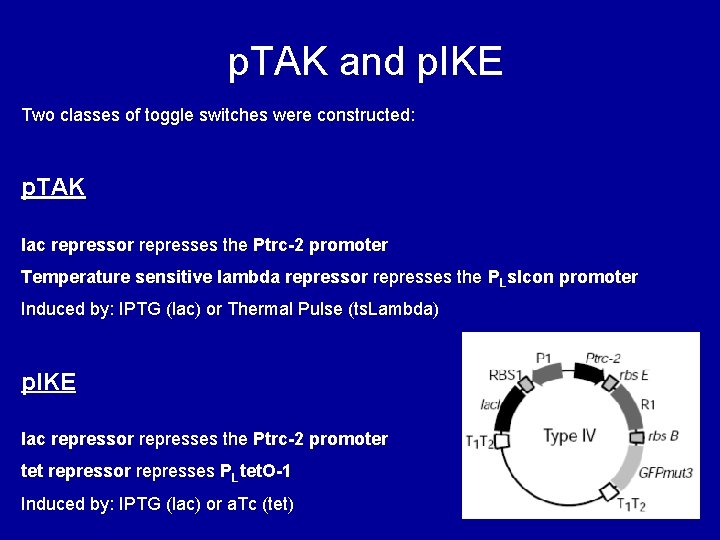
p. TAK and p. IKE Two classes of toggle switches were constructed: p. TAK lac repressor represses the Ptrc-2 promoter Temperature sensitive lambda repressor represses the PLslcon promoter Induced by: IPTG (lac) or Thermal Pulse (ts. Lambda) p. IKE lac repressor represses the Ptrc-2 promoter tet repressor represses PLtet. O-1 Induced by: IPTG (lac) or a. Tc (tet)
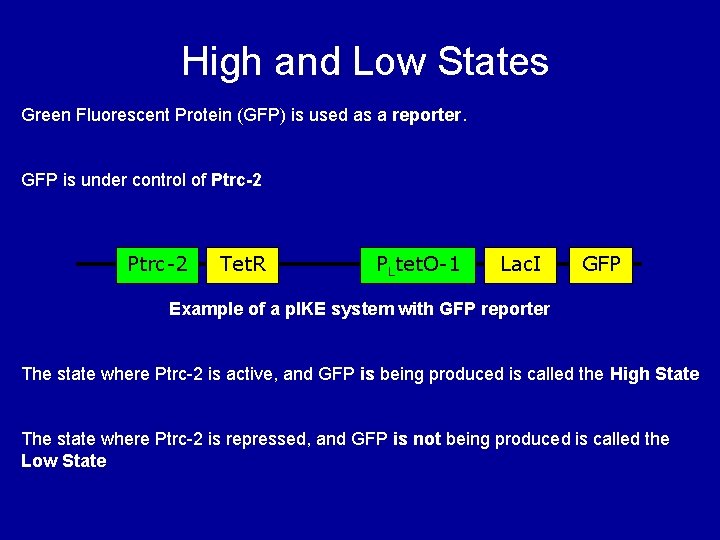
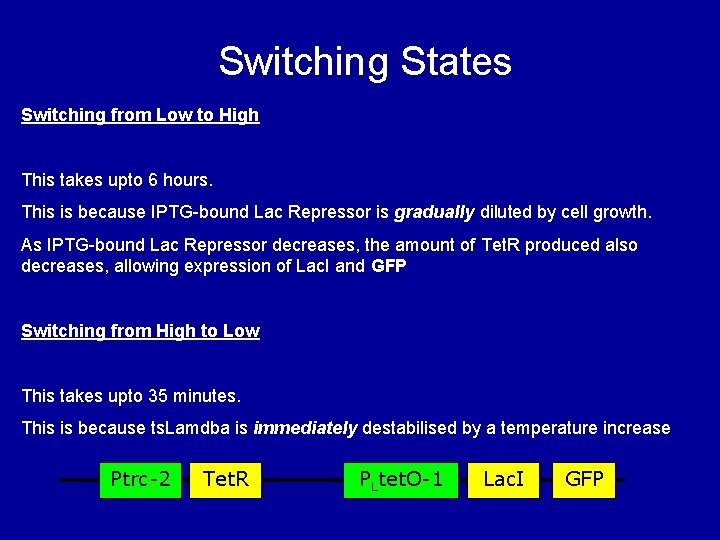
High and Low States Green Fluorescent Protein (GFP) is used as a reporter. GFP is under control of Ptrc-2 Tet. R PLtet. O-1 Lac. I GFP Example of a p. IKE system with GFP reporter The state where Ptrc-2 is active, and GFP is being produced is called the High State The state where Ptrc-2 is repressed, and GFP is not being produced is called the Low State
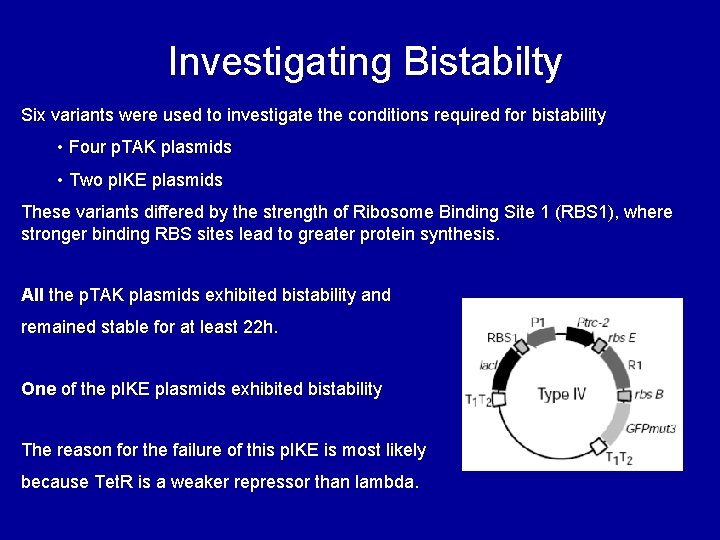
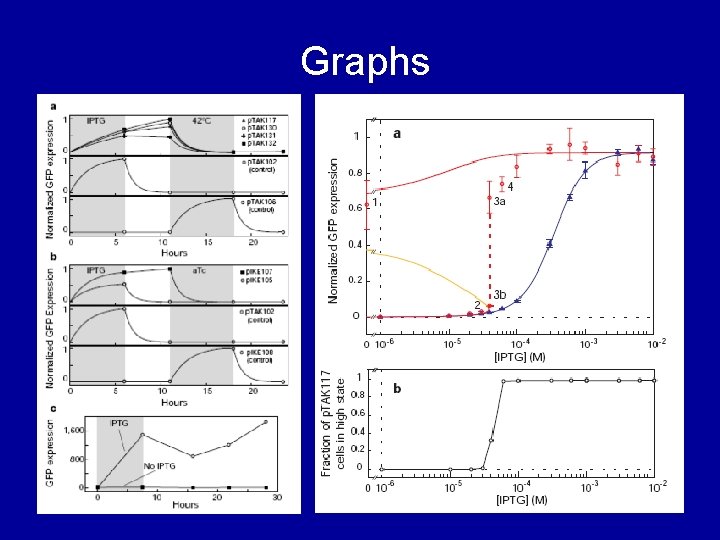
Investigating Bistabilty Six variants were used to investigate the conditions required for bistability • Four p. TAK plasmids • Two p. IKE plasmids These variants differed by the strength of Ribosome Binding Site 1 (RBS 1), where stronger binding RBS sites lead to greater protein synthesis. All the p. TAK plasmids exhibited bistability and remained stable for at least 22 h. One of the p. IKE plasmids exhibited bistability The reason for the failure of this p. IKE is most likely because Tet. R is a weaker repressor than lambda.
Graphs
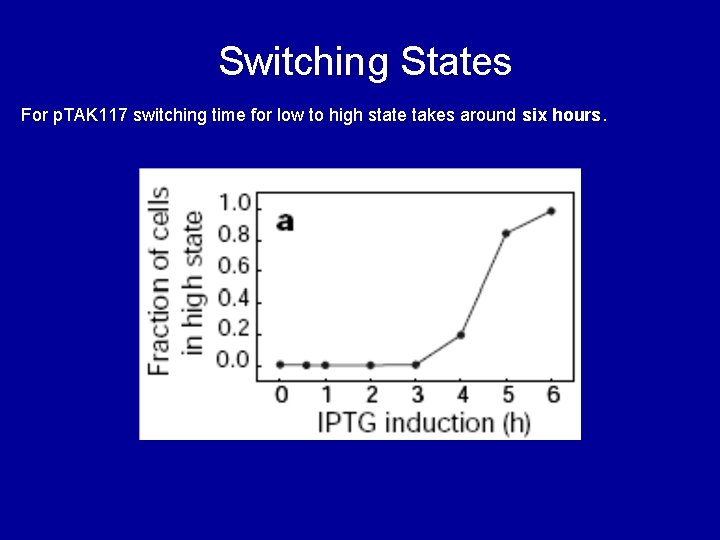
Switching States For p. TAK 117 switching time for low to high state takes around six hours.
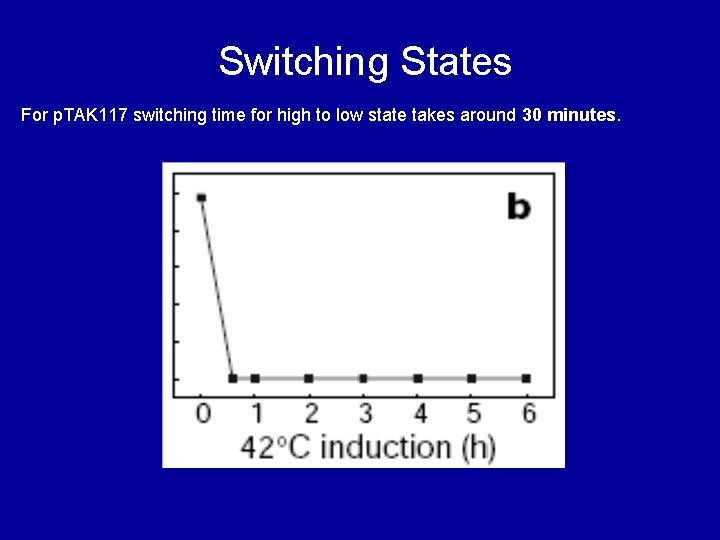
Switching States For p. TAK 117 switching time for high to low state takes around 30 minutes.
Switching States Switching from Low to High This takes upto 6 hours. This is because IPTG-bound Lac Repressor is gradually diluted by cell growth. As IPTG-bound Lac Repressor decreases, the amount of Tet. R produced also decreases, allowing expression of Lac. I and GFP Switching from High to Low This takes upto 35 minutes. This is because ts. Lamdba is immediately destabilised by a temperature increase Ptrc-2 Tet. R PLtet. O-1 Lac. I GFP
Other potential toggles In the examples of toggle switches used here the mechanism used to flip the switch has been introduction of an inducer. This has limited application in synthetic biology. There are other ways of achieving the switch which may be of use: - Addition of extra repressor - Destruction of repressor (eg. Using UV light)
Applications Gene Therapy Biotechnology Cellular memory unit