
Constructing Orthogonal Arrays MIT Learning Objectives Introduce explore
Constructing Orthogonal Arrays MIT
Learning Objectives • Introduce & explore orthogonality • Study the standard OAs • Practice computing DOF of an experiment • Learn how to select a standard OA • Introduce means to modify OAs • Consider studying interactions in OAs MIT
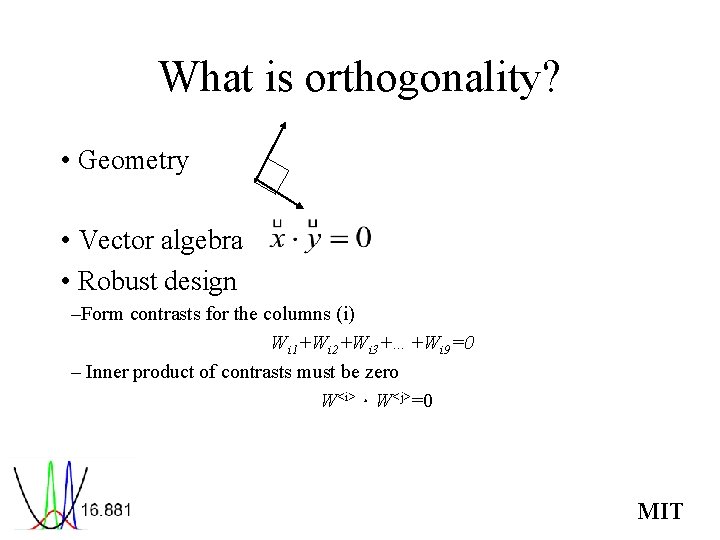
What is orthogonality? • Geometry • Vector algebra • Robust design –Form contrasts for the columns (i) Wi 1+Wi 2+Wi 3+…+Wi 9=0 – Inner product of contrasts must be zero W<i>.W<j>=0 MIT
Before Constructing an Arra We must define: • Number of factors to be studied • Number of levels for each factor • 2 factor interactions to be studied • Special difficulties in running experiments MIT
Counting Degrees of Freedom • Grand mean – 1 • Each control factor (e. g. , A) – (# of levels of A -1) • Each two factor interaction (e. g. , Ax. B) – (DOF for A) x (DOF for B) • Example --21 x 37 MIT
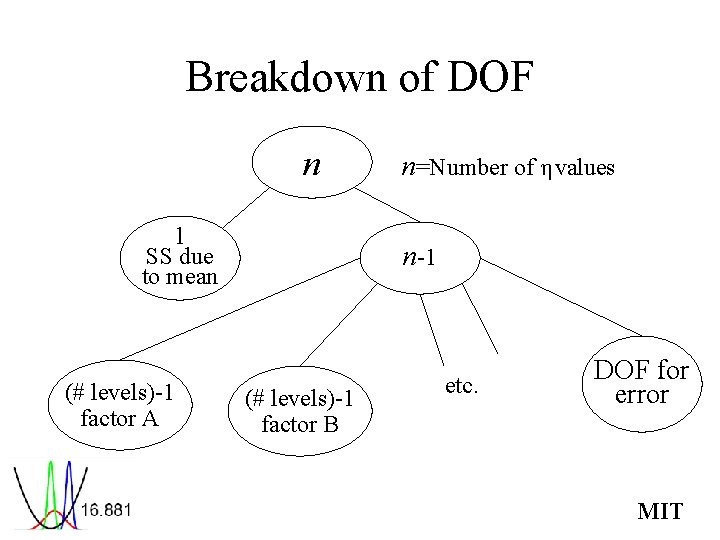
Breakdown of DOF n l SS due to mean (# levels)-1 factor A n=Number of ηvalues n-1 (# levels)-1 factor B etc. DOF for error MIT
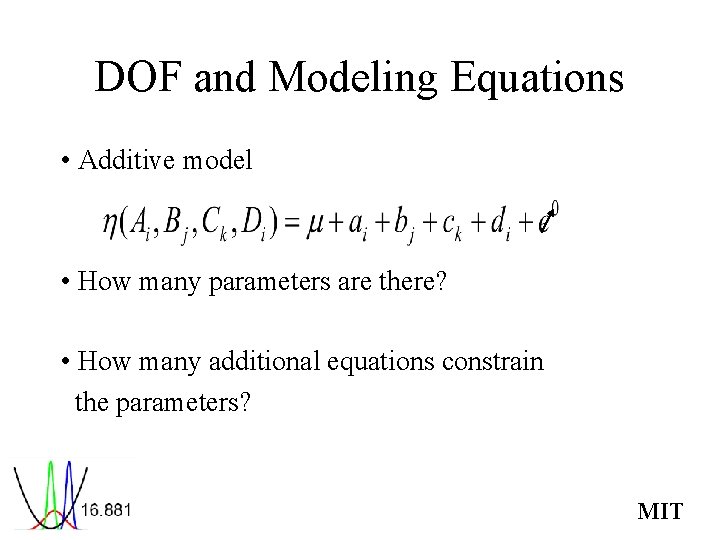
DOF and Modeling Equations • Additive model • How many parameters are there? • How many additional equations constrain the parameters? MIT
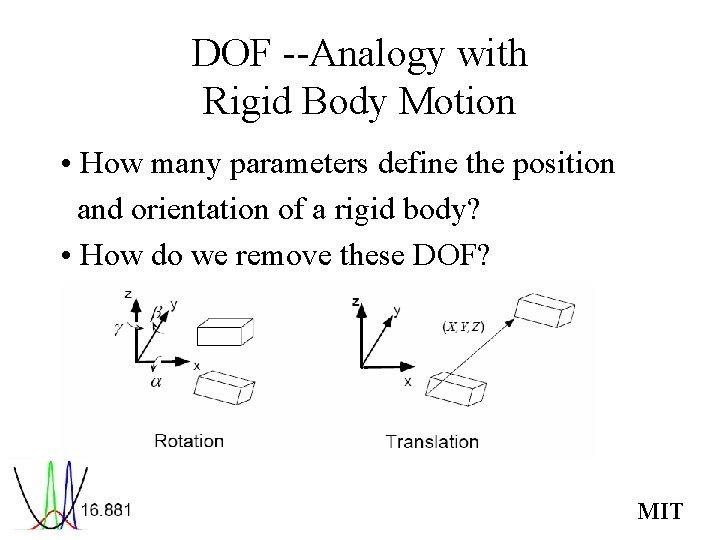
DOF --Analogy with Rigid Body Motion • How many parameters define the position and orientation of a rigid body? • How do we remove these DOF? MIT
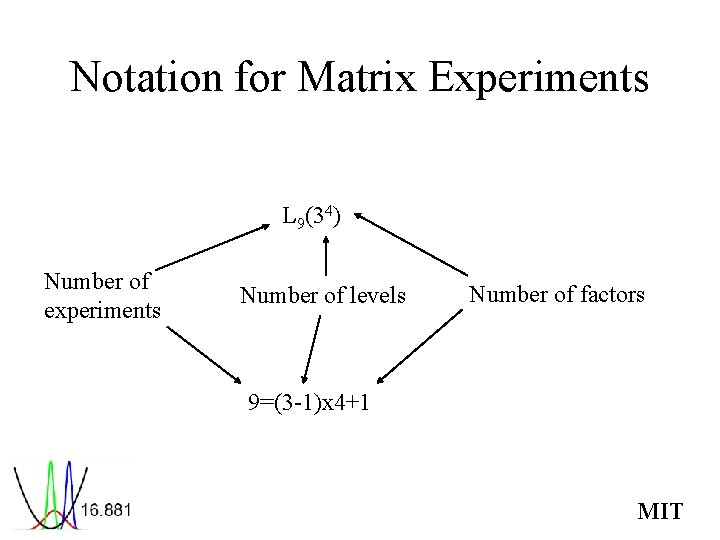
Notation for Matrix Experiments L 9(34) Number of experiments Number of levels Number of factors 9=(3 -1)x 4+1 MIT

Standard Orthogonal Arrays • See table 7. 1 on Phadke page 152 • Note: You can never use an array that has fewer rows than DOF req’d • Note: The number of factors of a given level is a maximum • You can put a factor with fewer columns into a column that has more levels – But NOT fewer! MIT
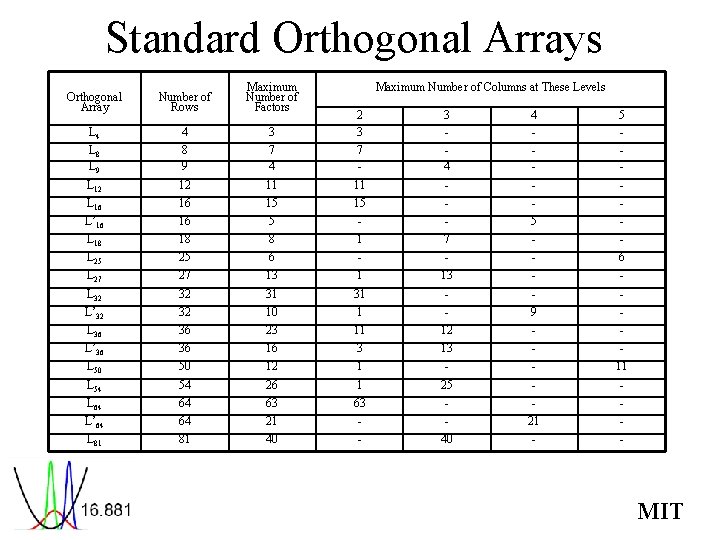
Standard Orthogonal Arrays Orthogonal Array Number of Rows Maximum Number of Factors L 4 4 L 8 L 9 Maximum Number of Columns at These Levels 3 2 3 3 - 4 - 5 - 8 9 7 4 7 - 4 - - L 12 12 11 11 - - - L 16 16 15 15 - - - L’ 16 16 5 - - 5 - L 18 18 8 1 7 - - L 25 L 27 25 27 6 13 1 13 - 6 - L 32 32 31 31 - - - L’ 32 32 10 1 - 9 - L 36 36 23 11 12 - - L’ 36 36 16 3 13 - - L 50 50 12 1 - - 11 L 54 54 26 1 25 - - L 64 64 63 63 - - - L’ 64 64 21 - - 21 - L 81 81 40 - - MIT
Difficulty in Changing Levels • Some factor levels cost money to change – Paper airplane – Other examples? • Note: All the matricesin Appendix C are arranged in increasing order of number of level changes required (left to right) • Therefore, put hard to change levels in the leftmost columns MIT
Choosing an Array -- Example 1 • 1 two level factor • 5 three level factors • What is the number of DOF • What is the smallest standard array that will work? MIT
Choosing an Array -- Example 2 • 2 two level factor • 3 three level factors • What is the number of DOF • What is the smallest standard array that will work? MIT
Dummy Levels • Turns a 2 level factor into a 3 level factor (or a 3 to a 4 etc. ) • By creating a “new” level A 3 that is really just A 1 (or A 2) • Let’s consider example 2 • Question --What will the factor effect plot look like? MIT
Dummy Levels Preserve Orthogonality • Let’s demonstrate this for Example 2 • But only if we assign the dummy level consistently MIT
Considerations in Assigning Dummy Levels • Desired accuracy of factor level effect –Examples? • Cost of the level assignment –Examples? • Can you assign dummy levels to more than one factor in a matrix experiment? • Can you assign more than one dummy level to a single factor? MIT
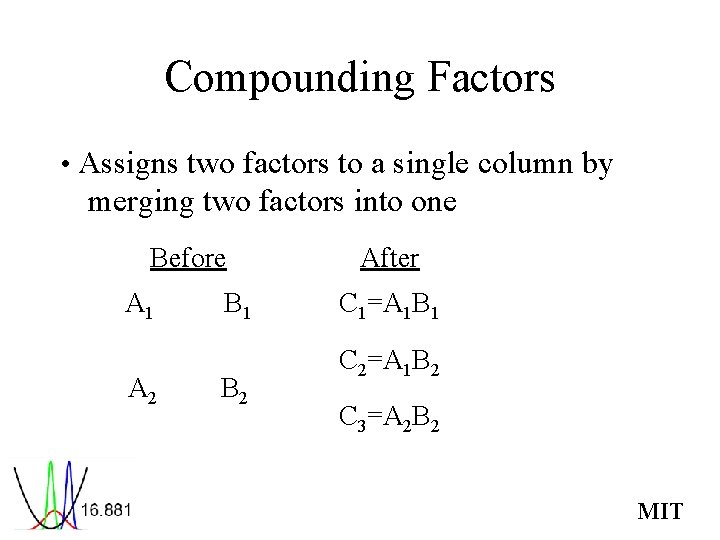
Compounding Factors • Assigns two factors to a single column by merging two factors into one Before A 1 A 2 B 1 B 2 After C 1=A 1 B 1 C 2=A 1 B 2 C 3=A 2 B 2 MIT
Compounding Factors -Example • 3 two level factors • 6 three level factors • What is the smallest array we can use? • How can compounding reduce the experimental effort? MIT
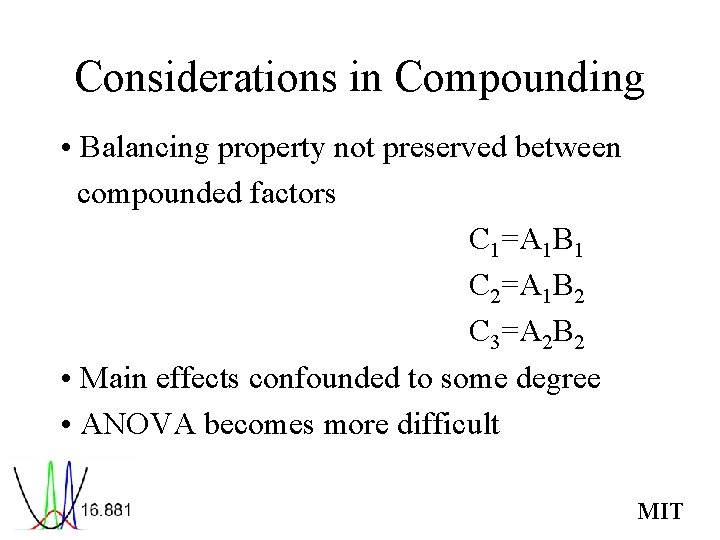
Considerations in Compounding • Balancing property not preserved between compounded factors C 1=A 1 B 1 C 2=A 1 B 2 C 3=A 2 B 2 • Main effects confounded to some degree • ANOVA becomes more difficult MIT
Interaction Tables • To avoid confounding A and B with Ax. B, leave a column unassigned • To know which column to leave unassigned, use an interaction table MIT
Interaction Table Example • We are running an L 8 • We believe that CF 4 and CF 6 have a significant interaction • Which column do we leave open? MIT
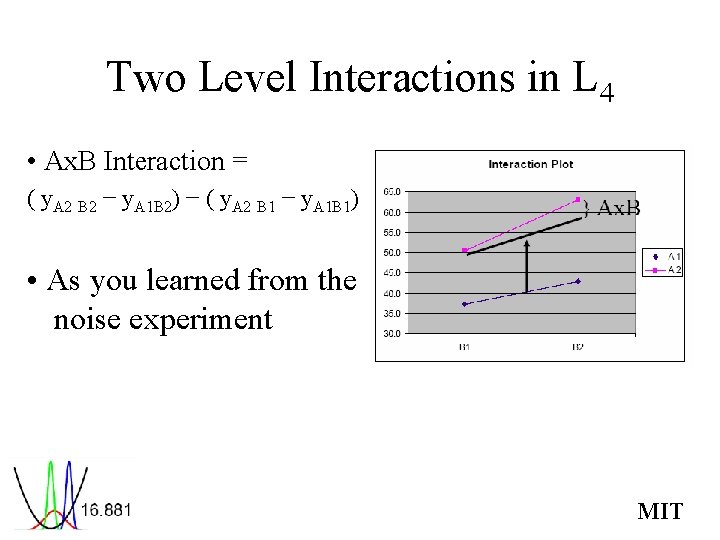
Two Level Interactions in L 4 • Ax. B Interaction = ( y. A 2 B 2 − y. A 1 B 2) − ( y. A 2 B 1 − y. A 1 B 1) • As you learned from the noise experiment MIT
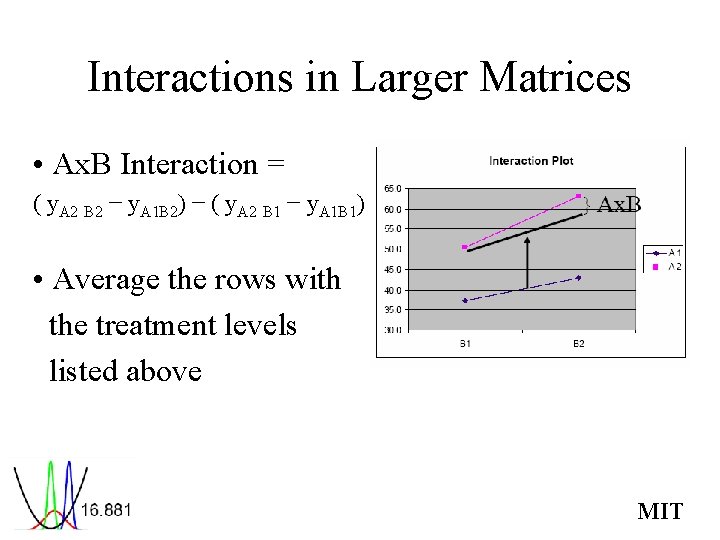
Interactions in Larger Matrices • Ax. B Interaction = ( y. A 2 B 2 − y. A 1 B 2) − ( y. A 2 B 1 − y. A 1 B 1) • Average the rows with the treatment levels listed above MIT
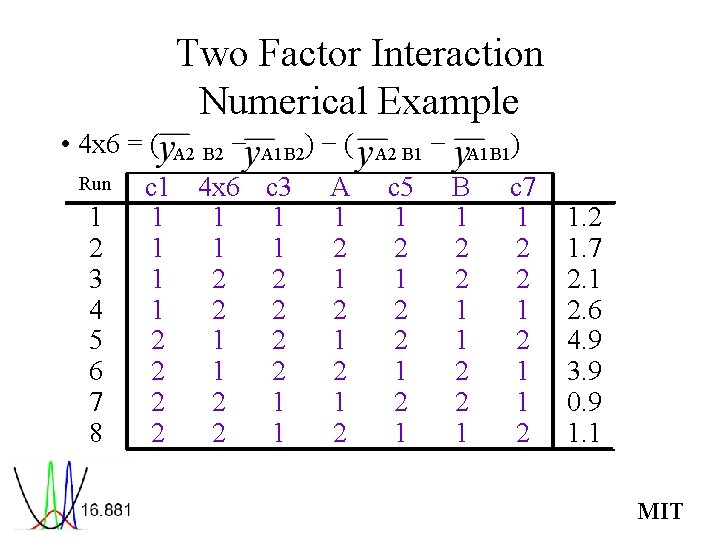
Two Factor Interaction Numerical Example • 4 x 6 = ( Run 1 2 3 4 5 6 7 8 A 2 B 2 − A 1 B 2) c 1 4 x 6 c 3 1 1 1 1 2 2 2 1 2 2 1 −( A 2 B 1 A 1 2 1 2 c 5 1 2 2 1 − A 1 B 1) B 1 2 2 1 c 7 1 2 2 1 1 2 1. 7 2. 1 2. 6 4. 9 3. 9 0. 9 1. 1 MIT
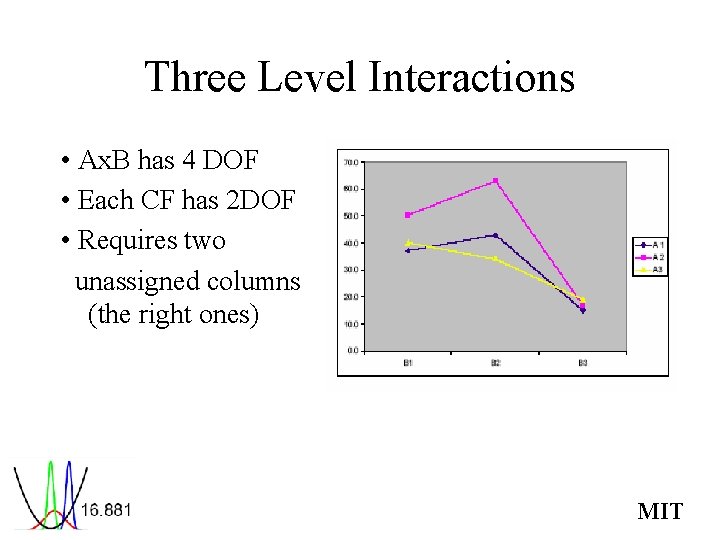
Three Level Interactions • Ax. B has 4 DOF • Each CF has 2 DOF • Requires two unassigned columns (the right ones) MIT
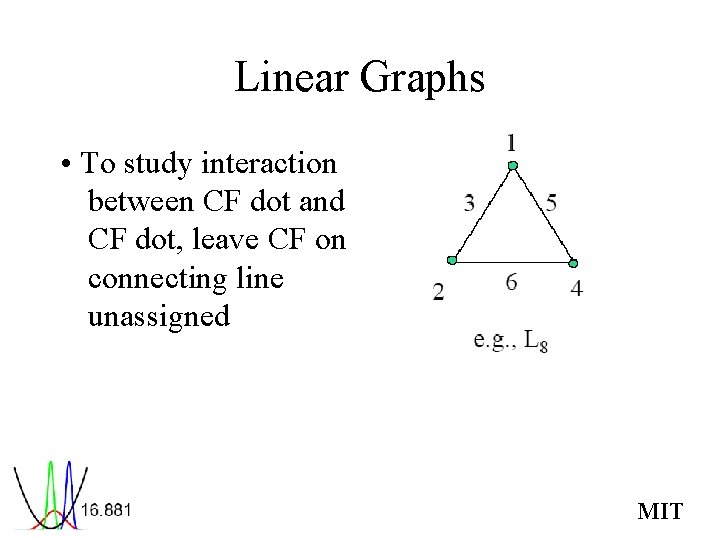
Linear Graphs • To study interaction between CF dot and CF dot, leave CF on connecting line unassigned MIT
Column Merging • Can turn 2 two level factors into a 4 level factor • Can turn 2 three level factors into a six level factor • Need to strike out interaction column (account for the right number of DOF!) • Example on an L 8 MIT
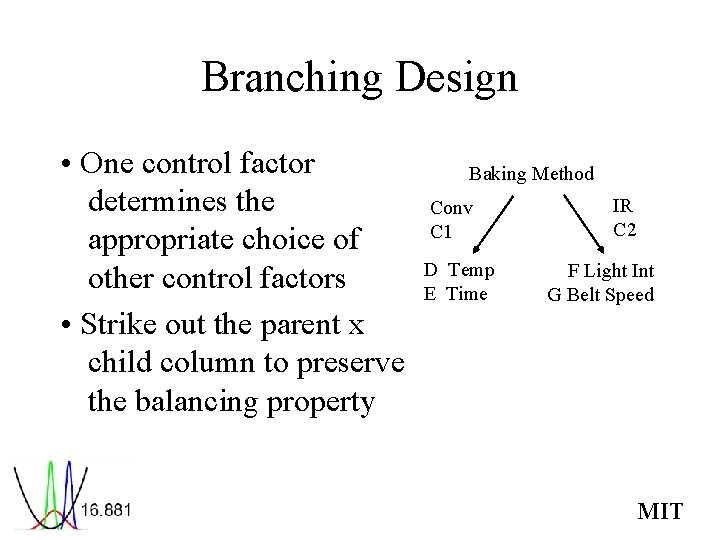
Branching Design • One control factor determines the appropriate choice of other control factors • Strike out the parent x child column to preserve the balancing property Baking Method Conv C 1 D Temp E Time IR C 2 F Light Int G Belt Speed MIT
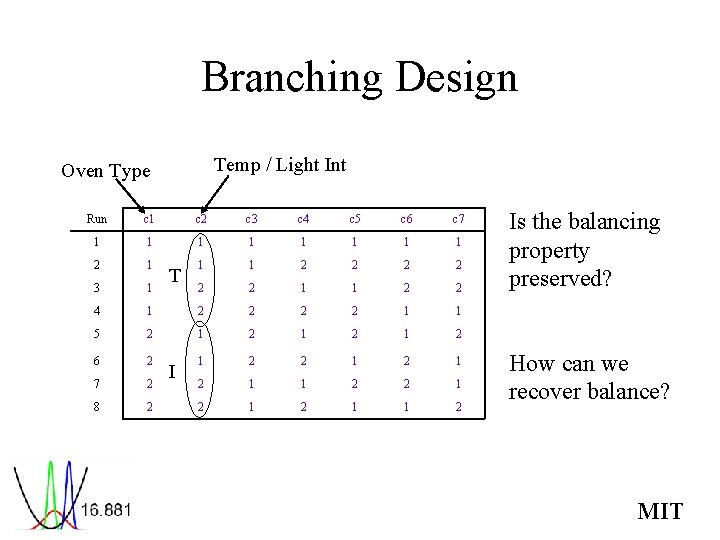
Branching Design Temp / Light Int Oven Type Run c 1 c 2 c 3 c 4 c 5 c 6 c 7 1 1 1 1 2 2 3 1 2 2 1 1 2 2 4 1 2 2 1 1 5 2 1 2 1 2 6 2 1 2 1 7 2 2 1 1 2 2 1 8 2 2 1 1 2 T I Is the balancing property preserved? How can we recover balance? MIT

Next Steps • Homework #7 due on Lecture 10 • Next session tomorrow– Read Phadke Ch. 10 – Read “Planning Efficient Software Tests” – Tought questions: • What does software do? • How is software different from hardware? • How does this affect the application of RD? • Quiz on Constructing Arrays MIT
- Slides: 31