
CONSTRUCTING FORMULAS Can you count to 8 Predicting
- Slides: 9
CONSTRUCTING FORMULAS Can you count to 8? !
Predicting Ionic Formulas ◦ The sum of the charges for the cation and anion add up to equal zero!
Writing Ionic Formulas Short cut…. 1. Write the symbols for the elements, cation (metal) first 2. Find the charge of the cation and anion 3. Crisscross the charges to use as subscripts, this should balance and give you a neutral formula (Do not bring the + and – down!) 4. Make sure your subscripts are the lowest whole number ratio
Writing formulas for binary ionic compounds… ◦ Examples: Aluminum and oxygen ◦ Al (3+) and O (2 -), crisscross the charges (remember you don’t have to show a subscript of one) ◦ Calcium and bromide: Ca (+2) and Br (-) ◦ Mg and NO 3 -1
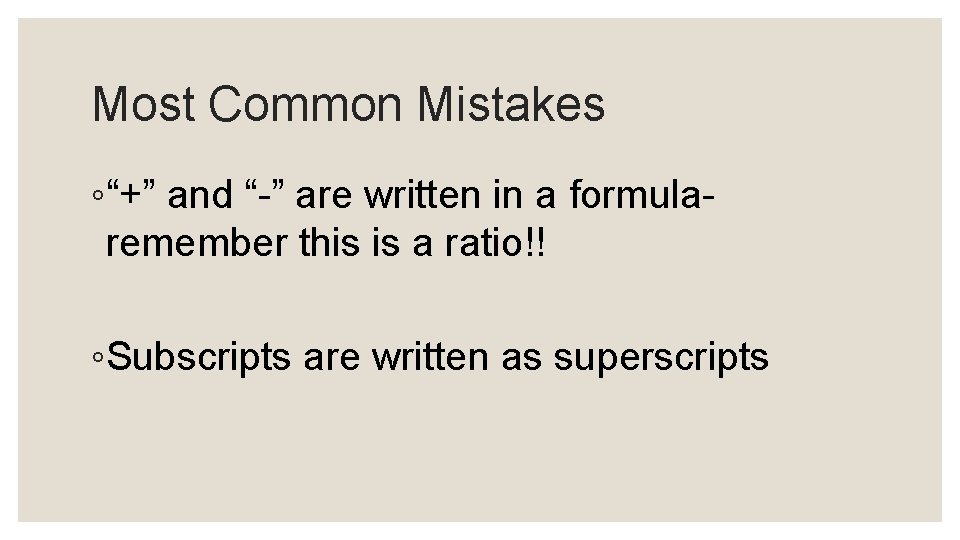
Most Common Mistakes ◦“+” and “-” are written in a formularemember this is a ratio!! ◦Subscripts are written as superscripts
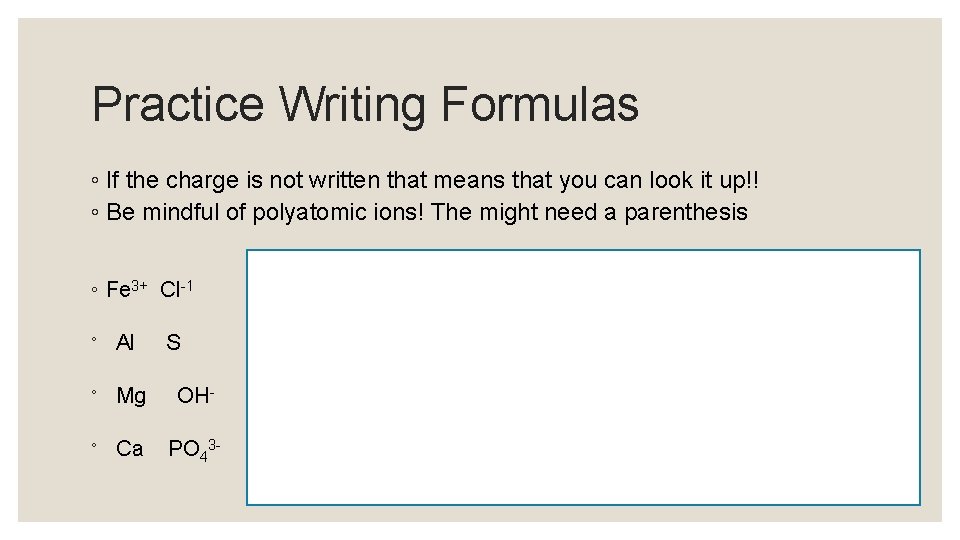
Practice Writing Formulas ◦ If the charge is not written that means that you can look it up!! ◦ Be mindful of polyatomic ions! The might need a parenthesis ◦ Fe 3+ Cl-1 ◦ Al ◦ Mg OH- ◦ Ca PO 43 - S
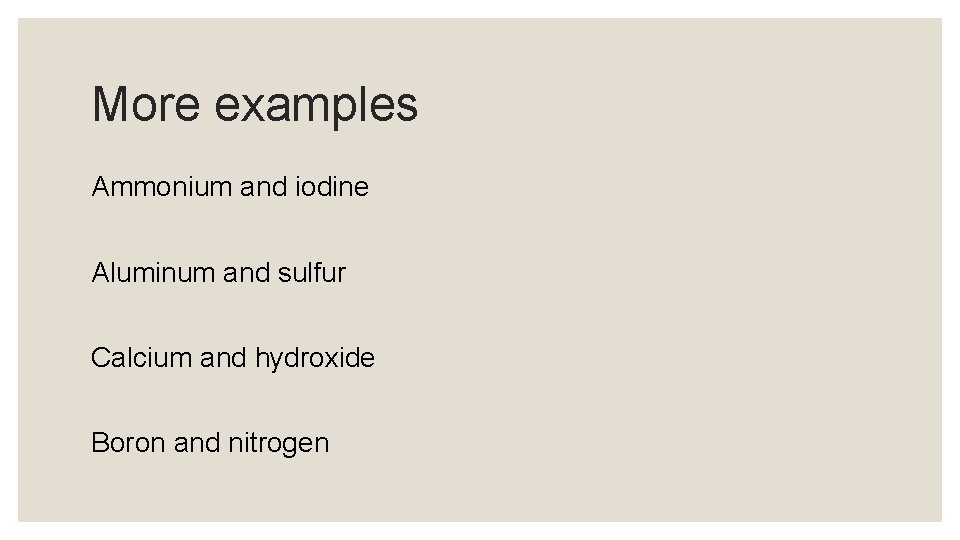
More examples Ammonium and iodine Aluminum and sulfur Calcium and hydroxide Boron and nitrogen
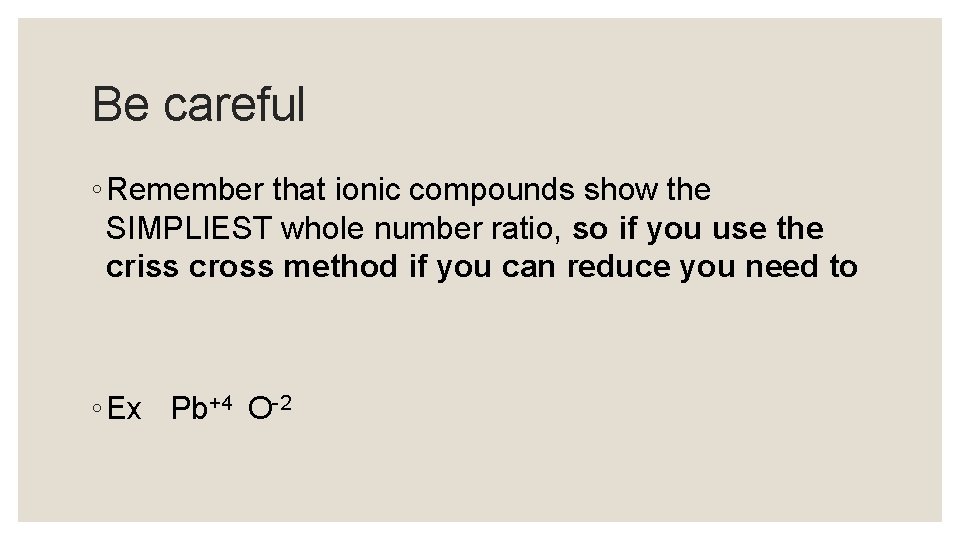
Be careful ◦ Remember that ionic compounds show the SIMPLIEST whole number ratio, so if you use the criss cross method if you can reduce you need to ◦ Ex Pb+4 O-2
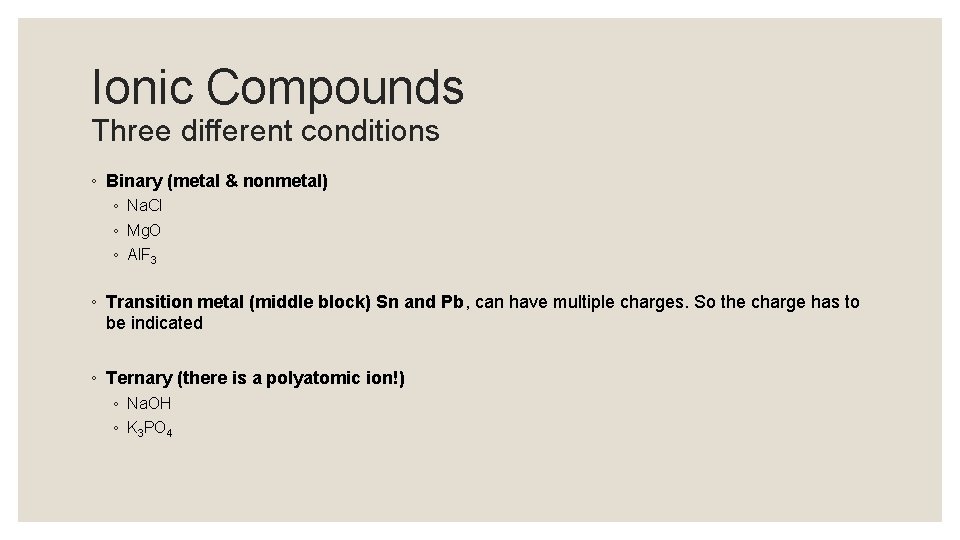
Ionic Compounds Three different conditions ◦ Binary (metal & nonmetal) ◦ Na. Cl ◦ Mg. O ◦ Al. F 3 ◦ Transition metal (middle block) Sn and Pb, can have multiple charges. So the charge has to be indicated ◦ Ternary (there is a polyatomic ion!) ◦ Na. OH ◦ K 3 PO 4