
Constructing a Rubric Constructing a Rubric Four Key
Constructing a Rubric
Constructing a Rubric Four Key Stages 1. Reflection 2. Listing of Objectives 3. Grouping and Labeling 4. Application (Stevens & Levi, 2005)
Step 1: Reflection Eight questions to consider: 1. 2. 3. 4. 5. 6. Why did you create assignment? Have you given this or similar assignment before? How does the assignment relate to the rest of the course? What skills do students need for successful completion? What exactly is the task assigned? What evidence can students provide to show they have successfully completed the assignment? 7. What does an exemplary product look like? 8. What does the worst example of a product look like? (Stevens & Levi, 2005)
Example: Ethnographies of Work II Final Research Project • Why did I create this assignment? – Semester-Long Signature Assignment – Research Project/e. Portfolio – Reflection – Measure application of ethnographic research skills – Inter-disciplinary skills (e. g. writing, research, presentation). – GLOs – Specialized Knowledge, Applied Learning, Intellectual Skills

Step 2: Listing What are the specific learning objectives for this assignment? What is the highest level of performance you expect for each learning goal?
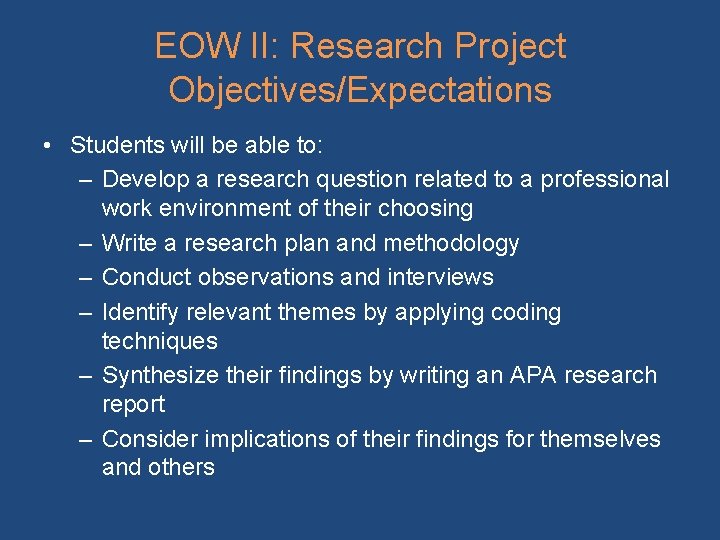
EOW II: Research Project Objectives/Expectations • Students will be able to: – Develop a research question related to a professional work environment of their choosing – Write a research plan and methodology – Conduct observations and interviews – Identify relevant themes by applying coding techniques – Synthesize their findings by writing an APA research report – Consider implications of their findings for themselves and others
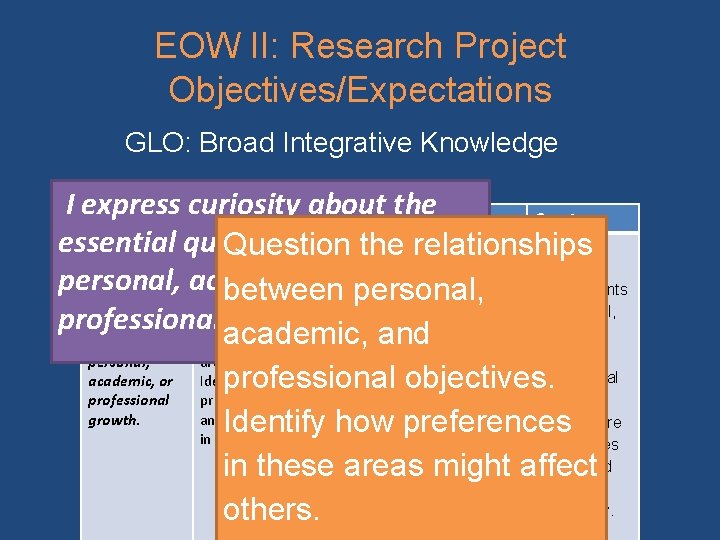
EOW II: Research Project Objectives/Expectations GLO: Broad Integrative Knowledge I express curiosity about the. Milestone Capstone Skill Benchmark Emerging Question the Recognize Reflect on I express Describe essential questions thatthe drive Question relationships curiosity differences relationships overlaps and how about the between personal, academic, orpersonal, between tensions commitments between essential personal, between to personal, questions that academic, and professional growth. academic, and personal, academic, drive professional and academic, and personal, areas of life. professional objectives. and professional academic, or Identify professional preferences objectives. professional growth will growth. and. Identify interests Identify how preferences objectives shape future how in these areas. preferences in and explains experiences theseareasons for affect for self and in these might affect prioritizing larger growth in one community. others. or more areas.
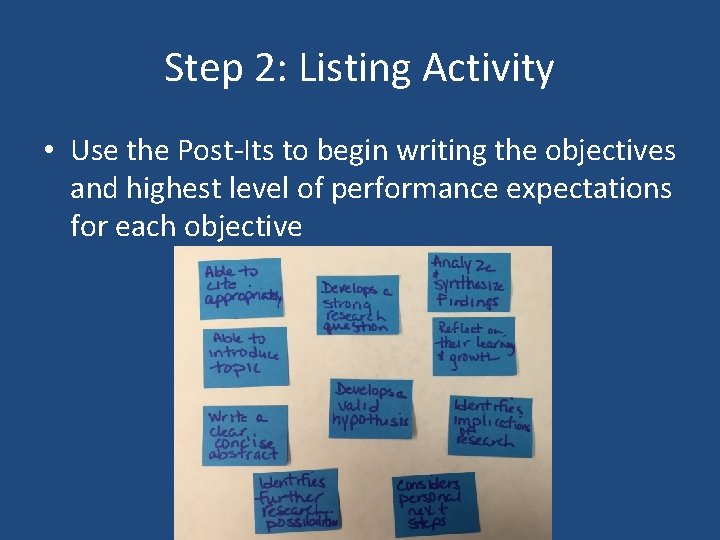
Step 2: Listing Activity • Use the Post-Its to begin writing the objectives and highest level of performance expectations for each objective
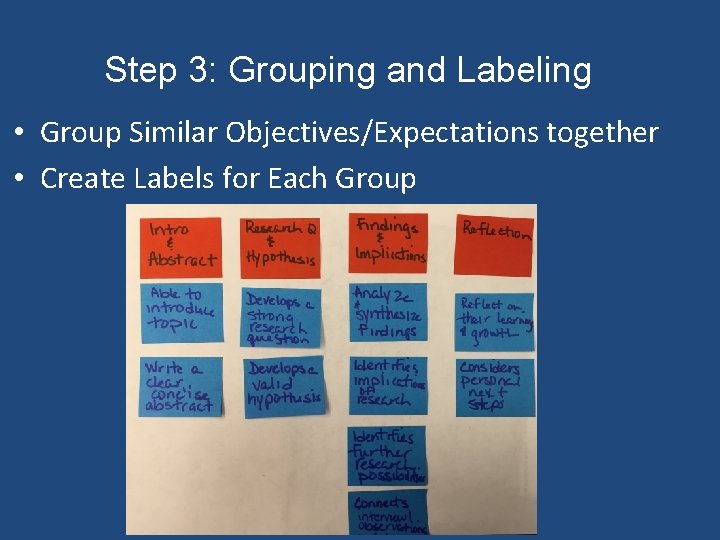
Step 3: Grouping and Labeling • Group Similar Objectives/Expectations together • Create Labels for Each Group
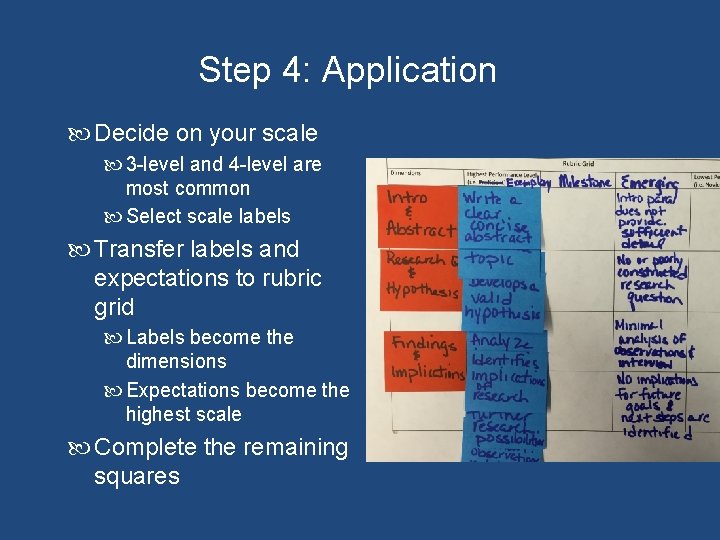
Step 4: Application Decide on your scale 3 -level and 4 -level are most common Select scale labels Transfer labels and expectations to rubric grid Labels become the dimensions Expectations become the highest scale Complete the remaining squares
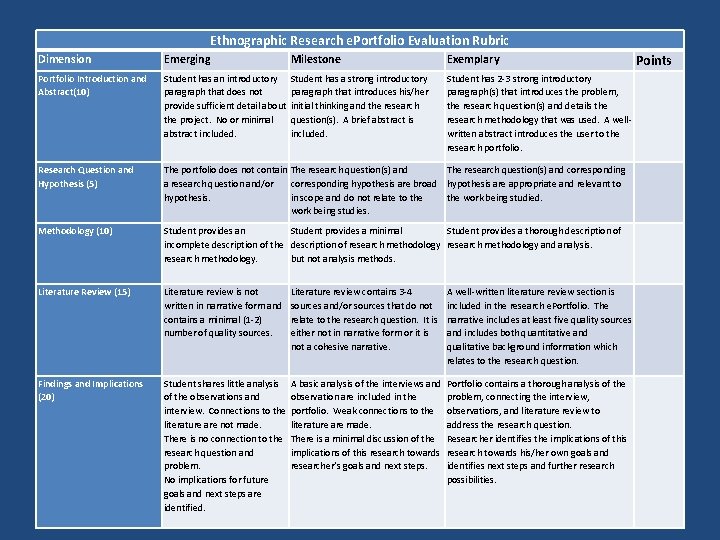
Ethnographic Research e. Portfolio Evaluation Rubric Dimension Emerging Milestone Exemplary Portfolio Introduction and Abstract(10) Student has an introductory paragraph that does not provide sufficient detail about the project. No or minimal abstract included. Student has a strong introductory paragraph that introduces his/her initial thinking and the research question(s). A brief abstract is included. Student has 2 -3 strong introductory paragraph(s) that introduces the problem, the research question(s) and details the research methodology that was used. A wellwritten abstract introduces the user to the research portfolio. Research Question and Hypothesis (5) The portfolio does not contain The research question(s) and corresponding a research question and/or corresponding hypothesis are broad hypothesis are appropriate and relevant to hypothesis. in scope and do not relate to the work being studied. work being studies. Methodology (10) Student provides an Student provides a minimal Student provides a thorough description of incomplete description of the description of research methodology and analysis. research methodology. but not analysis methods. Literature Review (15) Literature review is not written in narrative form and contains a minimal (1 -2) number of quality sources. Literature review contains 3 -4 sources and/or sources that do not relate to the research question. It is either not in narrative form or it is not a cohesive narrative. A well-written literature review section is included in the research e. Portfolio. The narrative includes at least five quality sources and includes both quantitative and qualitative background information which relates to the research question. Findings and Implications (20) Student shares little analysis of the observations and interview. Connections to the literature are not made. There is no connection to the research question and problem. No implications for future goals and next steps are identified. A basic analysis of the interviews and observation are included in the portfolio. Weak connections to the literature are made. There is a minimal discussion of the implications of this research towards researcher’s goals and next steps. Portfolio contains a thorough analysis of the problem, connecting the interview, observations, and literature review to address the research question. Researcher identifies the implications of this research towards his/her own goals and identifies next steps and further research possibilities. Points
- Slides: 11