
CONSTRUCTING A LEARNING ENVIRONMENT FREE FROM DISCRIMINATION PREJUDICE
![INTERNATIONAL INSTRUMENTS § UDHR Preamble: “(…) every individual and every organ of society [should]](https://slidetodoc.com/presentation_image_h2/000750db6479372a13e0f6fcabf670a9/image-6.jpg "INTERNATIONAL INSTRUMENTS § UDHR Preamble: “(…) every individual and every organ of society [should]")
- Slides: 21
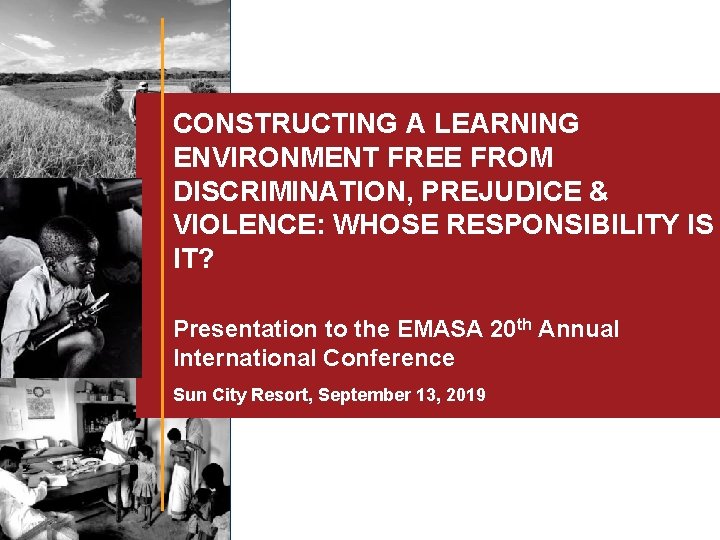
CONSTRUCTING A LEARNING ENVIRONMENT FREE FROM DISCRIMINATION, PREJUDICE & VIOLENCE: WHOSE RESPONSIBILITY IS IT? Presentation to the EMASA 20 th Annual International Conference Sun City Resort, September 13, 2019
CONTENTS § INTRODUCTION § LEGISLATIVE FRAMEWORK § NHRI MANDATE AREAS & HUMAN RIGHTS EDUCATION § INTERNATIONAL INSTRUMENTS § UN DECLARATION ON HUMAN RIGHTS EDUCATION § HUMAN RIGHTS EDUCATION IN SOUTH AFRICA § CHALLENGES: LGBTI RIGHTS & GENDER-BASED VIOLENCE § CHALLENGES: RACISM & DIVERSITY § NHRI’S RESPONSIBILITIES ON EDUCATION § RESPONSIBILITIES OF THE EDUCATOR § CONCLUSION
INTRODUCTION § Dark history of discrimination. § During Apartheid ‘race’ emerged as the dominant form of identity in South Africa. § Apartheid policy of segregation: lack of frequent interaction between racial groups. § Marginalisation and exclusion of LGBTQI Persons. § Deeply entrenched homophobic attitudes. § The lack of teacher training in the area of sexual, gender & cultural diversity. § School violence: country’s legacy of political struggle. § The extent to which human rights values are embedded in SA’s postapartheid curricula.
LEGISLATIVE FRAMEWORK § Sections 9, 10, 12, 14, 16, 28, & 29 of the Constitution. § The Promotion of Equality & Prevention of Unfair Discrimination Act 4 of 2000: prohibits unfair discrimination by the State and individuals. § The South African Schools Act (1996): In terms of the preamble of this Act, the school system needs to redress past injustices in educational provision and the need to combat racism, and sexism and all other forms of unfair discrimination and intolerance and uphold the rights of all learners. § Employment of Educators Act 76 of 1998: This Act governs the relationship between an educator – including teachers at public schools – and their employer.
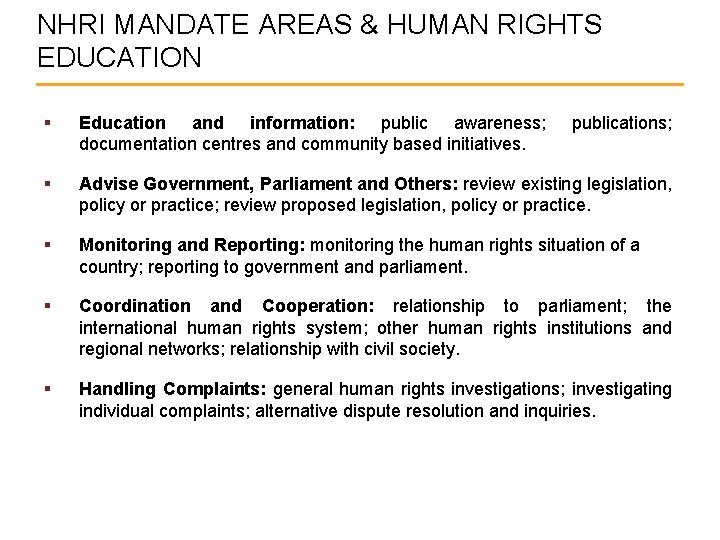
NHRI MANDATE AREAS & HUMAN RIGHTS EDUCATION § Education and information: public awareness; documentation centres and community based initiatives. § Advise Government, Parliament and Others: review existing legislation, policy or practice; review proposed legislation, policy or practice. § Monitoring and Reporting: monitoring the human rights situation of a country; reporting to government and parliament. § Coordination and Cooperation: relationship to parliament; the international human rights system; other human rights institutions and regional networks; relationship with civil society. § Handling Complaints: general human rights investigations; investigating individual complaints; alternative dispute resolution and inquiries. publications;
INTERNATIONAL INSTRUMENTS § UDHR Preamble: “(…) every individual and every organ of society [should] strive by teaching and education to promote respect for these rights and freedoms. . ” § CRC art 29: “(…) the education of the child shall be directed to: (…) The development of respect for human rights and fundamental freedoms…” § Vienna Declaration and Programme of Action: “(…) considers human rights education, training and public information essential for the promotion and achievement of stable and harmonious relations among communities and for fostering mutual understanding, tolerance and peace. ”
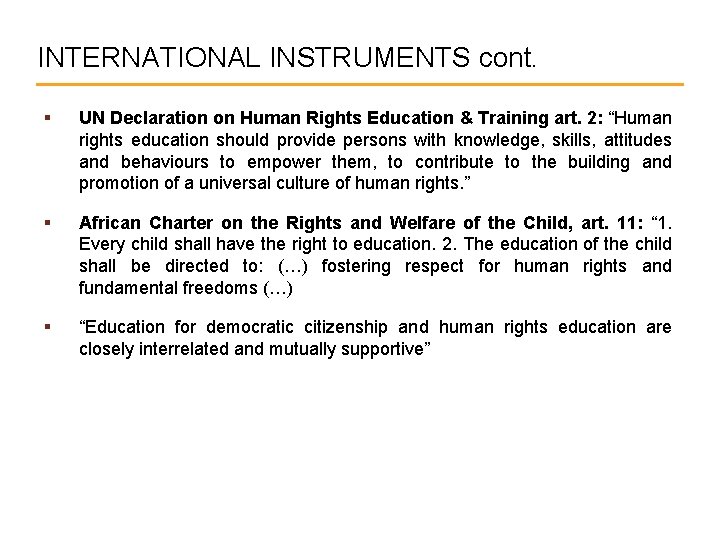
INTERNATIONAL INSTRUMENTS cont. § UN Declaration on Human Rights Education & Training art. 2: “Human rights education should provide persons with knowledge, skills, attitudes and behaviours to empower them, to contribute to the building and promotion of a universal culture of human rights. ” § African Charter on the Rights and Welfare of the Child, art. 11: “ 1. Every child shall have the right to education. 2. The education of the child shall be directed to: (…) fostering respect for human rights and fundamental freedoms (…) § “Education for democratic citizenship and human rights education are closely interrelated and mutually supportive”
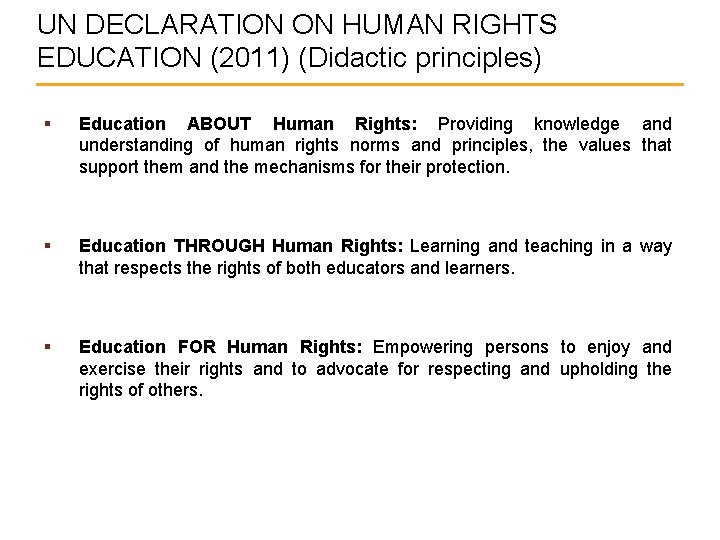
UN DECLARATION ON HUMAN RIGHTS EDUCATION (2011) (Didactic principles) § Education ABOUT Human Rights: Providing knowledge and understanding of human rights norms and principles, the values that support them and the mechanisms for their protection. § Education THROUGH Human Rights: Learning and teaching in a way that respects the rights of both educators and learners. § Education FOR Human Rights: Empowering persons to enjoy and exercise their rights and to advocate for respecting and upholding the rights of others.
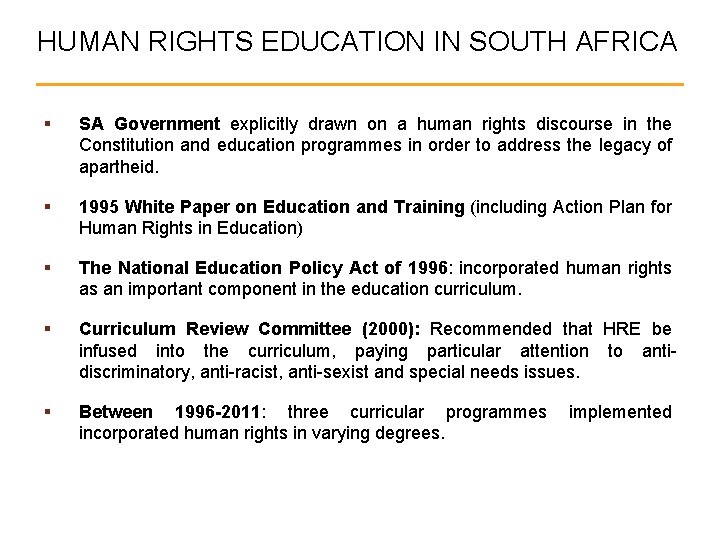
HUMAN RIGHTS EDUCATION IN SOUTH AFRICA § SA Government explicitly drawn on a human rights discourse in the Constitution and education programmes in order to address the legacy of apartheid. § 1995 White Paper on Education and Training (including Action Plan for Human Rights in Education) § The National Education Policy Act of 1996: incorporated human rights as an important component in the education curriculum. § Curriculum Review Committee (2000): Recommended that HRE be infused into the curriculum, paying particular attention to antidiscriminatory, anti-racist, anti-sexist and special needs issues. § Between 1996 -2011: three curricular programmes incorporated human rights in varying degrees. implemented
HUMAN RIGHTS EDUCATION IN SOUTH AFRICA § Under OBE: 2 & half hours allocated for human and social sciences. § OBE critiqued for lack of a guiding framework for teachers & the lack of relevance for the classroom. § The RNCS aimed to mainstream values related to social justice. § Introduction of CAPS curriculum, Min DBE states “we have built our curriculum on the values that inspired our Constitution” § Reception of human rights framework in schools: ranges from rejection, to passivity, to enthusiastic acceptance. § Life orientation teachers do not feel sufficiently trained to teach the subject.
HUMAN RIGHTS EDUCATION CHALLENGES § A gap between human rights values being promoted by DBE’s policy makers and the personal values held by teachers. § Majority of South African learners continue to be unaware of their constitutional rights and/or how these rights apply to the persistent inequalities surrounding them. § Human rights discourse is prevalent in South African textbooks in general but it is limited to conveying knowledge. § Teachers do not receive sufficient training to teach learners about rights and how to protect and defend them beyond conveying basic knowledge. § Majority of textbooks rely on a knowledge and awareness approach rather than an action and advocacy approach.
CHALLENGES: LGBTQI RIGHTS & GBV § There is social intolerance against LGBTI people. § Harassment and assault of LGBTQI learners by peers and educators. § Lack of support systems, lack of affirming materials in schools. § Non-heterosexual girls, have a high risk of sanctions in schools and have greater odds of being confronted by police and expulsion from school, than heterosexual girls. § “Corrective rape” is a growing phenomenon in South African schools. § Stigma attached to sexual orientation and gender identity or expression relegates many LGBTQI learners to the margins of society.
CHALLENGES: RACISM AND DIVERSITY § Incidents of unfair treatment of black learners. § Racial disparities in learner’s academic achievement and inequality between historically black and white schools. § Some schools are not tackling racism in schools as they should. § Some schools prefer to deny the existence of racism or presume a superficial tolerance. § Learners are expected to adapt to the existing ethos of the school, curricula and culture. We need to ask whose way of seeing the world children are taught in our schools in South Africa. § Some schools have embraced the changes that integration has brought and are experimenting with new approaches to deal with racial diversity in the classroom.
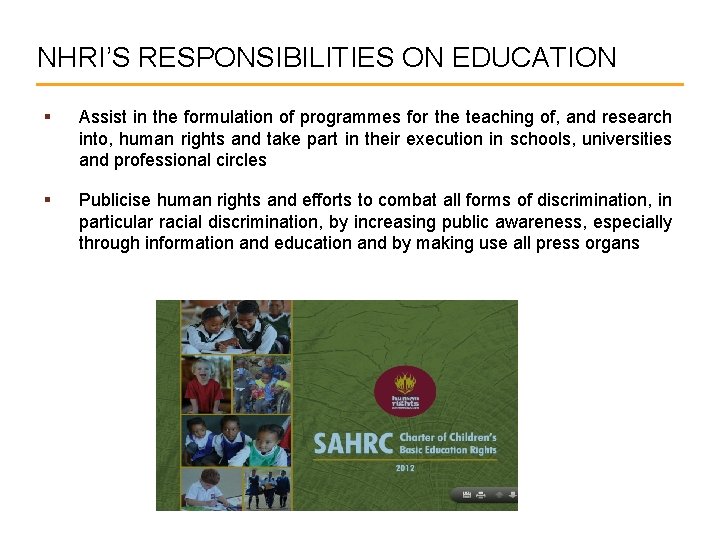
NHRI’S RESPONSIBILITIES ON EDUCATION § Assist in the formulation of programmes for the teaching of, and research into, human rights and take part in their execution in schools, universities and professional circles § Publicise human rights and efforts to combat all forms of discrimination, in particular racial discrimination, by increasing public awareness, especially through information and education and by making use all press organs
NHRI’S RESPONSIBILITIES ON EDUCATION § In 2012, the South African Human Rights Commission developed a Charter on Basic Education Rights and with the objective that the Charter will articulate the State’s obligation to respect, protect, promote and fulfil the right to basic education. § The Charter provides for various obligations to the state to ensure the realisation of the right to basic education; notes key shortcomings and inequalities; revisits commitments to address the gaps in achieving quality education and identifies the key role players. § The Charter is premised on the 4 A framework developed by the former UN Special Rapporteur on the right to education. The framework focuses on availability, acceptability, adaptability and accessibility of basic education.
NHRI’S RESPONSIBILITIES ON EDUCATION § Availability entails that the government assure that the available facilities are protected from elements, sufficient teaching materials, sanitation for both boys and girls, safe drinking water and trained teachers. § Accessibility can be divided into three dimensions; economic accessibility, physical accessibility and non-discrimination. § Acceptability concerns such issues such as language of instruction, freedom from censorship, recognition of children as the subjects of rights, acceptable teaching methods and minimum educational standard as approved by the state. § Adaptability: The education system should be able to respond to children’s needs within particular cultural and community settings. The state is required to recognise, provide and adapt education for children with disabilities, working children, refugees, or children deprived of their liberty. This component is essential to ensure that government and schools respect and safeguard human rights within schools.
RESPONSIBILITIES OF THE EDUCATOR § Norms and Standards for Educators (2000): The Framework identifies “seven roles and associated competence for educators [which] are in effect the norms for educator development and therefore the central feature of all initial educator qualifications”. One such role is that pertaining to community, citizenship and pastoral duties, in terms of which “The educator will practise and promote a critical, committed and ethical attitude towards developing a sense of respect and responsibility towards others. The educator will uphold the constitution and promote democratic values and practices in schools and society. Within the school, the educator will demonstrate an ability to develop a supportive and empowering environment for the learner and respond to the educational and other needs of learners and fellow educators. ”
RESPONSIBILITIES OF THE EDUCATOR § South African Council for Educators Code of Professional Ethics o Section 2(3) of the Code provides that educators registered with the SACE “acknowledge, uphold and promote basic human rights, as embodied in the Constitution of South Africa”. o Section 3 then stipulates that an educator “[respect] the dignity, beliefs and constitutional rights of learners and in particular children” and further “[strive] to enable learners to develop a set of values consistent with the fundamental rights contained in the Constitution of South Africa”.
RESPONSIBILITIES OF THE EDUCATOR § South African Council for Educators Code of Professional Ethics § Section 2(3) of the Code provides that educators registered with the SACE “acknowledge, uphold and promote basic human rights, as embodied in the Constitution of South Africa”. § Section 3 then stipulates that an educator “[respect] the dignity, beliefs and constitutional rights of learners and in particular children” and further “[strive] to enable learners to develop a set of values consistent with the fundamental rights contained in the Constitution of South Africa”. § Leadership in the classroom. “Who always does what he’s done, will only achieve what he has always achieved. ” ~ George Bernard Shaw
CONCLUSION § Address disconnect between human rights discourse and the absence of the fulfilment of human rights on the ground. § Develop a more human rights aligned curriculum. § Focus should be more on critical analysis rather than just imparting knowledge about human rights. § Education should not be viewed as just a tool formal learning but also a crucial instrument in personal and social development. § Curriculum changes should instigate learners to act on behalf of protecting their rights. § Embrace human rights and multi-culturalism rather than the assimilationist discourse. § Situational analysis of the teaching and learning environment.
CONCLUSION § Call upon all stakeholders state and non-state to pledge their support to the implementation of the policies and programmes outlined in the Nation Action Plan and the National Development Plan. § The South African government and other critical role players must review the educational curriculum in order to eliminate propagation of racism, prejudice and violence through the education system. § The South African Human Rights Commission should convene thought dialogues to interrogate societal values in order to drive systematic and cultural change. § The South African Parliament should consider gaps in policy and legislation in order to improve legal responses to address overt discriminatory and violent conduct in schools. § Civil society and media should hold educators and DBE accountable to values of human rights and non-discrimination.