
Constraints on Seismogenesis of Small Earthquakes from the
- Slides: 16
Constraints on Seismogenesis of Small Earthquakes from the Natural Earthquake Laboratory in South African Mines (NELSAM) Margaret S. Boettcher (USGS Mendenhall Fellow) Art Mc. Garr and Malcolm Johnston (USGS) Thomas H. Jordan (SCEC/USC) Vincent Heesakkers and Ze’ev Reches (Oklahoma U. )
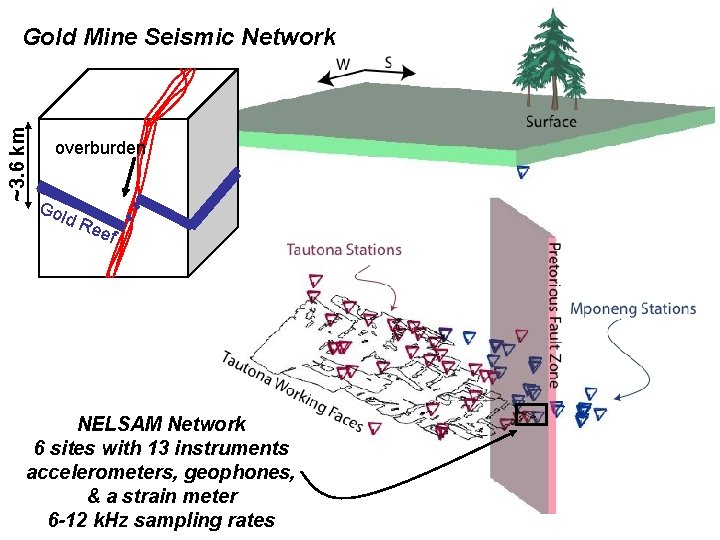
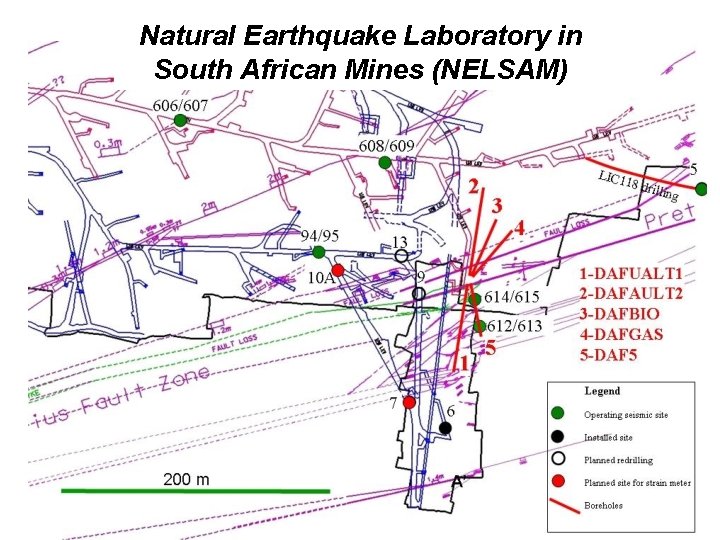
~3. 6 km Gold Mine Seismic Network overburden Gol d. R eef NELSAM Network Tau. Tona Mine: Geophones 6 sites with 13 25 instruments Mponeng Mine: 20 Geophones accelerometers, geophones, & a strain meter 1 -3 components, 200 - 3000 Hz 6 -12 k. Hz sampling rates
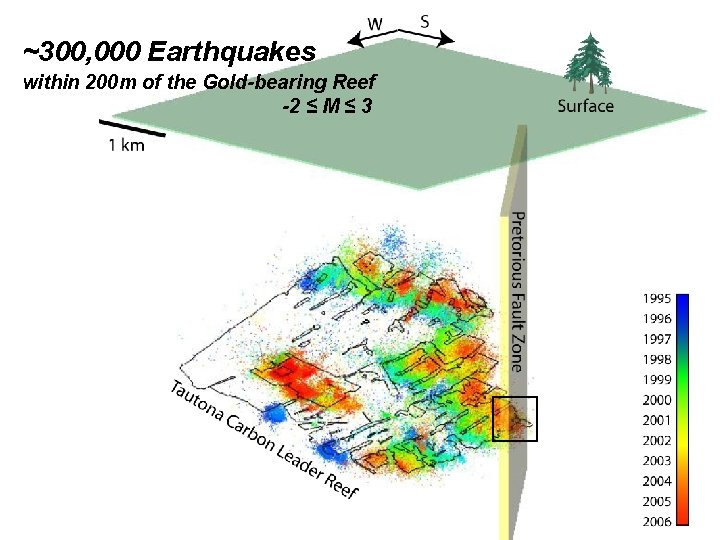
~300, 000 Earthquakes within 200 m of the Gold-bearing Reef -2 ≤ M ≤ 3
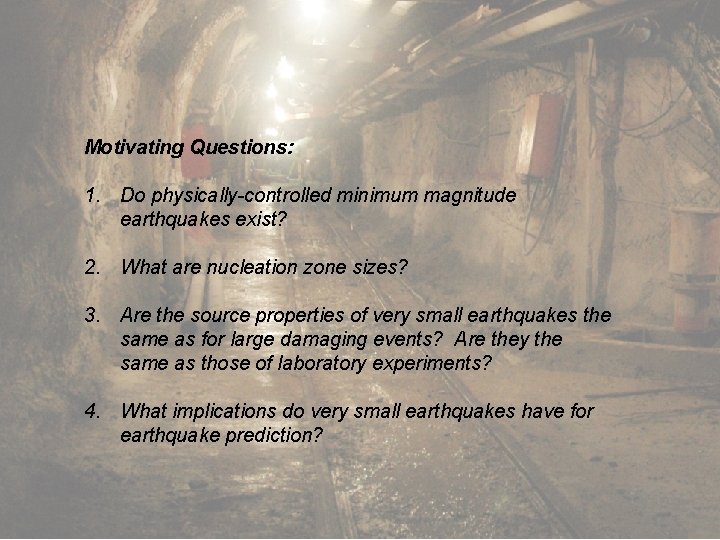
Motivating Questions: 1. Do physically-controlled minimum magnitude earthquakes exist? 2. What are nucleation zone sizes? 3. Are the source properties of very small earthquakes the same as for large damaging events? Are they the same as those of laboratory experiments? 4. What implications do very small earthquakes have for earthquake prediction?
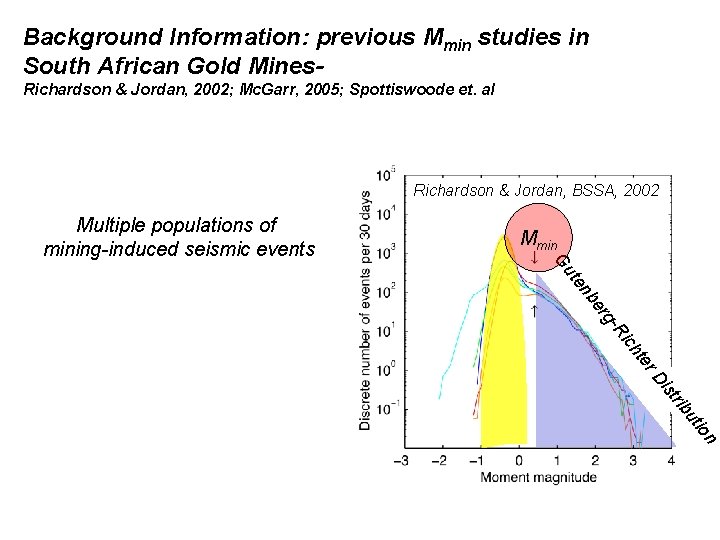
Background Information: previous Mmin studies in South African Gold Mines. Richardson & Jordan, 2002; Mc. Garr, 2005; Spottiswoode et. al “Directly Mining-Induced” • M < 0 Multiple populations of • explosive components • high frequency source spectra • follow Gutenberg-Richter distribution n • distributed in space and time io ut ib • failure on pre-existing planes of weakness r ist • shear + implosive components r. D “Tectonic-Like” te ich -R rg be en • affinity to active mining (space and time) Mmin t Gu mining-induced seismic events Richardson & Jordan, BSSA, 2002
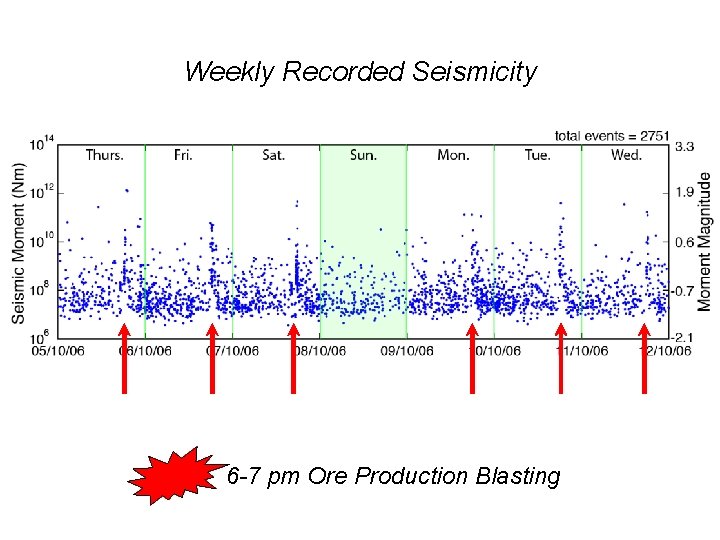
Weekly Recorded Seismicity 6 -7 pm Ore Production Blasting
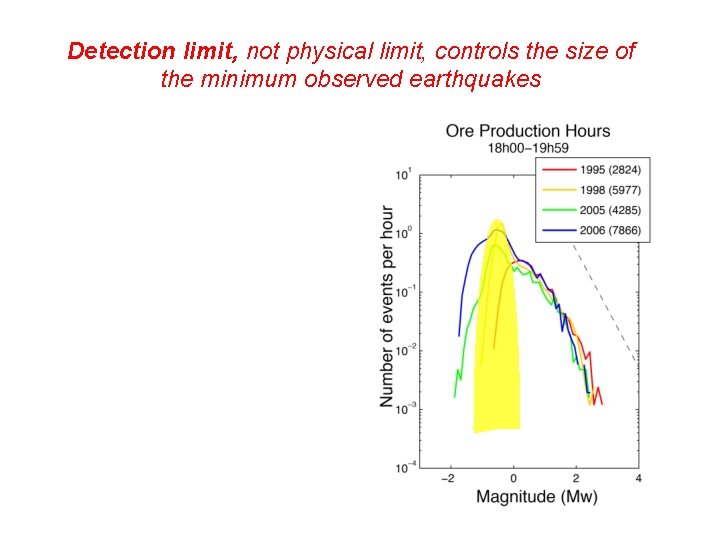
Are limit, there not physically-controlled minimum Detection physical limit, controls the size of magnitude earthquakes? the minimum observed earthquakes Mmin ≈ -1. 2 Gu ter ich R g- r be ten n tio ibu str Di
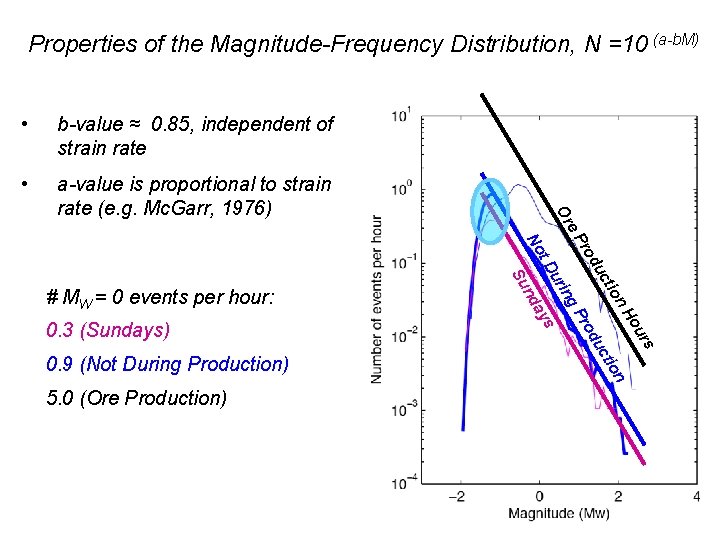
Properties of the Magnitude-Frequency Distribution, N =10 (a-b. M) b-value ≈ 0. 85, independent of strain rate • a-value is proportional to strain rate (e. g. Mc. Garr, 1976) Or • ou n. H n tio uc rs od Pr s ay g rin tio uc d ro Du 5. 0 (Ore Production) nd 0. 9 (Not During Production) e. P t No 0. 3 (Sundays) Su # MW = 0 events per hour:
• We currently have no observations of a physically-controlled minimum magnitude. • What is the current minimum detectable magnitude? • What implications does this size have for earthquake nucleation and prediction?
Natural Earthquake Laboratory in South African Mines (NELSAM)
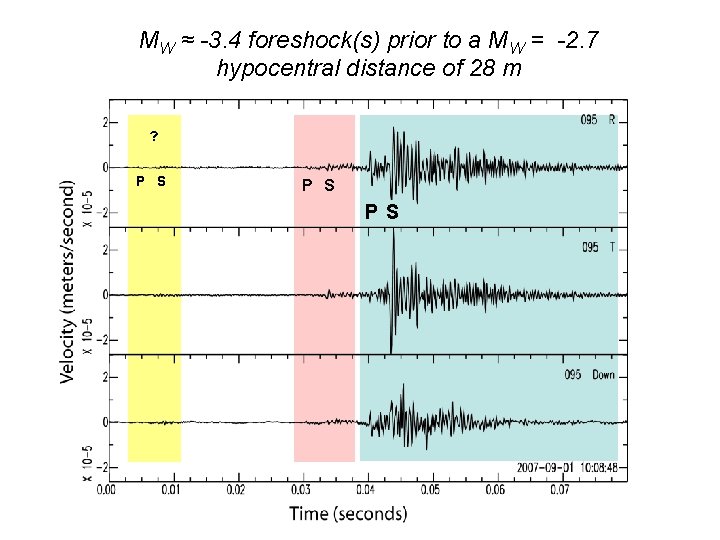
MW ≈ -3. 4 foreshock(s) prior to a MW = -2. 7 hypocentral distance of 28 m ? P S PS
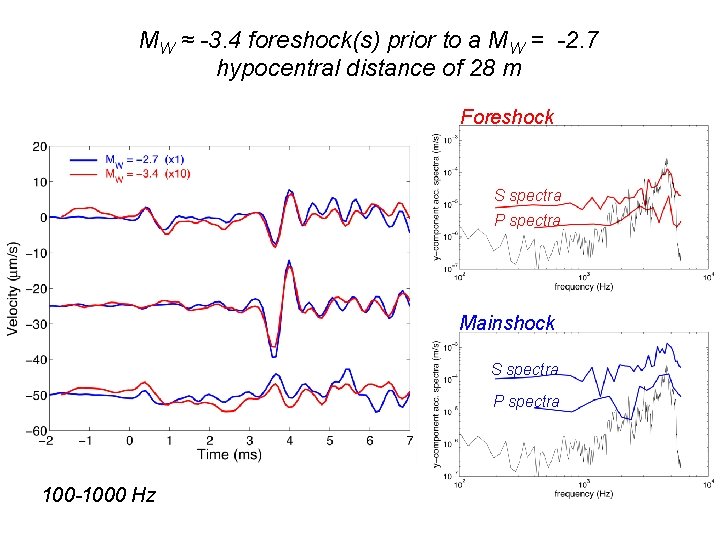
MW ≈ -3. 4 foreshock(s) prior to a MW = -2. 7 hypocentral distance of 28 m Foreshock S spectra P spectra Mainshock S spectra P spectra 100 -1000 Hz
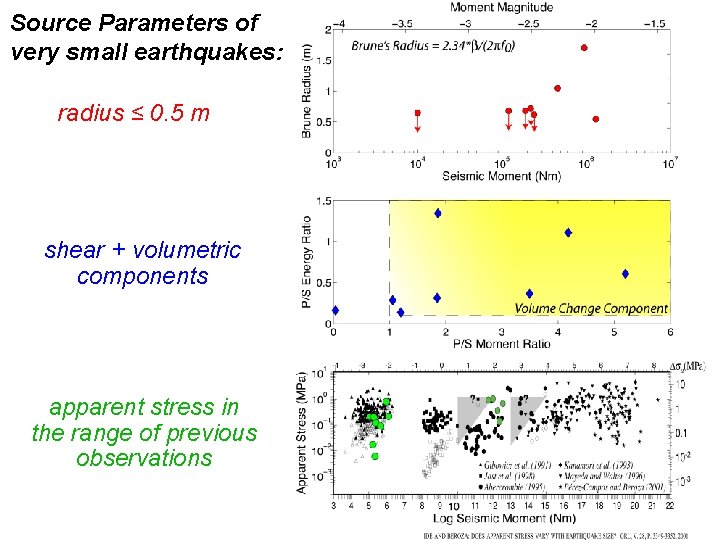
Source Parameters of very small earthquakes: radius ≤ 0. 5 m shear + volumetric components apparent stress in the range of previous observations
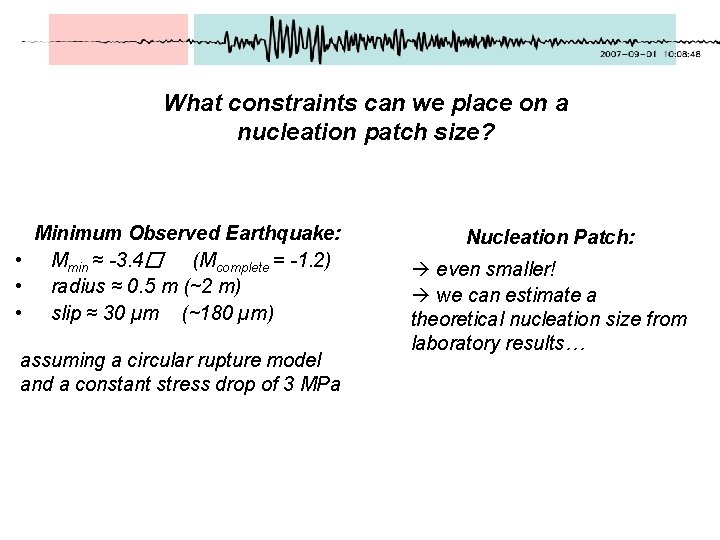
What constraints can we place on a nucleation patch size? Minimum Observed Earthquake: • Mmin ≈ -3. 4� (Mcomplete = -1. 2) • radius ≈ 0. 5 m (~2 m) • slip ≈ 30 µm (~180 µm) assuming a circular rupture model and a constant stress drop of 3 MPa Nucleation Patch: even smaller! we can estimate a theoretical nucleation size from laboratory results…
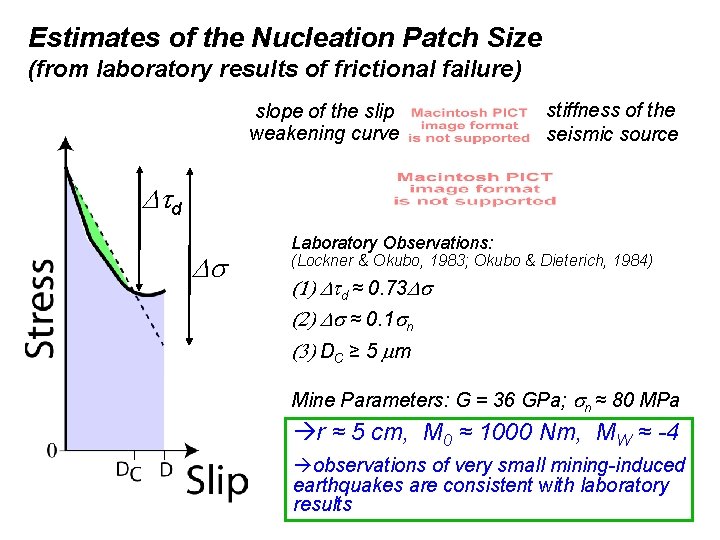
Estimates of the Nucleation Patch Size (from laboratory results of frictional failure) slope of the slip weakening curve stiffness of the seismic source d Laboratory Observations: (Lockner & Okubo, 1983; Okubo & Dieterich, 1984) d ≈ 0. 73 ≈ 0. 1 n DC ≥ 5 m Mine Parameters: G = 36 GPa; n ≈ 80 MPa r ≈ 5 cm, M 0 ≈ 1000 Nm, MW ≈ -4 observations of very small mining-induced earthquakes are consistent with laboratory results
Implications for Earthquake Physics and Prediction Detection limitations, not earthquake source physics, control the observed catalog completeness threshold (MW ≤ -1. 2) in Tau. Tona Mine, South Africa. There is no evidence for minimum-sized earthquakes. With decreasing seismic moment, earthquakes exhibit shear + tensile failure. If earthquake nucleation processes are dependent on fault zone properties, then using surface monitoring it is very unlikely that we will be able to detect precursory signals of earthquake processes (r ≈ 5 cm, MW ≈ -4). Apparent stress calculated for a number of very small mining induced earthquakes is in the same range as those previously determined for small mining events at much shallower depths as well as for large tectonic earthquakes. The Gutenberg-Richter b-value ≈ 0. 85 characterizes seismicity in Tau. Tona mine, independent of strain rate, while the a-value is directly proportionally to strain rate.