
Constraints in EntityRelationship Models Types of Constraints Keys



- Slides: 33
Constraints in Entity-Relationship Models
Types of Constraints • Keys are attributes or sets of attributes that uniquely identify an entity within its entity set. • Single-value constraints require that a value be unique in certain contexts. • Referential integrity constrains require that a value referred to actually exists in the database. • Domain constraints specify what set of values an attribute can take. • General constraints are arbitrary constraints that should hold in the database. We will study some examples in the second half of the semester. • Constraints are part of the schema of a database.
Keys • A key is a set of attributes for one entity set such that no two entities in this set agree on all the attributes of the key. – It is allowed for two entities to agree on some, but not all, of the key attributes. • A key for an entity set E is a set K of one or more attributes such that given any two entities e 1 and e 2 in E, e 1 and e 2 cannot have identical values for all the attributes in K. • E can have multiple keys. We usually designate one as the primary key. • We must designate a key for every entity set. 3
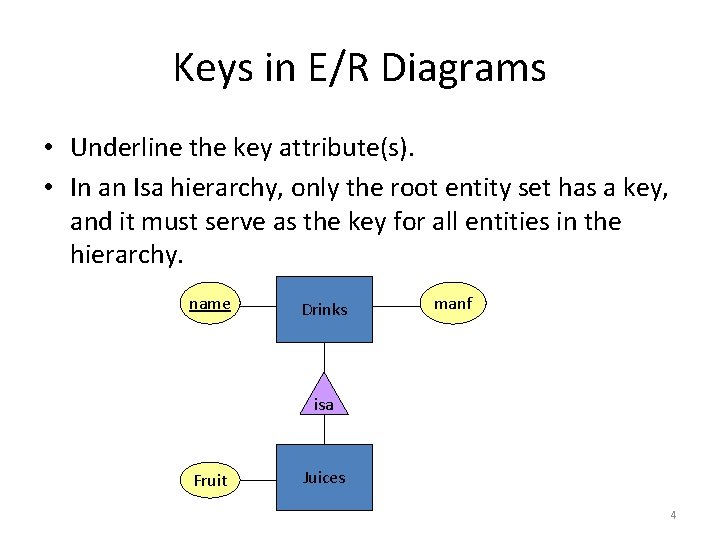
Keys in E/R Diagrams • Underline the key attribute(s). • In an Isa hierarchy, only the root entity set has a key, and it must serve as the key for all entities in the hierarchy. name Drinks manf isa Fruit Juices 4
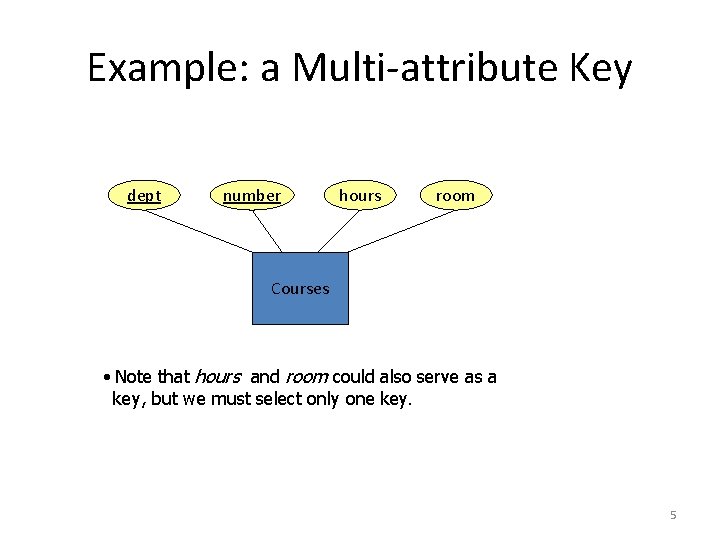
Example: a Multi-attribute Key dept number hours room Courses • Note that hours and room could also serve as a key, but we must select only one key. 5
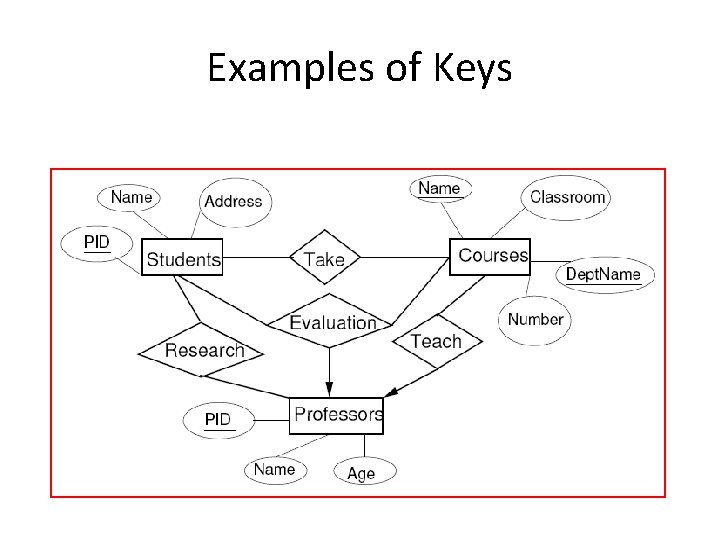
Examples of Keys
Single-Value Constraint • There is at most one value in a given context. 1. Each attribute of an entity set has a single value. – If the value is missing, we can invent a “null” value. – E/R models cannot represent the requirement that an attribute cannot have a null value. 2. A many-one relationship implies a single value constraint.
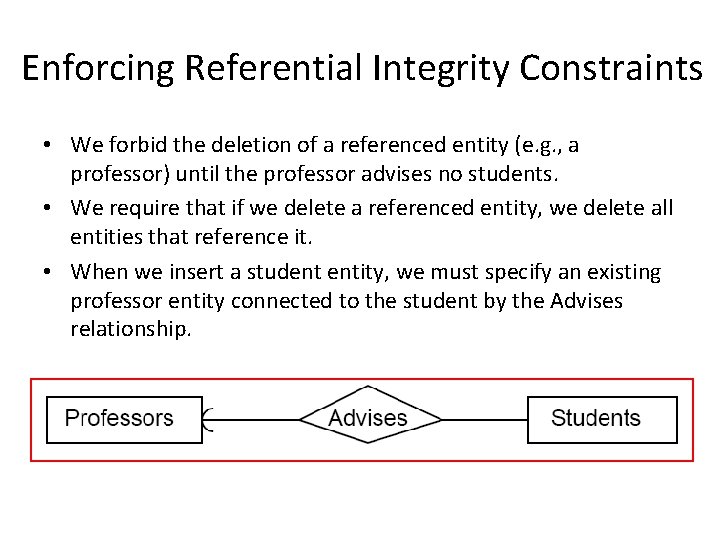
Referential Integrity Constraint • Asserts that exactly one value exists in a given context. • Usually used in the context of relationships. • Example: Many-one Advises relationship between Students and Professors. – Many-one requirement says that no student may have more than one advising professor. – Referential integrity constraint says that each student must have exactly one advising professor and that professor must be present in the database. • If R is a (many-to-one or one-to-one) relationship from E to F, we use a rounded arrowhead pointing to F to indicate that we require that the entity in F related by R to an entity in E must exist.
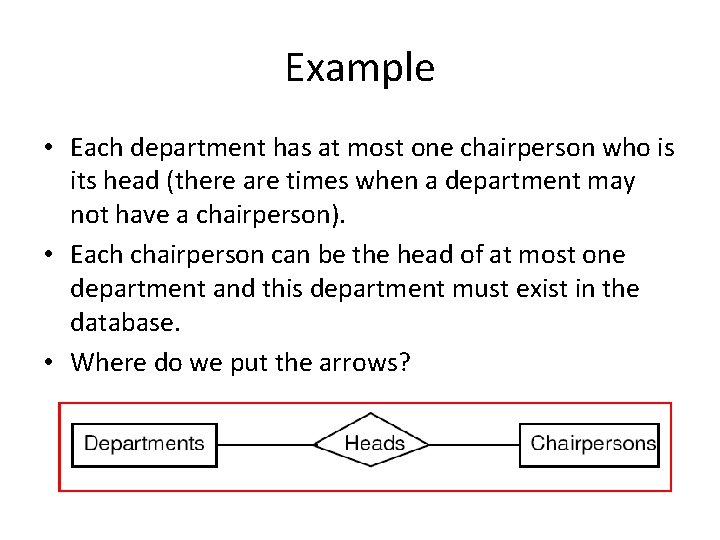
Example • Each department has at most one chairperson who is its head (there are times when a department may not have a chairperson). • Each chairperson can be the head of at most one department and this department must exist in the database. • Where do we put the arrows?
Enforcing Referential Integrity Constraints • We forbid the deletion of a referenced entity (e. g. , a professor) until the professor advises no students. • We require that if we delete a referenced entity, we delete all entities that reference it. • When we insert a student entity, we must specify an existing professor entity connected to the student by the Advises relationship.
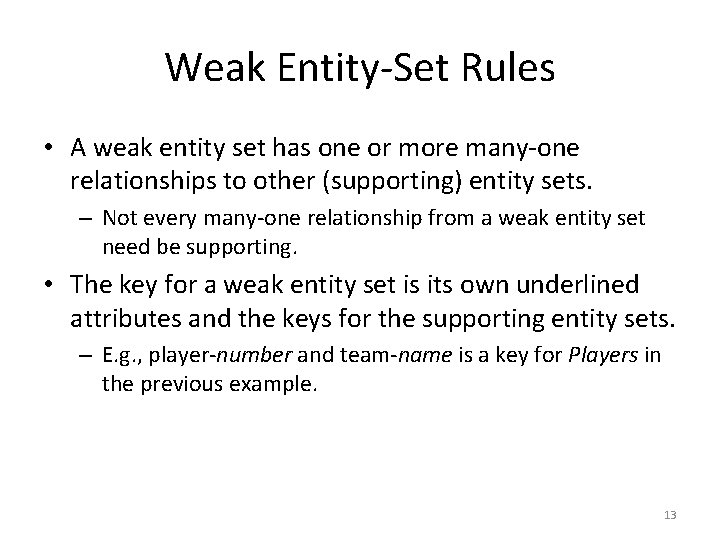
Weak Entity Sets • Occasionally, entities of an entity set need “help” to identify them uniquely. • Entity set E is said to be weak if in order to identify entities of E uniquely, we need to follow one or more many-one relationships from E and include the key of the related entities from the connected entity sets. 11
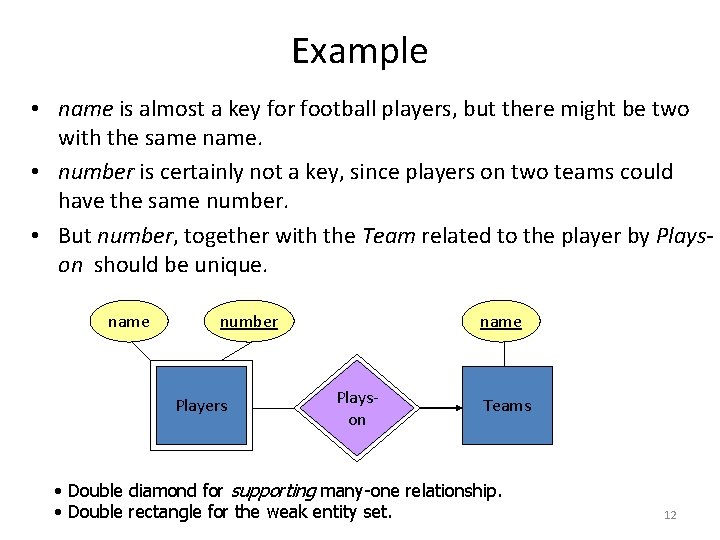
Example • name is almost a key for football players, but there might be two with the same name. • number is certainly not a key, since players on two teams could have the same number. • But number, together with the Team related to the player by Playson should be unique. name number Players name Playson Teams • Double diamond for supporting many-one relationship. • Double rectangle for the weak entity set. 12
Weak Entity-Set Rules • A weak entity set has one or more many-one relationships to other (supporting) entity sets. – Not every many-one relationship from a weak entity set need be supporting. • The key for a weak entity set is its own underlined attributes and the keys for the supporting entity sets. – E. g. , player-number and team-name is a key for Players in the previous example. 13
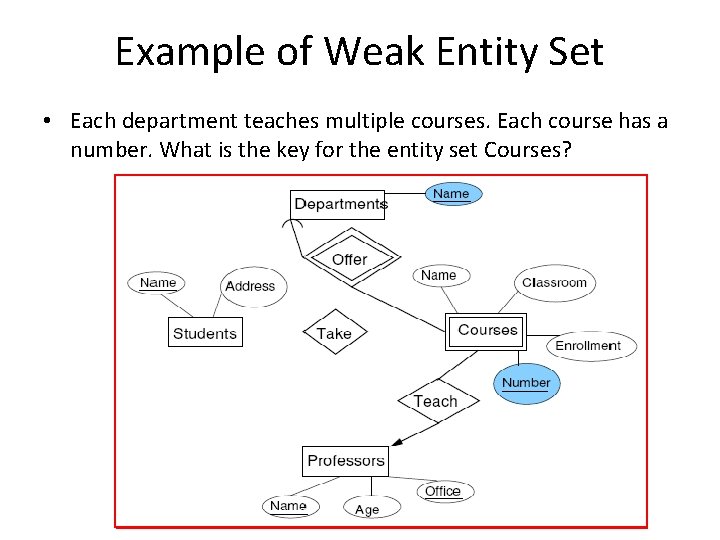
Example of Weak Entity Set • Each department teaches multiple courses. Each course has a number. What is the key for the entity set Courses?
Design Techniques • Be faithful to the specification of the application. • Avoid redundancy. • Keep the entities and relationship simple. – Don’t use an entity set when an attribute will do. • Select the right relationships. • Select the right type of element. • Limit the use of weak entity sets. 15
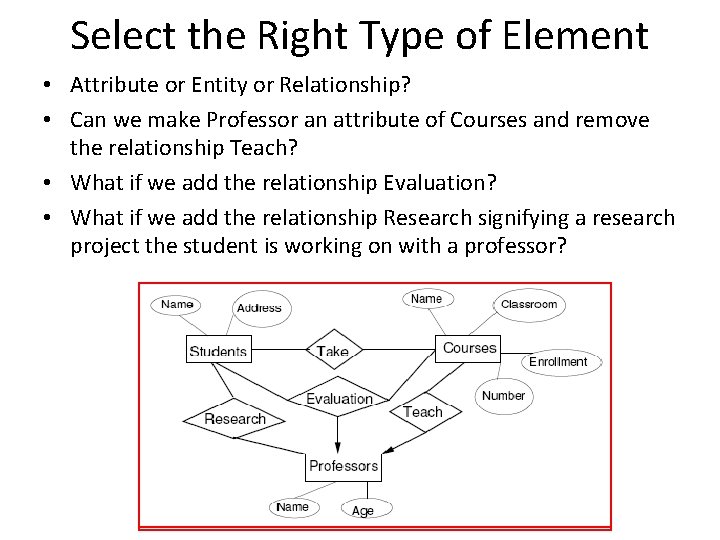
Be Faithful • Do not use meaningless or unecessary attributes. • Define the multiplicity of a relationship appropriately. – What is the multiplicity of the relationship Take between Students and Courses? – What is the multiplicity of the relationship Teach between Professors and Courses?
Avoiding Redundancy • Redundancy occurs when we say the same thing in two different ways. • Redundancy wastes space and (more importantly) encourages inconsistency. – The two instances of the same fact may become inconsistent if we change one and forget to change the other, related version. 17
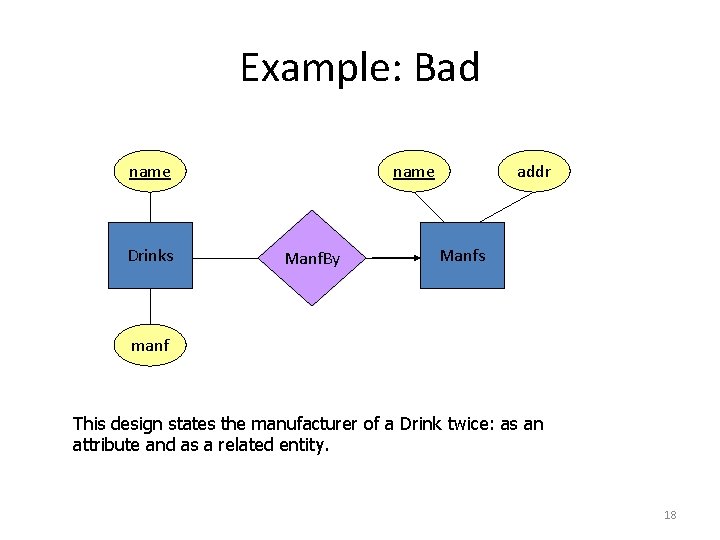
Example: Bad name Drinks name Manf. By addr Manfs manf This design states the manufacturer of a Drink twice: as an attribute and as a related entity. 18
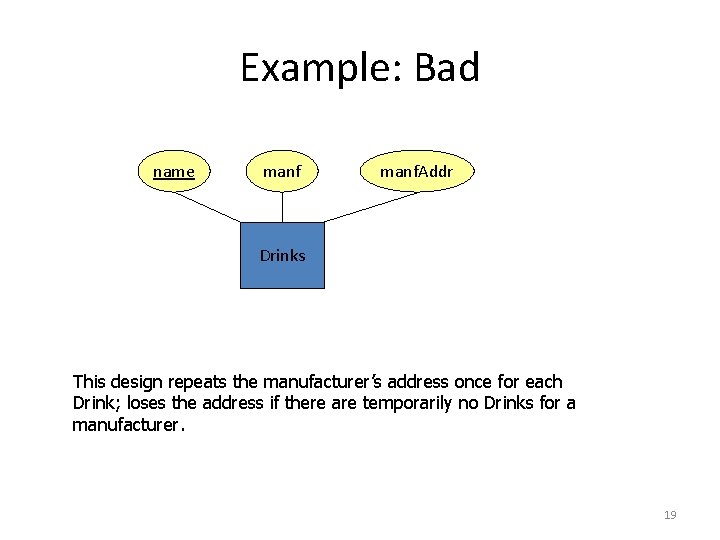
Example: Bad name manf. Addr Drinks This design repeats the manufacturer’s address once for each Drink; loses the address if there are temporarily no Drinks for a manufacturer. 19
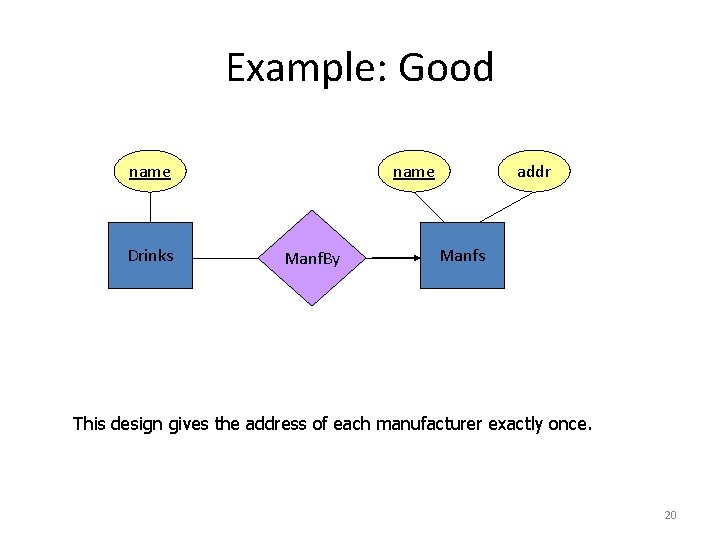
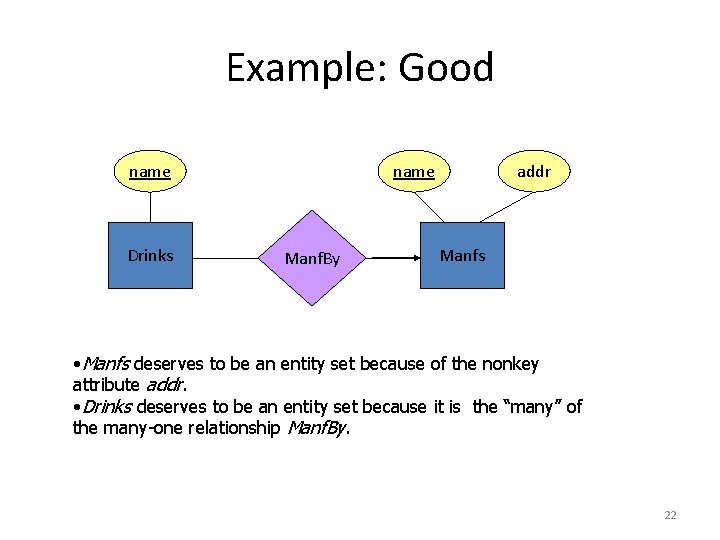
Example: Good name Drinks name Manf. By addr Manfs This design gives the address of each manufacturer exactly once. 20
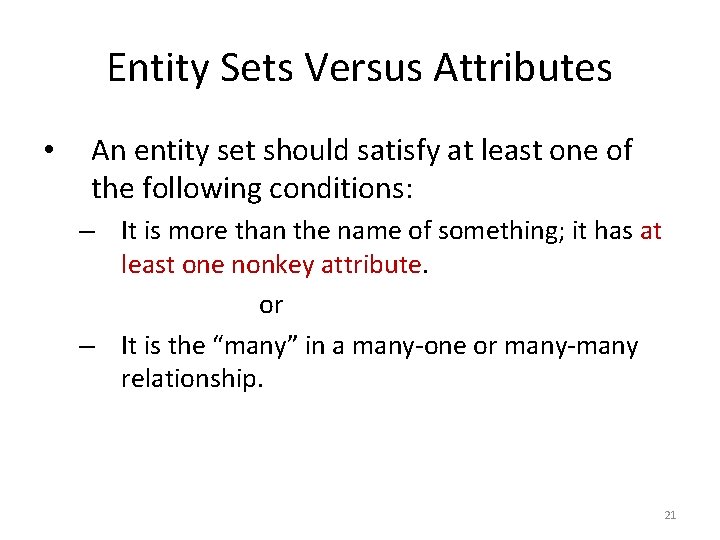
Entity Sets Versus Attributes • An entity set should satisfy at least one of the following conditions: – It is more than the name of something; it has at least one nonkey attribute. or – It is the “many” in a many-one or many-many relationship. 21
Example: Good name Drinks name Manf. By addr Manfs • Manfs deserves to be an entity set because of the nonkey attribute addr. • Drinks deserves to be an entity set because it is the “many” of the many-one relationship Manf. By. 22
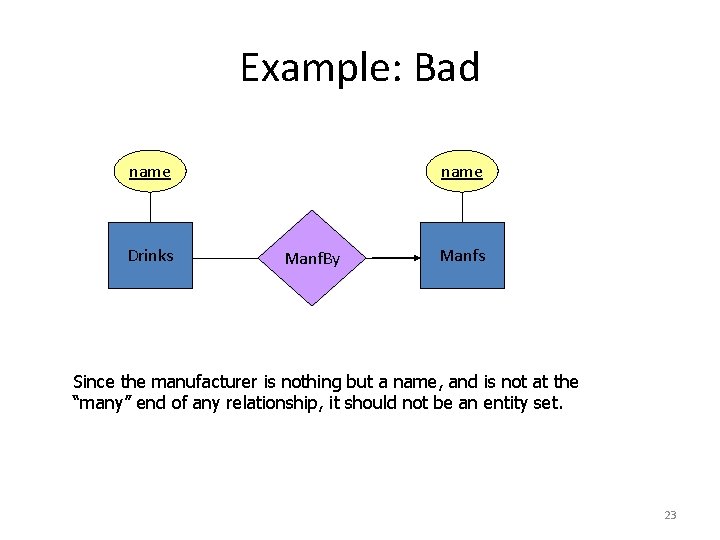
Example: Bad name Drinks name Manf. By Manfs Since the manufacturer is nothing but a name, and is not at the “many” end of any relationship, it should not be an entity set. 23
Example: Good name manf Drinks There is no need to make the manufacturer an entity set, because we record nothing about manufacturers besides their name. 24
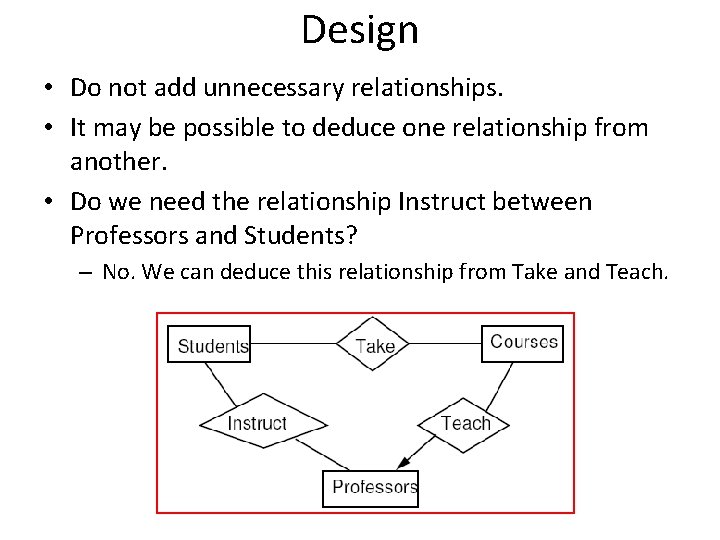
Design • Do not add unnecessary relationships. • It may be possible to deduce one relationship from another. • Do we need the relationship Instruct between Professors and Students? – No. We can deduce this relationship from Take and Teach.
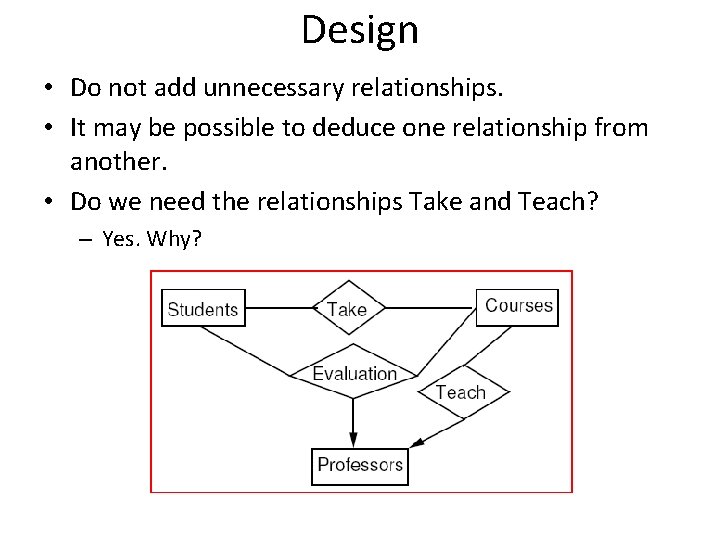
Design • Do not add unnecessary relationships. • It may be possible to deduce one relationship from another. • Do we need the relationships Take and Teach? – Yes. Why?
Select the Right Type of Element • Attribute or Entity or Relationship? • Can we make Professor an attribute of Courses and remove the relationship Teach? • What if we add the relationship Evaluation? • What if we add the relationship Research signifying a research project the student is working on with a professor?
Converting an Entity Set into an Attribute • If an entity set E satisfies the following properties: 1. All relationships involving E have arrows entering E. 2. The attributes of E collectively identify an entity (i. e. , no attribute depends on another). 3. No relationship involves E more than once • then we can replace E as follows: 1. If there is a many-one relationship R from an entity set F to E, remove R and make the attributes of E be attributes of F. 2. If there is a multi-way relationship R with an arrow to E, make the attributes of E be new attributes of R and remove the arrow from R to E.
Don’t Overuse Weak Entity Sets • Beginning database designers often doubt that anything could be a key by itself. – They make all entity sets weak, supported by all other entity sets to which they are linked. • In reality, we usually create unique ID’s for entity sets. – Examples include social-security numbers, automobile VIN’s etc. 29
When Do We Need Weak Entity Sets? • The usual reason is that there is no global authority capable of creating unique ID’s. • Example: it is unlikely that there could be an agreement to assign unique player numbers across all football teams in the world. 30
Binary vs. Non-Binary Relationships • Some relationships that appear to be non-binary may be better represented using binary relationships – E. g. A ternary relationship parents, relating a child to his/her father and mother, is best replaced by two binary relationships, father and mother • Using two binary relationships allows partial information (e. g. only mother being known) – But there are some relationships that are naturally non-binary • Example: works_on
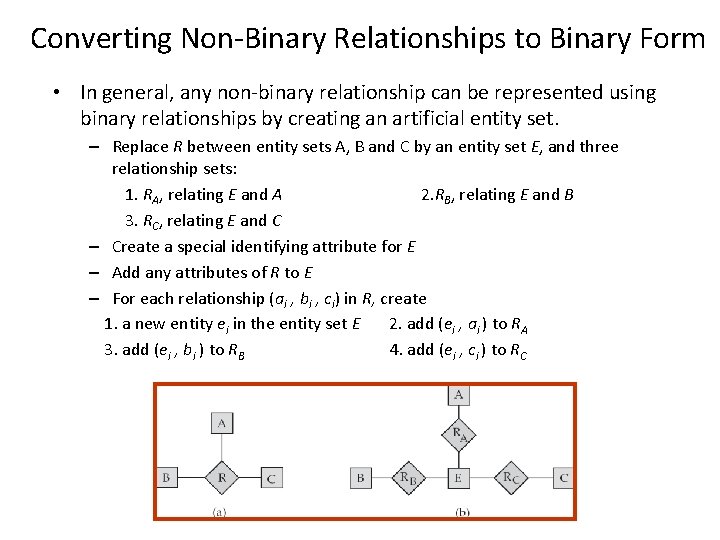
Converting Non-Binary Relationships to Binary Form • In general, any non-binary relationship can be represented using binary relationships by creating an artificial entity set. – Replace R between entity sets A, B and C by an entity set E, and three relationship sets: 1. RA, relating E and A 2. RB, relating E and B 3. RC, relating E and C – Create a special identifying attribute for E – Add any attributes of R to E – For each relationship (ai , bi , ci) in R, create 1. a new entity ei in the entity set E 2. add (ei , ai ) to RA 3. add (ei , bi ) to RB 4. add (ei , ci ) to RC
End of E/R Diagrams