
CONSTRAINTBASED PROBLEM SOLVING BASIC IDEA We dont know
CONSTRAINT-BASED PROBLEM SOLVING
BASIC IDEA • We don’t know how to solve a problem outright. • We do know rules that it shouldn’t break when solved • The constraints. • The reverse of a heuristic? • Usually involves some iteration • Try a guess. • See what constraints are violated => fix them • Repeat.
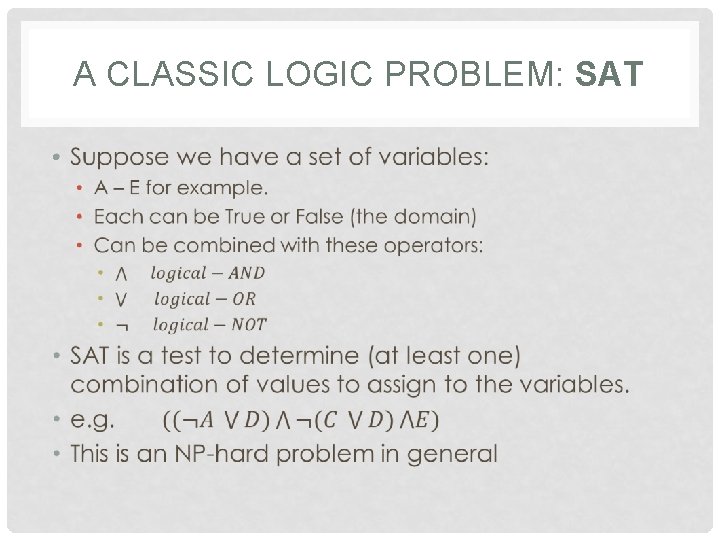
A CLASSIC LOGIC PROBLEM: SAT •

CONNECTION: PROLOG • Solving this type of problem is what Prolog is built for. • More general than SAT • variables can have any values. • A few other constraint-based libraries / languages: • • python-constraint (python package) Google’s OR-tools (python, C++, Java library) Screamer (Lisp library) Wolfram (? )

SOME COMMON CONSTRAINTS • …of a general constraint-solver • • ALL_UNIQUE(list) ALL_DIFFERENT(list) AT_LEAST_ONE(list, val) … • A huge goal is to avoid back-tracking • i. e. don’t do brute-force.
![OUR PROBLEM • Solve a Sudko puzzle • [rules of Sudoku? ] • Have](http://slidetodoc.com/presentation_image_h2/c81fa617e1537224f230d4aa815e3563/image-6.jpg "OUR PROBLEM • Solve a Sudko puzzle • [rules of Sudoku? ] • Have")
OUR PROBLEM • Solve a Sudko puzzle • [rules of Sudoku? ] • Have a set of variables for the missing spots. • Initially the domain is 1, 2, 3, …, 9 • if that value would vilolate the Sudoku rules, remove it from the domain for that variable. • if you get down to just one value, you know that’s the only answer. Use that to eliminate other values from other variables domains. • for easy – medium puzzles, repeatedly applying should let you solve. • for harder puzzles, you may have to do some trial-and-error (backtracking)
A RELATED (? ) PROBLEM: VERLET PHYSICS • • Might be a stretch…but it’s cool https: //www. youtube. com/watch? v=w 88 D 8 -0 -Kb 4 https: //www. youtube. com/watch? v=DWTpj. NUb. T 24 Discovered by Hitman: Codename 47 (2000) • http: //graphics. cmu. edu/nsp/course/15869/2006/papers/jakobsen. htm • Basic idea: 1. 2. 3. 4. 5. 6. a set of points a set of constraints between points. apply gravity and mouse-drag to points iteratively fix the constraints soft-body physics! ragdoll! cloth-simulators! profit!
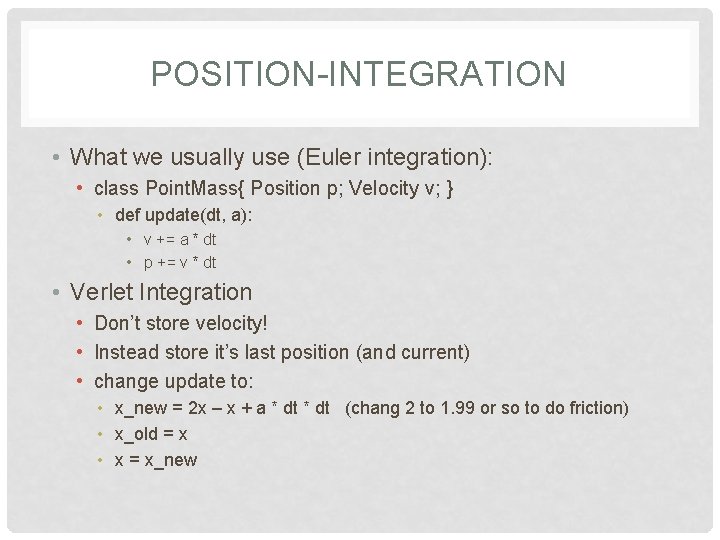
POSITION-INTEGRATION • What we usually use (Euler integration): • class Point. Mass{ Position p; Velocity v; } • def update(dt, a): • v += a * dt • p += v * dt • Verlet Integration • Don’t store velocity! • Instead store it’s last position (and current) • change update to: • x_new = 2 x – x + a * dt (chang 2 to 1. 99 or so to do friction) • x_old = x • x = x_new
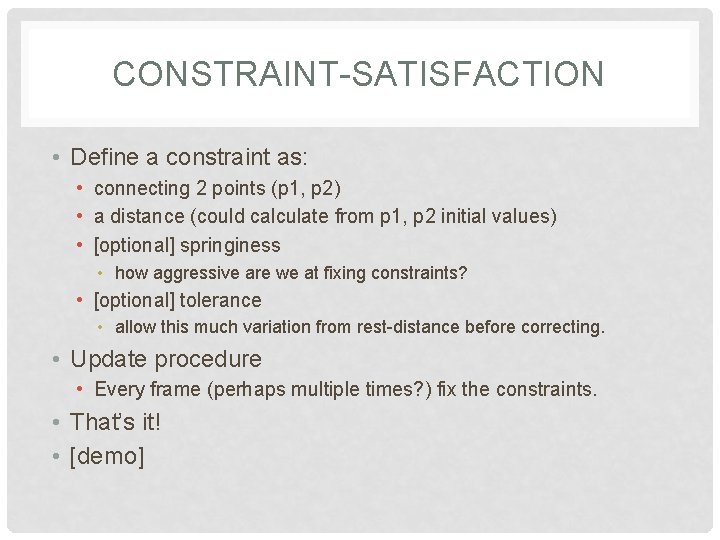
CONSTRAINT-SATISFACTION • Define a constraint as: • connecting 2 points (p 1, p 2) • a distance (could calculate from p 1, p 2 initial values) • [optional] springiness • how aggressive are we at fixing constraints? • [optional] tolerance • allow this much variation from rest-distance before correcting. • Update procedure • Every frame (perhaps multiple times? ) fix the constraints. • That’s it! • [demo]
- Slides: 9