
Constraint Programming in Practice Scheduling a Rehearsal Barbara
Constraint Programming in Practice: Scheduling a Rehearsal Barbara Smith ISN Workshop September 2003
The Rehearsal Problem • Originated at Lancaster University ; see Adelson, Norman & Laporte, ORQ, 1976 • Sequence an orchestral rehearsal of 9 pieces of music with 5 players • Players arrive just before the first piece they play in & leave just after the last piece • Minimize total waiting time i. e. time when players are present but not currently playing ISN Workshop September 2003 Scheduling a Rehearsal
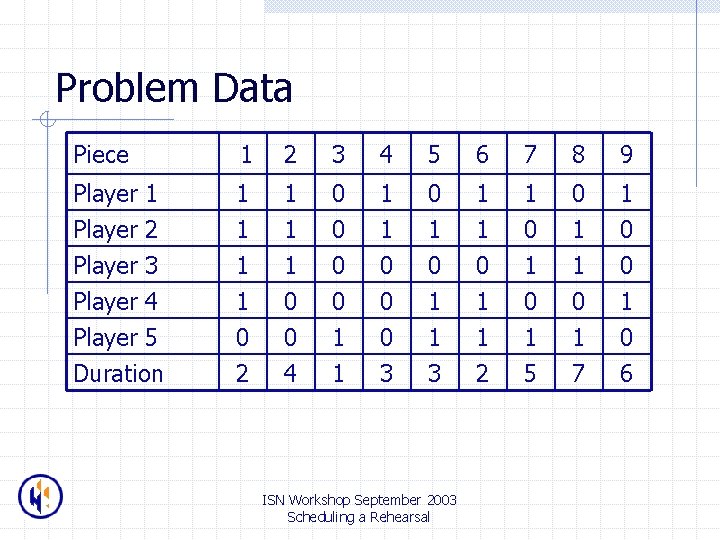
Problem Data Piece 1 2 3 4 5 6 7 8 9 Player 1 Player 2 Player 3 1 1 1 0 0 0 1 1 0 1 0 1 1 1 0 0 Player 4 Player 5 Duration 1 0 2 0 0 4 0 1 1 0 0 3 1 1 2 0 1 5 0 1 7 1 0 6 ISN Workshop September 2003 Scheduling a Rehearsal
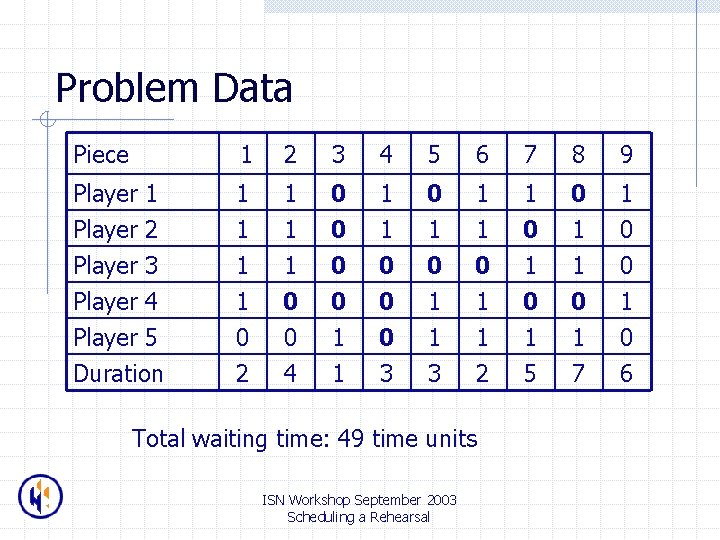
Problem Data Piece 1 2 3 4 5 6 7 8 9 Player 1 Player 2 Player 3 1 1 1 0 0 0 1 1 0 1 0 1 1 1 0 0 Player 4 Player 5 Duration 1 0 2 0 0 4 0 1 1 0 0 3 1 1 2 0 1 5 0 1 7 1 0 6 Total waiting time: 49 time units ISN Workshop September 2003 Scheduling a Rehearsal
The Main Question • Can we solve the rehearsal problem efficiently using constraint programming? ISN Workshop September 2003 Scheduling a Rehearsal
Constraint Satisfaction Problems • A CSP consists of: • a set of variables, each with a set of possible values (its domain) • and a set of constraints: a constraint on a subset of the variables specifies which values can be simultaneously assigned to these variables ISN Workshop September 2003 Scheduling a Rehearsal
Solutions to a CSP • A solution to a CSP is an assignment of a value to every variable in such a way that the constraints are satisfied • We might want just one solution (any solution) • . . or all solutions • … or an optimal solution ISN Workshop September 2003 Scheduling a Rehearsal

Constraints • A constraint affects a subset of the variables • A constraint simply specifies the assignments to these variables that it allows • Constraints are not limited e. g. to linear inequalities • This generality allows CSPs to represent a wide range of problems ISN Workshop September 2003 Scheduling a Rehearsal
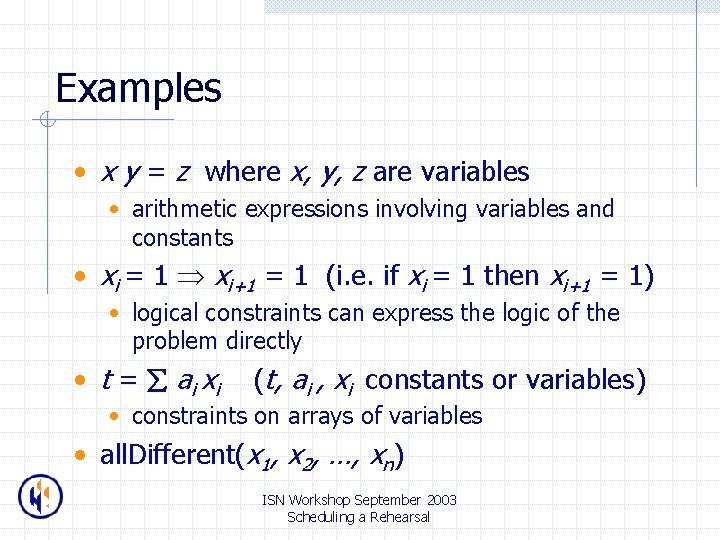
Examples • x y = z where x, y, z are variables • arithmetic expressions involving variables and constants • xi = 1 xi+1 = 1 (i. e. if xi = 1 then xi+1 = 1) • logical constraints can express the logic of the problem directly • t = a i xi (t, ai , xi constants or variables) • constraints on arrays of variables • all. Different(x 1, x 2, …, xn) ISN Workshop September 2003 Scheduling a Rehearsal
Constraint programming • Constraint programming systems, e. g. ILOG Solver, Eclipse, Sicstus Prolog… allow the programmer to: • define variables and their domains • specify the constraints, using predefined constraint types • define new constraints • solve the resulting CSP ISN Workshop September 2003 Scheduling a Rehearsal
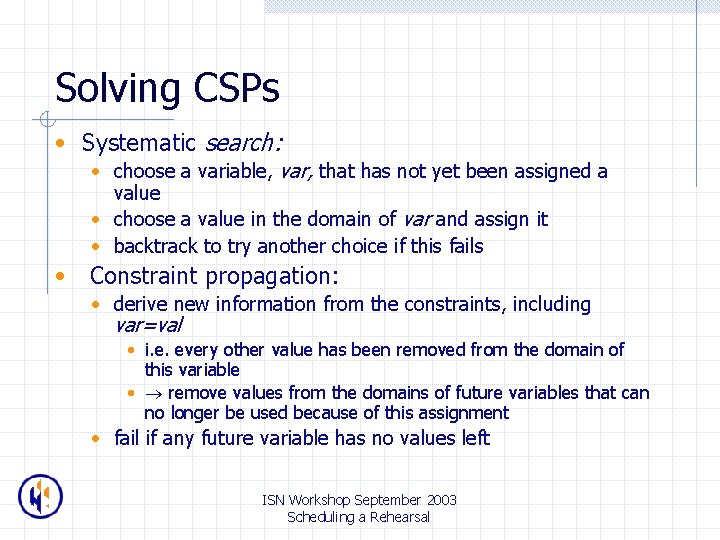
Solving CSPs • Systematic search: • choose a variable, var, that has not yet been assigned a value • choose a value in the domain of var and assign it • backtrack to try another choice if this fails • Constraint propagation: • derive new information from the constraints, including var=val • i. e. every other value has been removed from the domain of this variable • remove values from the domains of future variables that can no longer be used because of this assignment • fail if any future variable has no values left ISN Workshop September 2003 Scheduling a Rehearsal
Termination • Search terminates when • either every variable has been assigned a value: a solution has been found and we only wanted one • or there are no more choices to consider: there is no solution, or we have found them all • Given long enough, the search will terminate in either case ISN Workshop September 2003 Scheduling a Rehearsal
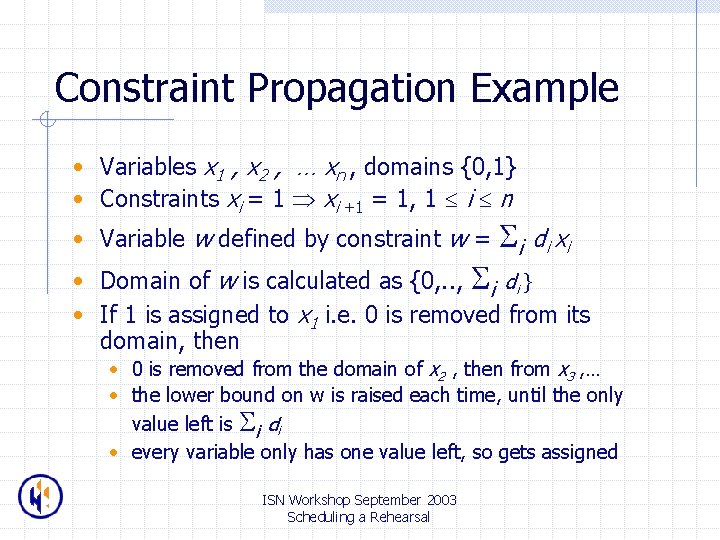
Constraint Propagation Example • Variables x 1 , x 2 , … xn , domains {0, 1} • Constraints xi = 1 xi +1 = 1, 1 i n • Variable w defined by constraint w = i d i xi • Domain of w is calculated as {0, . . , i di } • If 1 is assigned to x 1 i. e. 0 is removed from its domain, then • 0 is removed from the domain of x 2 , then from x 3 , … • the lower bound on w is raised each time, until the only value left is i di • every variable only has one value left, so gets assigned ISN Workshop September 2003 Scheduling a Rehearsal
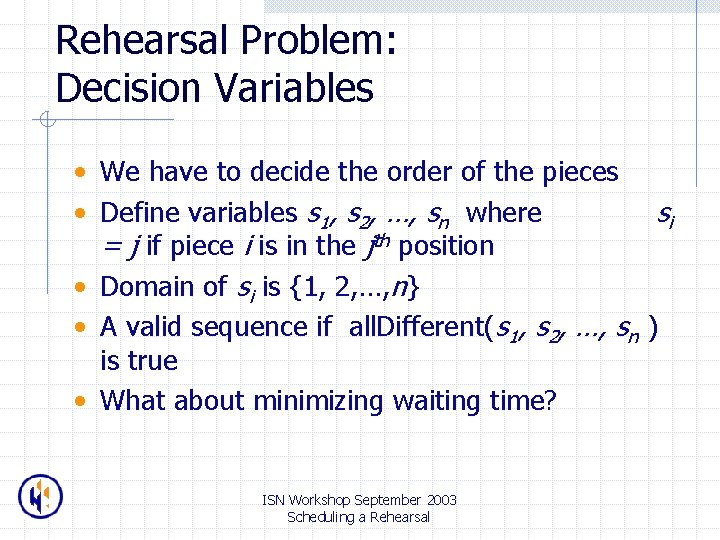
Rehearsal Problem: Decision Variables • We have to decide the order of the pieces • Define variables s 1, s 2, …, sn where si = j if piece i is in the jth position • Domain of si is {1, 2, …, n} • A valid sequence if all. Different(s 1, s 2, …, sn ) is true • What about minimizing waiting time? ISN Workshop September 2003 Scheduling a Rehearsal
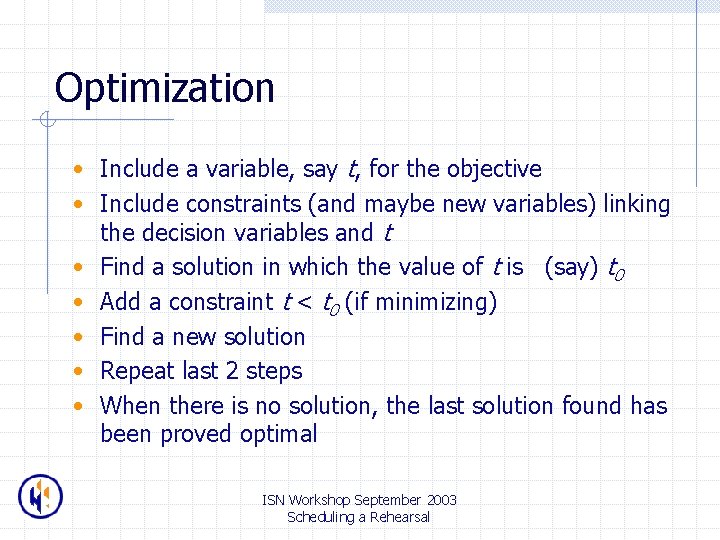
Optimization • Include a variable, say t, for the objective • Include constraints (and maybe new variables) linking the decision variables and t • Find a solution in which the value of t is (say) t 0 • Add a constraint t < t 0 (if minimizing) • Find a new solution • Repeat last 2 steps • When there is no solution, the last solution found has been proved optimal ISN Workshop September 2003 Scheduling a Rehearsal
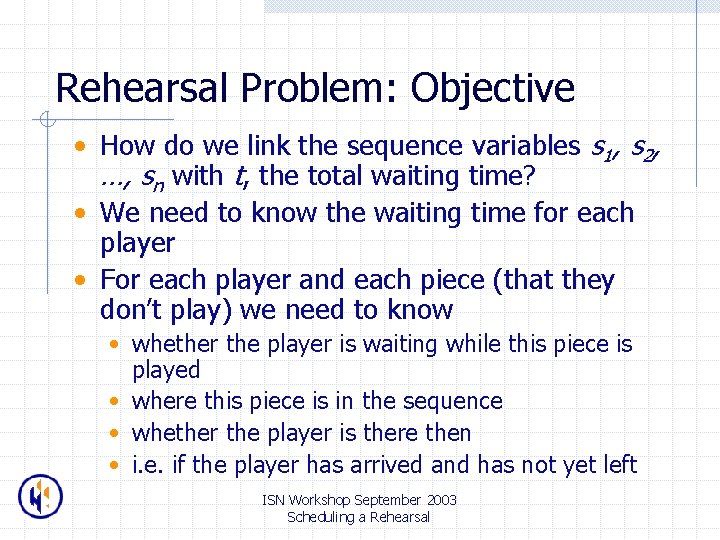
Rehearsal Problem: Objective • How do we link the sequence variables s 1, s 2, …, sn with t, the total waiting time? • We need to know the waiting time for each player • For each player and each piece (that they don’t play) we need to know • whether the player is waiting while this piece is played • where this piece is in the sequence • whether the player is there then • i. e. if the player has arrived and has not yet left ISN Workshop September 2003 Scheduling a Rehearsal
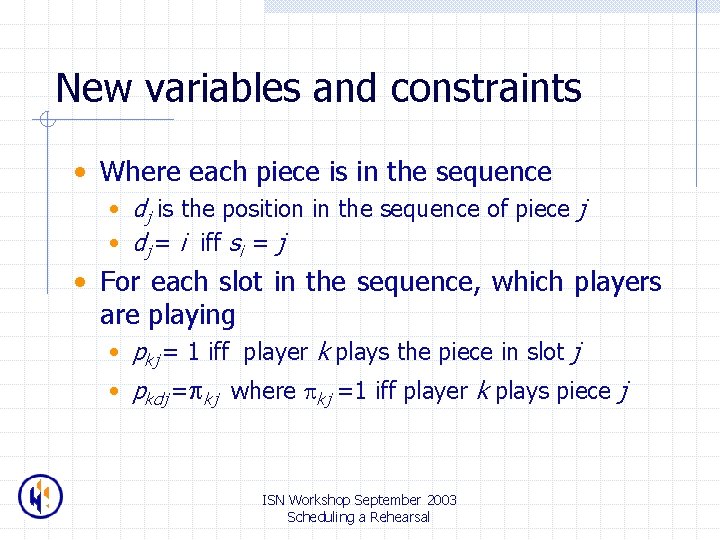
New variables and constraints • Where each piece is in the sequence • dj is the position in the sequence of piece j • dj = i iff si = j • For each slot in the sequence, which players are playing • pkj = 1 iff player k plays the piece in slot j • pkdj = kj where kj =1 iff player k plays piece j ISN Workshop September 2003 Scheduling a Rehearsal
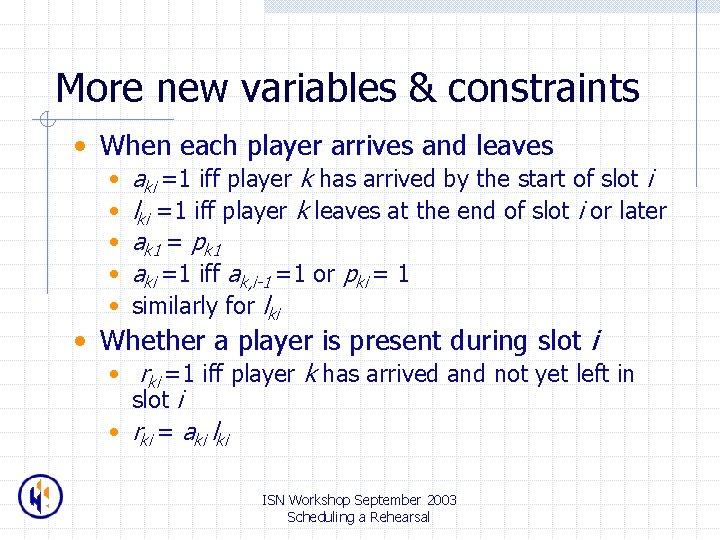
More new variables & constraints • When each player arrives and leaves • • • aki =1 iff player k has arrived by the start of slot i lki =1 iff player k leaves at the end of slot i or later ak 1 = pk 1 aki =1 iff ak, i-1 =1 or pki = 1 similarly for lki • Whether a player is present during slot i • rki =1 iff player k has arrived and not yet left in slot i • rki = aki lki ISN Workshop September 2003 Scheduling a Rehearsal
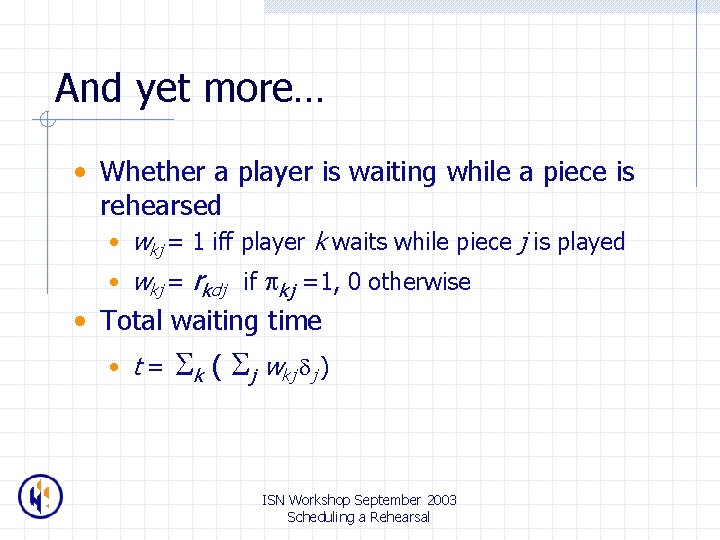
And yet more… • Whether a player is waiting while a piece is rehearsed • wkj = 1 iff player k waits while piece j is played • wkj = rkdj if kj =1, 0 otherwise • Total waiting time • t= k ( j wkj j ) ISN Workshop September 2003 Scheduling a Rehearsal
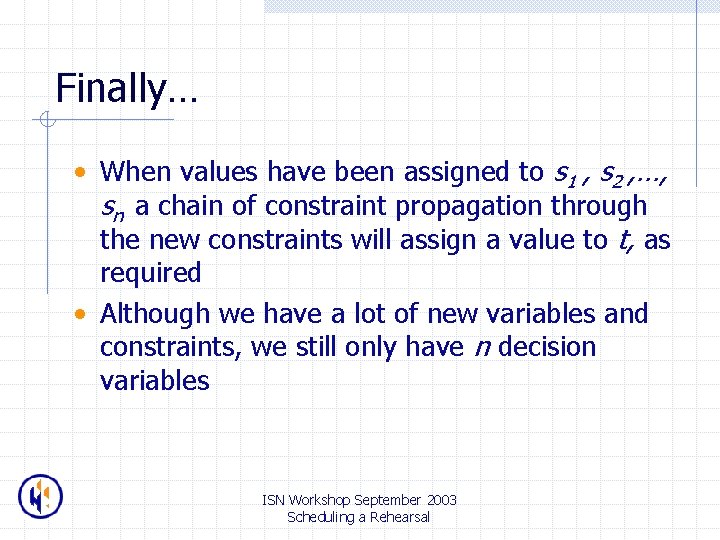
Finally… • When values have been assigned to s 1 , s 2 , …, sn a chain of constraint propagation through the new constraints will assign a value to t, as required • Although we have a lot of new variables and constraints, we still only have n decision variables ISN Workshop September 2003 Scheduling a Rehearsal
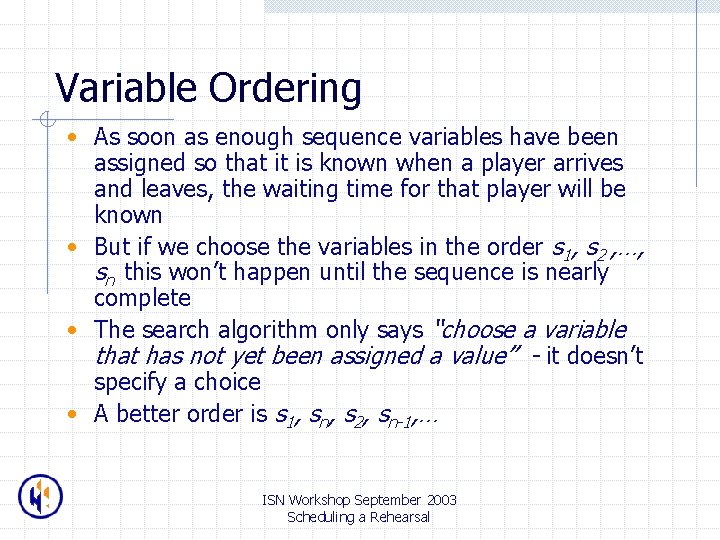
Variable Ordering • As soon as enough sequence variables have been assigned so that it is known when a player arrives and leaves, the waiting time for that player will be known • But if we choose the variables in the order s 1, s 2 , …, sn this won’t happen until the sequence is nearly complete • The search algorithm only says “choose a variable that has not yet been assigned a value” - it doesn’t specify a choice • A better order is s 1, sn, s 2, sn-1, … ISN Workshop September 2003 Scheduling a Rehearsal
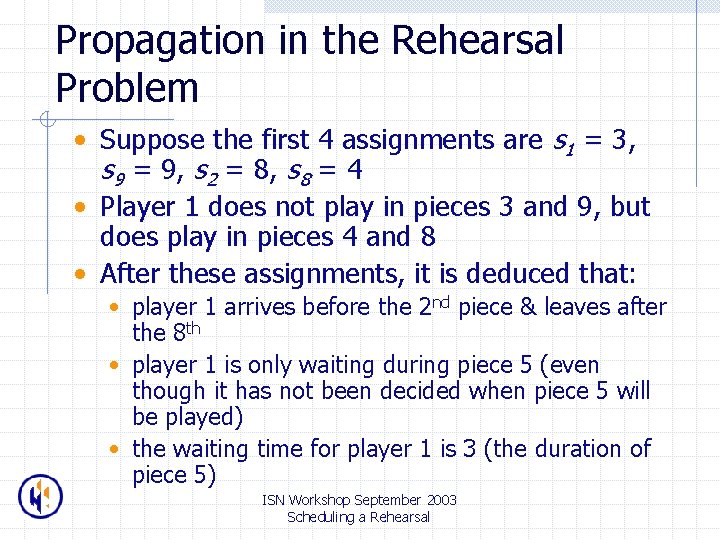
Propagation in the Rehearsal Problem • Suppose the first 4 assignments are s 1 = 3, s 9 = 9, s 2 = 8, s 8 = 4 • Player 1 does not play in pieces 3 and 9, but does play in pieces 4 and 8 • After these assignments, it is deduced that: • player 1 arrives before the 2 nd piece & leaves after the 8 th • player 1 is only waiting during piece 5 (even though it has not been decided when piece 5 will be played) • the waiting time for player 1 is 3 (the duration of piece 5) ISN Workshop September 2003 Scheduling a Rehearsal
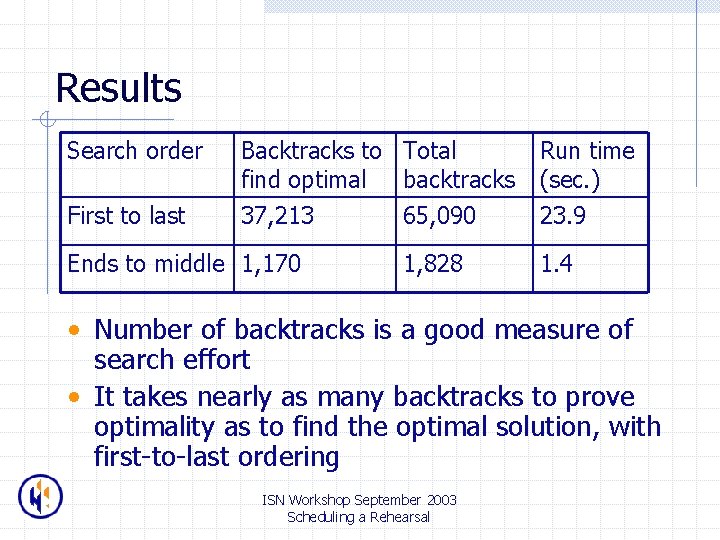
Results Search order Backtracks to Total find optimal backtracks Run time (sec. ) First to last 37, 213 65, 090 23. 9 1, 828 1. 4 Ends to middle 1, 170 • Number of backtracks is a good measure of search effort • It takes nearly as many backtracks to prove optimality as to find the optimal solution, with first-to-last ordering ISN Workshop September 2003 Scheduling a Rehearsal
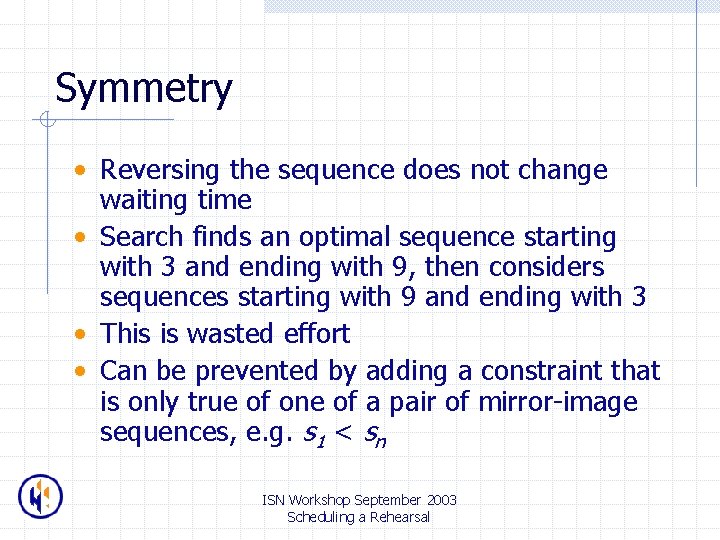
Symmetry • Reversing the sequence does not change waiting time • Search finds an optimal sequence starting with 3 and ending with 9, then considers sequences starting with 9 and ending with 3 • This is wasted effort • Can be prevented by adding a constraint that is only true of one of a pair of mirror-image sequences, e. g. s 1 < sn ISN Workshop September 2003 Scheduling a Rehearsal
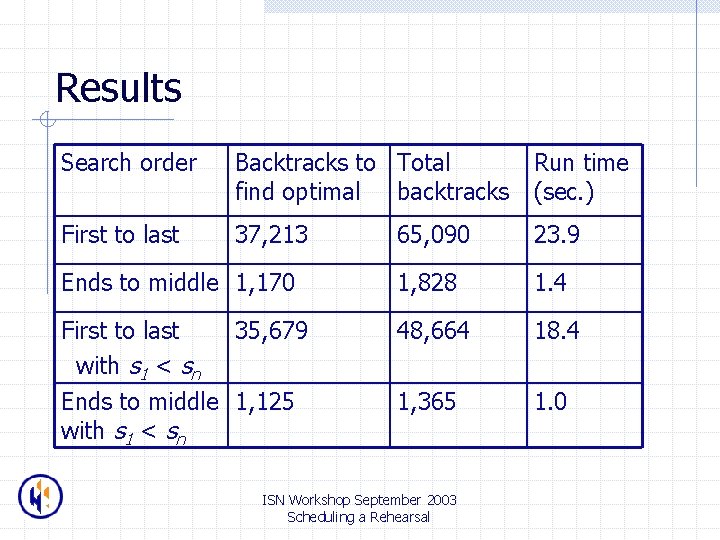
Results Search order Backtracks to Total find optimal backtracks Run time (sec. ) First to last 37, 213 65, 090 23. 9 Ends to middle 1, 170 1, 828 1. 4 First to last 35, 679 with s 1 < sn Ends to middle 1, 125 with s 1 < sn 48, 664 18. 4 1, 365 1. 0 ISN Workshop September 2003 Scheduling a Rehearsal
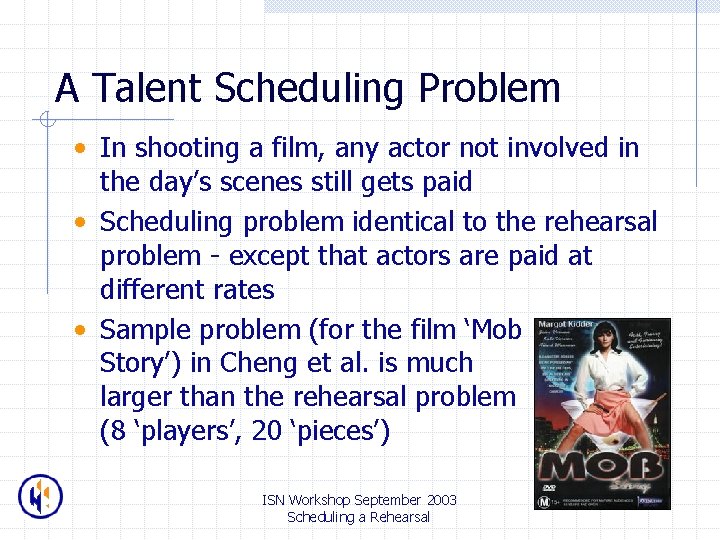
A Talent Scheduling Problem • In shooting a film, any actor not involved in the day’s scenes still gets paid • Scheduling problem identical to the rehearsal problem - except that actors are paid at different rates • Sample problem (for the film ‘Mob Story’) in Cheng et al. is much larger than the rehearsal problem (8 ‘players’, 20 ‘pieces’) ISN Workshop September 2003 Scheduling a Rehearsal
Improved Model • The existing model cannot solve the talent scheduling problem in a reasonable time • Waiting time for a player is only known when the first & last pieces he/she plays in are sequenced • Constraints don’t allow deductions about the sequence from a tighter constraint on the objective ISN Workshop September 2003 Scheduling a Rehearsal
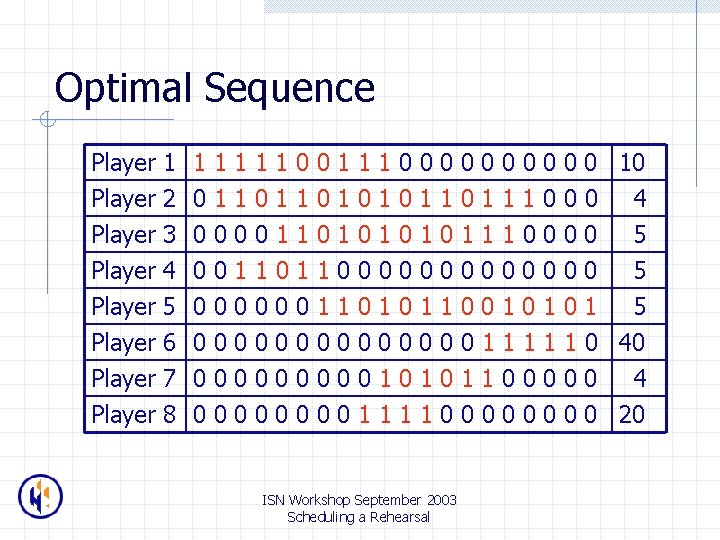
Optimal Sequence Player 1 2 3 4 1 0 0 0 1 1 0 0 1 1 1 0 0 0 1 1 0 1 0 0 0 1 1 1 0 0 0 10 0110111000 4 0101110000 5 00000 5 Player 5 6 7 8 0 0 0 0 0 0 1 0 0 0 1 10110 00000 10101 11100 ISN Workshop September 2003 Scheduling a Rehearsal 0 1 1 0 10101 5 1 1 0 40 00000 4 0 0 0 20
Implied Constraints • Implied constraints are logically redundant – don’t change the problem, just state part of it differently • Good implied constraints reduce solution time by increasing constraint propagation • The pieces the expensive players play in must be together • Given a good solution (so a tight bound on the total waiting time) if we have placed one of these pieces in the sequence, the others must be very close to it • This is not being recognised in the existing model ISN Workshop September 2003 Scheduling a Rehearsal
Constraint on Waiting time • Waiting time for a player is at least the number of slots in the sequence between the time they arrive and the time they leave, less the number of pieces they play in • This is a lower bound, because it just uses the fact that the duration of a piece is at least 1 time unit • This is apparently a weak constraint, but in fact allows a bound on the waiting time to reduce the domains of the sequence variables ISN Workshop September 2003 Scheduling a Rehearsal
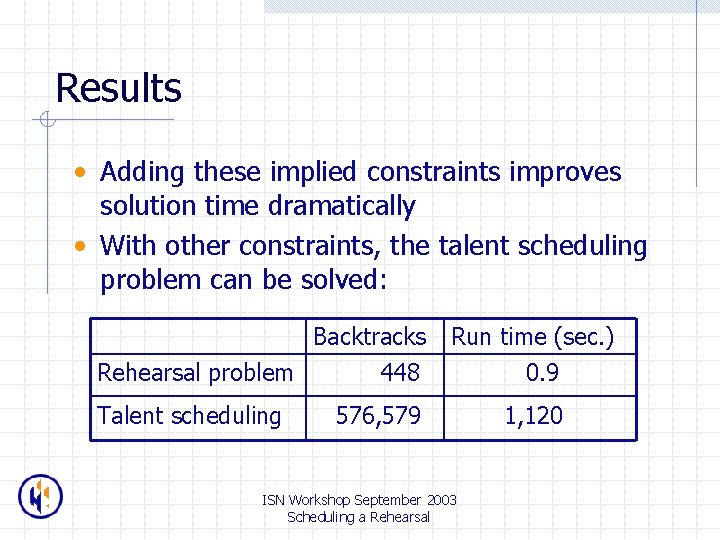
Results • Adding these implied constraints improves solution time dramatically • With other constraints, the talent scheduling problem can be solved: Backtracks Rehearsal problem 448 Talent scheduling Run time (sec. ) 0. 9 576, 579 ISN Workshop September 2003 Scheduling a Rehearsal 1, 120
Conclusions • The model for the rehearsal problem is complex – but then describing the connection between the sequence of pieces and the waiting time, in words, is also complex • This kind of sequencing problem is NP-hard, so it’s not surprising that solving a much larger problem requires a cleverer model • Further improvements are possible – e. g. start with a better initial solution • Improving the model needs an understanding of how constraints propagate – but mostly insight into the problem ISN Workshop September 2003 Scheduling a Rehearsal
- Slides: 32