
Constraint Branching and Disjunctive Cuts for Mixed Integer

“Constraint Branching and Disjunctive Cuts for Mixed Integer Programs” 1 Constraint Branching and Disjunctive Cuts for Mixed Integer Programs Michael Perregaard Dash Optimization IMA 2005
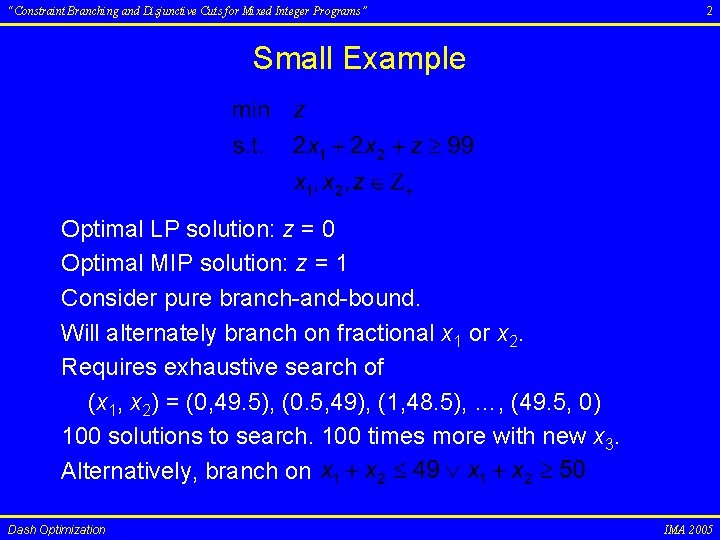
“Constraint Branching and Disjunctive Cuts for Mixed Integer Programs” 2 Small Example Optimal LP solution: z = 0 Optimal MIP solution: z = 1 Consider pure branch-and-bound. Will alternately branch on fractional x 1 or x 2. Requires exhaustive search of (x 1, x 2) = (0, 49. 5), (0. 5, 49), (1, 48. 5), …, (49. 5, 0) 100 solutions to search. 100 times more with new x 3. Alternatively, branch on Dash Optimization IMA 2005

“Constraint Branching and Disjunctive Cuts for Mixed Integer Programs” 3 Branching from Disjunctive Cuts • Branching is imposing a disjunction valid for all (feasible) integer solutions, but not the current LP solution. • Disjunctive cuts are derived from some base disjunction and often a strengthening argument. – Gomory’s Mixed Integer cuts. – Lift-and-Project cuts. – Reduce and Split cuts of Andersen, Cornuéjols and Li (2003). • The strengthening of the cut can be transformed into a strengthening of the base disjunction. • Use the strengthened base disjunction for branching. Dash Optimization IMA 2005
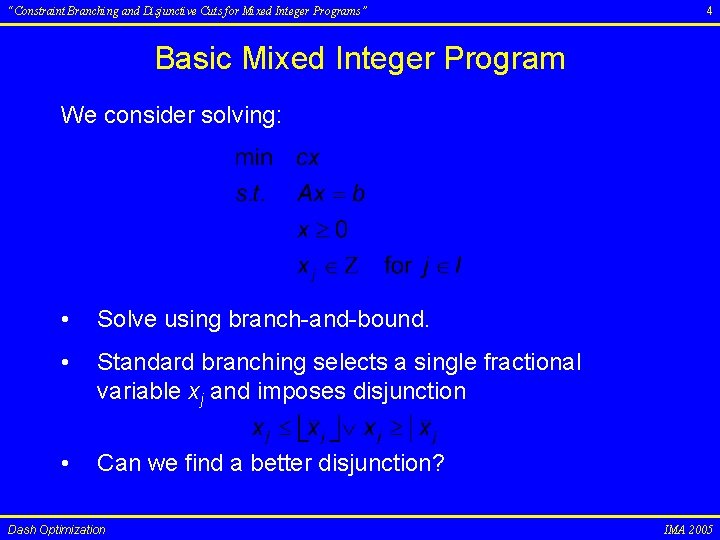
“Constraint Branching and Disjunctive Cuts for Mixed Integer Programs” 4 Basic Mixed Integer Program We consider solving: • Solve using branch-and-bound. • Standard branching selects a single fractional variable xj and imposes disjunction • Can we find a better disjunction? Dash Optimization IMA 2005

“Constraint Branching and Disjunctive Cuts for Mixed Integer Programs” 5 Disjunctive Normal Form Example For constraint where e. g. x 1 and x 2 are fractional, we can create a disjunction Dash Optimization IMA 2005
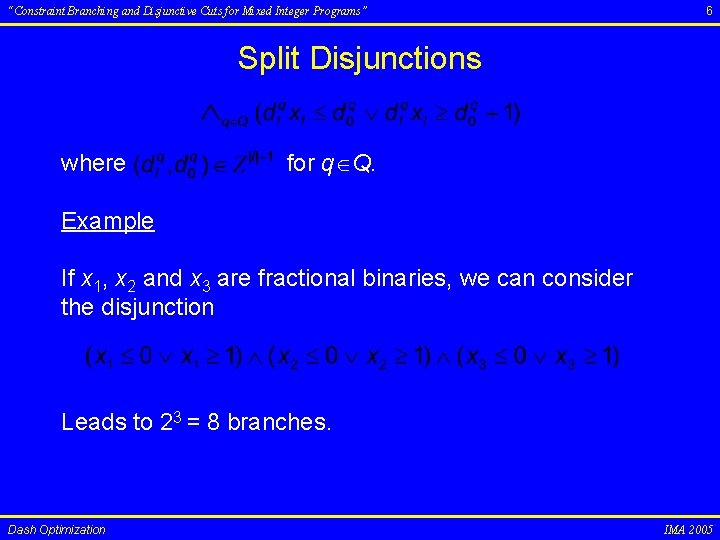
“Constraint Branching and Disjunctive Cuts for Mixed Integer Programs” 6 Split Disjunctions where for q Q. Example If x 1, x 2 and x 3 are fractional binaries, we can consider the disjunction Leads to 23 = 8 branches. Dash Optimization IMA 2005

7 “Constraint Branching and Disjunctive Cuts for Mixed Integer Programs” Basic Disjunctive (Intersection) Cut Given disjunction (in nonbasic space) where , then with is a valid inequality that cuts off the LP solution Dash Optimization . IMA 2005
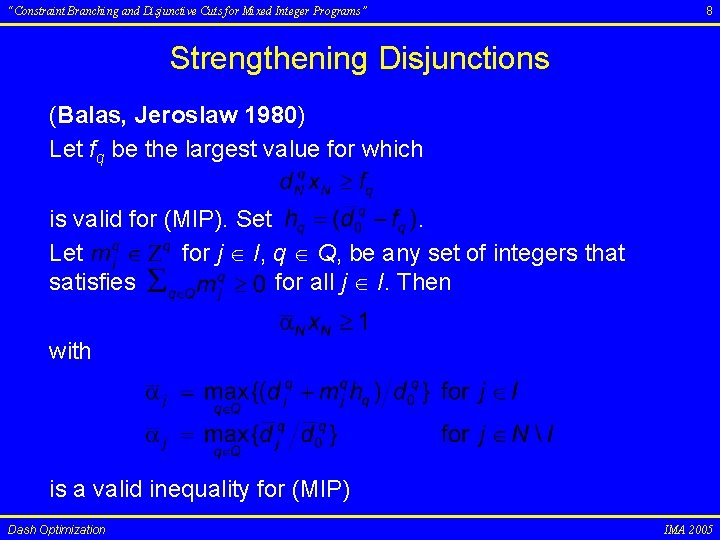
“Constraint Branching and Disjunctive Cuts for Mixed Integer Programs” 8 Strengthening Disjunctions (Balas, Jeroslaw 1980) Let fq be the largest value for which is valid for (MIP). Set. Let for j I, q Q, be any set of integers that satisfies for all j I. Then with is a valid inequality for (MIP) Dash Optimization IMA 2005
![9 “Constraint Branching and Disjunctive Cuts for Mixed Integer Programs” Strengthening Disjunctions [continued] Instead](http://slidetodoc.com/presentation_image_h2/db12a81b897e96da2644f6fed0a20b59/image-9.jpg "9 “Constraint Branching and Disjunctive Cuts for Mixed Integer Programs” Strengthening Disjunctions [continued] Instead")
9 “Constraint Branching and Disjunctive Cuts for Mixed Integer Programs” Strengthening Disjunctions [continued] Instead of strengthening cut, as in modify the disjunction directly, as in (*) Basic disjunctive cut from (*) identical to strengthened cut. Dash Optimization IMA 2005

10 “Constraint Branching and Disjunctive Cuts for Mixed Integer Programs” Strengthening Conjunctions Given valid disjunction for (MIP) for j I, q Q, be any set of integers. Then Let is a valid disjunction for (MIP) since integer. must be • Gomory’s Mixed Integer cuts and Lift-and-Project cuts strengthens in nonbasics. • Andersen, Cornuéjols, Li cuts iteratively strengthens individual basics and all nonbasics. Dash Optimization IMA 2005
“Constraint Branching and Disjunctive Cuts for Mixed Integer Programs” 11 General Branching Alternatives • Ryan-Foster for Set Packing and Set Partitioning. – B. A. Foster and D. M. Ryan (1981). – Specifically designed for Set Partitioning constraints: • Basis Reduction – H. W. Lenstra (1983) – Polynomial algorithm for solving integer programs for fixed number of variables. • General Branching of Mehrotra, Owen (2001) – Tests each variable using LP reoptimization to determine “best” coefficient. Dash Optimization IMA 2005
“Constraint Branching and Disjunctive Cuts for Mixed Integer Programs” 12 Even more Alternatives • General Branching of Karamanov, Cornjuéjols (Monday) – Branches on Gomory cut related disjunction. • Column Basis Reduction of Pataki (Thursday) • Generalized Branching Methods of Mehrotra (Friday) Dash Optimization IMA 2005
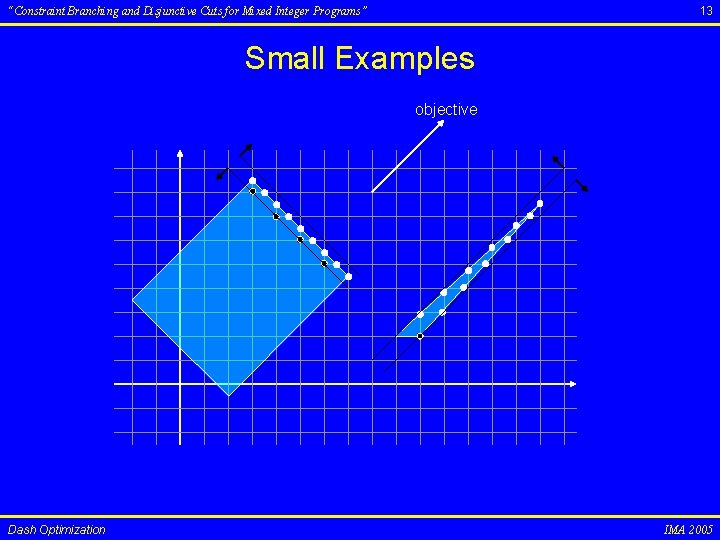
13 “Constraint Branching and Disjunctive Cuts for Mixed Integer Programs” Small Examples objective Dash Optimization IMA 2005
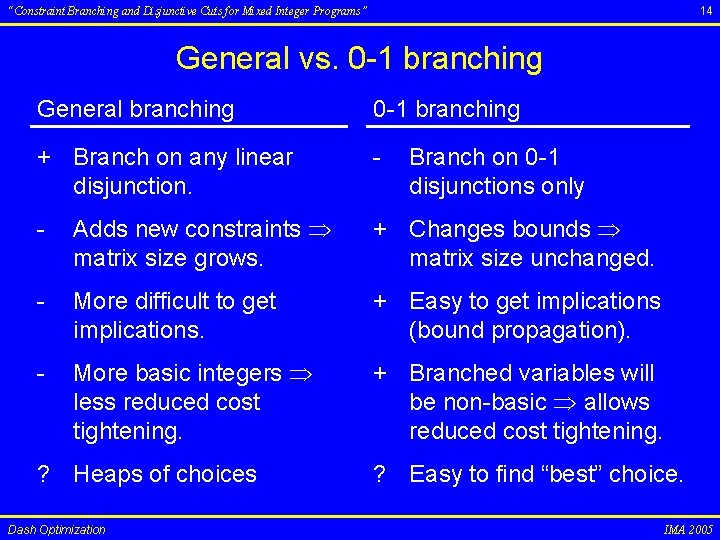
14 “Constraint Branching and Disjunctive Cuts for Mixed Integer Programs” General vs. 0 -1 branching General branching 0 -1 branching + Branch on any linear disjunction. - Branch on 0 -1 disjunctions only - Adds new constraints matrix size grows. + Changes bounds matrix size unchanged. - More difficult to get implications. + Easy to get implications (bound propagation). - More basic integers less reduced cost tightening. + Branched variables will be non-basic allows reduced cost tightening. ? Heaps of choices Dash Optimization ? Easy to find “best” choice. IMA 2005

“Constraint Branching and Disjunctive Cuts for Mixed Integer Programs” 15 Evaluating a Disjunction Work in space of nonbasic variables Measure the quality of a disjunction through that of the implied disjunctive cut x 1, with Dash Optimization IMA 2005

16 “Constraint Branching and Disjunctive Cuts for Mixed Integer Programs” Evaluating a Cut Andersen, Cornuéjols, Li (2003) suggests minimizing the L 2 -norm of cut coefficients for continuous variables. What about scaling and cost? Consider reduced costs . Cost to satisfy the cut by increasing non-basic variable xj is at least. Make cut expensive to satisfy maximize minimize. Since Dash Optimization , or can be zero, we estimate a cut by IMA 2005
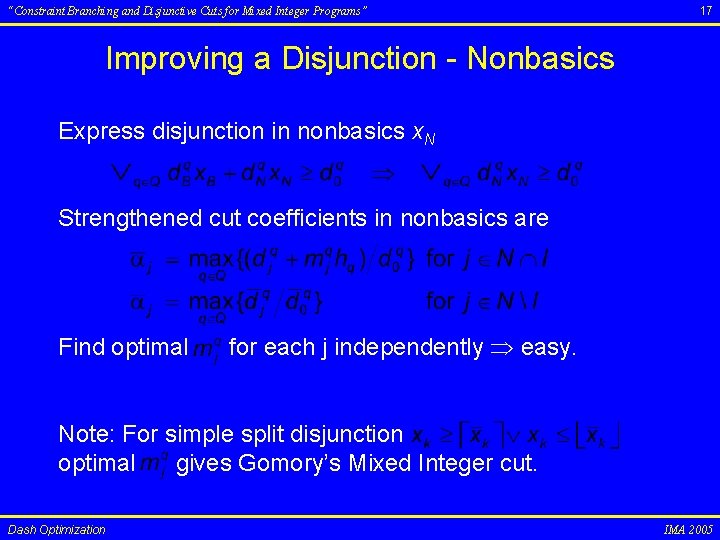
“Constraint Branching and Disjunctive Cuts for Mixed Integer Programs” 17 Improving a Disjunction - Nonbasics Express disjunction in nonbasics x. N Strengthened cut coefficients in nonbasics are Find optimal for each j independently easy. Note: For simple split disjunction optimal gives Gomory’s Mixed Integer cut. Dash Optimization IMA 2005
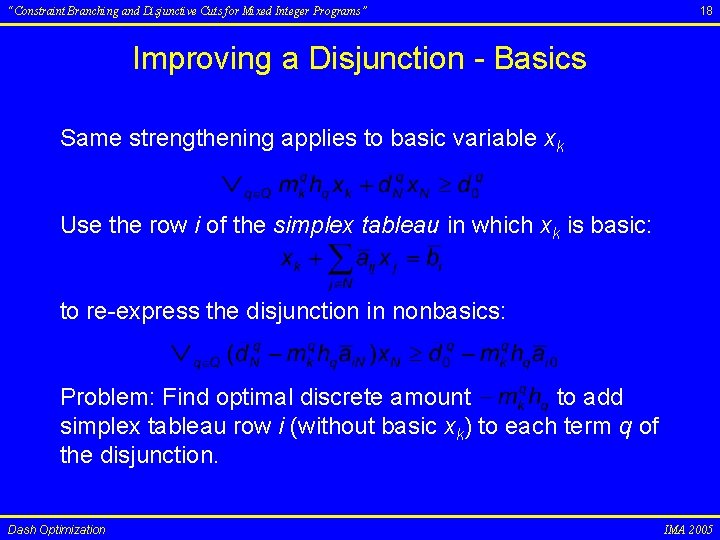
“Constraint Branching and Disjunctive Cuts for Mixed Integer Programs” 18 Improving a Disjunction - Basics Same strengthening applies to basic variable xk Use the row i of the simplex tableau in which xk is basic: to re-express the disjunction in nonbasics: Problem: Find optimal discrete amount to add simplex tableau row i (without basic xk) to each term q of the disjunction. Dash Optimization IMA 2005
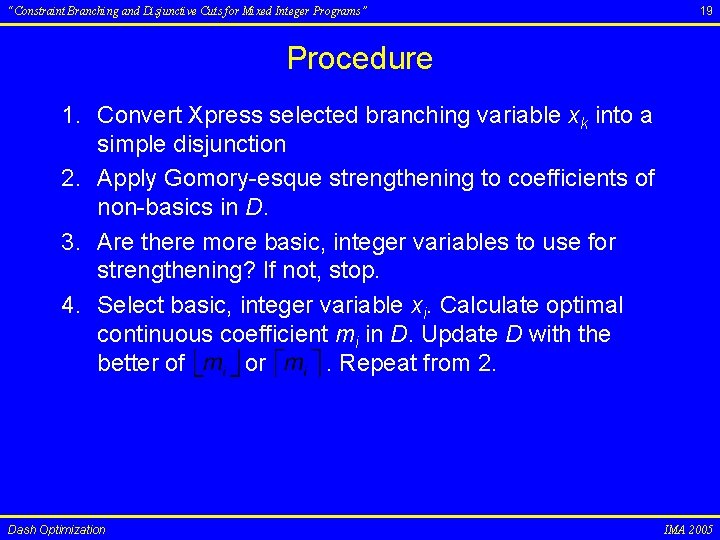
“Constraint Branching and Disjunctive Cuts for Mixed Integer Programs” 19 Procedure 1. Convert Xpress selected branching variable xk into a simple disjunction 2. Apply Gomory-esque strengthening to coefficients of non-basics in D. 3. Are there more basic, integer variables to use for strengthening? If not, stop. 4. Select basic, integer variable xi. Calculate optimal continuous coefficient mi in D. Update D with the better of or. Repeat from 2. Dash Optimization IMA 2005
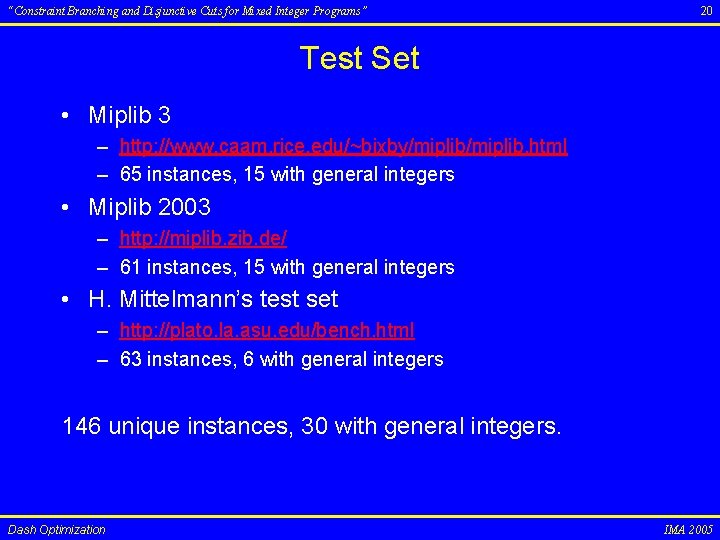
“Constraint Branching and Disjunctive Cuts for Mixed Integer Programs” 20 Test Set • Miplib 3 – http: //www. caam. rice. edu/~bixby/miplib. html – 65 instances, 15 with general integers • Miplib 2003 – http: //miplib. zib. de/ – 61 instances, 15 with general integers • H. Mittelmann’s test set – http: //plato. la. asu. edu/bench. html – 63 instances, 6 with general integers 146 unique instances, 30 with general integers. Dash Optimization IMA 2005
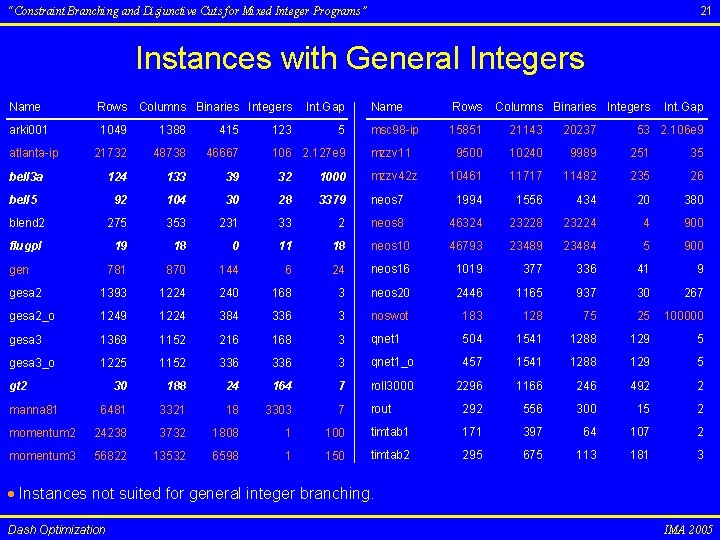
21 “Constraint Branching and Disjunctive Cuts for Mixed Integer Programs” Instances with General Integers Name Rows Columns Binaries Integers arki 001 1049 1388 415 Name Rows msc 98 -ip 15851 21143 20237 21732 48738 46667 mzzv 11 9500 10240 9989 251 35 bell 3 a 124 133 39 32 1000 mzzv 42 z 10461 11717 11482 235 26 bell 5 92 104 30 28 3379 neos 7 1994 1556 434 20 380 blend 2 275 353 231 33 2 neos 8 46324 23228 23224 4 900 flugpl 19 18 0 11 18 neos 10 46793 23489 23484 5 900 781 870 144 6 24 neos 16 1019 377 336 41 9 gesa 2 1393 1224 240 168 3 neos 20 2446 1165 937 30 267 gesa 2_o 1249 1224 384 336 3 noswot 183 128 75 25 100000 gesa 3 1369 1152 216 168 3 qnet 1 504 1541 1288 129 5 gesa 3_o 1225 1152 336 3 qnet 1_o 457 1541 1288 129 5 30 188 24 164 7 roll 3000 2296 1166 246 492 2 6481 3321 18 3303 7 rout 292 556 300 15 2 momentum 2 24238 3732 1808 1 100 timtab 1 171 397 64 107 2 momentum 3 56822 13532 6598 1 150 timtab 2 295 675 113 181 3 atlanta-ip gen gt 2 manna 81 123 Int. Gap 5 106 2. 127 e 9 Columns Binaries Integers Int. Gap 53 2. 106 e 9 Instances not suited for general integer branching. Dash Optimization IMA 2005

“Constraint Branching and Disjunctive Cuts for Mixed Integer Programs” 22 Computational Settings • Implemented in C using Xpress 2005 B optimizer library. • Uses Xpress callbacks to override default branches with new constraint branches. • No in-tree cutting. • No heuristics. • Best-first search. • Run on a dual processor Opteron 246 system (2 GHz, 4 GB RAM, Linux OS). Dash Optimization IMA 2005
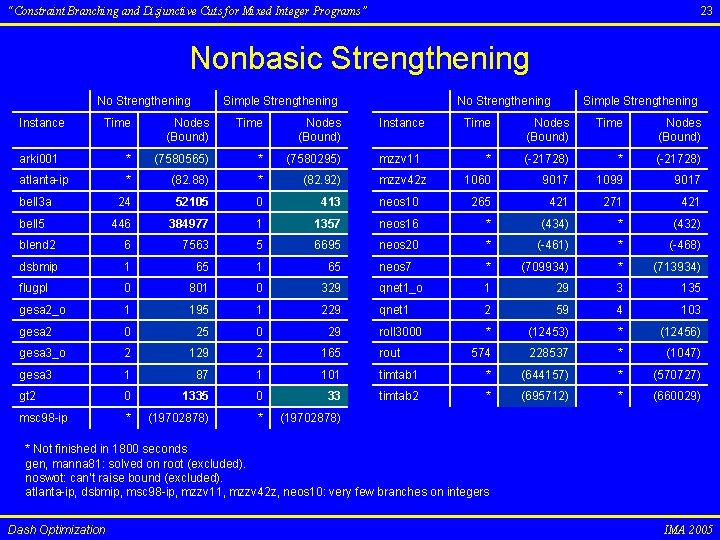
23 “Constraint Branching and Disjunctive Cuts for Mixed Integer Programs” Nonbasic Strengthening No Strengthening Simple Strengthening Time Nodes (Bound) * (-21728) 1060 9017 1099 9017 neos 10 265 421 271 421 1357 neos 16 * (434) * (432) 5 6695 neos 20 * (-461) * (-468) 65 1 65 neos 7 * (709934) * (713934) 0 801 0 329 qnet 1_o 1 29 3 135 gesa 2_o 1 195 1 229 qnet 1 2 59 4 103 gesa 2 0 25 0 29 roll 3000 * (12453) * (12456) gesa 3_o 2 129 2 165 rout 574 228537 * (1047) gesa 3 1 87 1 101 timtab 1 * (644157) * (570727) gt 2 0 1335 0 33 timtab 2 * (695712) * (660029) msc 98 -ip * (19702878) Instance Time Nodes (Bound) arki 001 * (7580565) * (7580295) atlanta-ip * (82. 88) * (82. 92) bell 3 a 24 52105 0 413 bell 5 446 384977 1 blend 2 6 7563 dsbmip 1 flugpl Instance Simple Strengthening mzzv 11 mzzv 42 z * Not finished in 1800 seconds gen, manna 81: solved on root (excluded). noswot: can’t raise bound (excluded). atlanta-ip, dsbmip, msc 98 -ip, mzzv 11, mzzv 42 z, neos 10: very few branches on integers Dash Optimization IMA 2005
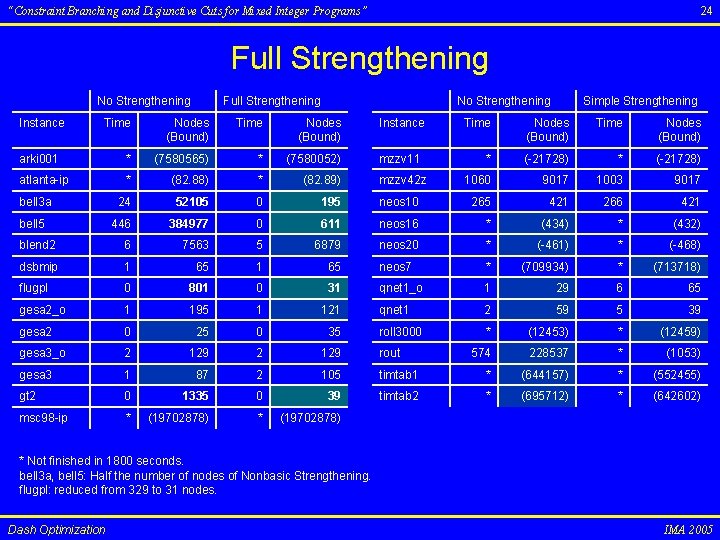
24 “Constraint Branching and Disjunctive Cuts for Mixed Integer Programs” Full Strengthening No Strengthening Full Strengthening Time Nodes (Bound) * (-21728) 1060 9017 1003 9017 neos 10 265 421 266 421 611 neos 16 * (434) * (432) 5 6879 neos 20 * (-461) * (-468) 65 1 65 neos 7 * (709934) * (713718) 0 801 0 31 qnet 1_o 1 29 6 65 gesa 2_o 1 195 1 121 qnet 1 2 59 5 39 gesa 2 0 25 0 35 roll 3000 * (12453) * (12459) gesa 3_o 2 129 rout 574 228537 * (1053) gesa 3 1 87 2 105 timtab 1 * (644157) * (552455) gt 2 0 1335 0 39 timtab 2 * (695712) * (642602) msc 98 -ip * (19702878) Instance Time Nodes (Bound) arki 001 * (7580565) * (7580052) atlanta-ip * (82. 88) * (82. 89) bell 3 a 24 52105 0 195 bell 5 446 384977 0 blend 2 6 7563 dsbmip 1 flugpl Instance Simple Strengthening mzzv 11 mzzv 42 z * Not finished in 1800 seconds. bell 3 a, bell 5: Half the number of nodes of Nonbasic Strengthening. flugpl: reduced from 329 to 31 nodes. Dash Optimization IMA 2005
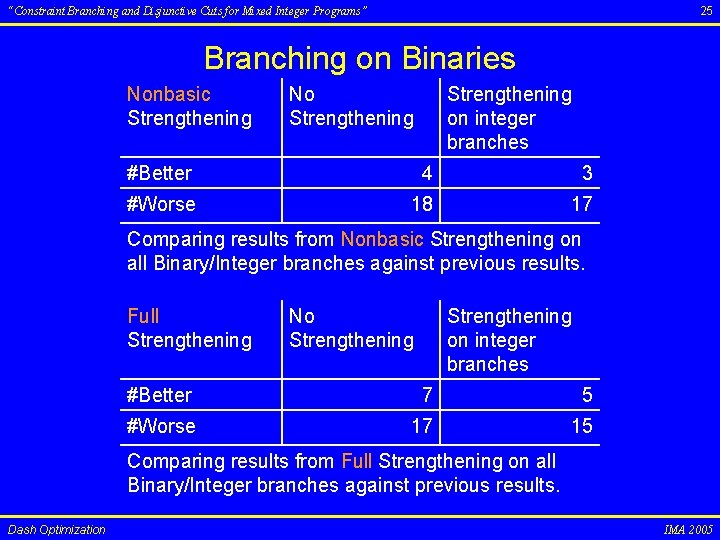
25 “Constraint Branching and Disjunctive Cuts for Mixed Integer Programs” Branching on Binaries Nonbasic Strengthening No Strengthening on integer branches #Better 4 3 #Worse 18 17 Comparing results from Nonbasic Strengthening on all Binary/Integer branches against previous results. Full Strengthening No Strengthening on integer branches #Better 7 5 #Worse 17 15 Comparing results from Full Strengthening on all Binary/Integer branches against previous results. Dash Optimization IMA 2005
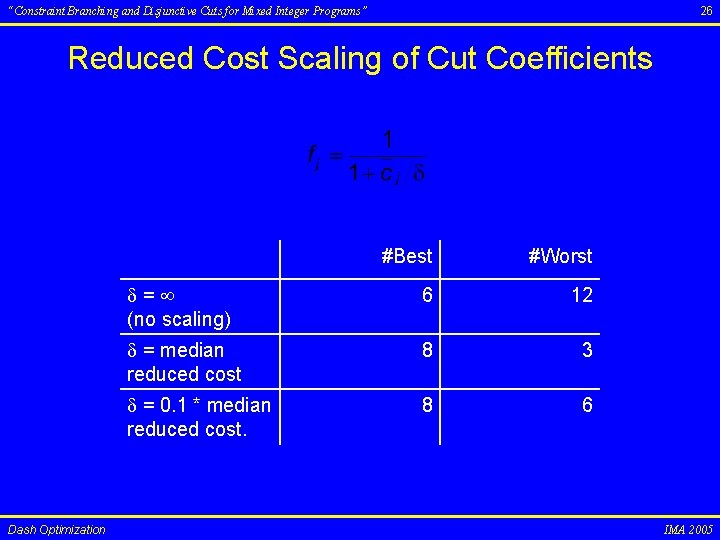
26 “Constraint Branching and Disjunctive Cuts for Mixed Integer Programs” Reduced Cost Scaling of Cut Coefficients Dash Optimization #Best #Worst = (no scaling) 6 12 = median reduced cost 8 3 = 0. 1 * median reduced cost. 8 6 IMA 2005
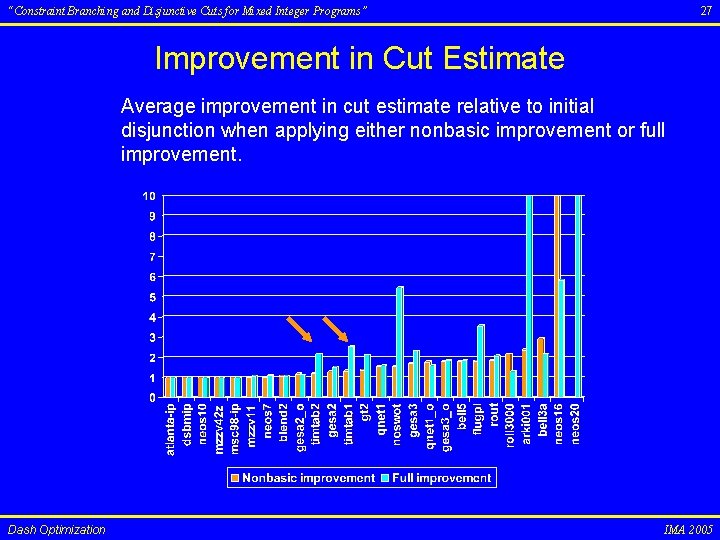
27 “Constraint Branching and Disjunctive Cuts for Mixed Integer Programs” Improvement in Cut Estimate Average improvement in cut estimate relative to initial disjunction when applying either nonbasic improvement or full improvement. Dash Optimization IMA 2005
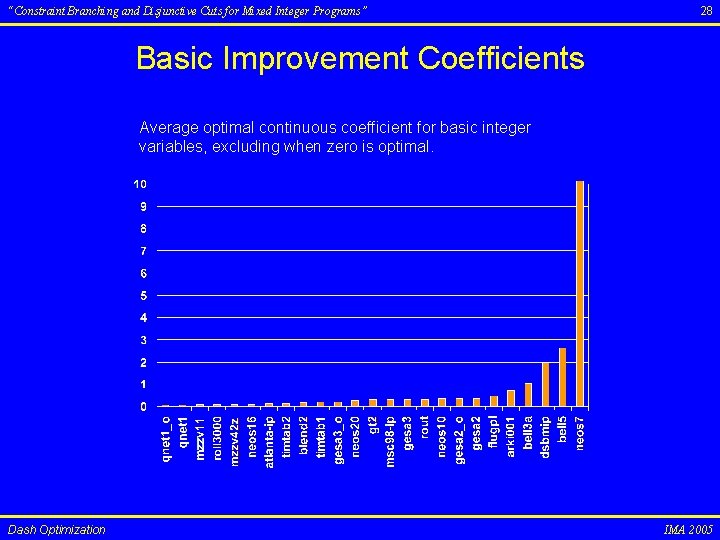
“Constraint Branching and Disjunctive Cuts for Mixed Integer Programs” 28 Basic Improvement Coefficients Average optimal continuous coefficient for basic integer variables, excluding when zero is optimal. Dash Optimization IMA 2005
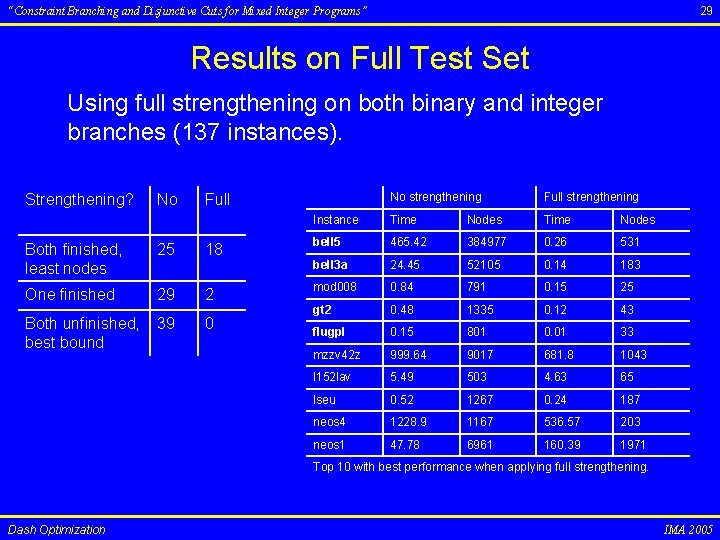
29 “Constraint Branching and Disjunctive Cuts for Mixed Integer Programs” Results on Full Test Set Using full strengthening on both binary and integer branches (137 instances). Strengthening? No No strengthening Full strengthening Instance Time Nodes Full Both finished, least nodes 25 18 bell 5 465. 42 384977 0. 26 531 bell 3 a 24. 45 52105 0. 14 183 One finished 29 2 mod 008 0. 84 791 0. 15 25 Both unfinished, best bound 39 0 gt 2 0. 48 1335 0. 12 43 flugpl 0. 15 801 0. 01 33 mzzv 42 z 999. 64 9017 681. 8 1043 l 152 lav 5. 49 503 4. 63 65 lseu 0. 52 1267 0. 24 187 neos 4 1228. 9 1167 536. 57 203 neos 1 47. 78 6961 160. 39 1971 Top 10 with best performance when applying full strengthening. Dash Optimization IMA 2005
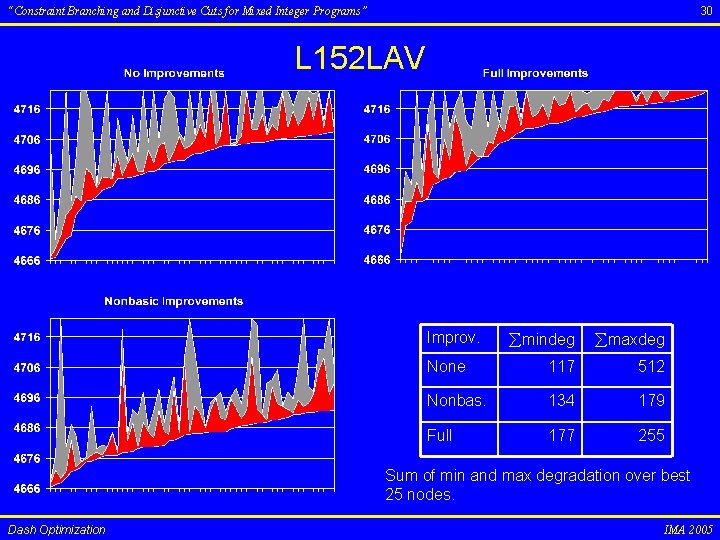
30 “Constraint Branching and Disjunctive Cuts for Mixed Integer Programs” L 152 LAV mindeg maxdeg None 117 512 Nonbas. 134 179 Full 177 255 Improv. Sum of min and max degradation over best 25 nodes. Dash Optimization IMA 2005
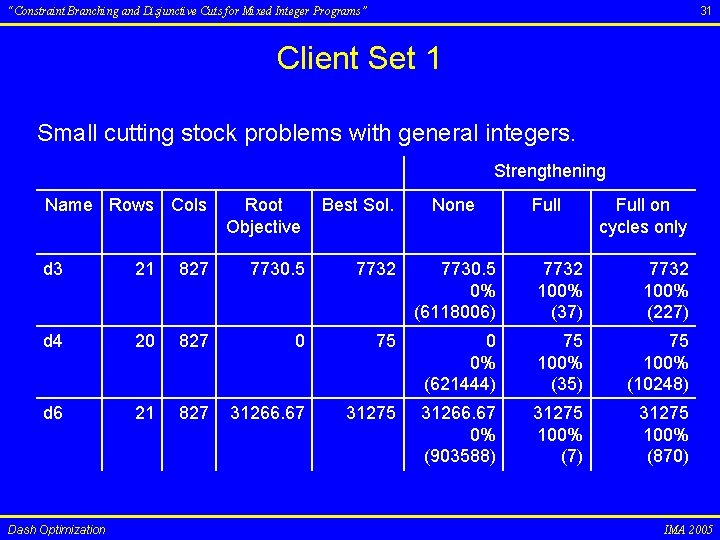
31 “Constraint Branching and Disjunctive Cuts for Mixed Integer Programs” Client Set 1 Small cutting stock problems with general integers. Strengthening Name Rows Cols Root Objective Best Sol. None Full on cycles only d 3 21 827 7730. 5 7732 7730. 5 0% (6118006) 7732 100% (37) 7732 100% (227) d 4 20 827 0 75 0 0% (621444) 75 100% (35) 75 100% (10248) d 6 21 827 31266. 67 31275 31266. 67 0% (903588) 31275 100% (7) 31275 100% (870) Dash Optimization IMA 2005
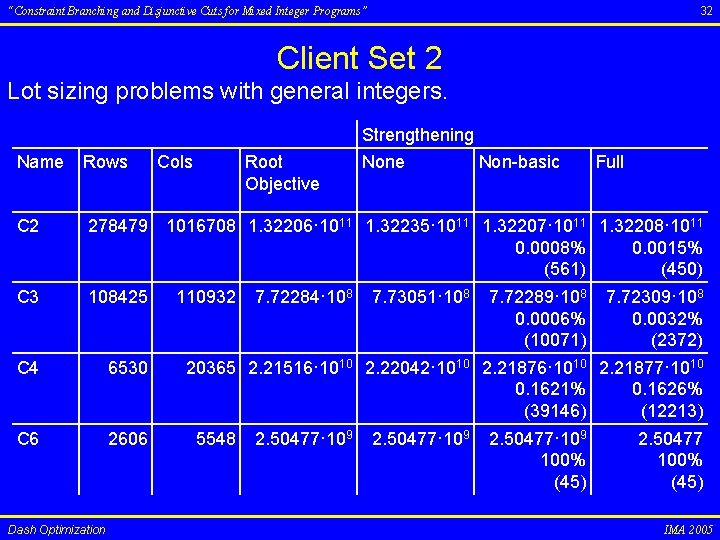
32 “Constraint Branching and Disjunctive Cuts for Mixed Integer Programs” Client Set 2 Lot sizing problems with general integers. Strengthening Name Rows C 2 278479 1016708 1. 32206· 1011 1. 32235· 1011 1. 32207· 1011 1. 32208· 1011 0. 0008% 0. 0015% (561) (450) C 3 108425 C 4 6530 C 6 2606 Dash Optimization Cols Root Objective 110932 7. 72284· 108 None 7. 73051· 108 Non-basic 7. 72289· 108 0. 0006% (10071) Full 7. 72309· 108 0. 0032% (2372) 20365 2. 21516· 1010 2. 22042· 1010 2. 21876· 1010 2. 21877· 1010 0. 1621% 0. 1626% (39146) (12213) 5548 2. 50477· 109 100% (45) 2. 50477 100% (45) IMA 2005
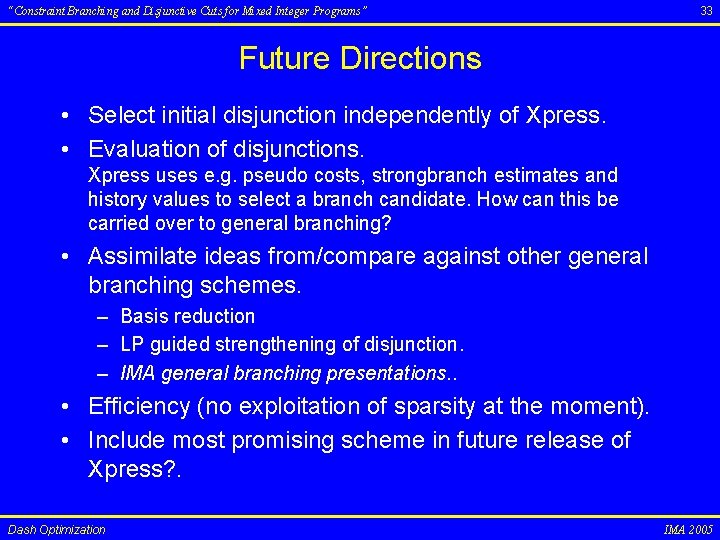
“Constraint Branching and Disjunctive Cuts for Mixed Integer Programs” 33 Future Directions • Select initial disjunction independently of Xpress. • Evaluation of disjunctions. Xpress uses e. g. pseudo costs, strongbranch estimates and history values to select a branch candidate. How can this be carried over to general branching? • Assimilate ideas from/compare against other general branching schemes. – Basis reduction – LP guided strengthening of disjunction. – IMA general branching presentations. . • Efficiency (no exploitation of sparsity at the moment). • Include most promising scheme in future release of Xpress? . Dash Optimization IMA 2005
- Slides: 33