
Constitutional Right to a Fair Trial Chapter 16


- Slides: 20
Constitutional Right to a Fair Trial Chapter 16
Key Terms – Chapter 16 • Acquittal • Capital Punishment • Contraband • Counsel • Double Jeopardy • Espionage • Ex Post Facto Clause • Exclusionary Rule • Indigent • Miranda Rights • Plea Bargain • Probable Cause • Search Warrant • Self-Incrimination • Treason
Constitutional Rights Before Trial Lesson 1
Rights of the Accused in a Democracy • Even people charged with or convicted of a crime have constitutionally protected rights. • Procedural due process protects the rights of the accused in criminal cases. • Procedural due process requires notifying a person of a criminal accusation and allowing a response. • Several safeguards protect the rights of a person throughout the criminal justice process.
Searches and Seizures • The Fourth Amendment protects Americans from unreasonable government searches and seizures. • Police may obtain a search warrant if they can demonstrate probable cause to suspect a crime. • There are situations in which a warrant is not required to search a person, or their belongings. • Arrest is considered a seizure and requires a warrant or probable cause, but police may stop and question people. • The exclusionary rule is not in the Fourth Amendment and is highly controversial. (Mapp v. Ohio, 1961)
Special Issues in Search and Seizure • The Fourth Amendment rights of students are limited. • At international borders and sobriety checkpoints, searches may be made without individual suspicion. • Racial profiling is inappropriate but using race as part of a description is acceptable.
Interrogations • The Fifth Amendment protects people from self-incrimination. • The Sixth Amendment ensures people the right to an attorney. Escobedo v. Illinois, 1964 • A confession cannot be used in court if it is not voluntary and trustworthy. • The Miranda rights require police to inform suspects in custody of their rights before questioning. Miranda v. Arizona, 1966
Constitutional Rights at Trial Lesson 2
Presumption of Innocence • The judge or jury must regard the defendant as innocent until the government proves guilt. • To prove guilt in a criminal trial, each element must be proven beyond a reasonable doubt. • Guilt must be proven, not innocence. • A defendant’s rights are protected by the Fifth and Sixth Amendments.
Right to a Jury • Although defendants have a right to a jury trial, most settle with a plea bargain. • The Supreme Court has approved the process of plea bargaining. • Many defendants waive their right to a jury trial. • Prospective jurors cannot be excluded solely because of their race, gender, or national origin.
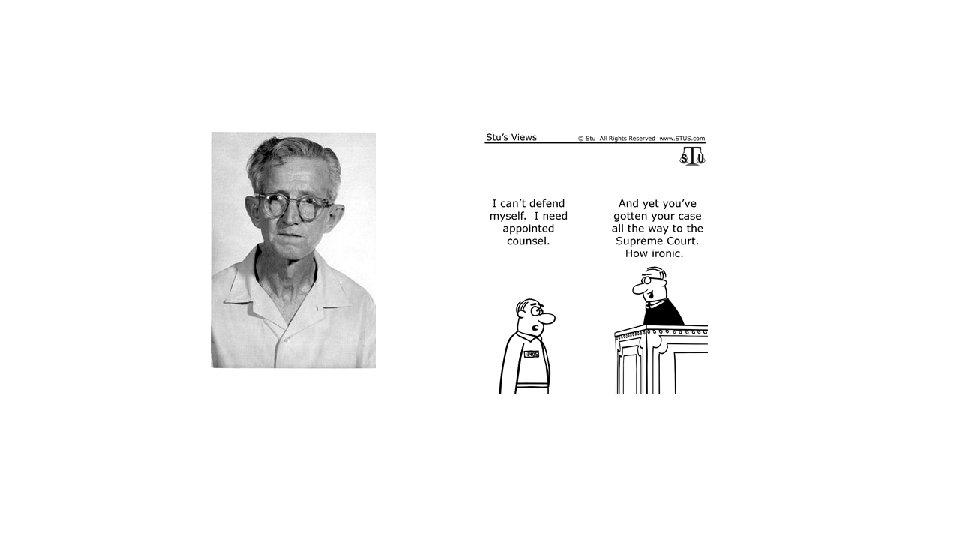
Right to an Attorney • At first, only defendants who could afford an attorney had legal counsel. • Questions arose in Powell v. Alabama, 1932 • In 1938, the Supreme Court ruled that federal courts must provide attorneys for indigent defendants. • Further clarified in Betts v. Brady, 1942 • In Gideon v. Wainwright, 1963, this right was extended to felony defendants in state courts. • The right to the assistance of counsel is basic to the idea of a fair trial.
Other Rights at Trial • The Sixth Amendment provides the right to a speedy and public trial in all criminal cases. • Defendants often waive their right to a speedy trial. • Defendants have the right to confront and cross-examine the witnesses against them. • Defendants cannot be forced to testify against themselves in a criminal trial.
The Juvenile Justice System • In the United States, juveniles in trouble with the law are treated differently from adults. • Juveniles may be taken into custody for status offenses such as running away and truancy. • The Supreme Court has ruled that juvenile cases do not require public or jury trials. • Juveniles may be tried in adult courts under exceptional circumstances.
Constitutional Rights after a Trial Lesson 3
Purposes and Types of Punishment • When a defendant is found guilty, a judge usually decides the sentence, or punishment. • Purposes of sentences include retribution, deterrence, rehabilitation, restitution, and incapacitation. • The ex post facto clause prevents punishment for actions that were not a crime when they occurred. • Disproportionate incarceration challenges the basic assumption of the fairness of the law.
Cruel and Unusual Punishment • The Eighth Amendment prohibits “cruel and unusual punishment. ” • Three-strikes laws typically impose automatic, lengthy sentences for a person’s third serious offense. • Capital punishment is the most controversial sentence given to defendants. • Mandatory sentences of life in prison without parole are unconstitutional for juveniles.
Rights After a Conviction or Acquittal • The Fifth Amendment protects against double jeopardy. • A defendant can apply for a writ of habeas corpus to challenge his or her imprisonment. • Habeas corpus serves as an important safeguard against arbitrary or unjustified imprisonment.