
CONSTITUTIONAL DESIGN WHY DO WE NEED A CONSTITUTION

- Slides: 11
CONSTITUTIONAL DESIGN
WHY DO WE NEED A CONSTITUTION? • It generates a degree of trust and coordination that is necessary for different kind of people to live together. • It specifies how the government will be constituted, who will have power to take which decisions. • It lays down limits on the powers of government and tells us what the rights of the citizens are. • It expresses the aspirations of the people about creating a good society.
The Making of the Indian Constitution • Indian constitution was drawn up under very difficult circumstances. • The making of the constitution for a huge and diverse country was not an easy task. • The people of India were emerging from the status of subjects to that of citizens. • The partition of the country on the basis of religious differences. • The issue of princely states. • The makers of the constitution had anxieties about the present and the future of the country.
The Path to Constitution • There was one advantage for the makers of Indian Constitution. They did not have to create a consensus about what a democratic India should look like. Much of the consensus had evolved during the freedom struggle. • Our national movement was not merely a struggle against a foreign rule. It was also a struggle to rejuvenate our country and to transform our society and politics. • There were sharp differences of opinion within the freedom struggle about the path India should take after independence. Such differences exist even today. Yet some basic ideas had come to be accepted by almost everyone.
• In 1928, Motilal Nehru and eight other Congress leaders drafted a constitution for India. • In 1931, the Karachi session of INC dwelt on how independent India’s constitution should look like. • Both these documents were committed to the inclusion of : • (a) universal adult franchise. • (b) Right to freedom and equality. • (c) Protection of the rights of minorities in the constitution of Independent India. • Thus some basic values were accepted by all leaders much before the Constituent Assembly met to deliberate on the constitution.
• The familiarity with political institutions of colonial rule like voting rights, participation in elections held in 1937, formation of Ministries all over British India proved to be very useful for the country in setting up its own institutions and working in them. • Years of thinking and deliberation on the framework of the constitution gave our leaders confidence to learn from other countries, but on our own terms. They were inspired by the ideals of French Revolution, the practice of parliamentary democracy in Britain , the Bill of Rights in the USA and the Russian Revolution. • At each step they were questioning whether these things suited our country. All these factors contributed to the making of our constitution.
The constituent Assembly • Elections to the Constituent Assembly were held in July 1946. Its first meeting was held in Dec 1946. • The constituent assembly that wrote the Indian constitution had 299 members. • The assembly adopted the constitution on 26 Nov 1949 and came into effect o 26 Jan 1950. • Why should we accept the Constitution made by the assembly more than seven decades ago? • The constitution does not reflect the views of its members alone. It expresses a broad consensus of its time. • The Constituent Assembly represented the people of India. The members were from all the regions, different linguistic groups, caste, classes, religions and occupations. • The manner in which the Constituent Assembly works gives sanctity to the constitution. It worked in a systematic , open and consensual manner.
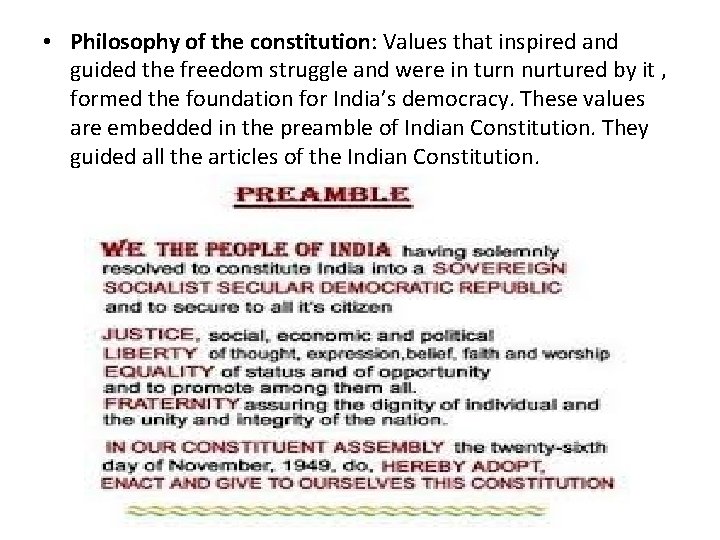
Guiding Values of the Indian Constitution • We can know the overall philosophy of our constitution in two ways. We can understand it by reading the views of some of our major leaders on our constitution. • It is equally important to read what the constitution says about its own philosophy. This is what the preamble to the constitution does. • The dream and the promises: Mahatma Gandhi was not a member of constituent assembly , yet it followed his vision. In 1931 in his magazine Young India , he spelt out what he wanted the constitution to do: release India from all thralldom and patronage, poorest shall feel that they have an effective voice, an India in which all
• All communities shall live in perfect harmony, women will enjoy the same rights as men. • Dr BR Ambedkar who played a key role in the making of the constitution had a different understanding of how inequality could be removed. He often bitterly criticised Mahatma Gandhi and his vision. In his concluding speech to the constituent assembly he stated, “ we are going to enter a life of contradiction. In politics we will have equality and in social and economic life we will have inequality. ” • Jawaharlal Nehru said, freedom and power bring responsibility. The service of India means the service of the millions who suffer. It means the ending of poverty and ignorance and disease and inequality of opportunity.
• Philosophy of the constitution: Values that inspired and guided the freedom struggle and were in turn nurtured by it , formed the foundation for India’s democracy. These values are embedded in the preamble of Indian Constitution. They guided all the articles of the Indian Constitution.
Institutional Design • A constitution is mainly about embodying the values into institutional arrangements. It is a very long and detailed document. It needs to be amended quite regularly to keep it updated. These changes are called constitutional amendments. • The Constitution describes the institutional arrangements in a very legal language. It lays down a procedure for choosing persons to govern the country. It defines who will have how much power to take which decisions. It puts limits to what the government can do by providing some rights to the citizens that cannot be violated.