
Constitutional Analysis What is the Cabinet and why
Constitutional Analysis What is the Cabinet and why is it there? Read Article 2 Section 2. What is the constitutional basis for the cabinet? Under the US Constitution, a president must be; • A natural-born US citizen • At least 35 years old • A US resident for at least 14 years
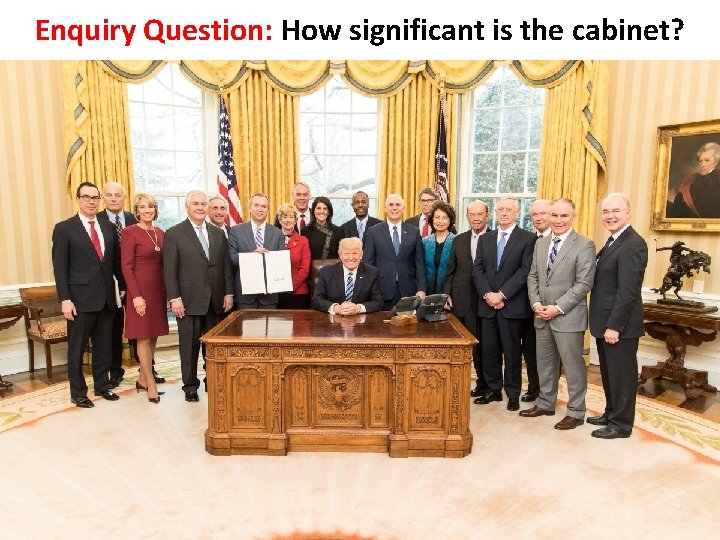
Enquiry Question: How significant is the cabinet?
Learning Objectives • To explain the influences on the composition of the cabinet • To analyse the role and extent of influence of the cabinet • To evaluate the extent to which EOP is a rival for the executive power of the cabinet
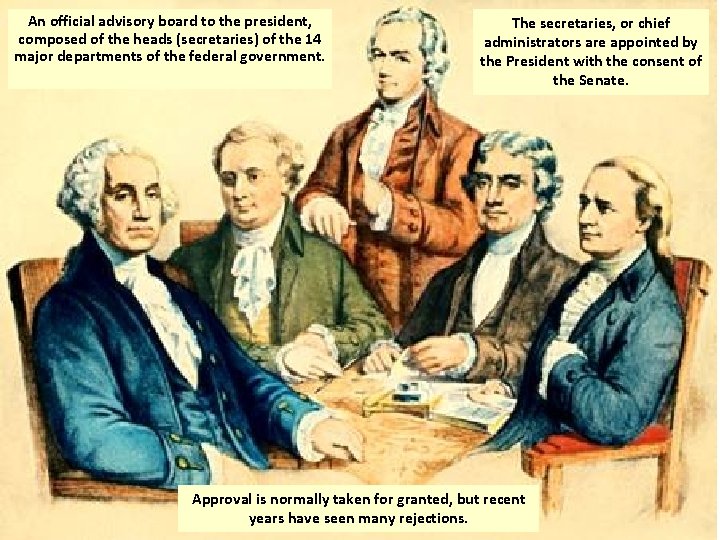
An official advisory board to the president, composed of the heads (secretaries) of the 14 major departments of the federal government. The secretaries, or chief administrators are appointed by the President with the consent of the Senate. Approval is normally taken for granted, but recent years have seen many rejections.
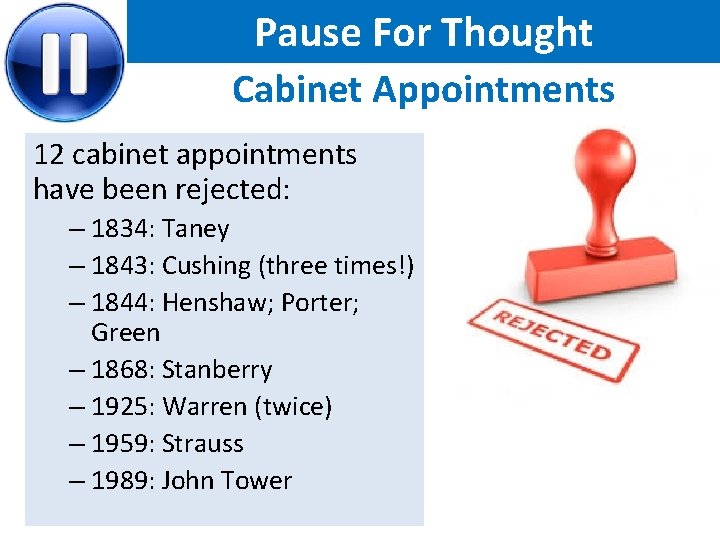
Pause For Thought Cabinet Appointments 12 cabinet appointments have been rejected: – 1834: Taney – 1843: Cushing (three times!) – 1844: Henshaw; Porter; Green – 1868: Stanberry – 1925: Warren (twice) – 1959: Strauss – 1989: John Tower
Cabinet Nominations Rejected Name: Lewis L. Strauss Nominated by: Dwight Eisenhower Nomination Position: Commerce Date Nominated: January 17, 1959 Date Rejected: June 18, 1959 Vote: 46 -49 https: //www. senate. gov/art andhistory/minute/C abinet_Nomination_Defeate d. htm Name: John G. Tower Nominated by: George H. W. Bush Nomination Position: Defense Date Nominated: January 20, 1989 Date Rejected: March 9, 1989 Vote: 47 -53 http: //www. nytimes. com/ 1989/03/10/us/senaterejects-tower-53 -47 -firstcabinet-veto-since-59 bush-confers-newchoice. html
Cabinet Nominations Withdrawn Name: Zoe E. Baird Nominated by: William J. Clinton Nomination Position: Attorney General Date Nominated: January 21, 1993 Date Withdrawn: January 26, 1993 (Note: Two other Clinton AG choices, Kimba Wood and Lani Guinier, were never formally nominated. ) http: //en. wikipedia. org/wiki/Nannygate Name: Anthony Lake Nominated by: William J. Clinton Nomination Position: Director, CIA Date Nominated: January 9, 1997 Date Withdrawn: April 18, 1997 http: //www. newyorker. com/magazine/199 7/03/31/tony-lake-is-missing Name: Hershel W. Gober Nominated by: William J. Clinton Nomination Position: Veterans Affairs Date Nominated: July 31, 1997 Date Withdrawn: October 27, 1997 http: //articles. latimes. com/1997/oct/25/n ews/mn-46573 Name: Linda Chavez Nominated by: George W. Bush Nomination Position: Labor Date Nominated: January 3, 2001 Date Withdrawn: January 9, 2001 http: //transcripts. cnn. com/TRANSCRIPT S/0101/09/bn. 02. html Name: Bernard Kerik Nominated by: George W. Bush Nomination Position: Homeland Security Date Nominated: December 2, 2004 Date Withdrawn: December 10, 2004 http: //nymag. com/nymetro/news/peop le/features/11618/
Cabinet Nominations Delayed Despite being nominated promptly during the transition period, most cabinet members were unable to take office on Inauguration Day because of delays in the formal confirmation process. By February 8, 2017, President Trump had fewer cabinet nominees confirmed than any prior president two weeks into their mandate, except George Washington. Part of the lateness was ascribed to obstructionism by Senate Democrats and part to delays in submitting background-check paperwork. The last Cabinet member, Robert Lighthizer, took office as U. S. Trade Representative on May 11, 2017, more than four months after his nomination.
Composition of the Cabinet • The appointment of the cabinet can sometimes help illustrate the uses of the cabinet. It was President Clinton who said that he wanted a cabinet that “looked like America”. • The consequential selection of women and people from ethnic minorities meant that the cabinet might help broaden the electoral appeal and support for the administration. Presidents will have a variety of motives in selecting their cabinets. They may aim to: • recruit policy specialists • build links with Congress through the appointment of serving congressmen and senators • bring trusted advisers into government • strengthen links with key racial groups and with women • represent different wings of the party and different regions of the country President Obama could be seen to want to: • bury campaign divisions through the appointment of Hillary Clinton as Secretary of State • send a message of bipartisanship through the retention of Robert Gates at Defense • make his Cabinet ‘look like America’ through the appointments of, e. g. , Eric Holder Steven Chu, Hilda Solis and Eric Shinseki
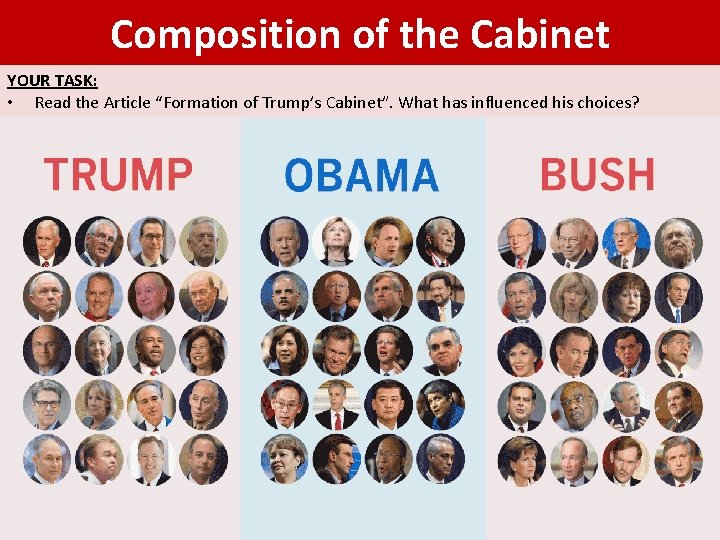
Composition of the Cabinet YOUR TASK: • Read the Article “Formation of Trump’s Cabinet”. What has influenced his choices?
Learning Objectives • To explain the influences on the composition of the cabinet • To analyse the role and extent of influence of the cabinet • To evaluate the extent to which EOP is a rival for the executive power of the cabinet
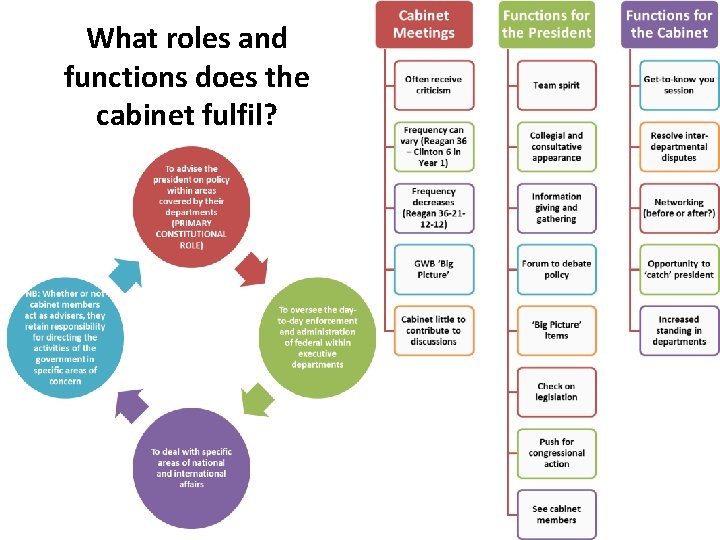
What roles and functions does the cabinet fulfil?
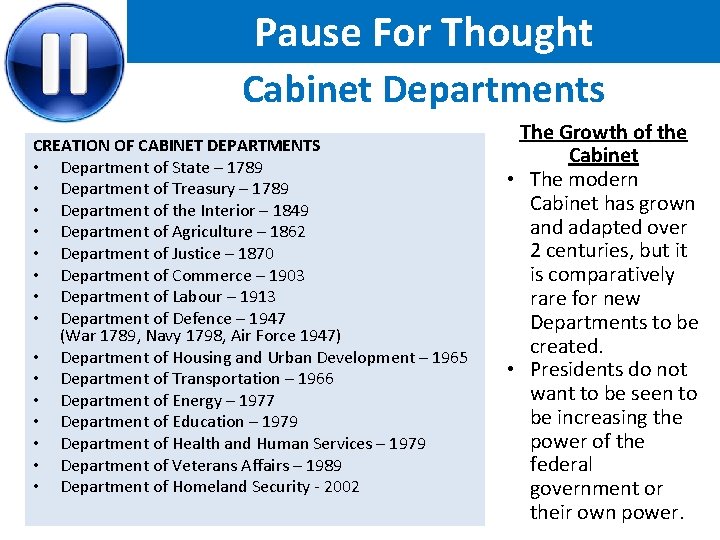
Pause For Thought Cabinet Departments CREATION OF CABINET DEPARTMENTS • Department of State – 1789 • Department of Treasury – 1789 • Department of the Interior – 1849 • Department of Agriculture – 1862 • Department of Justice – 1870 • Department of Commerce – 1903 • Department of Labour – 1913 • Department of Defence – 1947 (War 1789, Navy 1798, Air Force 1947) • Department of Housing and Urban Development – 1965 • Department of Transportation – 1966 • Department of Energy – 1977 • Department of Education – 1979 • Department of Health and Human Services – 1979 • Department of Veterans Affairs – 1989 • Department of Homeland Security - 2002 The Growth of the Cabinet • The modern Cabinet has grown and adapted over 2 centuries, but it is comparatively rare for new Departments to be created. • Presidents do not want to be seen to be increasing the power of the federal government or their own power.
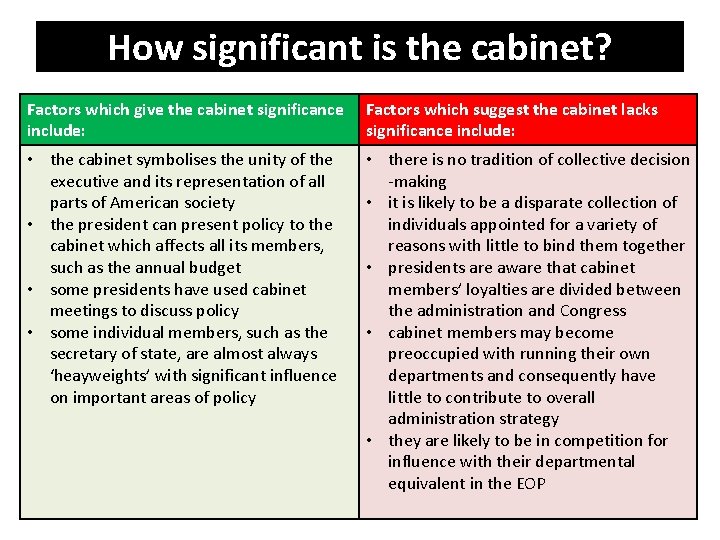
How significant is the cabinet? Factors which give the cabinet significance include: Factors which suggest the cabinet lacks significance include: • the cabinet symbolises the unity of the executive and its representation of all parts of American society • the president can present policy to the cabinet which affects all its members, such as the annual budget • some presidents have used cabinet meetings to discuss policy • some individual members, such as the secretary of state, are almost always ‘heayweights’ with significant influence on important areas of policy • there is no tradition of collective decision -making • it is likely to be a disparate collection of individuals appointed for a variety of reasons with little to bind them together • presidents are aware that cabinet members’ loyalties are divided between the administration and Congress • cabinet members may become preoccupied with running their own departments and consequently have little to contribute to overall administration strategy • they are likely to be in competition for influence with their departmental equivalent in the EOP
Learning Objectives • To explain the influences on the composition of the cabinet • To analyse the role and extent of influence of the cabinet • To evaluate the extent to which EOP is a rival for the executive power of the cabinet
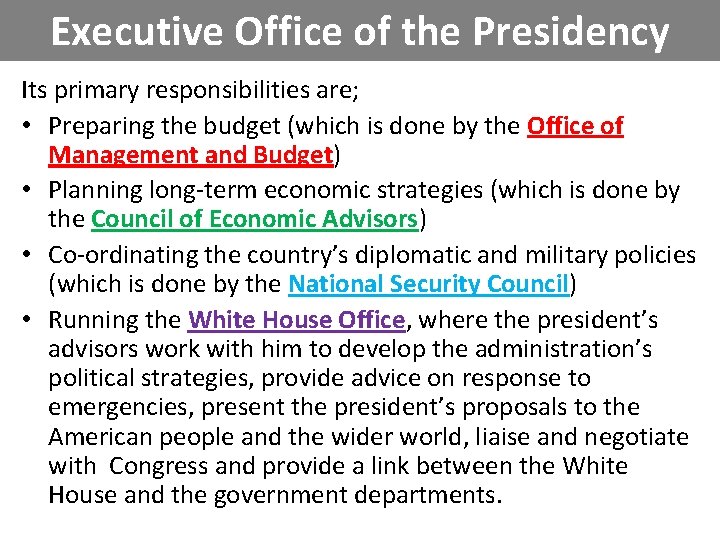
Executive Office of the Presidency Its primary responsibilities are; • Preparing the budget (which is done by the Office of Management and Budget) • Planning long-term economic strategies (which is done by the Council of Economic Advisors) • Co-ordinating the country’s diplomatic and military policies (which is done by the National Security Council) • Running the White House Office, where the president’s advisors work with him to develop the administration’s political strategies, provide advice on response to emergencies, present the president’s proposals to the American people and the wider world, liaise and negotiate with Congress and provide a link between the White House and the government departments.
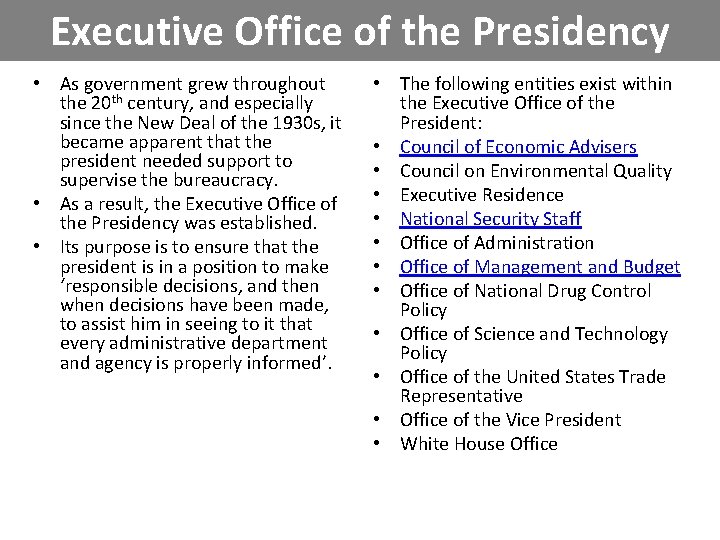
Executive Office of the Presidency • As government grew throughout the 20 th century, and especially since the New Deal of the 1930 s, it became apparent that the president needed support to supervise the bureaucracy. • As a result, the Executive Office of the Presidency was established. • Its purpose is to ensure that the president is in a position to make ‘responsible decisions, and then when decisions have been made, to assist him in seeing to it that every administrative department and agency is properly informed’. • The following entities exist within the Executive Office of the President: • Council of Economic Advisers • Council on Environmental Quality • Executive Residence • National Security Staff • Office of Administration • Office of Management and Budget • Office of National Drug Control Policy • Office of Science and Technology Policy • Office of the United States Trade Representative • Office of the Vice President • White House Office
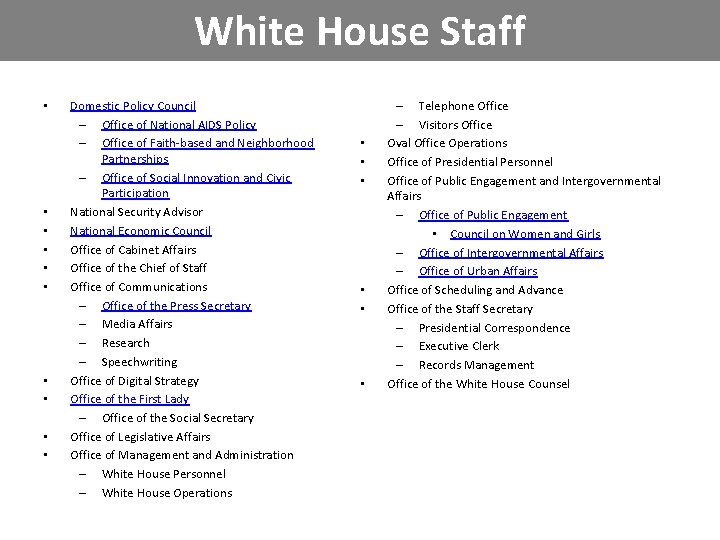
White House Staff • • • Domestic Policy Council – Office of National AIDS Policy – Office of Faith-based and Neighborhood Partnerships – Office of Social Innovation and Civic Participation National Security Advisor National Economic Council Office of Cabinet Affairs Office of the Chief of Staff Office of Communications – Office of the Press Secretary – Media Affairs – Research – Speechwriting Office of Digital Strategy Office of the First Lady – Office of the Social Secretary Office of Legislative Affairs Office of Management and Administration – White House Personnel – White House Operations • • • – Telephone Office – Visitors Office Oval Office Operations Office of Presidential Personnel Office of Public Engagement and Intergovernmental Affairs – Office of Public Engagement • Council on Women and Girls – Office of Intergovernmental Affairs – Office of Urban Affairs Office of Scheduling and Advance Office of the Staff Secretary – Presidential Correspondence – Executive Clerk – Records Management Office of the White House Counsel
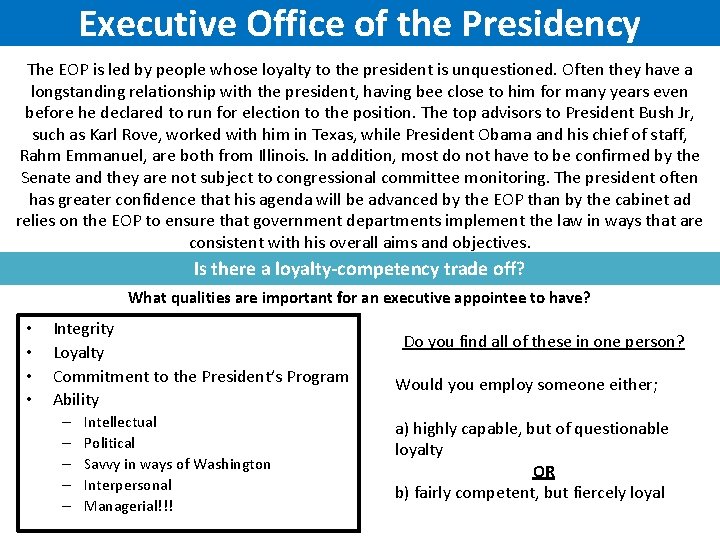
Executive Office of the Presidency The EOP is led by people whose loyalty to the president is unquestioned. Often they have a longstanding relationship with the president, having bee close to him for many years even before he declared to run for election to the position. The top advisors to President Bush Jr, such as Karl Rove, worked with him in Texas, while President Obama and his chief of staff, Rahm Emmanuel, are both from Illinois. In addition, most do not have to be confirmed by the Senate and they are not subject to congressional committee monitoring. The president often has greater confidence that his agenda will be advanced by the EOP than by the cabinet ad relies on the EOP to ensure that government departments implement the law in ways that are consistent with his overall aims and objectives. Is there a loyalty-competency trade off? What qualities are important for an executive appointee to have? • • Integrity Loyalty Commitment to the President’s Program Ability – – – Intellectual Political Savvy in ways of Washington Interpersonal Managerial!!! Do you find all of these in one person? Would you employ someone either; a) highly capable, but of questionable loyalty OR b) fairly competent, but fiercely loyal
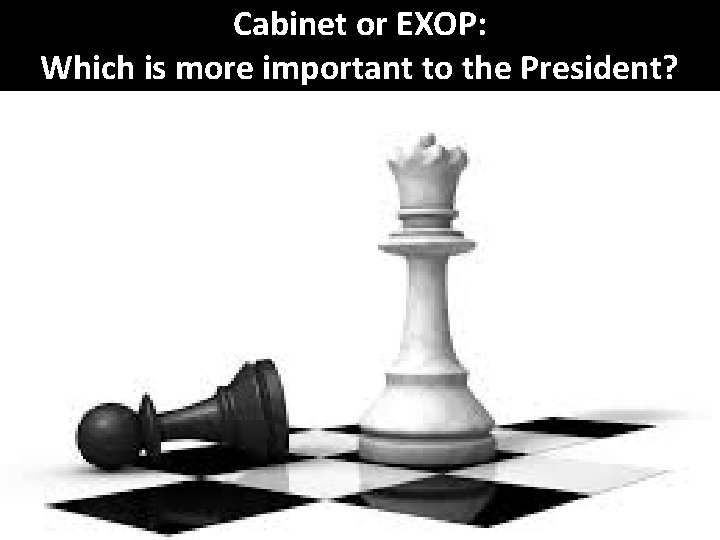
Cabinet or EXOP: Which is more important to the President?
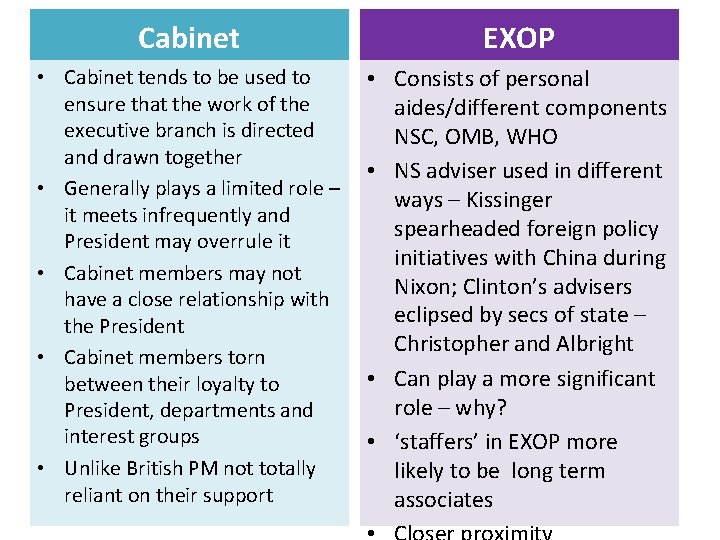
Cabinet EXOP • Cabinet tends to be used to ensure that the work of the executive branch is directed and drawn together • Generally plays a limited role – it meets infrequently and President may overrule it • Cabinet members may not have a close relationship with the President • Cabinet members torn between their loyalty to President, departments and interest groups • Unlike British PM not totally reliant on their support • Consists of personal aides/different components NSC, OMB, WHO • NS adviser used in different ways – Kissinger spearheaded foreign policy initiatives with China during Nixon; Clinton’s advisers eclipsed by secs of state – Christopher and Albright • Can play a more significant role – why? • ‘staffers’ in EXOP more likely to be long term associates
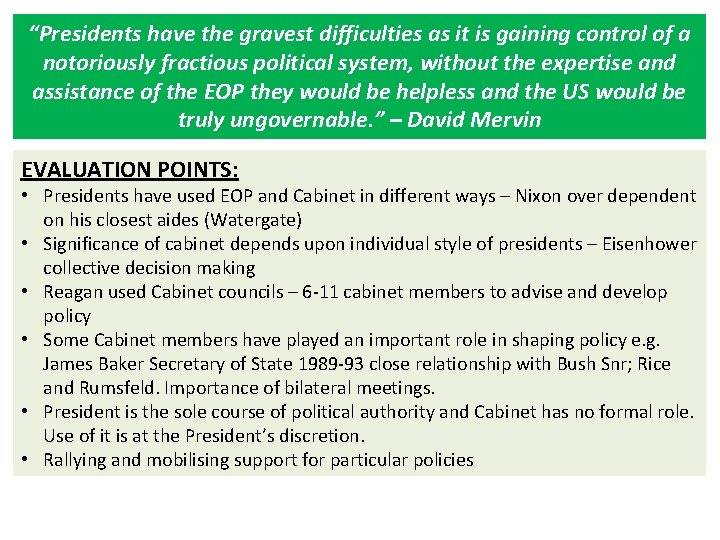
“Presidents have the gravest difficulties as it is gaining control of a notoriously fractious political system, without the expertise and assistance of the EOP they would be helpless and the US would be truly ungovernable. ” – David Mervin EVALUATION POINTS: • Presidents have used EOP and Cabinet in different ways – Nixon over dependent on his closest aides (Watergate) • Significance of cabinet depends upon individual style of presidents – Eisenhower collective decision making • Reagan used Cabinet councils – 6 -11 cabinet members to advise and develop policy • Some Cabinet members have played an important role in shaping policy e. g. James Baker Secretary of State 1989 -93 close relationship with Bush Snr; Rice and Rumsfeld. Importance of bilateral meetings. • President is the sole course of political authority and Cabinet has no formal role. Use of it is at the President’s discretion. • Rallying and mobilising support for particular policies
Learning Objectives • To explain the influences on the composition of the cabinet • To analyse the role and extent of influence of the cabinet • To evaluate the extent to which EOP is a rival for the executive power of the cabinet
Homework Application Task: Assess the significance of the Cabinet in the executive branch. (15) Flipped Learning Preparation Task: Relationships between the Presidency and other branches (Pearson p 373— 5) Stretch & Challenge Task What Now? Choosing Your Cabinet
- Slides: 24