
CONSTITUENTS OF MILK AND THEIR COMPOSITION Milk composition
- Slides: 10
CONSTITUENTS OF MILK AND THEIR COMPOSITION
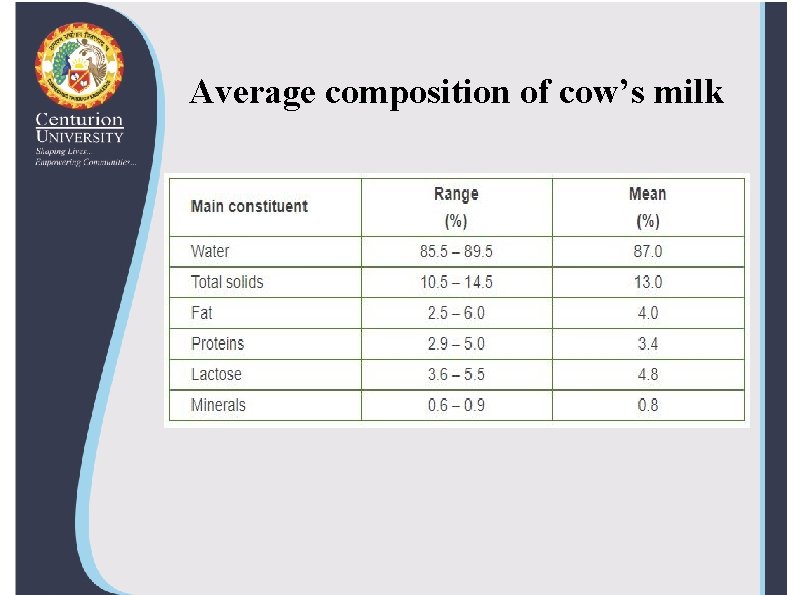
Milk composition üMilk contains more water than any other element, around 87% for dairy cows. The other elements are üdissolved, colloidally dispersed, and emulsified in water. üThe quantities of the main milk constituents can vary considerably depending on the individual animal, its breed, stage of lactation, age and health status. üHerd management practices and environmental conditions also influence milk composition.
Average composition of cow’s milk
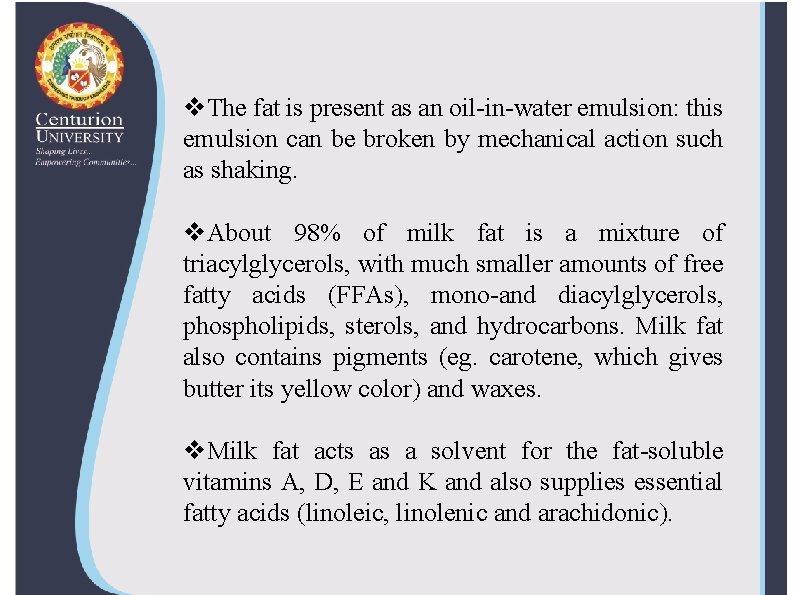
Milk fat v. If milk is left to stand, a layer of cream forms on the surface. The cream differs considerably in appearance from the lower layer of skim milk. v. Under the microscope cream can be seen to consist of a large number of spheres of varying sizes floating in the milk. Each sphere is surrounded by a thin skin (the fat globule membrane) which acts as the emulsifying agent for the fat suspended in milk. v. The membrane protects the fat against enzymes and prevents the globules coalescing into butter grains.
v. The fat is present as an oil-in-water emulsion: this emulsion can be broken by mechanical action such as shaking. v. About 98% of milk fat is a mixture of triacylglycerols, with much smaller amounts of free fatty acids (FFAs), mono-and diacylglycerols, phospholipids, sterols, and hydrocarbons. Milk fat also contains pigments (eg. carotene, which gives butter its yellow color) and waxes. v. Milk fat acts as a solvent for the fat-soluble vitamins A, D, E and K and also supplies essential fatty acids (linoleic, linolenic and arachidonic).
Milk proteins ØProteins perform a variety of functions in living organisms ranging Øfrom providing structure to reproduction. ØMilk proteins represent one of the greatest contributions of milk to human nutrition. ØProteins are polymers of amino acids. Only 20 different amino acids occur, regularly in proteins. ØThe content and sequence of amino acids in a protein therefore affect its properties.
ØSome proteins contain substances other than amino acids, e. g. lipoproteins contain fat and protein. Such proteins are called conjugated proteins as phosphoproteins, lipoproteins and chromoproteins. ØThe phosphate is linked chemically to phosphoproteins, the casein in milk is one such example. ØA combination of lipid and protein forms the lipoprotein and are excellent emulsifying agents. ØChromoproteins are proteins with a coloured prosthetic group and include haemoglobin and myoglobin.
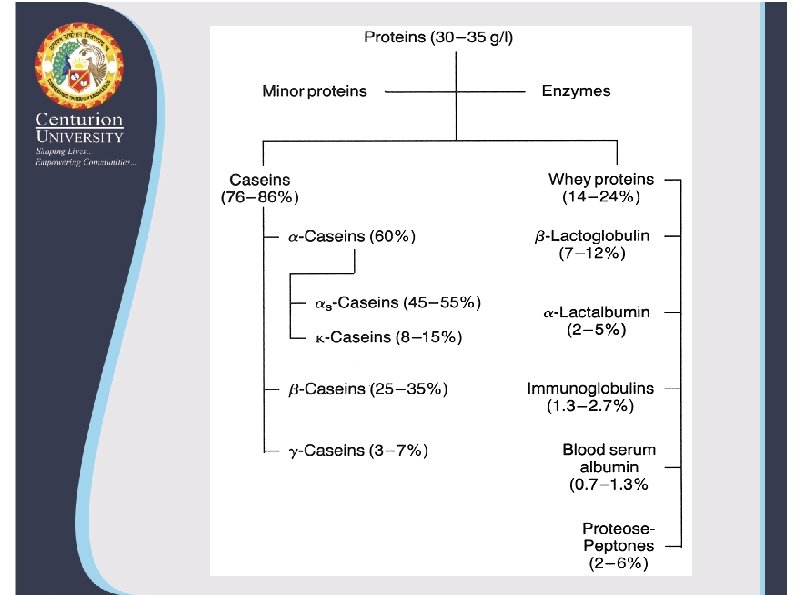
Casein proteins üThe casein is a group name for the dominant class of protein in milk. üNormal bovine milk contains about 3. 5% protein, out of which casein constitutes about 80%. üCasein is easily separated from milk, either by acid precipitation or by adding rennin. üIn cheese making most of the casein is recovered with the milk fat.
Whey proteins üThe whey proteins are also made up of a number of distinct proteins as shown in the previous figure. üWhey protein comprises the group of proteins in whey during the cheese making process. üWhey protein also contains fragments of casein molecules. üAfter the fat and casein have been removed from milk, one is left with whey, which contains the soluble milk salts, milk sugar and the remainder of the milk proteins.