
Constantpower loads Characteristics DC microgrids comprise cascade distributed
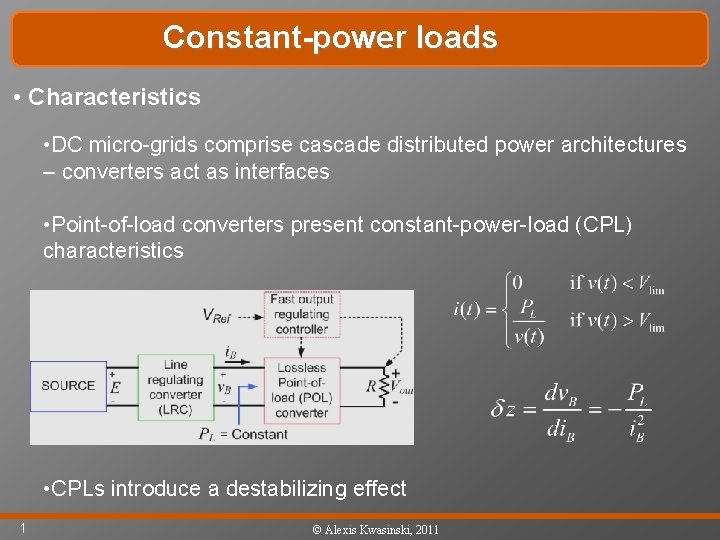
Constant-power loads • Characteristics • DC micro-grids comprise cascade distributed power architectures – converters act as interfaces • Point-of-load converters present constant-power-load (CPL) characteristics • CPLs introduce a destabilizing effect 1 © Alexis Kwasinski, 2011

Constant-power loads • Characteristics Simplified cascade distributed power architecture with a buck LRC. • Constraints on state variables makes it extremely difficult to find a closed form solution, but they are essential to yield the limit cycle behavior. 2 © Alexis Kwasinski, 2011

Constant-power loads • Characteristics • The steady state fast average model yields some insights: • Lack of resistive coefficient in first-order term • Unwanted dynamics introduced by the second-order term can not be damped. • Necessary condition for limit cycle behavior: • Note: x 1 = i. L and x 2 = v. C 3 © Alexis Kwasinski, 2011

Constant-power loads • Characteristics • Large oscillations may be observed not only when operating converters in open loop but also when they are regulated with most conventional controllers, such as PI controllers. Simulation results for an ideal buck converter with a PI controller both for a 100 W CPL (continuous trace) and a 2. 25 Ω resistor (dashed trace); E = 24 V, L = 0. 2 m. H, PL = 100 W, C = 470 μF. 4 © Alexis Kwasinski, 2011

Controls • Characteristics • Large oscillations and/or voltage collapse are observed due to constant-power loads in micro-grids without proper controls 5 © Alexis Kwasinski, 2011
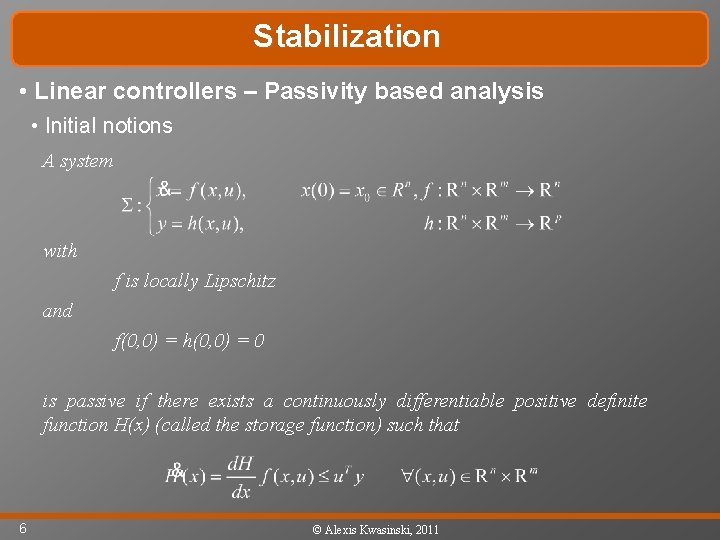
Stabilization • Linear controllers – Passivity based analysis • Initial notions A system with f is locally Lipschitz and f(0, 0) = h(0, 0) = 0 is passive if there exists a continuously differentiable positive definite function H(x) (called the storage function) such that 6 © Alexis Kwasinski, 2011
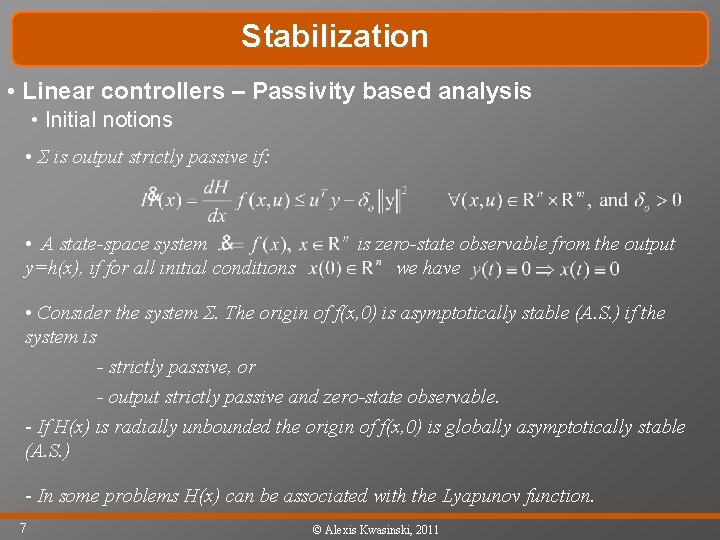
Stabilization • Linear controllers – Passivity based analysis • Initial notions • Σ is output strictly passive if: • A state-space system y=h(x), if for all initial conditions is zero-state observable from the output we have • Consider the system Σ. The origin of f(x, 0) is asymptotically stable (A. S. ) if the system is - strictly passive, or - output strictly passive and zero-state observable. - If H(x) is radially unbounded the origin of f(x, 0) is globally asymptotically stable (A. S. ) - In some problems H(x) can be associated with the Lyapunov function. 7 © Alexis Kwasinski, 2011
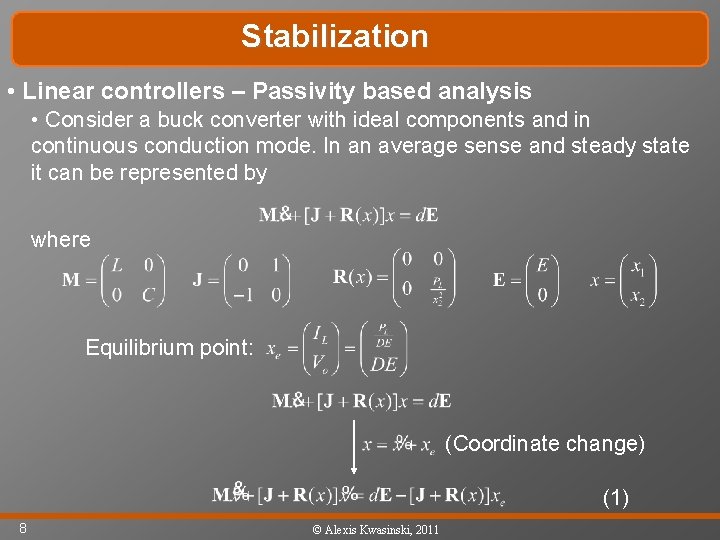
Stabilization • Linear controllers – Passivity based analysis • Consider a buck converter with ideal components and in continuous conduction mode. In an average sense and steady state it can be represented by where Equilibrium point: (Coordinate change) (1) 8 © Alexis Kwasinski, 2011
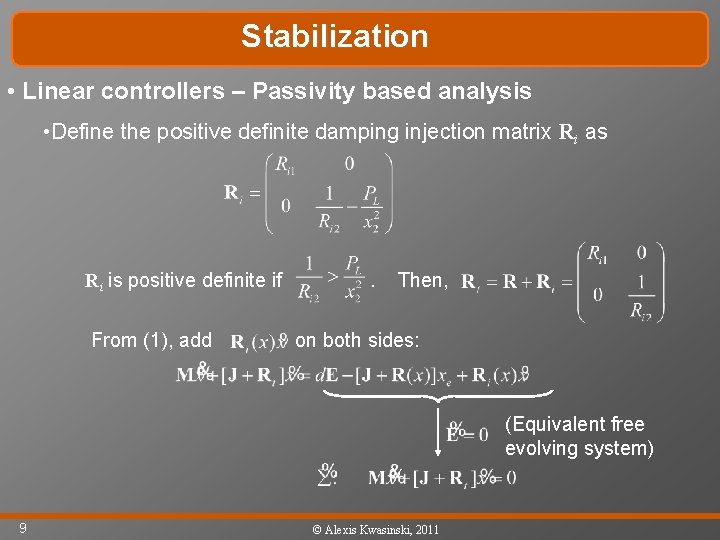
Stabilization • Linear controllers – Passivity based analysis • Define the positive definite damping injection matrix Ri as Ri is positive definite if . Then, From (1), add on both sides: (Equivalent free evolving system) 9 © Alexis Kwasinski, 2011
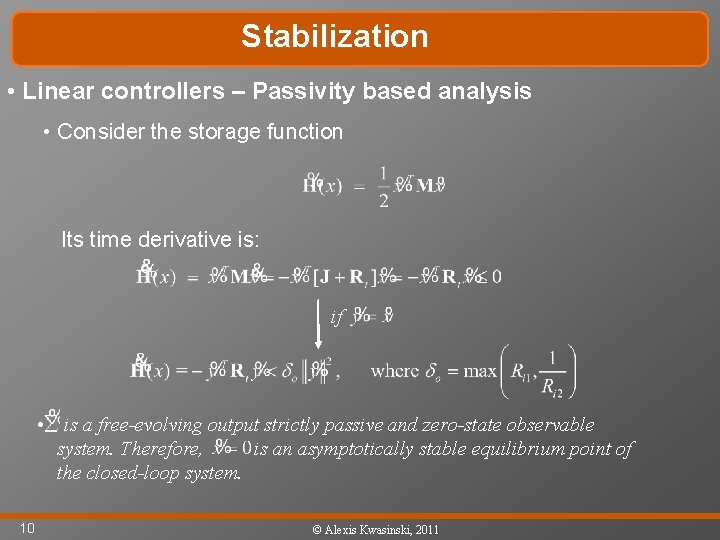
Stabilization • Linear controllers – Passivity based analysis • Consider the storage function Its time derivative is: if • is a free-evolving output strictly passive and zero-state observable system. Therefore, is an asymptotically stable equilibrium point of the closed-loop system. 10 © Alexis Kwasinski, 2011
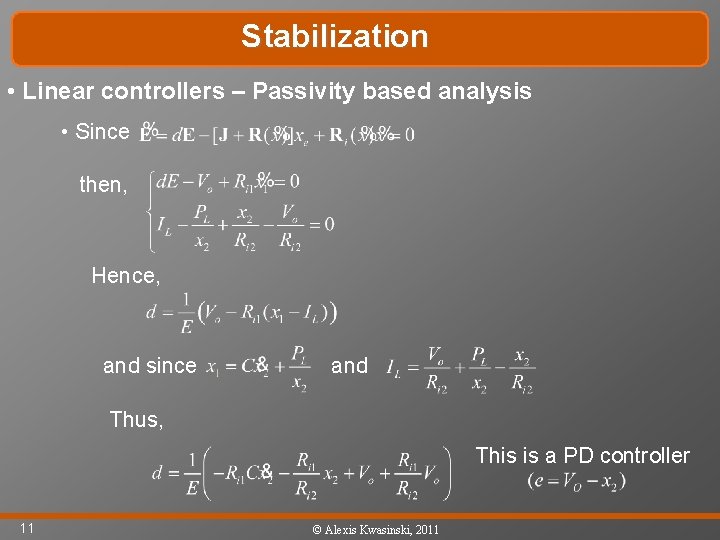
Stabilization • Linear controllers – Passivity based analysis • Since then, Hence, and since and Thus, This is a PD controller 11 © Alexis Kwasinski, 2011
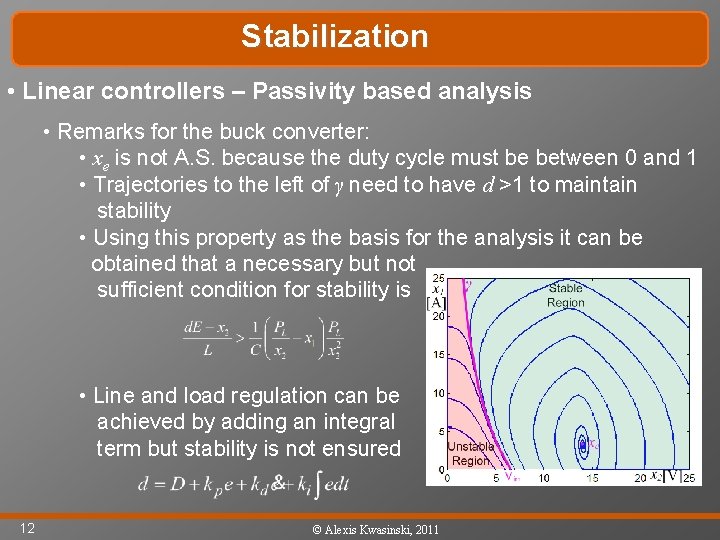
Stabilization • Linear controllers – Passivity based analysis • Remarks for the buck converter: • xe is not A. S. because the duty cycle must be between 0 and 1 • Trajectories to the left of γ need to have d >1 to maintain stability • Using this property as the basis for the analysis it can be obtained that a necessary but not sufficient condition for stability is • Line and load regulation can be achieved by adding an integral term but stability is not ensured 12 © Alexis Kwasinski, 2011
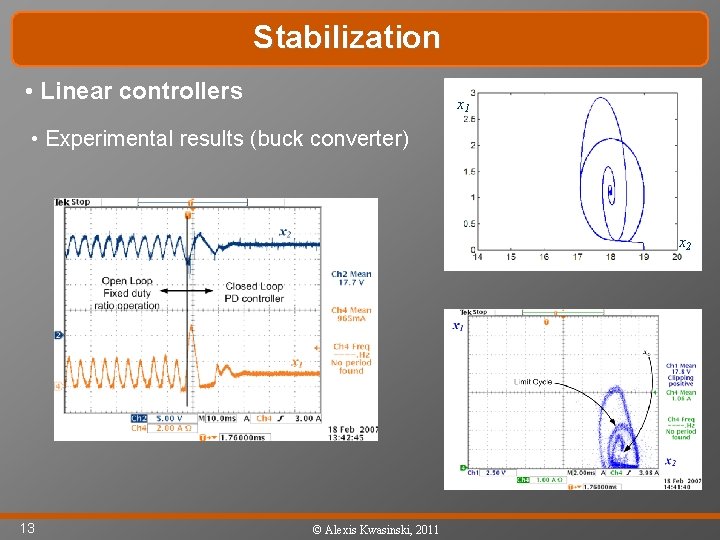
Stabilization • Linear controllers x 1 • Experimental results (buck converter) x 2 13 © Alexis Kwasinski, 2011
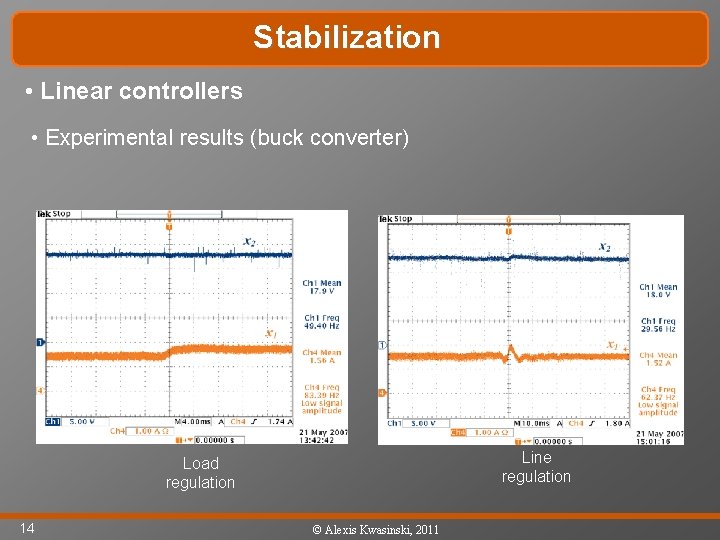
Stabilization • Linear controllers • Experimental results (buck converter) Line regulation Load regulation 14 © Alexis Kwasinski, 2011
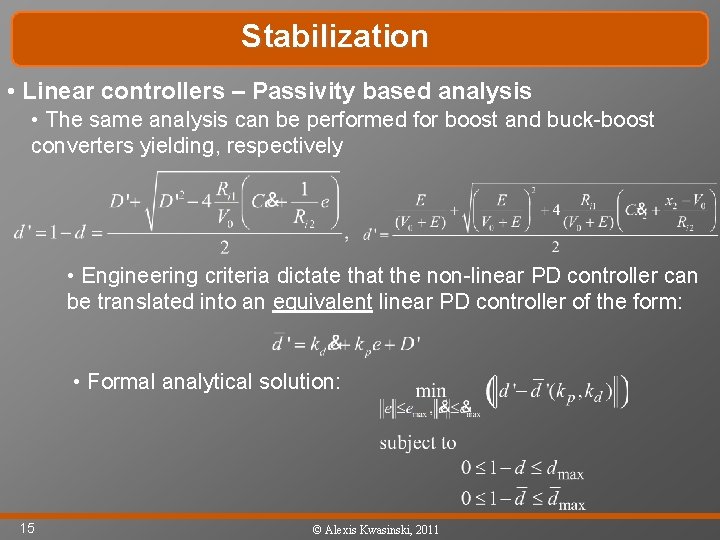
Stabilization • Linear controllers – Passivity based analysis • The same analysis can be performed for boost and buck-boost converters yielding, respectively • Engineering criteria dictate that the non-linear PD controller can be translated into an equivalent linear PD controller of the form: • Formal analytical solution: 15 © Alexis Kwasinski, 2011
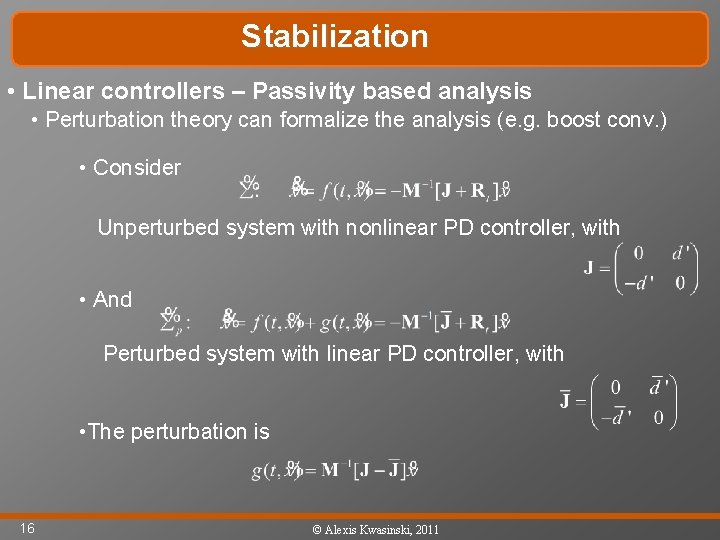
Stabilization • Linear controllers – Passivity based analysis • Perturbation theory can formalize the analysis (e. g. boost conv. ) • Consider Unperturbed system with nonlinear PD controller, with • And Perturbed system with linear PD controller, with • The perturbation is 16 © Alexis Kwasinski, 2011
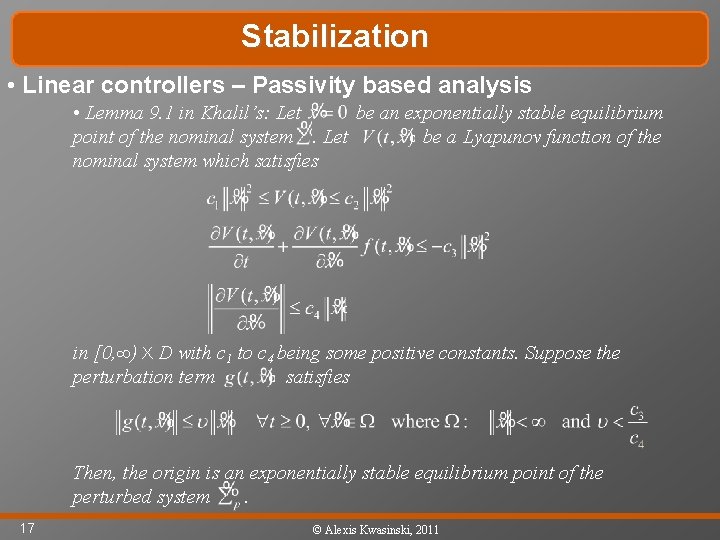
Stabilization • Linear controllers – Passivity based analysis • Lemma 9. 1 in Khalil’s: Let be an exponentially stable equilibrium point of the nominal system. Let be a Lyapunov function of the nominal system which satisfies in [0, ∞) X D with c 1 to c 4 being some positive constants. Suppose the perturbation term satisfies Then, the origin is an exponentially stable equilibrium point of the perturbed system. 17 © Alexis Kwasinski, 2011
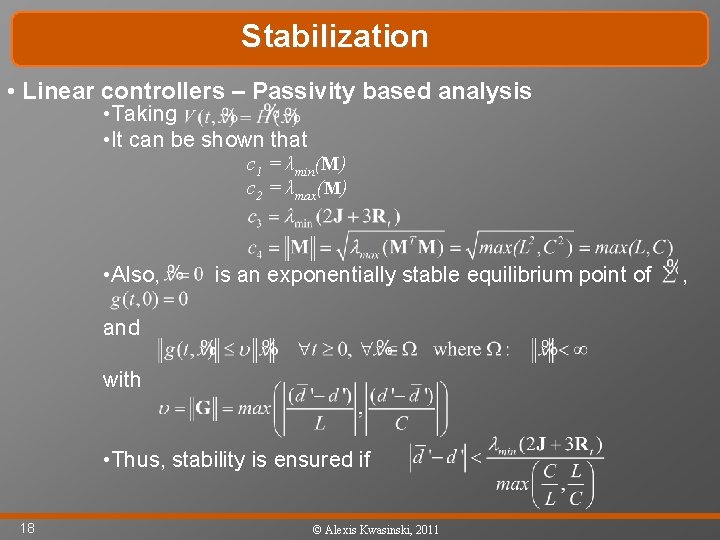
Stabilization • Linear controllers – Passivity based analysis • Taking • It can be shown that c 1 = λmin(M) c 2 = λmax(M) • Also, is an exponentially stable equilibrium point of , and with • Thus, stability is ensured if 18 © Alexis Kwasinski, 2011
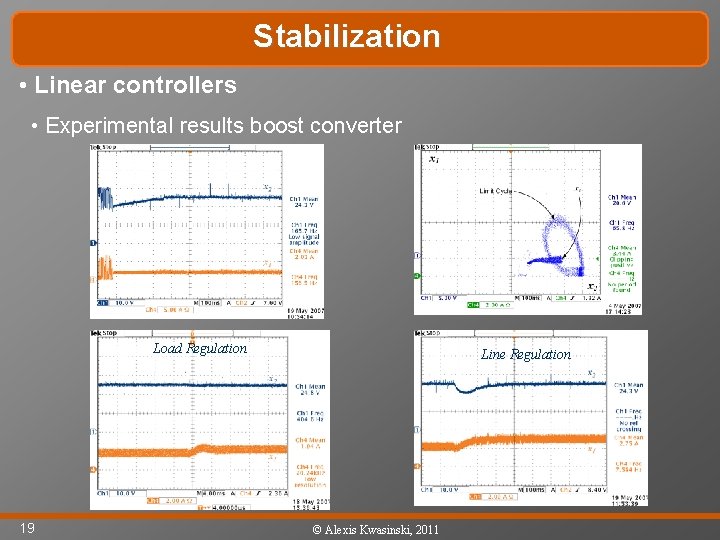
Stabilization • Linear controllers • Experimental results boost converter Load Regulation 19 Line Regulation © Alexis Kwasinski, 2011
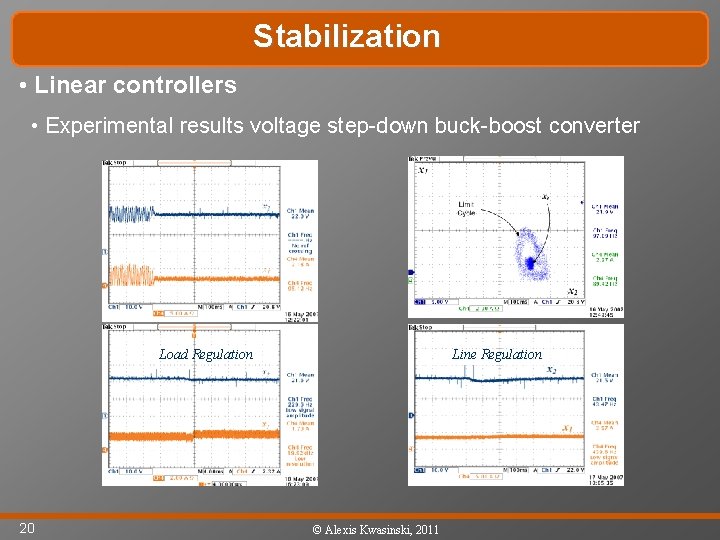
Stabilization • Linear controllers • Experimental results voltage step-down buck-boost converter Load Regulation 20 Line Regulation © Alexis Kwasinski, 2011
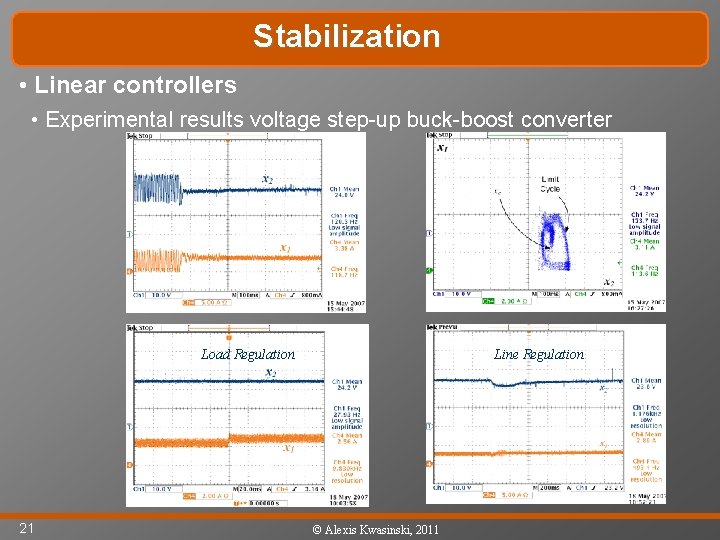
Stabilization • Linear controllers • Experimental results voltage step-up buck-boost converter Load Regulation 21 Line Regulation © Alexis Kwasinski, 2011
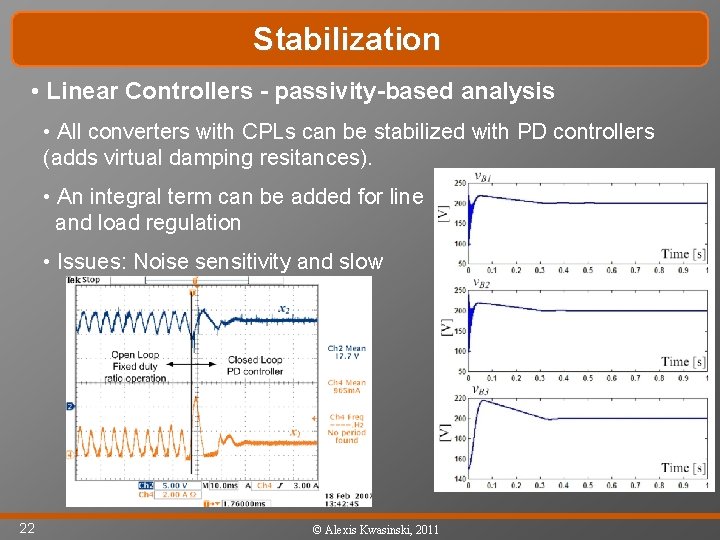
Stabilization • Linear Controllers - passivity-based analysis • All converters with CPLs can be stabilized with PD controllers (adds virtual damping resitances). • An integral term can be added for line and load regulation • Issues: Noise sensitivity and slow 22 © Alexis Kwasinski, 2011
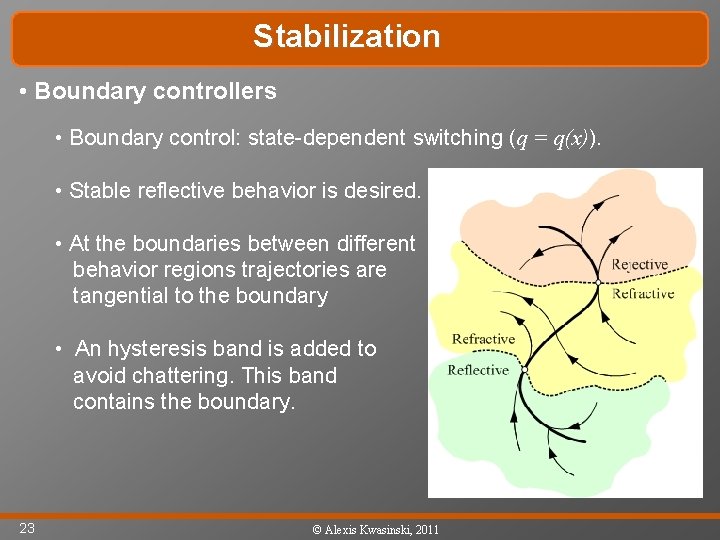
Stabilization • Boundary controllers • Boundary control: state-dependent switching (q = q(x)). • Stable reflective behavior is desired. • At the boundaries between different behavior regions trajectories are tangential to the boundary • An hysteresis band is added to avoid chattering. This band contains the boundary. 23 © Alexis Kwasinski, 2011
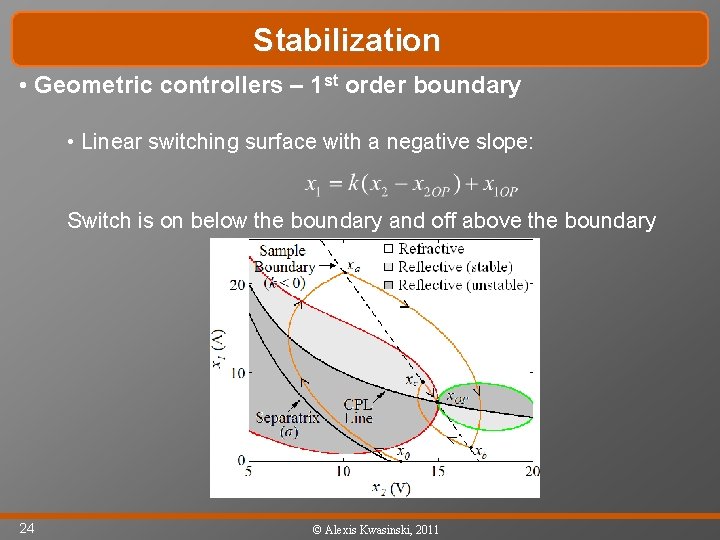
Stabilization • Geometric controllers – 1 st order boundary • Linear switching surface with a negative slope: Switch is on below the boundary and off above the boundary 24 © Alexis Kwasinski, 2011
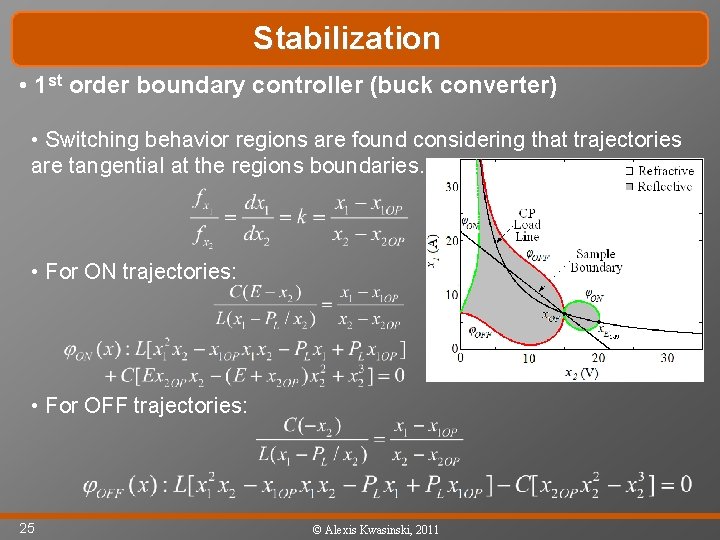
Stabilization • 1 st order boundary controller (buck converter) • Switching behavior regions are found considering that trajectories are tangential at the regions boundaries. • For ON trajectories: • For OFF trajectories: 25 © Alexis Kwasinski, 2011
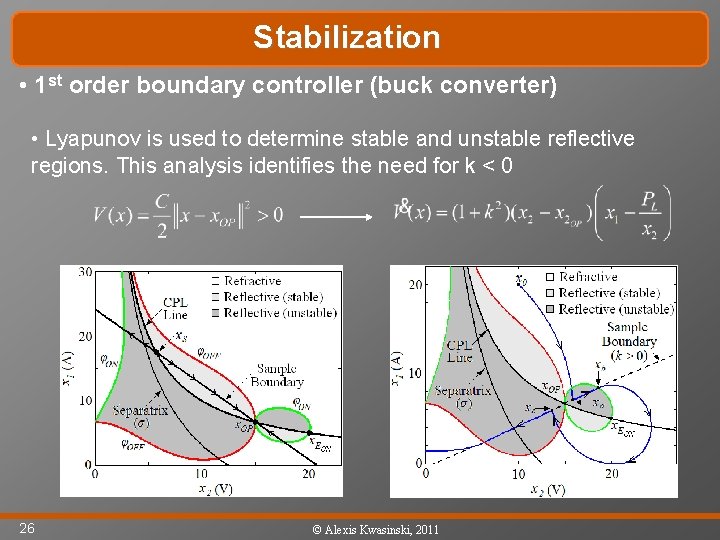
Stabilization • 1 st order boundary controller (buck converter) • Lyapunov is used to determine stable and unstable reflective regions. This analysis identifies the need for k < 0 26 © Alexis Kwasinski, 2011
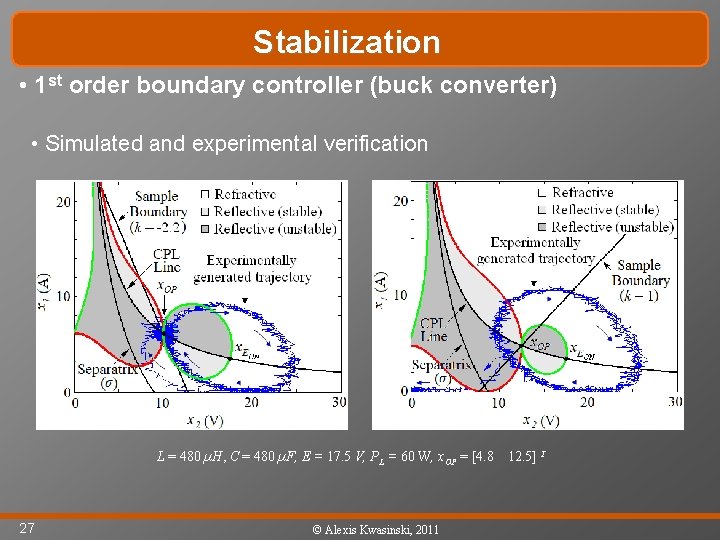
Stabilization • 1 st order boundary controller (buck converter) • Simulated and experimental verification L = 480 µH, C = 480 µF, E = 17. 5 V, PL = 60 W, x. OP = [4. 8 12. 5] T 27 © Alexis Kwasinski, 2011
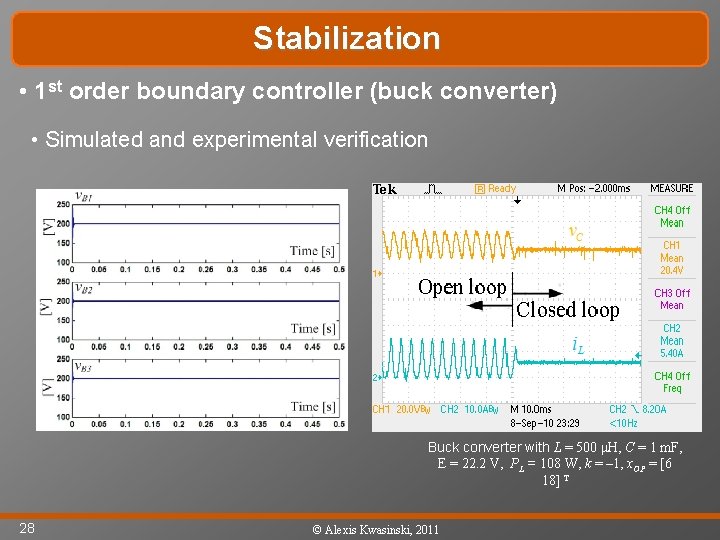
Stabilization • 1 st order boundary controller (buck converter) • Simulated and experimental verification Buck converter with L = 500 μH, C = 1 m. F, E = 22. 2 V, PL = 108 W, k = – 1, x. OP = [6 18] T 28 © Alexis Kwasinski, 2011
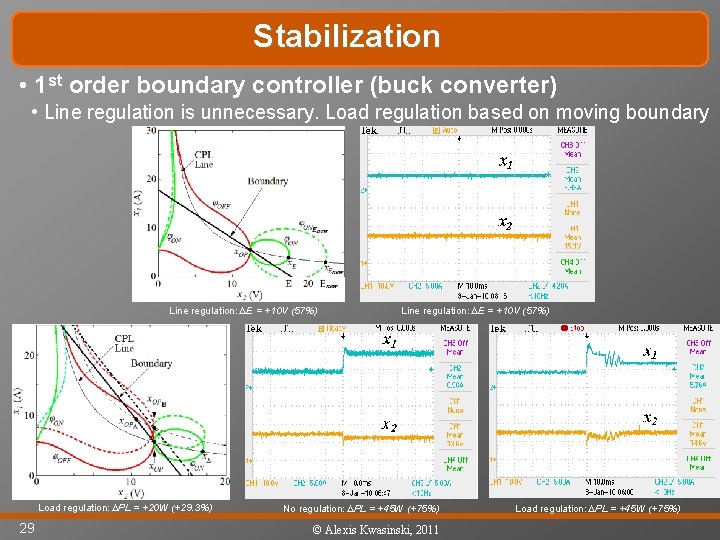
Stabilization • 1 st order boundary controller (buck converter) • Line regulation is unnecessary. Load regulation based on moving boundary Line regulation: ∆E = +10 V (57%) Load regulation: ∆PL = +20 W (+29. 3%) 29 Line regulation: ∆E = +10 V (57%) No regulation: ∆PL = +45 W (+75%) © Alexis Kwasinski, 2011 Load regulation: ∆PL = +45 W (+75%)
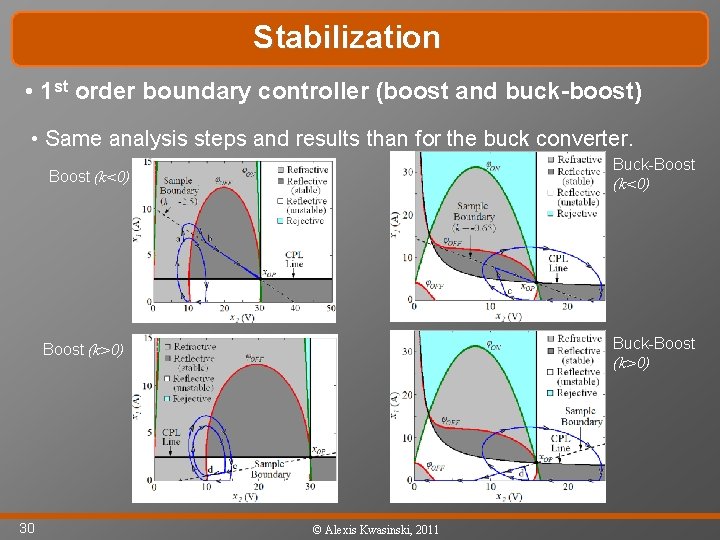
Stabilization • 1 st order boundary controller (boost and buck-boost) • Same analysis steps and results than for the buck converter. Buck-Boost (k<0) Buck-Boost (k>0) 30 © Alexis Kwasinski, 2011
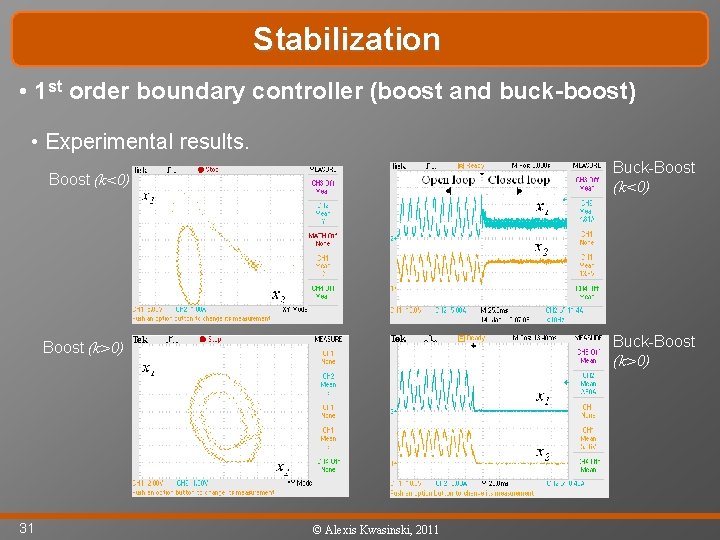
Stabilization • 1 st order boundary controller (boost and buck-boost) • Experimental results. Buck-Boost (k<0) Buck-Boost (k>0) 31 © Alexis Kwasinski, 2011
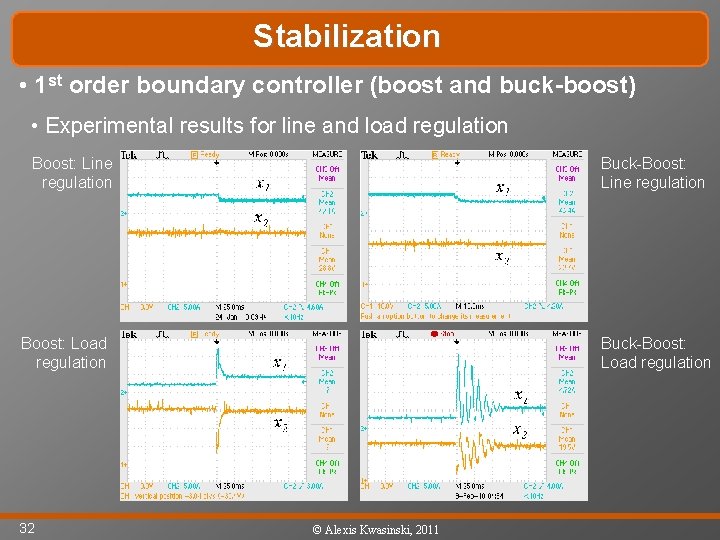
Stabilization • 1 st order boundary controller (boost and buck-boost) • Experimental results for line and load regulation Boost: Line regulation Buck-Boost: Line regulation Boost: Load regulation 32 Buck-Boost: Load regulation © Alexis Kwasinski, 2011
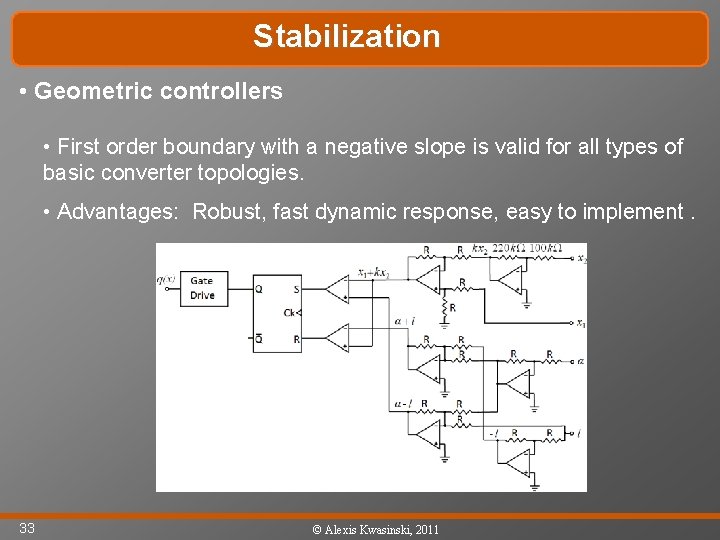
Stabilization • Geometric controllers • First order boundary with a negative slope is valid for all types of basic converter topologies. • Advantages: Robust, fast dynamic response, easy to implement. 33 © Alexis Kwasinski, 2011
- Slides: 33