
Constant time delay CTD is a control procedure



- Slides: 7
Constant time delay (CTD) is a control procedure used extensively in behavior change and learning interventions for persons with disabilities. Constant time delay is a constant interval of time between the presentation of a natural stimulus and the prompt stimulus. Determining current skills: test for base knowledge on the skill or behavior. Selecting activities: Deicide on an activity that enforces the desired skill or goal. Selecting cues: A cue is a signal that helps learners identify skills or behaviorss they should be using. Selecting the controlling prompt is a prompt that elicits the correct behavior on a consistent basis. Designing data collection procedures, and Collect data: make easy to monitor system o o o is collecting data to monitor a learner's progress. This is accomplished by collecting data during (a) 0 -second sessions and (b) the delay-trial sessions. The expected pattern during 0 -second sessions is to have 100% prompted correct responses. O Monitoring progress: A key component delay, teachers/practitioners implement a fixed delay (i. e. , 3 -5 seconds) after using the 0 -second delay over a predetermined number of trials. O Increasing the delay: With constant time direction, teachers/practitioners immediately deliver the controlling prompt immediately provide positive feedback by: offering reinforcement (e. g. , praise, access to materials, break) and stating what the learner did. securing attention, presenting the target stimulus, and delivering the cue/task O Implementing time delay After target stimulus using an attention-getting strategy (e. g. , saying learner's name, saying, “Look. ”. Having the learner touch the stimulus), and presenting the cue or task direction. O Gaining learner attention deliver the Phase 2 steps include: Identifying target skills: Area with an identified skill or behavior. o Step-by-Step Instructions for Time Delay are provided in two phases. Phase 1 steps include: B. A chained task- Chained tasked involve a series of behaviors in a given sequence to complete a complex skill. Chained tasks need a teacher to determine (1) the number and sequence of steps in a chain (2) whether teach one step at a time or (3) whether to teach all the steps at the same time. Ex. Chained tasks including hand washing, making a sandwich, eating a meal, getting dressed, putting on a coat, cooking and transitioning from one class to the next. In general teaching the entire chain at the same time is recommended. Teachers identify the Target skill or behavior as being either: A. Discrete task- requires a single response and has a short duration. Ex. Pointing to objects, naming picture or objects, picking up the correct letter, , reading words, writing the answers to simple math problems, greeting a peer who enters the room , an answering questions are discrete tasks. In Constant time delay- there is no delay between instruction and prompt when a learner firsts learns the skill. However, a fixed amount of time is always used between the instruction and the prompt as the learner becomes more proficient at using the new skill. populations can benefit from using Constant Time Delay. STEP'S FOR IMPLEMENTATIO Who Uses Constant Time N Delay ? Everyone uses Constant Time Delay. All Ø What is Constant Time Delay? Constant Time Delay
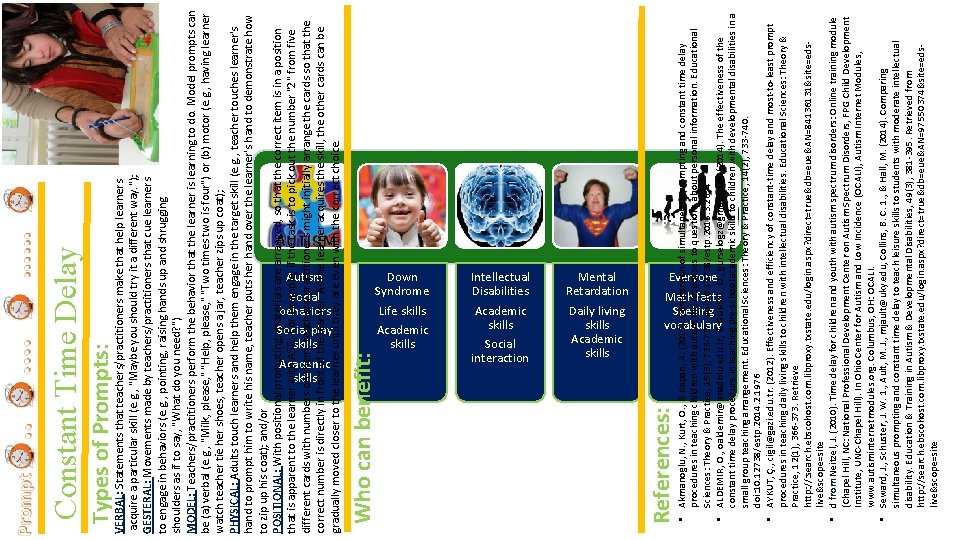
VERBAL: Statements that teachers/practitioners make that help learners acquire a particular skill (e. g. , "Maybe you should try it a different way. "); GESTERAL: Movements made by teachers/practitioners that cue learners to engage in behaviors (e. g. , pointing, raising hands up and shrugging shoulders as if to say, "What do you need? ") MODEL: Teachers/practitioners perform the behavior that the learner is learning to do. Model prompts can be (a) verbal (e. g. , "Milk, please, " "Help, please, " "Two times two is four") or (b) motor (e. g. , having learner watch teacher tie her shoes, teacher opens a jar, teacher zips up coat); PHYSICAL: Adults touch learners and help them engage in the target skill (e. g. , teacher touches learner's hand to prompt him to write his name, teacher puts her hand over the learner's hand to demonstrate how to zip up his coat); and/or POSITIONAL: With positional prompting, materials are arranged, so that the correct item is in a position that is apparent to the learner with ASD. For example, if the task is to pick out the number "2" from five different cards with numbers on them, teachers/practitioners might initially arrange the cards so that the correct number is directly in front of the learner. As the learner acquires the skill, the other cards can be gradually moved closer to the learner until they are even with the correct choice. Types of Prompts: Constant Time Delay Down Syndrome Life skills Academic skills Intellectual Disabilities Academic skills Social interaction Mental Retardation Daily living skills Academic skills Everyone Math facts Spelling vocabulary • Akmanoglu, N. , Kurt, O. , & Kapan, A. (2015). Comparison of simultaneous prompting and constant time delay procedures in teaching children with autism the responses to questions about personal information. Educational Sciences: Theory & Practice, 15(3), 723 -737. doi: 10. 12738/estp. 2015. 3. 2654 • ALDEMIR, O. , oaldemir@anadolu. edu. tr, & GURSEL, O. , gurselogz@gmail. com. (2014). The effectiveness of the constant time delay procedure in teaching pre-school academic skills to children with developmental disabilities in a small group teaching arrangement. Educational Sciences: Theory & Practice, 14(2), 733 -740. doi: 10. 12738/estp. 2014. 2. 1976 • AYKUT, Ç. , cigil@gazi. edu. tr. (2012). Effectiveness and efficiency of constant-time delay and most-to-least prompt procedures in teaching daily living skills to children with intellectual disabilities. Educational Sciences: Theory & Practice, 12(1), 366 -373. Retrieve http: //: search. ebscohost. com. libproxy. txstate. edu/login. aspx? direct=true&db=eue&AN=84136131&site=edslive&scope=site • d from Neitzel, J. (2010). Time delay for children and youth with autism spectrum disorders: Online training module (Chapel Hill, NC: National Professional Development Center on Autism Spectrum Disorders, FPG Child Development Institute, UNC-Chapel Hill). In Ohio Center for Autism and Low Incidence (OCALI), Autism Internet Modules, www. autisminternetmodules. org. Columbus, OH: OCALI. • Seward, J. , Schuster, J. W. 1. , Ault, M. J. , mjault@uky. edu, Collins, B. C. 1. , & Hall, M. (2014). Comparing simultaneous prompting and constant time delay to teach leisure skills to students with moderate intellectual disability. Education & Training in Autism & Developmental Disabilities, 49(3), 381 -395. Retrieved from http: //search. ebscohost. com. libproxy. txstate. edu/login. aspx? direct=true&db=eue&AN=97550374&site=edslive&scope=site References: Who can benefit: Autism Social behaviors Social play skills Academic skills
Is a practice that focuses on fading the use of prompts during instruction activities while also delivering reinforcement to increase the likelihood that target skills/behaviors will be used in the future. The Goal
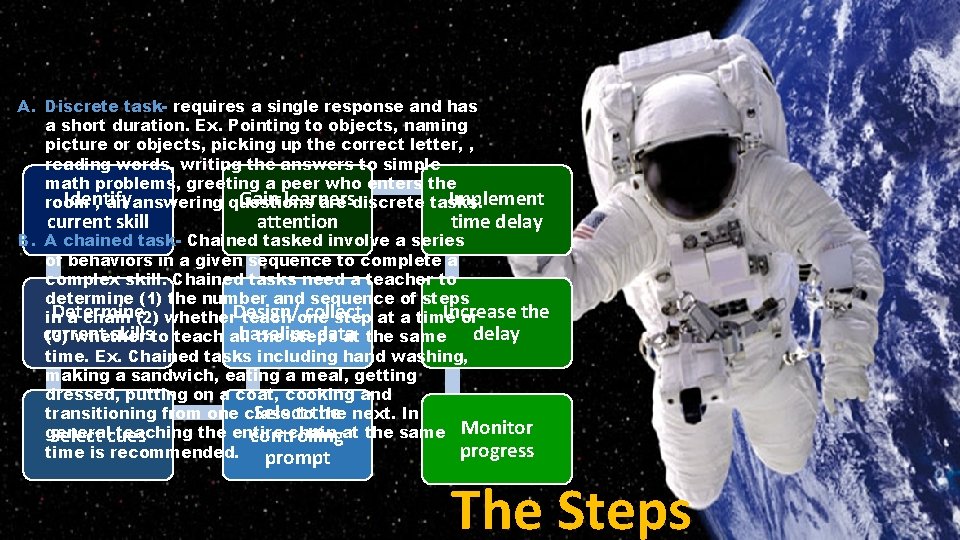
A. Discrete task- requires a single response and has a short duration. Ex. Pointing to objects, naming picture or objects, picking up the correct letter, , reading words, writing the answers to simple math problems, greeting a peer who enters the Identify Gain learners Implement room , an answering questions are discrete tasks. current skill attention time delay B. A chained task- Chained tasked involve a series of behaviors in a given sequence to complete a complex skill. Chained tasks need a teacher to determine (1) the number and sequence of steps Determine Increase the in a chain (2) whether. Design/ collect teach one step at a time or current skills baseline data delay (3) whether to teach all the steps at the same time. Ex. Chained tasks including hand washing, making a sandwich, eating a meal, getting dressed, putting on a coat, cooking and Select the transitioning from one class to the next. In general teaching the entire chain at the same Monitor Select cues controlling progress time is recommended. prompt The Steps
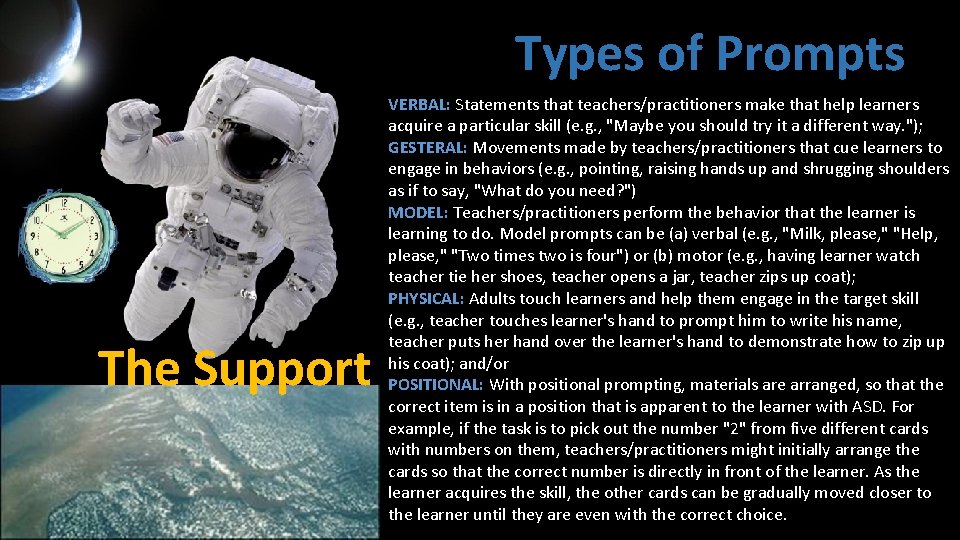
Types of Prompts The Support VERBAL: Statements that teachers/practitioners make that help learners acquire a particular skill (e. g. , "Maybe you should try it a different way. "); GESTERAL: Movements made by teachers/practitioners that cue learners to engage in behaviors (e. g. , pointing, raising hands up and shrugging shoulders as if to say, "What do you need? ") MODEL: Teachers/practitioners perform the behavior that the learner is learning to do. Model prompts can be (a) verbal (e. g. , "Milk, please, " "Help, please, " "Two times two is four") or (b) motor (e. g. , having learner watch teacher tie her shoes, teacher opens a jar, teacher zips up coat); PHYSICAL: Adults touch learners and help them engage in the target skill (e. g. , teacher touches learner's hand to prompt him to write his name, teacher puts her hand over the learner's hand to demonstrate how to zip up his coat); and/or POSITIONAL: With positional prompting, materials are arranged, so that the correct item is in a position that is apparent to the learner with ASD. For example, if the task is to pick out the number "2" from five different cards with numbers on them, teachers/practitioners might initially arrange the cards so that the correct number is directly in front of the learner. As the learner acquires the skill, the other cards can be gradually moved closer to the learner until they are even with the correct choice.
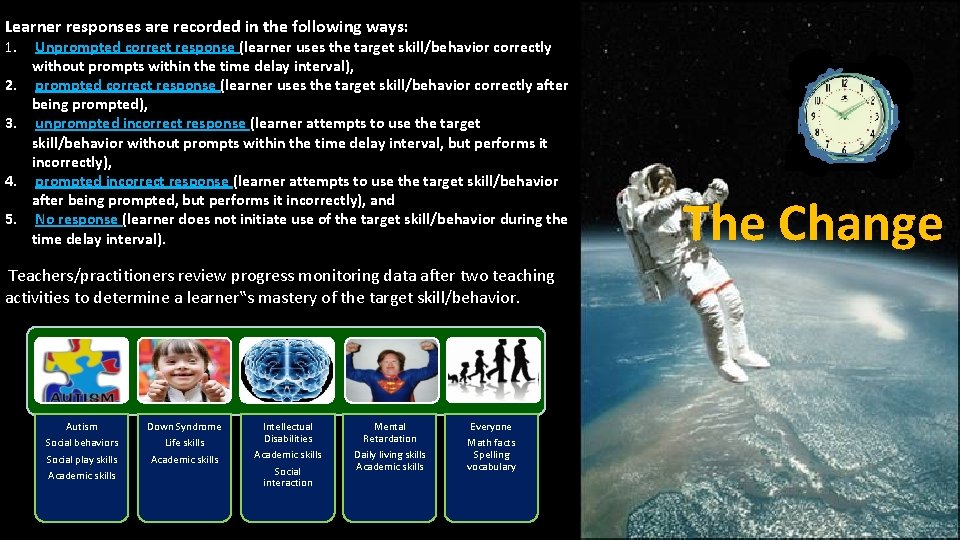
Learner responses are recorded in the following ways: 1. Unprompted correct response (learner uses the target skill/behavior correctly without prompts within the time delay interval), 2. prompted correct response (learner uses the target skill/behavior correctly after being prompted), 3. unprompted incorrect response (learner attempts to use the target skill/behavior without prompts within the time delay interval, but performs it incorrectly), 4. prompted incorrect response (learner attempts to use the target skill/behavior after being prompted, but performs it incorrectly), and 5. No response (learner does not initiate use of the target skill/behavior during the time delay interval). Teachers/practitioners review progress monitoring data after two teaching activities to determine a learner‟s mastery of the target skill/behavior. Autism Social behaviors Social play skills Academic skills Down Syndrome Life skills Academic skills Intellectual Disabilities Academic skills Social interaction Mental Retardation Daily living skills Academic skills Everyone Math facts Spelling vocabulary The Change
One Small step for man kind One Giant leap for {Insert your name here} The Achievement