
Constant Fraction Discriminators B Satyanarayana HMC preamp output
Constant Fraction Discriminators B. Satyanarayana
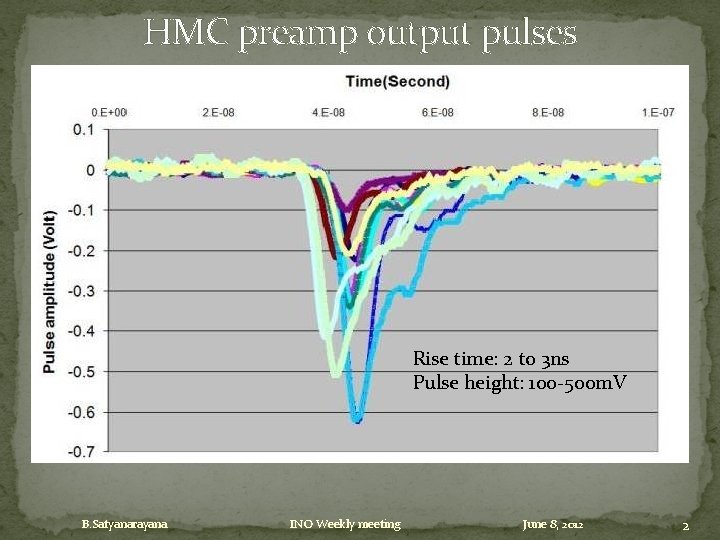
HMC preamp output pulses Rise time: 2 to 3 ns Pulse height: 100 -500 m. V B. Satyanarayana INO Weekly meeting June 8, 2012 2

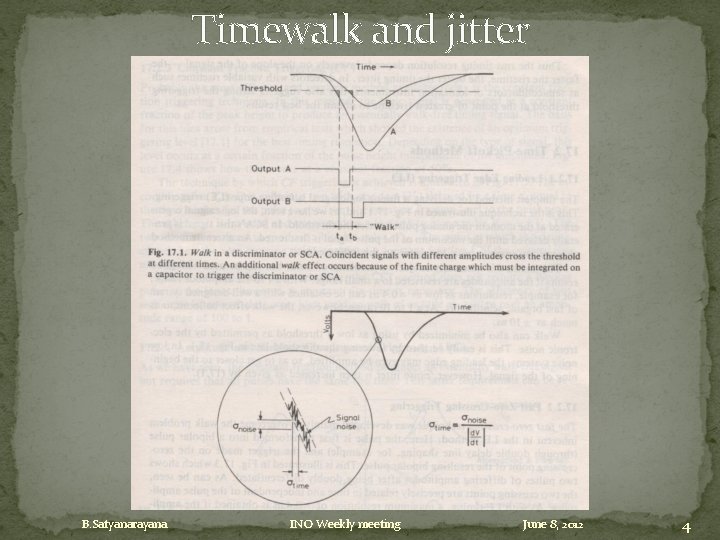
Considerations for discriminators �Two common problems �Walk (due to variations in the amplitude and rise time, finite amount of charge required to trigger the discriminator) �Jitter (due to intrinsic detection process – variations in the number of charges generated, their transit times and multiplication factor etc. ) �Time-Pickoff methods �Leading edge triggering �Fast zero-crossing triggering �Constant fraction triggering �Amplitude and rise time compensated triggering B. Satyanarayana INO Weekly meeting June 8, 2012 3
Timewalk and jitter B. Satyanarayana INO Weekly meeting June 8, 2012 4
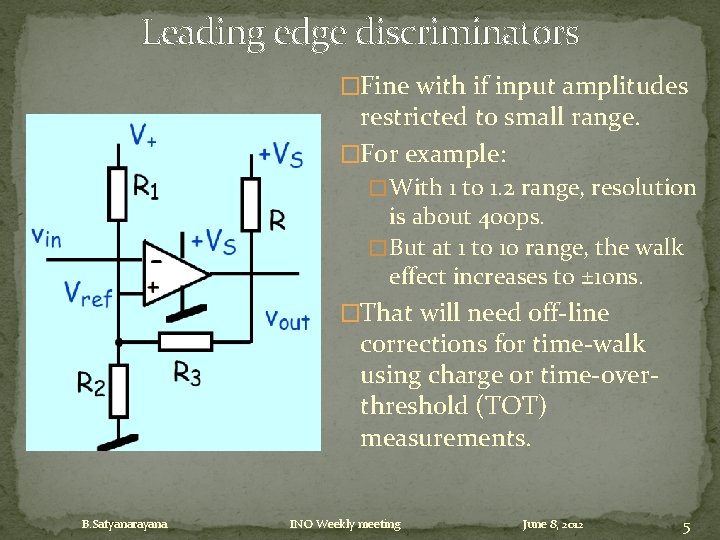
Leading edge discriminators �Fine with if input amplitudes restricted to small range. �For example: � With 1 to 1. 2 range, resolution is about 400 ps. � But at 1 to 10 range, the walk effect increases to ± 10 ns. �That will need off-line corrections for time-walk using charge or time-overthreshold (TOT) measurements. B. Satyanarayana INO Weekly meeting June 8, 2012 5
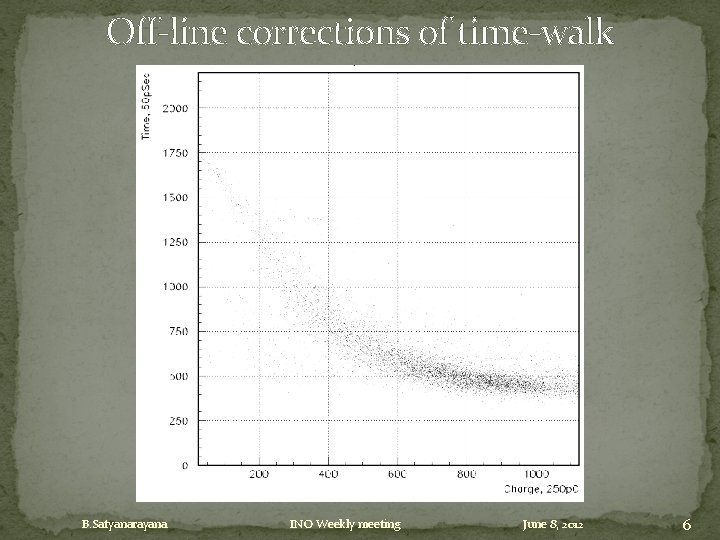
Off-line corrections of time-walk B. Satyanarayana INO Weekly meeting June 8, 2012 6
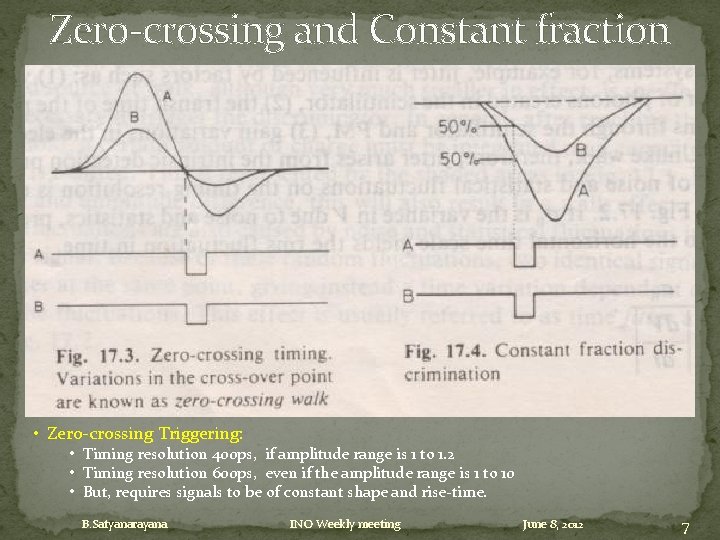
Zero-crossing and Constant fraction • Zero-crossing Triggering: • Timing resolution 400 ps, if amplitude range is 1 to 1. 2 • Timing resolution 600 ps, even if the amplitude range is 1 to 10 • But, requires signals to be of constant shape and rise-time. B. Satyanarayana INO Weekly meeting June 8, 2012 7
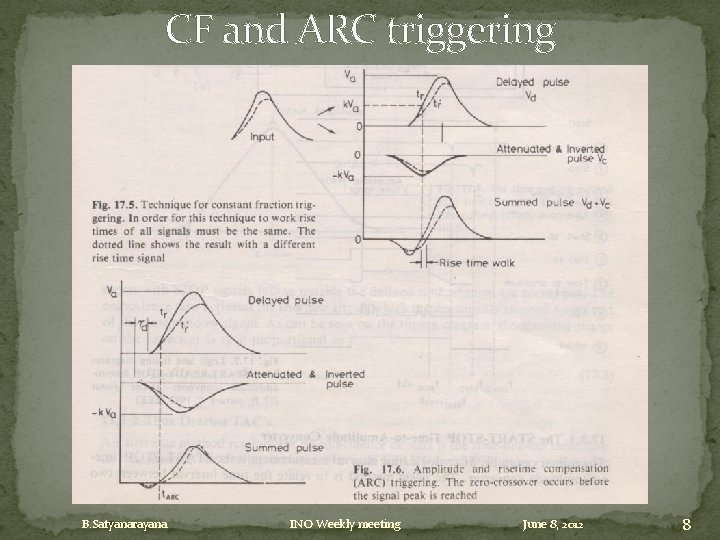
CF and ARC triggering B. Satyanarayana INO Weekly meeting June 8, 2012 8
CFD technique • The particular fraction desired in a CFD determines the amount of attenuation of the attenuated input signal. • If the delay is chosen correctly, the CF will fire at the place where the maximum of the attenuated signal crosses the delayed signal. • That point will be at a constant fraction of the delayed signal amplitude. • The relationship between delay and rise time in such a case is: td = tr (1 - f ) , where f is both the fraction desired (usually. 2) and the attenuation factor of the input signal. • If the delay is set to a value less than the shortest anticipated risetime, walk can be eliminated even when signals have varying rise-times. • In what follows, f will only represent the attenuation of the input signal. • If the input signal is simulated by a linear ramp, its equation is Pi = -mt. • The attenuated signal is then Pa = - fmt , and the delayed signal is Pd = -m(t - td ). • We want to set Pa = Pd and solve for t , which results in tc = td / (1 - f) • Note that this is independent of the slope m (and thus risetime). • The amplitude fraction F in this general case can be found by calculating the ratio of pd evaluated at the crossing time to the maximum value of Pd : F = -m (tc – td) / -mtr = ftd / tr(1 - f) B. Satyanarayana INO Weekly meeting June 8, 2012 9
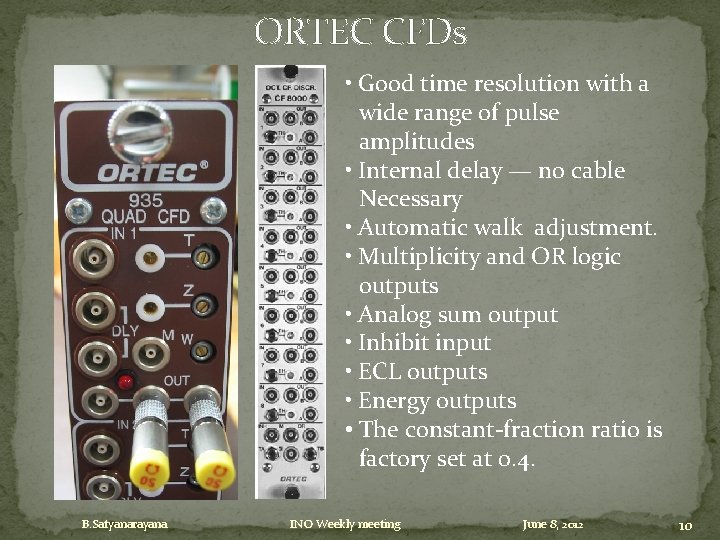
ORTEC CFDs • Good time resolution with a wide range of pulse amplitudes • Internal delay — no cable Necessary • Automatic walk adjustment. • Multiplicity and OR logic outputs • Analog sum output • Inhibit input • ECL outputs • Energy outputs • The constant-fraction ratio is factory set at 0. 4. B. Satyanarayana INO Weekly meeting June 8, 2012 10

References �W. R. Leo, Techniques for Nuclear and Particle Physics Experiments, 2 nd ed. , Narosa Publishing House. �J. Bialkowski et al, Remarks on constant fraction discriminators applied for Ba. F 2 crystals, NIM A 281 (1989) 657 -659. �ORTEC manuals. B. Satyanarayana INO Weekly meeting June 8, 2012 11
- Slides: 11