
CONSONANTSTEM NOMINAL CASE MORPHOLOGY IN THE SLAVIC LANGUAGES

- Slides: 11
CONSONANT-STEM NOMINAL CASE MORPHOLOGY IN THE SLAVIC LANGUAGES Hans Slechta
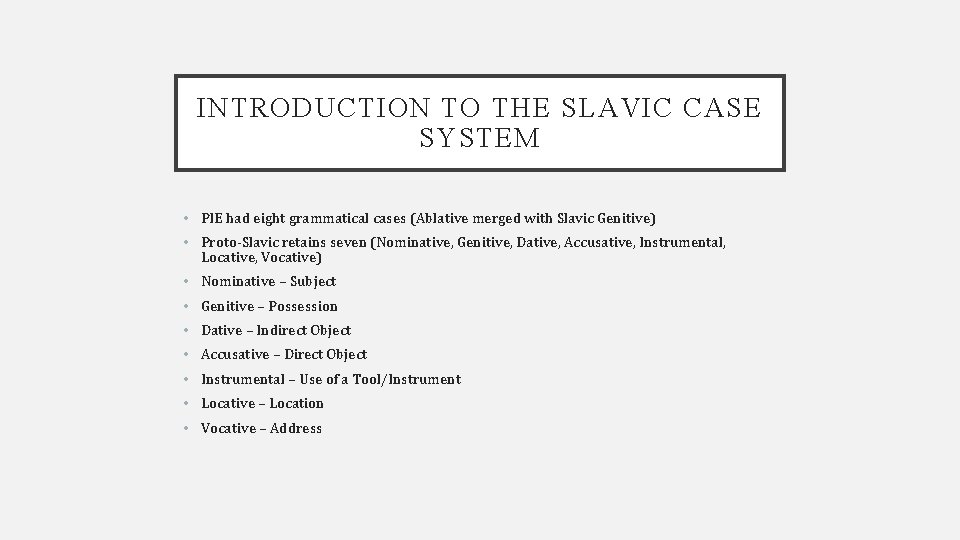
INTRODUCTION TO THE SLAVIC CASE SYSTEM • PIE had eight grammatical cases (Ablative merged with Slavic Genitive) • Proto-Slavic retains seven (Nominative, Genitive, Dative, Accusative, Instrumental, Locative, Vocative) • Nominative – Subject • Genitive – Possession • Dative – Indirect Object • Accusative – Direct Object • Instrumental – Use of a Tool/Instrument • Locative – Location • Vocative – Address
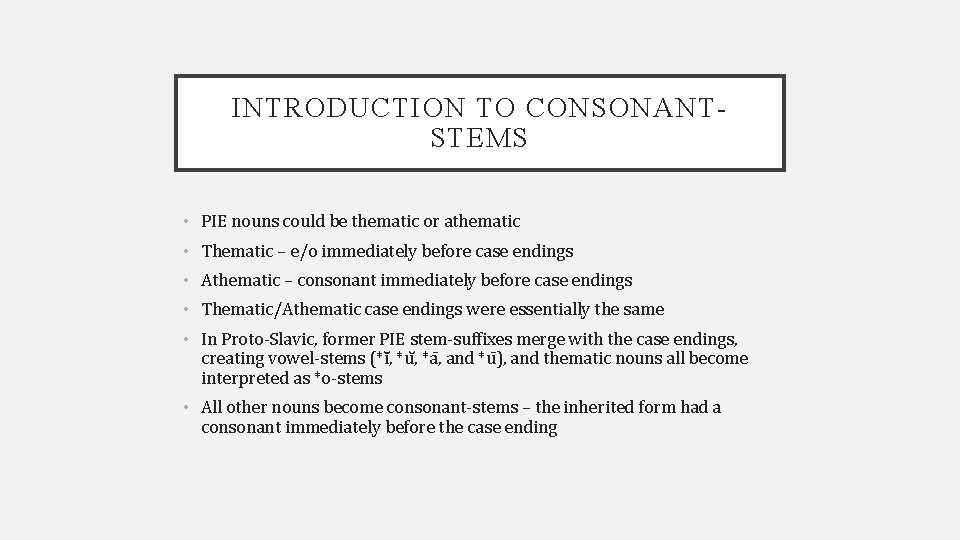
INTRODUCTION TO CONSONANTSTEMS • PIE nouns could be thematic or athematic • Thematic – e/o immediately before case endings • Athematic – consonant immediately before case endings • Thematic/Athematic case endings were essentially the same • In Proto-Slavic, former PIE stem-suffixes merge with the case endings, creating vowel-stems (*i , *u , *a , and *u ), and thematic nouns all become interpreted as *o-stems • All other nouns become consonant-stems – the inherited form had a consonant immediately before the case ending
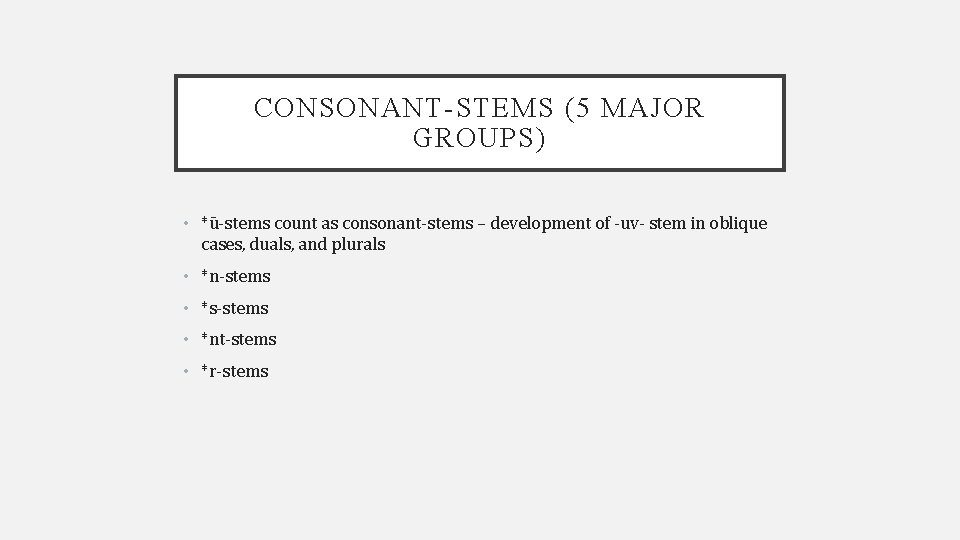
CONSONANT-STEMS (5 MAJOR GROUPS) • *ū-stems count as consonant-stems – development of -uv- stem in oblique cases, duals, and plurals • *n-stems • *s-stems • *nt-stems • *r-stems
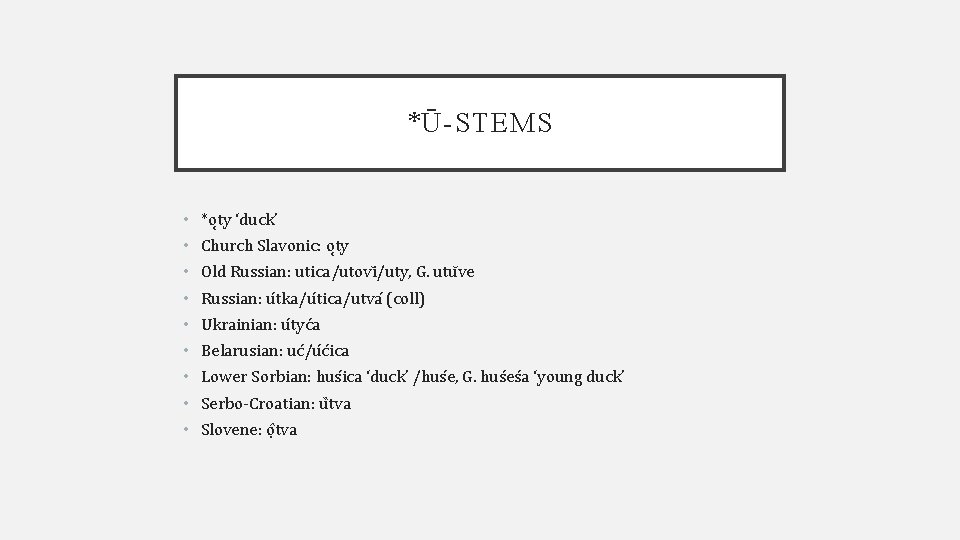
*Ū-STEMS • *o ty ‘duck’ • Church Slavonic: o ty • Old Russian: utica/utovi /uty, G. utu ve • Russian: u tka/u tica/utva (coll) • Ukrainian: u tyc a • Belarusian: uc /u c ica • Lower Sorbian: hus ica ‘duck’ /hus e, G. hus es a ‘young duck’ • Serbo-Croatian: u tva • Slovene: ọ tva
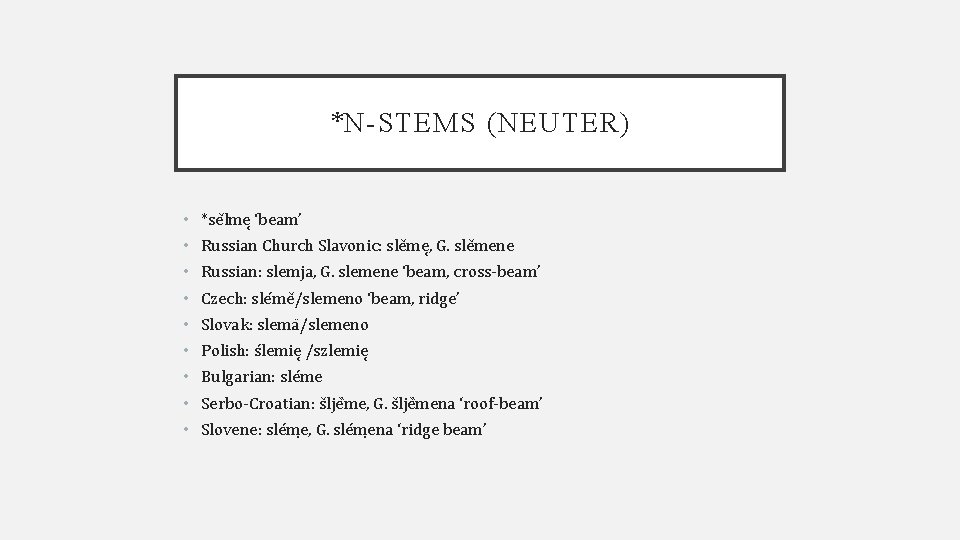
*N-STEMS (NEUTER) • *se lme ‘beam’ • Russian Church Slavonic: sle me , G. sle mene • Russian: slemja, G. slemene ‘beam, cross-beam’ • Czech: sle me /slemeno ‘beam, ridge’ • Slovak: slema /slemeno • Polish: s lemie /szlemie • Bulgarian: sle me • Serbo-Croatian: s lje me, G. s lje mena ‘roof-beam’ • Slovene: sle m e, G. sle m ena ‘ridge beam’
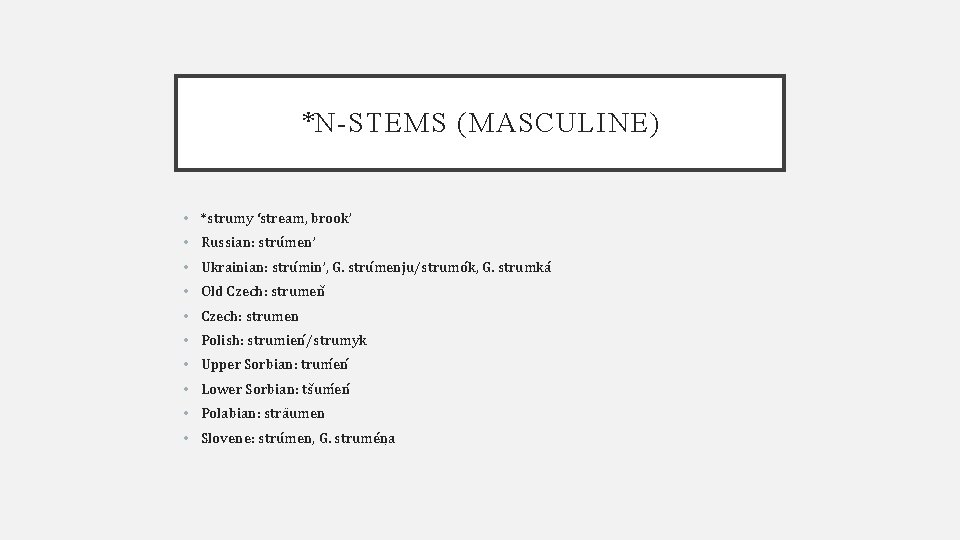
*N-STEMS (MASCULINE) • *strumy ‘stream, brook’ • Russian: stru men’ • Ukrainian: stru min’, G. stru menju/strumo k, G. strumka • Old Czech: strumen • Czech: strumen • Polish: strumien /strumyk • Upper Sorbian: trum en • Lower Sorbian: ts um en • Polabian: stra umen • Slovene: stru men, G. strume n a
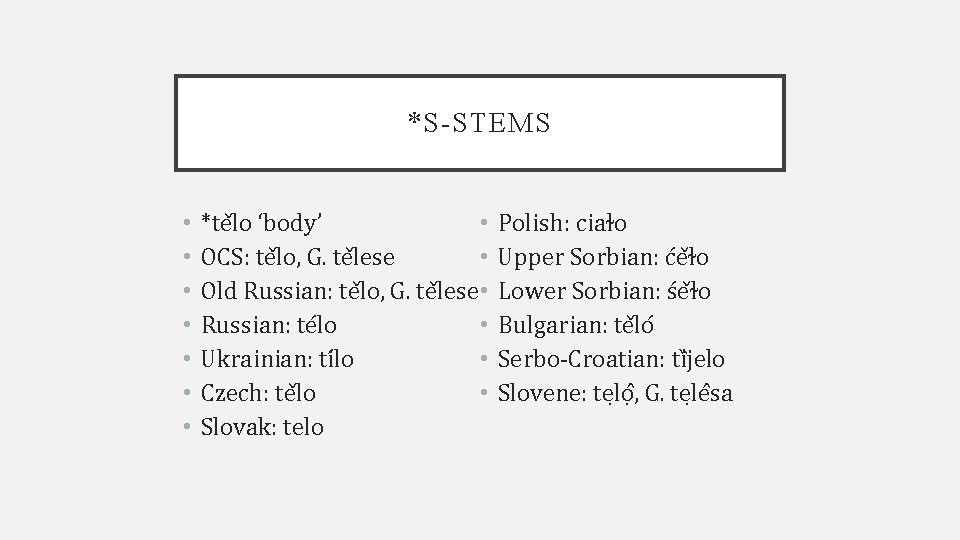
*S-STEMS • • *te lo ‘body’ • OCS: te lo, G. te lese Old Russian: te lo, G. te lese • • Russian: te lo Ukrainian: ti lo • Czech: te lo • Slovak: telo Polish: ciaɫo Upper Sorbian: c e ɫo Lower Sorbian: s e ɫo Bulgarian: te lo Serbo-Croatian: ti jelo Slovene: te lọ , G. te le sa
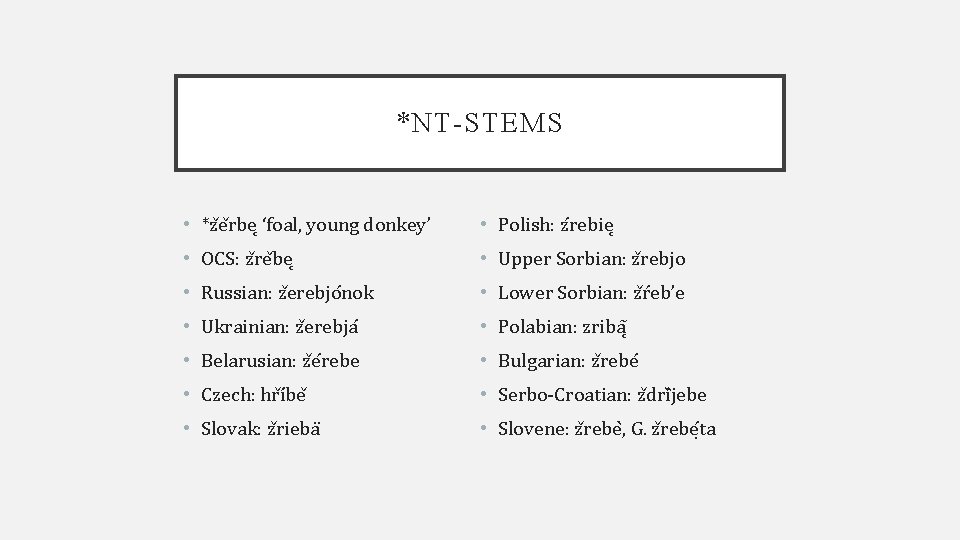
*NT-STEMS • *z e rbe ‘foal, young donkey’ • Polish: z rebie • OCS: z re be • Upper Sorbian: z rebjo • Russian: z erebjo nok • Lower Sorbian: z r eb’e • Ukrainian: z erebja • Polabian: zriba • Belarusian: z e rebe • Bulgarian: z rebe • Czech: hr i be • Serbo-Croatian: z dri jebe • Slovak: z rieba • Slovene: z rebe , G. z rebe ta
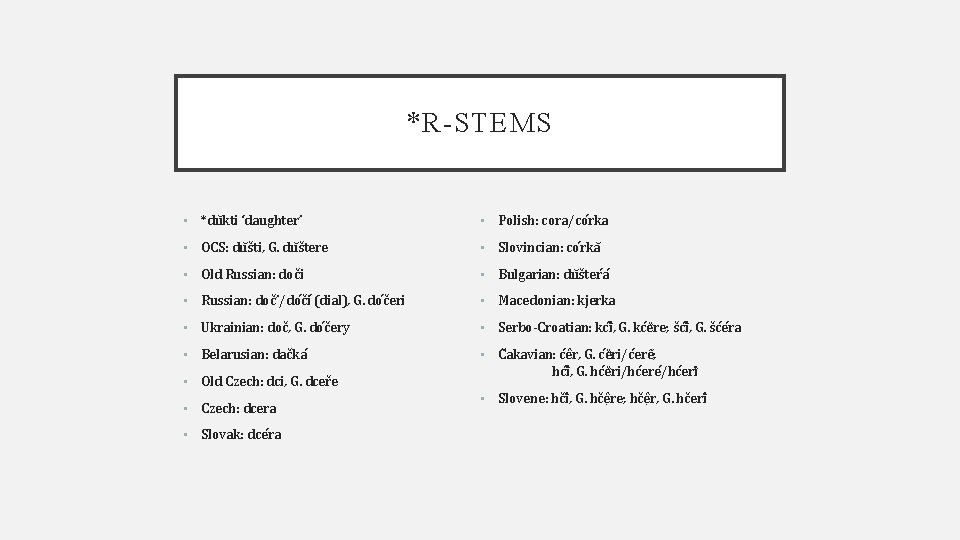
*R-STEMS • *du kti ‘daughter’ • Polish: cora/co rka • OCS: du s ti, G. du s tere • Slovincian: co rka • Old Russian: doc i • Bulgarian: du s ter a • Russian: doc ’/do c i (dial), G. do c eri • Macedonian: kjerka • Ukrainian: doc , G. do c ery • Serbo-Croatian: kc i , G. kc e re; s c i , G. s c e ra • Belarusian: dac ka • C akavian: c e r, G. c e ri/c ere ; hc i , G. hc e ri/hc ere /hc eri • Old Czech: dci, G. dcer e • Czech: dcera • Slovak: dce ra • Slovene: hc i , G. hc ẹ re; hc ẹ r, G. hc eri
SOURCES • Derksen 2008: Etymological Dictionary of the Slavic Inherited Lexicon • Olander 2015: Proto-Slavic Inflectional Morphology • Trubachev, et. al. 1974 -2004: Etymological Dictionary of the Slavic Languages • Vasmer 1953 -1958: Russian Etymological Dictionary