
Consolidation Standards IFRS 10 A critical look Consolidation
- Slides: 17
Consolidation Standards IFRS 10 A critical look
Consolidation Standards How do we consolidate? & When do we consolidate?
Consolidation Standards A historical perspective
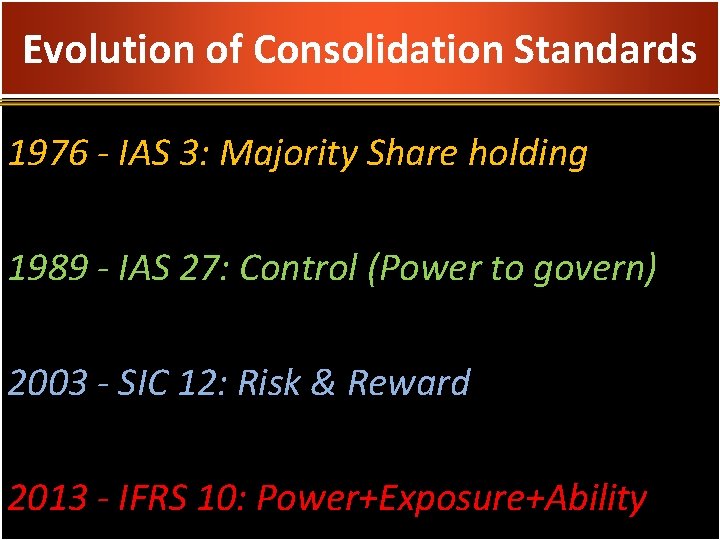
Evolution of Consolidation Standards 1976 - IAS 3: Majority Share holding 1989 - IAS 27: Control (Power to govern) 2003 - SIC 12: Risk & Reward 2013 - IFRS 10: Power+Exposure+Ability
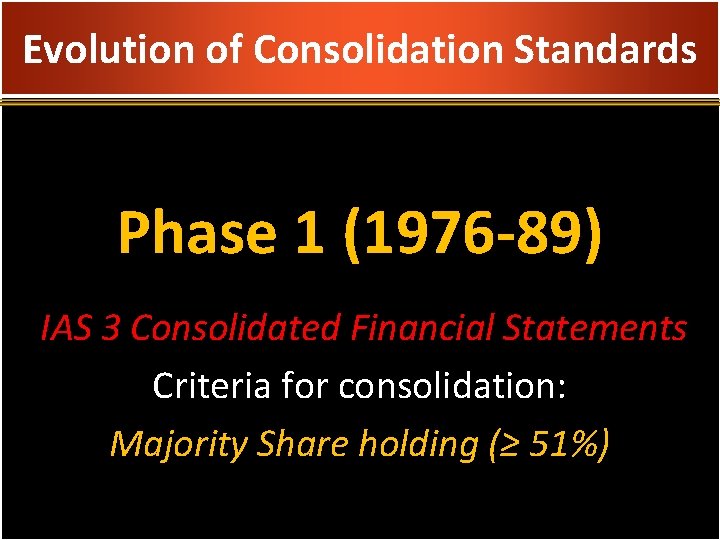
Evolution of Consolidation Standards Phase 1 (1976 -89) IAS 3 Consolidated Financial Statements Criteria for consolidation: Majority Share holding (≥ 51%)
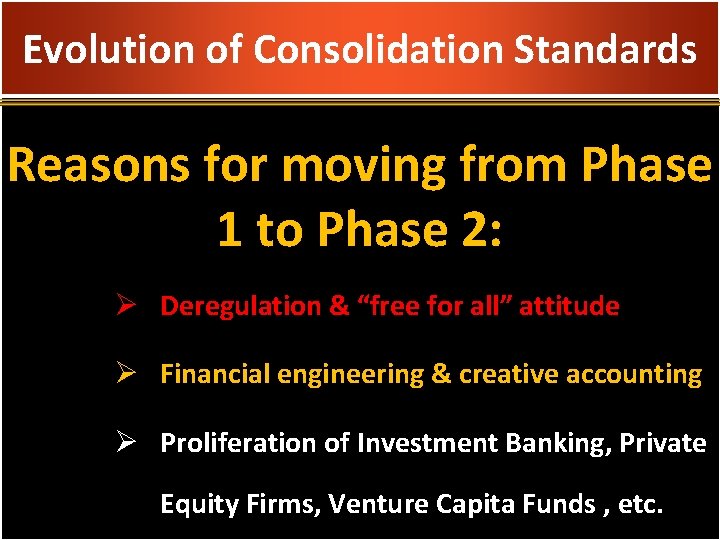
Evolution of Consolidation Standards Reasons for moving from Phase 1 to Phase 2: Ø Deregulation & “free for all” attitude Ø Financial engineering & creative accounting Ø Proliferation of Investment Banking, Private Equity Firms, Venture Capita Funds , etc.
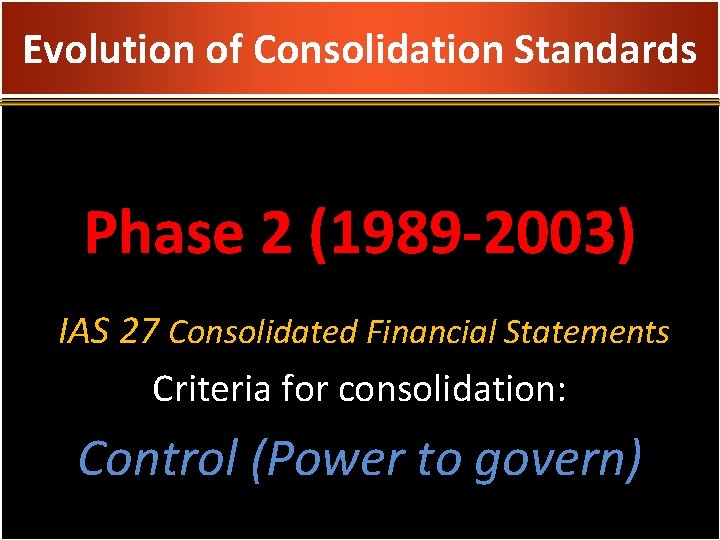
Evolution of Consolidation Standards Phase 2 (1989 -2003) IAS 27 Consolidated Financial Statements Criteria for consolidation: Control (Power to govern)
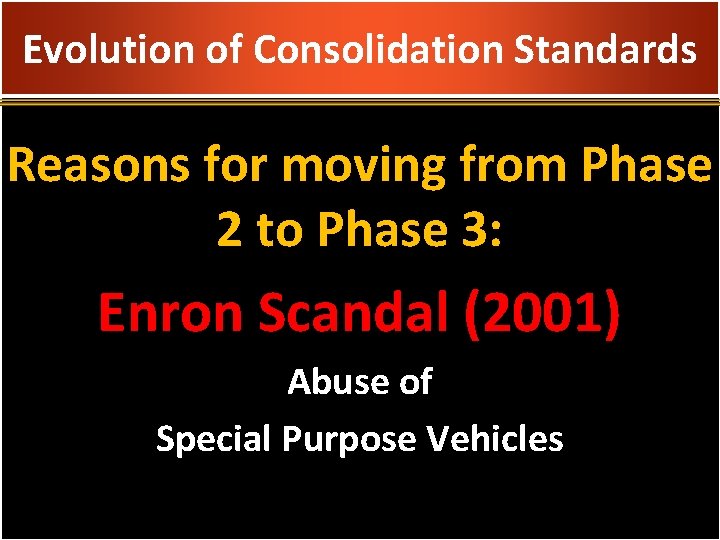
Evolution of Consolidation Standards Reasons for moving from Phase 2 to Phase 3: Enron Scandal (2001) Abuse of Special Purpose Vehicles
Evolution of Consolidation Standards Phase 3 (2003 -2008) SIC 12 Consolidation - Special Purpose Entities Criteria for consolidation: Risk & Reward
On the Other Side (2002 - 08) Reasons for moving from Phase 3 to Phase 4: Ø Corporate greed & Regulator’s apathy Ø Sub prime mortgage Ø Bearsterns & Lehman Brothers Ø Domino effect & global crisis
Evolution of Consolidation Standards Phase 4 (Since 2013 ) IFRS 10 Consolidated Financial Statements Criteria for consolidation: PEA Power, Exposure & Ability
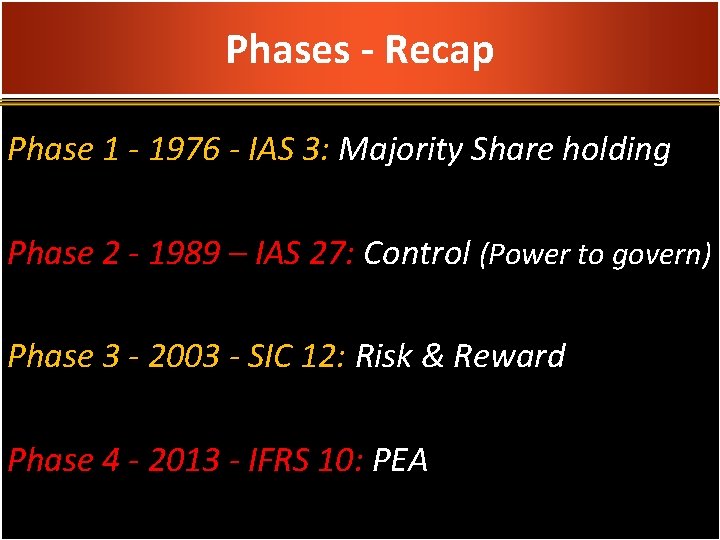
Phases - Recap Phase 1 - 1976 - IAS 3: Majority Share holding Phase 2 - 1989 – IAS 27: Control (Power to govern) Phase 3 - 2003 - SIC 12: Risk & Reward Phase 4 - 2013 - IFRS 10: PEA
May sanity prevail! “Insanity is doing the same thing in the same way again and expecting different results” - Anon.
Standard setting Needs A New Thinking Hat!
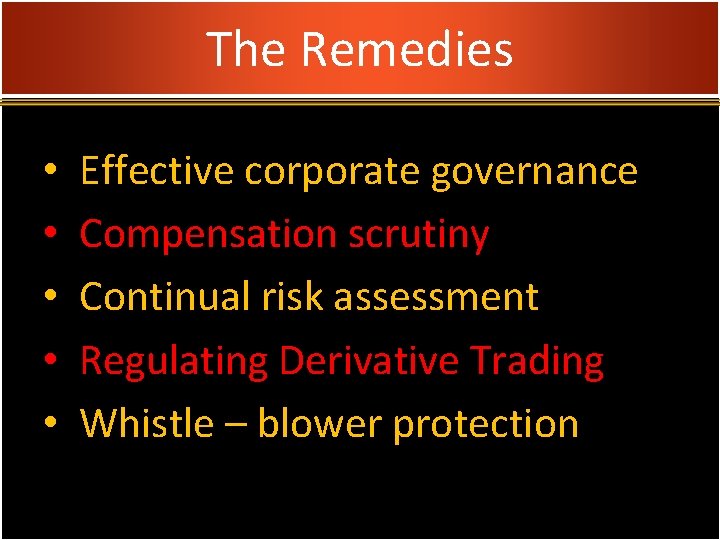
The Remedies • • • Effective corporate governance Compensation scrutiny Continual risk assessment Regulating Derivative Trading Whistle – blower protection
The Need of the hour Paradigm shift in measuring corporate success “Not Just Short term profits But Long term stability”
Thank you Questions Please. - James Ravi FCA, CPA